New Zealand
Fishing regions · Last reviewed 2026-08-10
An isolated temperate archipelago with a distinctive marine fauna, a customary fishing framework recognised in law, and introduced trout in some of the clearest rivers anywhere.
Safety: cliffs and rock platforms — can cause serious injury or death. 7 more points apply here.
Being listed here is not permission to fish. What that meansClose
Access, fishing rights, seasons, licences, local bylaws and permitted methods vary and can change. Check current access, permission, local regulations, closures and restrictions before you travel or fish. FishingHQ describes what the ground is and names who holds the answer; it does not hold the answer itself.
Find the authority for a jurisdiction · What FishingHQ does and does not cover
New Zealand is a long, narrow, isolated pair of islands sitting alone in the South Pacific with a great deal of ocean around them, and that isolation shaped both the fauna and the fishing.
The sea fishery is temperate and distinctly its own. Snapper — a sea bream, not a true snapper — is the species around which recreational sea fishing is organised, along with kahawai, kingfish and blue cod in the south. Access to sea fishing is broadly open, without a licence for recreational fishing, but with a comprehensive framework of species-specific size and daily limits that is taken seriously and enforced.
Fresh water is almost the reverse. New Zealand's native freshwater fish are small, largely nocturnal and mostly unfamiliar to anglers; the famous freshwater fishing is for brown and rainbow trout, both introduced in the nineteenth century, which have thrived in cold clear rivers to a degree that made the country a destination. Freshwater fishing requires a licence, and the trout fishery is managed by regional fish and game bodies.
And there is a third layer that has no direct equivalent in the other regions on FishingHQ: customary Māori fishing rights are recognised in law through settlement legislation and administered through distinct customary provisions, alongside the commercial and recreational sectors. Understanding that the fishery is divided three ways rather than two is genuinely necessary to understanding how it is managed.
What fishing here is like
A strongly participatory outdoor culture in which recreational fishing is mainstream rather than a minority interest, and in which taking a feed home is normal and uncontroversial alongside a growing catch-and-release ethic for particular species.
Sea fishing is dominated by small boats and by shore fishing from rock and beach, with a substantial charter sector. The freshwater trout fishery has an international reputation built on water clarity: sight fishing to individual large trout in rivers where they can be seen from the bank is the country's signature freshwater experience, and it demands a different skill set from most northern-hemisphere trout fishing. Spearfishing and freediving are well established, in cool but reasonably clear water, and are a mainstream part of the coastal culture rather than a fringe activity.
What dominates
Sea fishing above all — small-boat bottom fishing and soft-plastic work for snapper, shore fishing from rock and surf, and jigging and live-baiting for kingfish over reef and pinnacle. Spearfishing and freediving, including for kingfish and reef species, and gathering shellfish and crayfish where permitted. Freshwater fly fishing for introduced brown and rainbow trout, with a strong sight-fishing tradition. Salmon fishing in some South Island rivers, also from introduced stock.
The water available
A long temperate coastline with rock, surf beach, harbour and estuary; kelp-dominated inshore reef; offshore pinnacles and deep water; and the open South Pacific and Tasman Sea beyond. Inland, cold clear rivers running off high country, large lakes including volcanic ones in the North Island, and glacial lakes in the South. Water clarity in many rivers is exceptional by international standards and is the basis of the sight-fishing tradition. Tidal range is moderate and varies around the coast.
How the rules are structured
Salt and fresh water are managed differently and by different bodies. Recreational sea fishing is broadly open without a licence but is governed by a comprehensive national framework of species-specific size limits, daily bag limits, method restrictions and closed areas, administered by the national fisheries agency and varying between fisheries management areas around the coast. Freshwater fishing for trout and salmon requires a licence, issued by regional fish and game bodies which also set local seasons and rules, with a separate arrangement covering the central North Island lakes. Customary Māori fishing rights are recognised in law and administered under distinct customary provisions alongside the commercial and recreational sectors. Marine reserves prohibit fishing entirely within their boundaries. FishingHQ does not state what any current rule is.
Who to ask
- The national fisheries agency, for recreational sea fishing rules including size limits, bag limits and area-specific measures
- Regional fish and game bodies, for freshwater trout and salmon licensing, seasons and local rules
- The separate management arrangement covering the central North Island trout fishery, which operates under its own licence
- The national conservation agency, for marine reserves and protected species
- Customary fisheries authorities and local iwi, where customary provisions apply
Words you will meet
- Snapper
- Pagrus auratus, a Sparidae sea bream and not a true snapper. The most important recreational species in the country, and known also by the Māori name tāmure.
- Kahawai
- Arripis trutta, called Australian salmon across the Tasman. Neither a salmon nor a trout despite the scientific name, and a major shore sport fish.
- Kingi
- Yellowtail kingfish, Seriola lalandi. The premier reef and pinnacle sport fish, and the reason a great deal of heavy tackle is sold here.
- Crayfish
- The spiny rock lobster, not the freshwater crayfish a British or American reader would picture. Gathered by divers and in pots, and heavily regulated.
- Longline / kontiki
- A shore-set longline, in the kontiki form towed out by a powered or kite-driven float. A distinctive New Zealand shore method with its own rules.
- Rāhui
- A customary restriction placed on an area or a resource, often temporary. It carries cultural and, in some circumstances, legal weight, and visitors should treat one as binding.
Conditions and hazards
The coastline is exposed and the swell is oceanic — it arrives from the Southern Ocean and the Tasman with a long fetch behind it, and rock fishing here has a long record of anglers being swept away. That is the dominant coastal hazard and it is why lifejacket campaigns for rock fishing are prominent. Water is cool enough that immersion is quickly incapacitating. Bar crossings at harbour entrances are a specific and serious small-boat hazard, where swell meets shallow water and outgoing tide. Inland, rivers rise fast after rain in steep country and wading in fast clear water is more dangerous than its clarity suggests. Weather changes quickly, and the sun is strong — ultraviolet levels here are notably high for the latitude.
Customary fishing recognised in law, not tolerated alongside it
The framework here differs from most countries in a way that is worth stating carefully and at the level the sources support.
MĀORI CUSTOMARY FISHING RIGHTS are recognised in New Zealand law and are administered through defined mechanisms rather than existing as an informal exception. Customary take is a distinct category alongside commercial and recreational fishing, with its own authorisation.
RĀHUI is the term a visitor is most likely to meet: a customary restriction placed on an area or a resource, often after a death or to allow a depleted resource to recover. It may be observed voluntarily, and in some cases is given legal effect. An angler who encounters a rāhui should respect it regardless of its legal status, and asking locally is the right response rather than looking for a statutory position.
FISHINGHQ DESCRIBES THIS AND NO FURTHER. The detail of customary practice, the specific tikanga involved and the arrangements of particular iwi and hapū are not this platform's to summarise, and general fishing sources are not an appropriate basis for doing so.
RECREATIONAL FISHING generally is mainstream, participatory and food-directed: taking a feed home is normal and uncontroversial, alongside a growing release ethic for particular species.
Small boats, rock, and a shore-set longline nobody else uses
Sea fishing dominates, and one of its methods has no real equivalent anywhere else.
SMALL-BOAT FISHING is the normal mode — trailer boats launched off beaches and ramps for snapper, kingfish and reef species, with a strong jigging and softbait culture that has developed rapidly and independently.
SHORE FISHING from rock and surf beach is widespread and is where the safety record is worst.
THE KONTIKI is the distinctive one: a shore-set longline towed out beyond the surf by a powered or kite-driven float, set with many hooks and retrieved from the beach. It is a mainstream recreational method here and would be unlawful or unheard of in most other countries, and it exists because the surf beaches are long, the ground is clean and the fish are far enough out to make casting impractical.
DIVING for crayfish — the spiny rock lobster, not the freshwater animal a British reader pictures — and for pāua is culturally central and is done by a very large proportion of coastal households.
FRESHWATER is dominated by introduced trout in genuinely exceptional rivers, fished largely by sight in water clear enough to make that possible.
Isolation, and a fish community that is largely its own
Long separation has produced a marine fauna with a high proportion of species found nowhere else, and several familiar names attached to unfamiliar fish.
SNAPPER is Pagrus auratus — a sea bream rather than a true snapper, and the country's defining inshore species.
KAHAWAI is Arripis trutta, called Australian salmon across the Tasman and related to neither salmon nor the northern species anglers might assume.
KINGI is yellowtail kingfish, the premier reef and pelagic target.
BLUE COD is a southern species with no northern-hemisphere equivalent despite the name.
AND CRAYFISH means the spiny rock lobster.
THE PRACTICAL WARNING FOR VISITORS. Common names here map onto different fish from the ones a British, American or Australian angler expects, and identification errors follow directly from that rather than from the fish being hard to tell apart. Size and bag limits are set per species and are actively enforced, so an identification mistake is a compliance mistake.
FRESHWATER is the opposite case: brown and rainbow trout are introduced, familiar, and fished with entirely transferable technique.
Southern Ocean swell on an exposed coast
The dominant hazard here is the sea itself, and its character is different from anything in the northern hemisphere.
THE SWELL IS OCEANIC. It arrives from the Southern Ocean and the Tasman with thousands of kilometres of fetch behind it, which means long-period groundswell carrying very large amounts of energy onto rock and beach — and arriving on a calm day, with no local wind to warn anybody.
ROCK FISHING HERE HAS A LONG RECORD OF PEOPLE BEING SWEPT AWAY, and the response has been a strong public safety culture around lifejackets on rock marks. Wearing one while rock fishing is normal here and is unusual in Britain, and the difference is a direct response to the incident record.
SMALL-BOAT BAR CROSSINGS at harbour entrances are a second specific hazard, and one that catches visitors who have judged the sea from inside the harbour.
WATER IS COLD in the south and temperate in the north; immersion is a real risk in both.
ON REGULATION: fisheries are managed nationally with regional variation, a quota system underpinning commercial take, recreational bag and size limits per species, marine reserves that are genuinely no-take, and the customary framework alongside. Check the current position with the fisheries authority before keeping anything.
Two currents, and a year that runs against the textbooks
The seasonal pattern here is inverted from the northern hemisphere and is further shaped by the water arriving on each coast.
WARM WATER FROM THE NORTH pushes down the east coast in the warmer months, bringing pelagic species — kingfish, marlin, tuna — progressively further south, and retreating again as the water cools. Cooler water from the south influences the lower half of the country year-round.
SO THE PELAGIC SEASON MOVES GEOGRAPHICALLY rather than simply switching on: the same species is available at different times in Northland and in the Bay of Plenty, and the timing shifts between years with the water.
SNAPPER move inshore to spawn as water warms and are the mainstay of the summer inshore fishery.
TROUT FISHING follows a defined season on most waters, with the opening a fixed event in the calendar, and winter fishing restricted to particular rivers and lakes.
AND THE INVERSION IS ABSOLUTE. Summer is December to February. Any advice binding a month to a season is wrong here, which is why FishingHQ's editorial rules refuse that construction anywhere.
Seasons and closures differ by species and by area and are revised. Check the current position with the fisheries authority.
Clear water, short rivers and a coast facing two different oceans
A long, narrow, mountainous country produces fishing environments that are unusually varied over short distances and unusually clear almost everywhere.
THE RIVERS ARE SHORT AND STEEP. Water reaches the sea quickly, which means it is cold, well oxygenated and — the defining property — extremely clear. Clarity is what makes the country's signature freshwater fishery possible: sight fishing to individual large trout that can be seen and watched before a cast is made. That is a hunting discipline rather than a water-covering one, and it inverts the northern-hemisphere habit of fishing likely water blind. It also means the angler is visible to the fish, so approach, shadow and movement matter more than fly selection.
AND THEY RISE FAST. The same steepness that produces clarity produces flash flooding. A river can become unfishable in hours and dangerous faster than that, and rainfall in headwaters a valley away is enough to do it.
THE LAKES include very large glacial and volcanic systems, deep and cold, which fish quite differently from the rivers and support their own boat-based traditions.
THE COAST FACES TWO REGIMES. The eastern side meets the Pacific and is comparatively sheltered in places; the western and southern coasts take Southern Ocean swell with a fetch of thousands of kilometres and no land to break it. Rock fishing on exposed western and southern coast is genuinely dangerous ground, and the swell that reaches it can be generated by weather nowhere near the country.
THE INSHORE MARINE ENVIRONMENT is temperate reef, kelp, sand and harbour, with cool but reasonably clear water — which is why freediving and spearfishing are mainstream here rather than marginal. Harbours and estuaries are extensive and are fisheries in their own right.
AND DEEP WATER IS CLOSE in places. The shelf is narrow off parts of the coast, which puts genuinely deep-water species within reach of small boats on a good day, and produces the mismatch between a modest-looking launch and a serious offshore trip.
The words on the rulebook, and why the fish names are not English
A visitor from Britain or North America will find the fishing terminology broadly familiar and the fish names largely not, and the second is the part that matters legally.
MOST MARINE FISH ARE KNOWN BY TE REO MĀORI NAMES, in ordinary English-language use and in the regulations. Kahawai, hapuku, tarakihi, kingfish and kina are what these are called by everyone, on the rulebook and on the wharf; there is no separate English name in circulation for several of them. An angler checking a size or bag limit will be reading these words, so learning the ones relevant to the fishing intended is a practical necessity rather than a courtesy. FishingHQ notes them as the names in use and goes no further: what they carry beyond that is not ours to explain.
SNAPPER MEANS ONE FISH HERE. Australasian snapper is the dominant inshore species and "snapper" refers to it unambiguously, which will mislead anyone arriving from the Caribbean or the Gulf of Mexico where the word covers a large and different group.
TROUT TERMINOLOGY IS BRITISH IN ORIGIN and mostly unchanged, because the fish and the fishery were imported together. What is different is the frame of reference: "a good fish" in a New Zealand river means something considerably larger than it does in most British ones.
SOFTBAITING is a specific and widely used term for fishing soft plastic lures on inshore ground, particularly for snapper. It named a technique that arrived and spread quickly enough to need one, and it is used here in a way it is not elsewhere.
LAND-BASED GAME describes fishing for large pelagic species from rocks rather than from a boat. It is a genuine discipline here, with its own tackle and its own hazard profile, and the term will not be recognised in most of the northern hemisphere.
CUSTOMARY FISHING is a legal term in this country, not a descriptive one. It refers to a category recognised in law with its own authorisation process, and it is administered by the relevant iwi or hapū and the fisheries authority rather than by any general rule. The correct action for a visitor is to treat it as a legal category they should read about from the authority concerned, not as something a fishing site should summarise.
A freshwater fishery that is entirely introduced, and cannot be sold
New Zealand's freshwater sport fishery has no native component at all, and the two decisions that created it in the nineteenth century still govern how it works today.
THERE WERE NO TROUT. Brown trout were introduced from the 1860s and rainbow trout from the 1880s, shipped as ova over months by sea, by acclimatisation societies established for the purpose. They took extraordinarily well: cold clear rivers, abundant invertebrate life and no competing large predatory fish produced growth rates that astonished the people who had done it. Salmon followed, with chinook establishing in some South Island rivers.
THE SOCIETIES BECAME THE MANAGEMENT. Those voluntary bodies evolved into the regional fish and game structure that still administers the freshwater sport fishery, funded by licence sales and governed by elected councils. That is an unusual arrangement internationally — a sport fishery managed by the anglers' own statutory bodies rather than by a national agency — and it descends directly from the acclimatisation societies.
AND TROUT CANNOT BE SOLD. The commercial sale of wild trout is prohibited, with narrow exceptions. This single decision is why the fishery is what it is: no commercial value means no commercial fishery, no market pressure, and a resource managed exclusively for recreation. Visitors from countries with a commercial freshwater sector consistently underestimate how much of the difference this one rule accounts for.
THE COST IS ALSO PART OF THE HISTORY. Introduced salmonids are predators and competitors in ecosystems that evolved without them, and their effect on native galaxiids and invertebrates is documented and unwelcome. The country simultaneously manages a prized introduced fishery and a native freshwater fauna that the same fish damage. Both facts are true, they are in tension, and the tension is managed rather than resolved.
THE MARINE HISTORY IS SEPARATE AND OLDER. Fishing the coast for food long predates all of the above and is continuous; the modern commercial sector has since the 1980s been managed under a quota system that was among the earliest of its kind and is studied internationally. Customary fishing rights are recognised in law, administered through the relevant iwi and hapū alongside the fisheries authority. What that recognition means in practice is properly explained by those communities and by the authority, and this page points there rather than paraphrasing.
Two entirely separate rulebooks, and which one you are under
This page's safety section was previously tagged as its framework answer, which meant the question "what permission do I need and who grants it" was reading as answered by a page about being swept off rocks. It is answered here instead, and the first thing to say is that there are two frameworks rather than one, they are administered by different bodies, and which one applies depends on the water rather than on the fish.
SALT WATER AND FRESH WATER ARE GOVERNED SEPARATELY. Recreational sea fishing sits under the national fisheries administration, with amateur bag limits, minimum sizes and area-specific measures set by species and by region. Freshwater sports fishing — trout and salmon, which are introduced species here and are managed as a sports fishery rather than as a commercial one — sits under a completely different arrangement, with its own licence, its own season structure and its own regional variation. An angler moving from the coast to a river in the same week is changing rulebooks entirely, and knowing one tells them nothing useful about the other.
THE FRESHWATER LICENCE IS A REAL LICENCE AND IT IS REQUIRED. That is worth stating for visitors from countries where trout fishing is the landowner's gift: here it is a sports-fishing licence obtained before fishing, with its own conditions about seasons, methods and waters, and some waters carry additional endorsements.
THE SEA FRAMEWORK IS SPECIES-BY-SPECIES AND AREA-BY-AREA. Amateur limits differ between fisheries management areas for the same species, they are revised, and they are enforced. The commercial sector runs under an internationally influential quota system.
MARINE RESERVES ARE GENUINELY NO-TAKE. This is a point where visitors get into trouble, because reserve boundaries in some countries permit recreational fishing and here they generally do not. A marine reserve means nothing is removed, by anybody, by any method, and the boundaries are mapped rather than obvious from the water.
AND THE CUSTOMARY FRAMEWORK SITS ALONGSIDE BOTH. Māori customary fishing rights are recognised in law and are administered through their own instruments, including area-based management tools that can restrict or prohibit taking in a particular place for a stated period. These are legal instruments rather than requests, they are place-specific, and a visitor's obligation is to find out whether one applies where they intend to fish.
WHO TO ASK. The national fisheries authority for anything in salt water, the regional sports fish and game body for anything in fresh water, the reserve or conservation authority for anything inside a protected area, and local iwi or the relevant customary authority where a customary management tool is in place. FishingHQ does not state what any current limit, season or boundary is — all of them change, several of them change annually, and the current position is the only one worth having.
Official guidance — why, and the sources (2)
Stated by a fisheries authority, scientific institute or recognised angling body. Authoritative, but summarising rather than demonstrating.
- Code of Conduct for Responsible Fisheries — Food and Agriculture Organization of the United Nations, Rome, 1995 (Standards body)Relied on for: That responsible fishing includes the safety of fishers, and the international framework within which national fisheries authorities set and revise measures.Background and mechanism onlyCitation checked — the work exists and is described correctly
- General angling website restatements of established technique — Various (Credible secondary source)Relied on for: Widely restated descriptions of regional angling practice and of the conditions under which it is undertaken, recorded as practitioner consensus rather than as scholarship.Background and mechanism onlyCitation checked — the work exists and is described correctly
Some of what lives here
Fish recorded here that FishingHQ holds a reviewed photograph of. It is not a complete list of what New Zealand holds, and it is not a prediction that you will catch any of them — it is a way in to the ones we can show you.
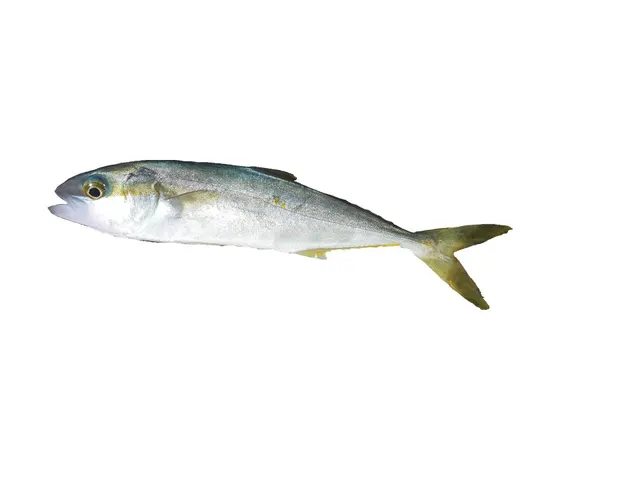 Yellowtail kingfishA circumglobal subtropical jack of kelp edges and rocky reef that fights harder than almost anything of its size and heads straight for structure.
Hugues Evano (IFREMER, Délégation océan Indien (DOI), Département Ressources Biologiques et Environnement (RBE), F-97420 Le Port, France) — CC BY 4.0, via Wikimedia Commons
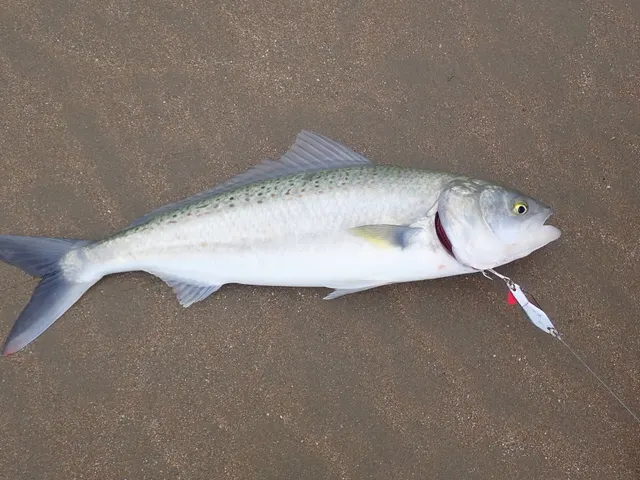 KahawaiA hard-fighting schooling predator of southern Australian and New Zealand coasts, called salmon in one country and kahawai in the other, and related to neither salmon nor trout.
zoology — CC0 1.0 Public Domain Dedication, via Wikimedia Commons
Safety
Cliffs and rock platforms — Can cause serious injury or death
Ocean rock platforms are swept by large waves arriving with a very long fetch, and anglers are washed off. The sets that cause it are not visible in advance from the platform, and the escape route is usually upward and slow.
What reduces it: Never fish rock platforms alone. Wear a lifejacket — this is the setting the campaigns are about. Watch a mark for a full set cycle before going onto it. Wear footwear with grip on wet rock, plan the escape before you start, and never turn your back on the sea.
Boat safety — Can cause serious injury or death
Bar crossings at harbour entrances are where swell meets shallow water and outgoing tide, producing steep breaking seas in a confined space. Small boats are capsized there, and it happens on the way home when the crew is tired.
What reduces it: Do not attempt a bar you do not understand. Check conditions and tide before committing and be prepared to wait or to go elsewhere. Lifejackets worn rather than stowed. File a plan ashore and carry a means of calling for help.
Moving water and currents — Can cause injury needing treatment
Rivers in steep country rise very quickly after rain, and the exceptional clarity of New Zealand water makes fast water look shallower and slower than it is. Wading accidents follow from both.
What reduces it: Check the forecast for the catchment rather than for where you are standing. Do not cross what you cannot see the bottom of, and remember that clarity is not depth. Use a wading staff, wade with somebody, and be willing to walk round.
Precautions that always apply here
- Wear a buoyancy aid or lifejacket. Cold water incapacitates strong swimmers within a minute, long before swimming ability matters.
- Do not wade alone. Judge depth and flow from the bank first, and turn back sooner than feels necessary.
- Check the tide before you go and know your exit route. Being cut off is the commonest way a shore session becomes a rescue.
- Tell somebody where you are going and when you expect to be back.
- Carry a charged phone in a waterproof case, or another means of calling for help.
Further safety reading
- Wading safely — Exceptional water clarity makes fast rivers look shallower and slower than they are, and rivers in steep country rise very quickly after rain in the catchment rather than overhead.
Check the rules before you fish
Fishing laws, bylaws, access rules, seasons, bait restrictions and permitted methods vary by location and can change. Check the current rules from the relevant authority and the water you intend to fish before fishing.
Check with:
- Current national or regional law for where you are fishing
- Current local bylaws
- The relevant fisheries authority
- The landowner, club or fishery whose water it is
- Any restrictions specific to the species or the method you intend to use
Where to go next
What swims here
- Australasian snapperThe species recreational sea fishing in New Zealand is organised around, known there as tāmure — and a sea bream rather than a true snapper, which the name actively conceals.
- KahawaiCalled Australian salmon across the Tasman and kahawai here, and neither a salmon nor a trout despite carrying trutta in its name — the Arripidae are a southern-hemisphere family related to none of them.
- Yellowtail kingfishKnown there as kingi, and the reason a great deal of heavy tackle is sold in the country — one species targeted by nearly every sea method on FishingHQ.
How this compares
Rules and access
- Customary, community and indigenous fishing rightsCustomary fishing rights and the practice of temporary closure are recognised in law here, which makes it one of the clearest jurisdictions in which to see how the two systems interact.
- Licences and permissionSalt and fresh water are managed by different bodies on different principles — recreational sea fishing broadly open without a licence, freshwater trout licensed regionally, and customary rights recognised separately in law.
Environment and conservation
Sources and evidence
- FishBase: a global information system on fishes — Froese, R. and D. Pauly, eds. — FishBase Consortium (Scientific institute)Relied on for: The identities and distributions of the species named as regionally characteristic, including Pagrus auratus as a Sparidae rather than a true snapper, Arripis trutta and its common names in Australia and New Zealand, and Seriola lalandi.States this directlyPassage read and verified
- Check Clean Dry — biosecurity guidance for water users — GB Non-native Species Secretariat (Conservation authority)Relied on for: The general framework by which introduced species are assessed, applied here to brown and rainbow trout as nineteenth-century introductions that established widely.FishingHQ's interpretation of what it saysPassage read and verified
- RNLI water safety guidance: cold water shock and Float to Live — Royal National Lifeboat Institution (Water-safety or diver-training authority)Relied on for: The mechanism by which people are swept from coastal rock platforms, cold water shock, and the value of a buoyancy aid and an escape plan.FishingHQ's interpretation of what it saysPassage read and verified
Why the 8 connections on this page are here, and the sources
What swims here
Backed by research — 3 connections
Supported by peer-reviewed research or fisheries science. The sources are listed and can be checked.
Australasian snapper
A distribution and taxonomy claim held to a scientific standard, because the taxonomic point is the one the common name obscures.
- FishBase: a global information system on fishes — Froese, R. and D. Pauly, eds. — FishBase Consortium (Scientific institute)Relied on for: That Pagrus auratus is a Sparidae occurring widely off New Zealand and Australia, on rocky reefs and in estuaries from 0 to 200 m, with a nomenclatural history including confusion with Chrysophrys auratus.States this directlyPassage read and verified
Kahawai
A distribution and taxonomy claim held to a scientific standard, because the common names actively mislead in two directions at once.
- FishBase: a global information system on fishes — Froese, R. and D. Pauly, eds. — FishBase Consortium (Scientific institute)Relied on for: That Arripis trutta is an Arripidae distributed across southern Australia and New Zealand, called Australian salmon in Australia and kahawai in New Zealand.States this directlyPassage read and verified
Yellowtail kingfish
A distribution claim held to a scientific standard.
- FishBase: a global information system on fishes — Froese, R. and D. Pauly, eds. — FishBase Consortium (Scientific institute)Relied on for: That Seriola lalandi is circumglobal in subtropical waters including South Africa, Japan, Australia, New Zealand and Hawaii and from British Columbia to Chile.States this directlyPassage read and verified
How this compares
Official guidance — 1 connection
Stated by a fisheries authority, scientific institute or recognised angling body. Authoritative, but summarising rather than demonstrating.
Australia
A regulatory-structure comparison between two adjacent jurisdictions, which is the most useful thing to tell somebody moving between them.
- FAO fishing gear types and fishing technology information — Food and Agriculture Organization of the United Nations (Scientific institute)Relied on for: That fisheries management measures are administered at the level of the authority holding competence, which differs between these two countries.Background and mechanism onlyCitation checked — the work exists and is described correctly
- Environment Agency fisheries management, byelaws and rod licensing information — Environment Agency (Government fisheries body)Relied on for: That licensing and management competence may sit at national or sub-national level.FishingHQ's interpretation of what it saysCitation checked — the work exists and is described correctly
Safety reading
Official guidance — 1 connection
Stated by a fisheries authority, scientific institute or recognised angling body. Authoritative, but summarising rather than demonstrating.
Wading safely
A regional safety claim about a specific and locally distinctive mechanism.
- RNLI water safety guidance: cold water shock and Float to Live — Royal National Lifeboat Institution (Water-safety or diver-training authority)Relied on for: Moving water risk and the principle of assessing conditions before entering.FishingHQ's interpretation of what it saysPassage read and verified
- RoSPA water safety information and UK accidental drowning statistics — Royal Society for the Prevention of Accidents (Water-safety or diver-training authority)Relied on for: That inland waters account for the majority of accidental drownings.Background and mechanism onlyPassage read and verified
Rules and access
Official guidance — 2 connections
Stated by a fisheries authority, scientific institute or recognised angling body. Authoritative, but summarising rather than demonstrating.
Customary, community and indigenous fishing rights
A place joined to the regulatory concept whose structure it illustrates. The edge asserts that the concept applies here, never what any current arrangement requires.
- Words of the Lagoon: Fishing and Marine Lore in the Palau District of Micronesia — University of California Press, Berkeley, 1981 (Reference work)Relied on for: Customary marine tenure, traditional fishing rights, closed areas and local marine knowledge, and the way community-held rights operate in practice.States this directlyCitation checked — the work exists and is described correctly
- Code of Conduct for Responsible Fisheries — Food and Agriculture Organization of the United Nations, Rome, 1995 (Standards body)Relied on for: The international framework for responsible fisheries, including recognition of traditional and small-scale fishing rights.States this directlyCitation checked — the work exists and is described correctly
Licences and permission
A regulatory-structure claim, stated as structure. The three-way division between commercial, recreational and customary has no direct equivalent elsewhere on FishingHQ.
- Environment Agency fisheries management, byelaws and rod licensing information — Environment Agency (Government fisheries body)Relied on for: That licensing frameworks differ in scope between fisheries and between salt and fresh water, providing the contrast drawn here.FishingHQ's interpretation of what it saysCitation checked — the work exists and is described correctly
- FAO fishing gear types and fishing technology information — Food and Agriculture Organization of the United Nations (Scientific institute)Relied on for: That fisheries management measures are administered at the level of the authority holding competence.Background and mechanism onlyCitation checked — the work exists and is described correctly
Environment and conservation
Official guidance — 1 connection
Stated by a fisheries authority, scientific institute or recognised angling body. Authoritative, but summarising rather than demonstrating.
Invasive species and biosecurity
An introduction claim held to an authoritative standard, and included because it complicates FishingHQ's usual biosecurity framing rather than repeating it.
- Check Clean Dry — biosecurity guidance for water users — GB Non-native Species Secretariat (Conservation authority)Relied on for: The framework by which introduced species are assessed, including that outcomes range from severe harm to established naturalised populations.FishingHQ's interpretation of what it saysPassage read and verified
- FishBase: a global information system on fishes — Froese, R. and D. Pauly, eds. — FishBase Consortium (Scientific institute)Relied on for: That Salmo trutta and Oncorhynchus mykiss have been introduced widely outside their native ranges.Background and mechanism onlyPassage read and verified
How FishingHQ labels evidence is explained in the evidence policy.