Rudd
Fish · Last reviewed 2026-08-10
A golden, blood-finned cyprinid of still water, separated from roach by an upturned mouth and a dorsal fin set behind the pelvic fins.
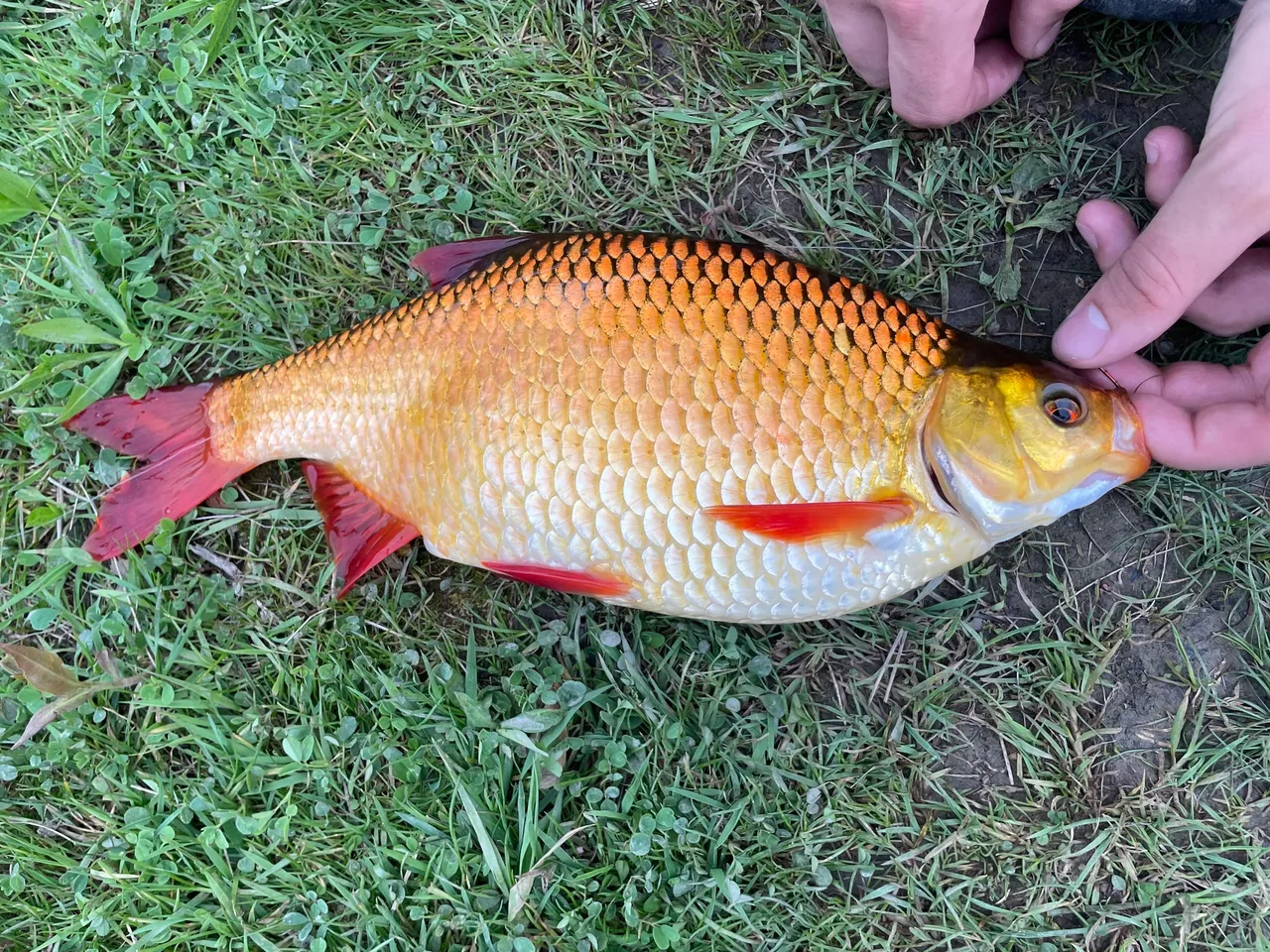
How this was identified, and who took it
Identified by: The record's leading character is unambiguous here: the mouth is strongly upturned and angled for surface feeding, where a roach's is level or downturned. Supported by a deep brassy-gold flank, vivid scarlet lower fins and a golden-orange eye. Stated plainly: the dorsal fin is folded flat, so the dorsal-behind-pelvic offset that is the record's second character cannot be checked from this frame.Stephanie Tran — CC BY, via iNaturalist — source, licenceCatching Rudd
Everything here on fishing for it. Each entry opens the page behind it.
- Ground
- Where
- 5 places FishingHQ documents — strongest claim anywhere: regular local target · From the shore
Rudd is the fish roach is mistaken for, and the confusion has consequences: the two hybridise, and a great many photographs captioned 'roach' are rudd or hybrids.
Two characters settle it. A rudd's mouth is upturned, angled to take food from the surface; a roach's is level or slightly downturned. And the rudd's dorsal fin is set clearly behind the base of the pelvic fins, where a roach's sits directly above them. Colour helps — rudd are brassier, with deeper red fins and a yellow-gold flank — but colour varies with water and cannot be relied on alone.
Behaviourally the difference follows the mouth. Rudd feed upward, taking insects from the surface and midwater, which makes them a genuine dry-fly target in a way roach are not.
How it is caught
- Dry fly fishingFloat tackle fished shallow, and genuinely a dry-fly target because of the upturned mouth.
- Float fishingFloat tackle fished shallow, and genuinely a dry-fly target because of the upturned mouth.
- Pole fishingRudd feed in the upper layers and are held there with loose feed, which the pole can deliver and fish over precisely.
- Surface fishing for coarse fishAn upward-feeding fish by anatomy — the jaw is angled to take from above — which makes it the species most consistently available on the surface.
Gear for this fish
- Dry fliesSurface flies to fish feeding upward in weedy still water.
- Surface controller rigA surface-feeding shoal fish that takes floating baits readily, and one of the few species where the approach works in cooler conditions than carp will.
- Waggler float rigRudd feed higher in the water than roach and the waggler is the arrangement that can fish the top few feet without dragging the bait down.
Where Rudd is documented
Places where public sources describe this species as fished, with how it is fished and how strongly the evidence supports it. This is not a range map and it is not a recommendation — it is what has been written down about a fishery rather than a record of any individual catch, and being listed is never permission to fish.
The Norfolk Broads
3 documented places
Broad
Recorded here
From the shore
Broad
Recorded here
From the shore
Broad
Regular local target
From the shore
What these strengths mean
- Recorded here
- At least one credible public account of this species being caught here. That is all it means.
- Regular local target
- Fishing sources describe this as a normal local target here, not merely as caught.
- Repeatedly reported
- Several independent public accounts. Enough to say it happens more than once; not enough to call it a fishery.
Identification
- Scientific name
- Scardinius erythrophthalmus
- Family
- Leuciscidae
- Water
- Freshwater
- Conservation status
- Least Concern
- Regions
- Britain & Ireland, Western Europe, Central & Eastern Europe, Northern Europe
- Mouth distinctly upturned, angled for surface feeding; a roach's mouth is level or downturned.
- Dorsal fin set clearly behind the base of the pelvic fins, not directly above them as in roach.
- Brassy gold flank with deep blood-red pelvic, anal and tail fins.
- A keeled belly between the pelvic fins and the vent, which roach lacks.
Size
- Typical
- 150–500 g (5 oz–1.1 lb)
- Large
- 0.8–1.4 kg (1.8–3 lb)
Exceptional: FishBase records a maximum of 61.7 cm
How big a rudd gets, and how long it lives
Rudd size is worth stating carefully because hybridisation makes British record claims genuinely difficult and because the honest ceiling is lower than the literature suggests.
MOST ROD-CAUGHT RUDD ARE 150 TO 500 GRAMS — five ounces to just over a pound — and 15 to 30 centimetres.
A FISH OVER 800 GRAMS IS A GOOD RUDD anywhere in Britain, and anything approaching or exceeding 1.4 kilograms is a specimen. FishBase records a maximum length of 61.7 centimetres for the species, which is far beyond anything a British angler will encounter and comes from continental populations.
THE HYBRID PROBLEM IS THE REASON BRITISH RECORDS ARE CONTESTED. Rudd hybridise readily with roach and with bream, and the resulting fish are intermediate, often large, and genuinely difficult to name. A great many claimed record rudd have turned out to be hybrids on examination, and a great many photographs captioned 'rudd' are hybrids. The characters that settle it — an upturned mouth, a dorsal fin set behind the pelvic base, and a keeled belly — have to be checked together rather than singly, because a hybrid may show one of them.
GROWTH IS MODERATE AND MATURITY COMES AT TWO TO THREE YEARS. Rudd are not especially long-lived, and their growth depends heavily on water productivity and on how crowded the population is — a stunted rudd population in a small overstocked water produces enormous numbers of fish that never reach half a pound, while the same species in a rich gravel pit reaches several times that.
WHICH MEANS THE WATER PREDICTS THE SIZE far better than the region does, and an angler looking for a big rudd is looking for a specific kind of water rather than a specific part of the country.
Backed by research — why, and the sources (2)
Supported by peer-reviewed research or fisheries science. The sources are listed and can be checked.
- Freshwater Fishes of the British Isles — HarperCollins (New Naturalist 75), 1992 (Reference work)Relied on for: Distribution, habitat association, life history, growth and conservation position of the freshwater fishes of the British Isles.States this directlyCitation checked — the work exists and is described correctly
- FishBase: a global information system on fishes — Froese, R. and D. Pauly, eds. — FishBase Consortium (Scientific institute)Relied on for: Distribution, habitat association, depth range, growth, maximum size and reproductive parameters recorded for the species.States this directlyPassage read and verified
The rudd year: a summer surface fish
Rudd have one of the most strongly seasonal patterns of any British coarse fish, and it follows directly from how they feed.
THEY SPAWN IN LATE SPRING, later than roach in the same water, scattering adhesive eggs among dense submerged and marginal vegetation. The difference in timing is one of the mechanisms that keeps rudd and roach partly distinct despite their readiness to hybridise — where the timing converges, so do the populations.
THE WEED IS SPAWNING SUBSTRATE, FOOD AND COVER AT ONCE, which is why a water that has been dredged or stripped of marginal vegetation loses its rudd while keeping its roach.
SUMMER IS THE SEASON, AND IT IS NOT CLOSE. Rudd feed upward on insects at and near the surface, and warm still evenings bring them into the top few inches over deep water. That behaviour makes them one of very few British coarse fish reliably taken on a dry fly, and it makes an evening in July the best rudd fishing of the year by a wide margin.
COLD WATER SHUTS THEM DOWN far more thoroughly than it does roach. A rudd in January is a difficult fish, feeding little and holding deep, and the winter rudd fishing that does exist is a fraction of the summer's. This is the practical reason rudd are considered a summer species while roach are considered a year-round one, and it is a statement about metabolism and food supply rather than about anglers' habits.
AND THE COMMONEST SEASONAL MISTAKE IS FISHING TOO DEEP. Practitioner consensus is consistent that rudd are higher in the water than anglers expect, and the fault is worst early in the season when the habit of winter fishing has not yet been broken.
Backed by research — why, and the sources (3)
Supported by peer-reviewed research or fisheries science. The sources are listed and can be checked.
- Freshwater Fishes of the British Isles — HarperCollins (New Naturalist 75), 1992 (Reference work)Relied on for: Distribution, habitat association, life history, growth and conservation position of the freshwater fishes of the British Isles.States this directlyCitation checked — the work exists and is described correctly
- FishBase: a global information system on fishes — Froese, R. and D. Pauly, eds. — FishBase Consortium (Scientific institute)Relied on for: Distribution, habitat association, depth range, growth, maximum size and reproductive parameters recorded for the species.States this directlyPassage read and verified
- Coarse Fishing — A. & C. Black, 1912 (Specialist angling publication)Relied on for: Established coarse angling practice, including method, bait, presentation and the reasoning behind them.States this directlyCitation checked — the work exists and is described correctly
Upturned mouth, surface layer, and the weedy margin nothing has cleared
Rudd habitat is easy to confuse with roach habitat, and the distinction is worth drawing precisely because the two fish are separated far more reliably by where they are than by how they look.
THE MOUTH SETS THE HABITAT. A rudd's lower jaw projects and the mouth angles upward, which is the anatomy of a fish that feeds looking up — on insects at and just under the surface, on emerging invertebrates, on the fauna of submerged plants. A roach's mouth is level or slightly downturned and it feeds on and near the bottom. So the two species partition the same water vertically, and rudd occupy the upper layer.
WHICH PLACES THEM IN WARM, STILL, WEEDY WATER. Rudd are fish of lakes, ponds, gravel pits, drains, canals, meres and the slow weedy margins of lowland rivers, and they are strongly associated with dense submerged and emergent vegetation — lily beds, reed margins, weed rafts, overhanging cover. They are far less tolerant of current than roach and far more tolerant of warmth, and in a river they will be in the backwater rather than the main flow.
THE WEED IS FOOD, COVER AND SPAWNING SUBSTRATE AT ONCE. Rudd feed heavily on plant material and on the invertebrates living on plants, hold under and beside vegetation for security, and attach adhesive eggs to it. A water that has been dredged, hardened or stripped of marginal weed loses all three functions simultaneously, which is why rudd have declined sharply in canalised and heavily managed systems while roach persist.
THEY ARE A SUMMER SURFACE FISH IN A WAY FEW COARSE SPECIES ARE. On a warm still evening rudd will be in the top few inches over deep water, taking insects, in a way that makes them one of the very few British coarse fish reliably caught on a dry fly. That behaviour is a habitat statement: the fish is using the surface film as a feeding zone.
BRACKISH TOLERANCE EXTENDS THE RANGE, and rudd occur in low-salinity coastal waters including parts of the Baltic, occupying reed and vegetated bays there exactly as they occupy a lake.
AND HYBRIDISATION MUDDIES THE PICTURE ON THE GROUND. Rudd hybridise with roach and with bream, and hybrid populations are common in waters holding all three. Where the fish look intermediate, the habitat they were caught in is genuinely useful supporting evidence — a fish taken off the top in a weed bed is more likely to have rudd in it than one taken hard on the bottom in open water.
Backed by research — why, and the sources (2)
Supported by peer-reviewed research or fisheries science. The sources are listed and can be checked.
- Freshwater Fishes of the British Isles — HarperCollins (New Naturalist 75), 1992 (Reference work)Relied on for: Habitat association, distribution and ecology of European freshwater fishes, including position within a water body.States this directlyCitation checked — the work exists and is described correctly
- FishBase: a global information system on fishes — Froese, R. and D. Pauly, eds. — FishBase Consortium (Scientific institute)Relied on for: Habitat association, depth range and water-type tolerance recorded for the species.States this directlyPassage read and verified
Fishing the top layer, and a coarse fish that is a genuine dry-fly target
Rudd methods follow directly from the mouth: this is a fish that feeds looking up, and almost every effective approach presents a bait at or near the surface.
SHALLOW FLOAT FISHING IS THE FOUNDATION. A light float set at a few inches to a couple of feet, over deeper water and beside weed or cover, with bait falling slowly through the top layer, is the standard and it is standard because it matches the feeding. Setting a float at four feet in a rudd swim is fishing beneath them.
LOOSE FEEDING KEEPS THE SHOAL UP AND HOLDS IT. Small quantities of floating or slow-sinking bait introduced regularly bring rudd higher in the water and keep them competing, and that competition is what makes them catchable — a rudd shoal that has settled to the bottom is a much harder proposition.
SURFACE FISHING WITH BREAD IS AS SIMPLE AS IT SOUNDS AND AS EFFECTIVE. Floating crust or flake in a warm evening, cast beyond feeding fish and drawn back, produces takes that are entirely visible.
AND THE FLY ROD IS A LEGITIMATE TOOL RATHER THAN A CURIOSITY. Rudd are one of very few British coarse fish reliably taken on a dry fly, because on a still summer evening they are genuinely feeding on insects in the surface film. A small dry or an emerger presented to visible rises works exactly as it would for trout, and it is one of the more rewarding pieces of freshwater fishing available on a lowland water.
STEALTH MATTERS BECAUSE THE FISH ARE SHALLOW AND EXPOSED. Rudd in the top eighteen inches of clear water see everything, so approach, shadow and line disturbance all cost fish.
WEED IS WHERE THEY LIVE, and the record's habitat section explains why: the productive water is beside lily beds, reed margins and weed rafts rather than in open water, which makes accurate casting to an edge the practical requirement.
AND HYBRIDS COMPLICATE ANY CATCH RETURN. Rudd hybridise with roach and bream freely, and a fish taken deep on the bottom is more likely to have roach in it than one taken off the top — which is supporting evidence rather than proof, and the identification points settle it.
What experienced anglers do — why, and the sources (2)
Widely and independently recommended by experienced anglers and specialist sources. This is real angling knowledge, not proof: controlled evidence for it is limited, and FishingHQ records it as convention rather than as a demonstrated effect.
- Coarse Fishing — A. & C. Black, 1912 (Specialist angling publication)Relied on for: Established coarse angling practice, including method, presentation and the reasoning behind them.States this directlyCitation checked — the work exists and is described correctly
- Freshwater Fishing — Macdonald & Jane's, 1975 (Specialist angling publication)Relied on for: Freshwater angling technique and the principles behind method selection.States this directlyCitation checked — the work exists and is described correctly
Lifecycle and reproduction
Moderately long-lived, maturing at two to three years. Hybridises readily with roach and with bream, producing intermediate fish that are genuinely difficult to name and that complicate any attempt to survey a population by eye.
Spawns in late spring among dense submerged and marginal vegetation, scattering adhesive eggs. Spawning is later than roach in the same water, which is one reason the two remain partly distinct despite hybridising.
Feeding and senses
Feeds upward on insects at and near the surface, along with filamentous algae, plant material and small invertebrates. The upturned mouth is the whole explanation of the diet.
A daylight sight feeder working the upper layers, which is why rudd are caught shallow and on the drop far more often than hard on the bottom.
Through the year
Feeds well through the warmer months in shallow weedy water, becomes far less active in cold conditions, and is generally a summer fish for anglers in a way roach are not.
Distribution
Eurasia: Most European rivers north of Pyrenees and Alps, eastward to Ural and Eya drainages, Aral and White Sea basins; Black Sea basin in Europe and northern Asia Minor. Naturally absent from Iberian Peninsula, Adriatic basin, Italy, Greece south of Pinios drainage, Great Britain north of 54 N, Ireland and Scandinavia north of 62° N . Definitely absent in Siberia. Reports from this area arose from the confusion between the rudd and the roach . Introduced to several countries. Several countries report adverse ecological impact after introduction
This is a biological range — where the species occurs, not a prediction that you will catch one. To browse the fishing geography FishingHQ holds, start at fishing places.
Why anglers care
A traditional still-water coarse target, taken on floating baits, small surface flies and float tackle fished shallow. Its significance is that it is one of the few European coarse fish that genuinely feeds at the surface, which makes it accessible to fly tackle and to very simple float fishing. Practitioner consensus holds that fishing over-depth for rudd is the commonest mistake; the fish are usually higher in the water than anglers expect.
Handling and returning
A soft-scaled cyprinid easily damaged by dry hands and hard surfaces. Wet hands, unhook over an unhooking mat or in the water, and return promptly. Rudd should never be moved between waters — introductions have caused real damage to native fish communities elsewhere.
Going further
- Rudd vs Roach — how to tell them apart.
Where to go next
Where it lives
Understanding this fish
Told apart from
More fish
Not related to this page — just the rest of the section. There is little else joined to this subject yet, and a short page should still lead somewhere.
Sources and evidence
- FishBase: a global information system on fishes — Froese, R. and D. Pauly, eds. — FishBase Consortium (Scientific institute)Relied on for: Family, maximum size, depth and environment, distribution and the IUCN assessment for Scardinius erythrophthalmus.States this directlyPassage read and verified
- The IUCN Red List of Threatened Species — International Union for Conservation of Nature (Conservation authority)Relied on for: The Least Concern assessment for Scardinius erythrophthalmus, assessed 29 May 2022.States this directlyCitation checked — the work exists and is described correctly
Why the 10 connections on this page are here, and the sources
How it is caught
What experienced anglers do — 4 connections
Widely and independently recommended by experienced anglers and specialist sources. This is real angling knowledge, not proof: controlled evidence for it is limited, and FishingHQ records it as convention rather than as a demonstrated effect.
Dry fly fishing
A practitioner claim about how Scardinius erythrophthalmus is commonly fished, following from where and how it feeds.
- General angling website restatements of established technique — Various (Credible secondary source)Relied on for: Widely restated practitioner accounts of fishing for rudd.Citation checked — the work exists and is described correctly
- Sea Angler — Bauer Media (Specialist angling publication)Relied on for: Practitioner treatment of the methods used for rudd and comparable species.Citation checked — the work exists and is described correctly
Float fishing
A practitioner claim about how Scardinius erythrophthalmus is commonly fished, following from where and how it feeds.
- General angling website restatements of established technique — Various (Credible secondary source)Relied on for: Widely restated practitioner accounts of fishing for rudd.Citation checked — the work exists and is described correctly
- Sea Angler — Bauer Media (Specialist angling publication)Relied on for: Practitioner treatment of the methods used for rudd and comparable species.Citation checked — the work exists and is described correctly
Pole fishing
Established angling practice for this species, recorded as convention. The note states the property of the animal or its water that makes the method the answer.
- Coarse Fishing — A. & C. Black, 1912 (Specialist angling publication)Relied on for: Established coarse-angling technique and its application to the species.States this directlyCitation checked — the work exists and is described correctly
- Angling Times — Bauer Media (Specialist angling publication)Relied on for: Contemporary British coarse practice for this species.Background and mechanism onlyCitation checked — the work exists and is described correctly
Surface fishing for coarse fish
That a species is conventionally fished for by this method, drawn from angling literature and from widely restated practitioner description rather than from testing.
- Coarse Fishing — A. & C. Black, 1912 (Specialist angling publication)Relied on for: Classical British coarse angling practice: river float work, shotting, bait delivery and the reels and rods used for each.States this directlyCitation checked — the work exists and is described correctly
- Freshwater Fishing — Macdonald & Jane's, 1975 (Specialist angling publication)Relied on for: Comprehensive British freshwater angling practice including river float fishing, surface presentation and the equipment for each.States this directlyCitation checked — the work exists and is described correctly
Gear for this fish
What experienced anglers do — 3 connections
Widely and independently recommended by experienced anglers and specialist sources. This is real angling knowledge, not proof: controlled evidence for it is limited, and FishingHQ records it as convention rather than as a demonstrated effect.
Dry flies
A practitioner claim about tackle commonly used for Scardinius erythrophthalmus.
- General angling website restatements of established technique — Various (Credible secondary source)Relied on for: Widely restated practitioner accounts of this presentation for rudd.Citation checked — the work exists and is described correctly
- Angling Times — Bauer Media (Specialist angling publication)Relied on for: Practitioner treatment of comparable presentations for the species group.Citation checked — the work exists and is described correctly
Surface controller rig
That anglers conventionally choose this arrangement when targeting this fish. It is a claim about practice rather than about the fish, and it does not assert that the arrangement is necessary or that it will succeed.
- Coarse Fishing — A. & C. Black, 1912 (Specialist angling publication)Relied on for: Classical coarse angling practice: terminal arrangements, shotting, float attachment and bite registration in still and running water.States this directlyCitation checked — the work exists and is described correctly
- Angling Times — Bauer Media (Specialist angling publication)Relied on for: Contemporary UK coarse and match angling practice as reported by practitioners, including pole, float and surface rig convention.States this directlyCitation checked — the work exists and is described correctly
Waggler float rig
Which species a terminal arrangement is directed at is established practitioner knowledge, converging across independent angling traditions and literatures, and is labelled as consensus rather than as tested result.
- Coarse Fishing — A. & C. Black, 1912 (Specialist angling publication)Relied on for: Classical coarse angling practice: terminal arrangements, shotting, bite registration and the species each is directed at.States this directlyCitation checked — the work exists and is described correctly
- Angling Times — Bauer Media (Specialist angling publication)Relied on for: Contemporary UK coarse and match angling practice as reported by practitioners, including which rigs are directed at which species.States this directlyCitation checked — the work exists and is described correctly
Where it lives
Backed by research — 1 connection
Supported by peer-reviewed research or fisheries science. The sources are listed and can be checked.
Lowland stillwaters
A habitat association for Scardinius erythrophthalmus taken from the environment and distribution data on its FishBase summary.
- FishBase: a global information system on fishes — Froese, R. and D. Pauly, eds. — FishBase Consortium (Scientific institute)Relied on for: The environment, depth range and habitat description recorded for Scardinius erythrophthalmus.States this directlyPassage read and verified
Understanding this fish
Backed by research — 1 connection
Supported by peer-reviewed research or fisheries science. The sources are listed and can be checked.
How fish see
A link from a species to the mechanism that explains how it lives, written only where the species is a worked example of that mechanism rather than merely subject to it.
- Freshwater Fishes of the British Isles — HarperCollins (New Naturalist 75), 1992 (Reference work)Relied on for: Life history, habitat requirement, physiological tolerance and seasonal behaviour of European freshwater fishes.States this directlyCitation checked — the work exists and is described correctly
- FishBase: a global information system on fishes — Froese, R. and D. Pauly, eds. — FishBase Consortium (Scientific institute)Relied on for: Recorded environment, depth range, temperature and oxygen tolerance, feeding biology and distribution of the species named.States this directlyPassage read and verified
Told apart from
Backed by research — 1 connection
Supported by peer-reviewed research or fisheries science. The sources are listed and can be checked.
Roach
An identification comparison naming both binomials: Scardinius erythrophthalmus and Rutilus rutilus.
- FishBase: a global information system on fishes — Froese, R. and D. Pauly, eds. — FishBase Consortium (Scientific institute)Relied on for: Morphological and distributional data for Scardinius erythrophthalmus and for Rutilus rutilus.States this directlyPassage read and verified
- The IUCN Red List of Threatened Species — International Union for Conservation of Nature (Conservation authority)Relied on for: Separate assessments treating Scardinius erythrophthalmus and Rutilus rutilus as distinct species.States this directlyCitation checked — the work exists and is described correctly
An identification link between two species readers genuinely mistake for one another, resting on published identification keys rather than on angling lore. It names the character that separates them, which is what makes it useful rather than merely adjacent.
- Freshwater Fishes of the British Isles — HarperCollins (New Naturalist 75), 1992 (Reference work)Relied on for: Identification, distinguishing features and confusable species among the freshwater fishes of the British Isles, together with their distribution and habitat.States this directlyCitation checked — the work exists and is described correctly
- The Fishes of the British Isles and North-West Europe — Macmillan, 1969 (Reference work)Relied on for: Morphological identification features and identification keys for the fishes of the British Isles and north-west Europe, including the characters separating confusable species.States this directlyCitation checked — the work exists and is described correctly
How FishingHQ labels evidence is explained in the evidence policy.