How to identify rudd
Scardinius erythrophthalmus · Leuciscidae
The characters that identify rudd, ranked by how far each one can be trusted on its own.
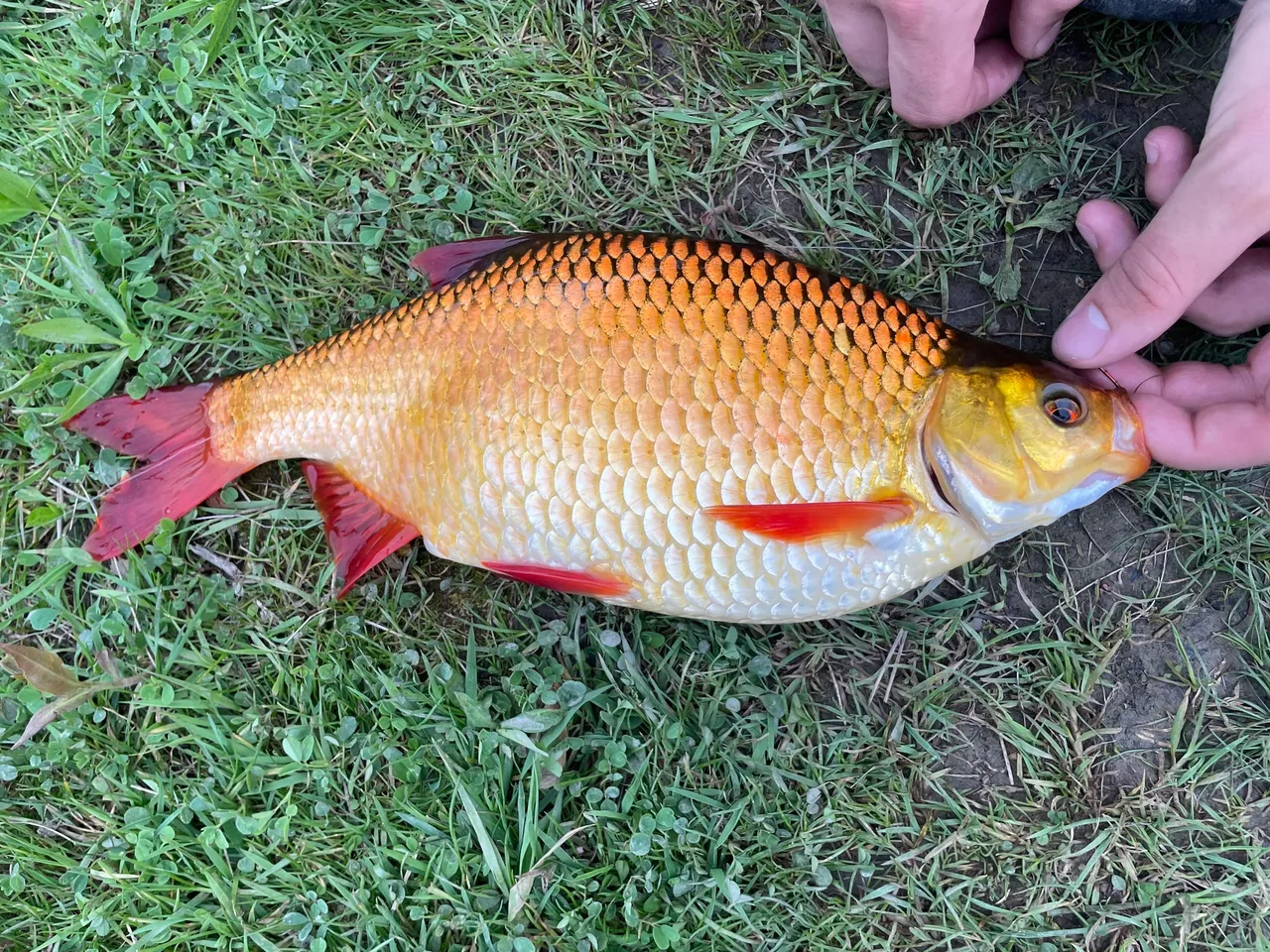
How this was identified, and who took it
Identified by: The record's leading character is unambiguous here: the mouth is strongly upturned and angled for surface feeding, where a roach's is level or downturned. Supported by a deep brassy-gold flank, vivid scarlet lower fins and a golden-orange eye. Stated plainly: the dorsal fin is folded flat, so the dorsal-behind-pelvic offset that is the record's second character cannot be checked from this frame.Stephanie Tran — CC BY, via iNaturalist — source, licenceLook at this first
Lay a finger across the base of the pelvic fins and look straight up at the back. On a rudd the dorsal fin starts well behind that line. On a roach it starts directly above it. One glance, one relationship, and it works at any size.
Diagnostic — settles it on its own
Each of these settles the identification on its own. If one is clear, you have your answer.
Where the dorsal fin sits relative to the pelvic fins
Look at the fish side on and find the paired fins on the underside behind the gills. Then look straight up from their base to the back. On this species the fin on the back begins clearly behind that point; on a roach it begins directly above it. This is a relationship between two parts of one animal rather than a shade or a mood colour, so it survives death, cold, poor light and a phone camera, and it is the test to learn first.
Supporting — use with other characters
Real characters that are not conclusive by themselves. Use two or three together.
Which way the mouth points
Look at the head in profile. The mouth is angled upwards, with the lower jaw leading, because this is a fish that feeds on things at and just under the surface. A roach's mouth is level or angled slightly downwards. It is a quick second check and it agrees with the fin position; where the two disagree, suspect a hybrid rather than deciding between them.
A ridge along the belly behind the pelvic fins
Run a fingertip along the underside between the paired fins and the vent. On this species there is a definite keel there — a narrow ridge you can feel rather than only see. Roach has no such keel and the belly is rounded. It is a small character and it is a structural one, which makes it a useful third opinion when a fish has lost its colour or when the fin position is marginal.
Suggestive only — varies with condition
Hints only. These vary with condition, season, water and how long the fish has been out of it, and a fish that contradicts them is still the same species.
Brassy gold flanks and deep red fins
The overall impression is warm gold rather than the cool silver of a roach, with the paired fins, the anal fin and the tail carrying a deep blood red. It is genuinely striking on a fresh fish in good condition and it is the reason most people think they can name this species at a glance. It is also the least reliable thing on the page: intensity varies with water, season, condition and age, hybrids show intermediate colour, and a stressed or long-dead fish loses it.
What it gets confused with
- Roach above all, which shares the water, the general shape and the reddish fins, and which is separated by the dorsal fin position, the mouth angle and the belly keel rather than by colour.
- Roach-rudd hybrids, which occur wherever both are present, are common, and show intermediate values of every character this page uses — which is a real problem rather than a footnote.
- Golden orfe and ornamental ide in waters where they have been stocked, which are gold, deep-finned and superficially similar to somebody expecting only two candidates.
- Silver bream in mixed lowland waters, which is deeper-bodied with an orange flush at the base of the paired fins and a quite different body outline once compared.
Side by side: Rudd vs Roach.
Where this stops working
This species hybridises with roach freely wherever the two occur, the hybrids are common rather than rare, and they show intermediate dorsal fin position, intermediate mouth angle, a partial keel and intermediate colour. That means a proportion of large claimed specimens of either parent are hybrids, and a fish that sits between the two descriptions is probably not either of them. Colour is the character everybody uses and it is the weakest: it varies with water, season and condition, and it fades. Small fish are harder than large ones because the fin position is less clearly separated. A definitive answer on an intermediate fish needs characters this page cannot photograph.
The full record
This page covers identification only. The Rudd record covers behaviour, lifecycle, distribution, handling and the sources behind all of it.
Reviewed 2026-08-16.
More about this fish
Telling it apart is one question. Here are the others.
How it is caught
- Dry fly fishingFloat tackle fished shallow, and genuinely a dry-fly target because of the upturned mouth.
- Float fishingFloat tackle fished shallow, and genuinely a dry-fly target because of the upturned mouth.
- Pole fishingRudd feed in the upper layers and are held there with loose feed, which the pole can deliver and fish over precisely.
- Surface fishing for coarse fishAn upward-feeding fish by anatomy — the jaw is angled to take from above — which makes it the species most consistently available on the surface.
Where it lives
Why the 5 connections on this page are here, and the sources
How it is caught
What experienced anglers do — 4 connections
Widely and independently recommended by experienced anglers and specialist sources. This is real angling knowledge, not proof: controlled evidence for it is limited, and FishingHQ records it as convention rather than as a demonstrated effect.
Dry fly fishing
A practitioner claim about how Scardinius erythrophthalmus is commonly fished, following from where and how it feeds.
- General angling website restatements of established technique — Various (Credible secondary source)Relied on for: Widely restated practitioner accounts of fishing for rudd.Citation checked — the work exists and is described correctly
- Sea Angler — Bauer Media (Specialist angling publication)Relied on for: Practitioner treatment of the methods used for rudd and comparable species.Citation checked — the work exists and is described correctly
Float fishing
A practitioner claim about how Scardinius erythrophthalmus is commonly fished, following from where and how it feeds.
- General angling website restatements of established technique — Various (Credible secondary source)Relied on for: Widely restated practitioner accounts of fishing for rudd.Citation checked — the work exists and is described correctly
- Sea Angler — Bauer Media (Specialist angling publication)Relied on for: Practitioner treatment of the methods used for rudd and comparable species.Citation checked — the work exists and is described correctly
Pole fishing
Established angling practice for this species, recorded as convention. The note states the property of the animal or its water that makes the method the answer.
- Coarse Fishing — A. & C. Black, 1912 (Specialist angling publication)Relied on for: Established coarse-angling technique and its application to the species.States this directlyCitation checked — the work exists and is described correctly
- Angling Times — Bauer Media (Specialist angling publication)Relied on for: Contemporary British coarse practice for this species.Background and mechanism onlyCitation checked — the work exists and is described correctly
Surface fishing for coarse fish
That a species is conventionally fished for by this method, drawn from angling literature and from widely restated practitioner description rather than from testing.
- Coarse Fishing — A. & C. Black, 1912 (Specialist angling publication)Relied on for: Classical British coarse angling practice: river float work, shotting, bait delivery and the reels and rods used for each.States this directlyCitation checked — the work exists and is described correctly
- Freshwater Fishing — Macdonald & Jane's, 1975 (Specialist angling publication)Relied on for: Comprehensive British freshwater angling practice including river float fishing, surface presentation and the equipment for each.States this directlyCitation checked — the work exists and is described correctly
Where it lives
Backed by research — 1 connection
Supported by peer-reviewed research or fisheries science. The sources are listed and can be checked.
Lowland stillwaters
A habitat association for Scardinius erythrophthalmus taken from the environment and distribution data on its FishBase summary.
- FishBase: a global information system on fishes — Froese, R. and D. Pauly, eds. — FishBase Consortium (Scientific institute)Relied on for: The environment, depth range and habitat description recorded for Scardinius erythrophthalmus.States this directlyPassage read and verified