What does barramundi eat?
What is established about how barramundi feeds, kept separate from what anglers infer from it.
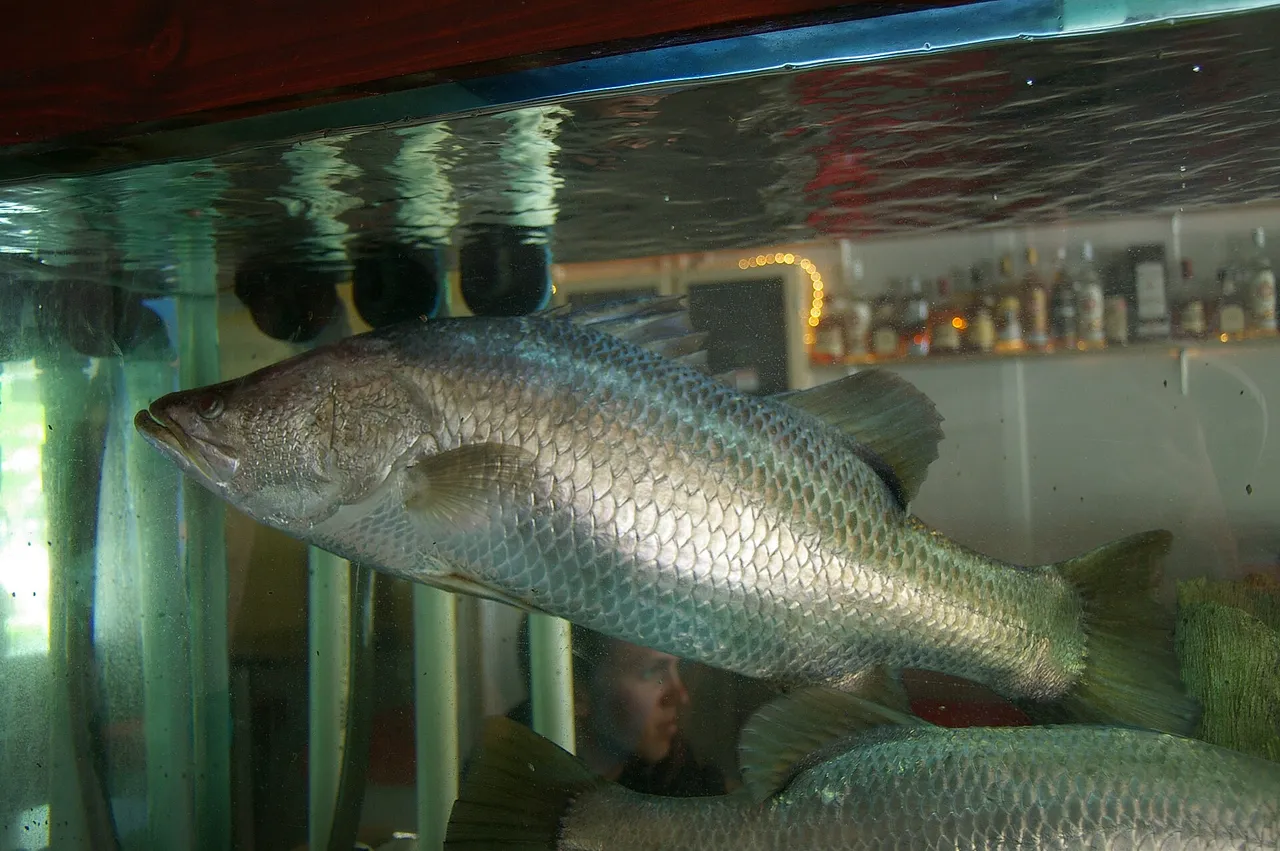
How this was identified, and who took it
Identified by: Full lateral view showing the dished head profile, pointed snout, large silver scales and rounded caudal fin. Photographed through aquarium glass; the caption says so.John Robert McPherson — CC0 1.0 Public Domain Dedication, via Wikimedia Commons — source, licenceWhat is known about how it feeds
A barramundi does not chase things. It waits beside structure and inhales.
The mouth is large and protrusible, and opening it suddenly generates enough suction to draw prey in from a short distance — a mechanism that requires no speed advantage over the prey at all. The fish then returns immediately to the cover it struck from, which is a single continuous movement rather than two decisions.
The verified relationship is decapod crustaceans, and prawns are the dominant item in the estuarine and tidal creek habitat the species uses. The delivery mechanism is the tide: a falling tide flushes prawns and small fish out of mangrove and off flooded flats into the channels where barramundi are waiting, and that is the most predictable feeding event in the fishery.
Fish are taken heavily too, and bony bream and mullet feature across the range.
The life history adds something no other species in this file has. Barramundi are protandrous hermaphrodites: they mature as males and change to female as they grow, so almost every large barramundi is female and every small one is male. Removing large fish removes the breeding females specifically, which is why size limits on this species frequently cap the top as well as the bottom.
The fish is catadromous, moving between fresh water and salt, and feeds throughout.
The food
Prey with a verified dietary link to this fish. Each entry carries its own evidence, and each is written at the precision the source actually used: a named species where the source named one, a group or food category where it said “polychaetes”, “crustaceans” or “detritus” and meant it. That is why this list is shorter than the animal’s real diet rather than longer.
- Decapod crustaceans as prey — a group rather than a species: the evidence names the group
Prawns are a dominant item in the barramundi diet in estuarine and tidal creek habitat, particularly on falling tides that flush them out of mangrove.
Food with no page of its own here yet
These are real components of the diet, listed as plain text because FishingHQ has no page for them yet. Inventing pages to make the list look fuller would be the fabrication this whole approach exists to prevent.
- bony bream
- mullet
- small barramundi (cannibalism)
- mud crabs
- catfish
What anglers do with this
Everything below is interpretation, not finding. It is what experienced anglers conclude from the biology above, and the reasoning is usually sound and almost never tested. It is separated from the biology deliberately.
The tidal flush is the timing and it is the closest thing to a schedule in tropical estuary fishing: work the drains and creek mouths on the falling tide, when the prey has no choice about where it goes. That is convention resting on a well-documented movement.
The return-to-cover habit is the practical problem and it is mechanical: a hooked barramundi goes back to the snag it came from, and the outcome is decided immediately.
The suction mechanism is used to argue that an offering does not need to outrun anything, only to be in the right place with the current — practitioner reasoning from the feeding mechanics.
The sex-change biology is the basis of slot limits in several jurisdictions, and what applies is a question for the relevant authority.
What this does not establish
One group-level relationship for a broad opportunistic diet with a substantial fish component that is not represented. Composition varies between freshwater, estuarine and coastal habitat and with the size of the fish. Nothing here establishes proportions.
Where this connects
These are the baits, lures, methods and explainers FishingHQ already joins to this fish — which is why the list is sometimes short. They are not chosen for this page, and a link here means an evidenced relationship exists, not that it follows from the diet.
Lures recorded for this species
Where it lives
The science behind the feeding
This page covers feeding. The Barramundi record covers identification, lifecycle, seasonal behaviour, handling and the sources behind all of it.
Reviewed 2026-08-12.