How to identify barramundi
Lates calcarifer · Latidae
The characters that identify barramundi, ranked by how far each one can be trusted on its own.
Safety: species that bite — can cause serious injury or death. One more point applies here.
How this was identified, and who took it
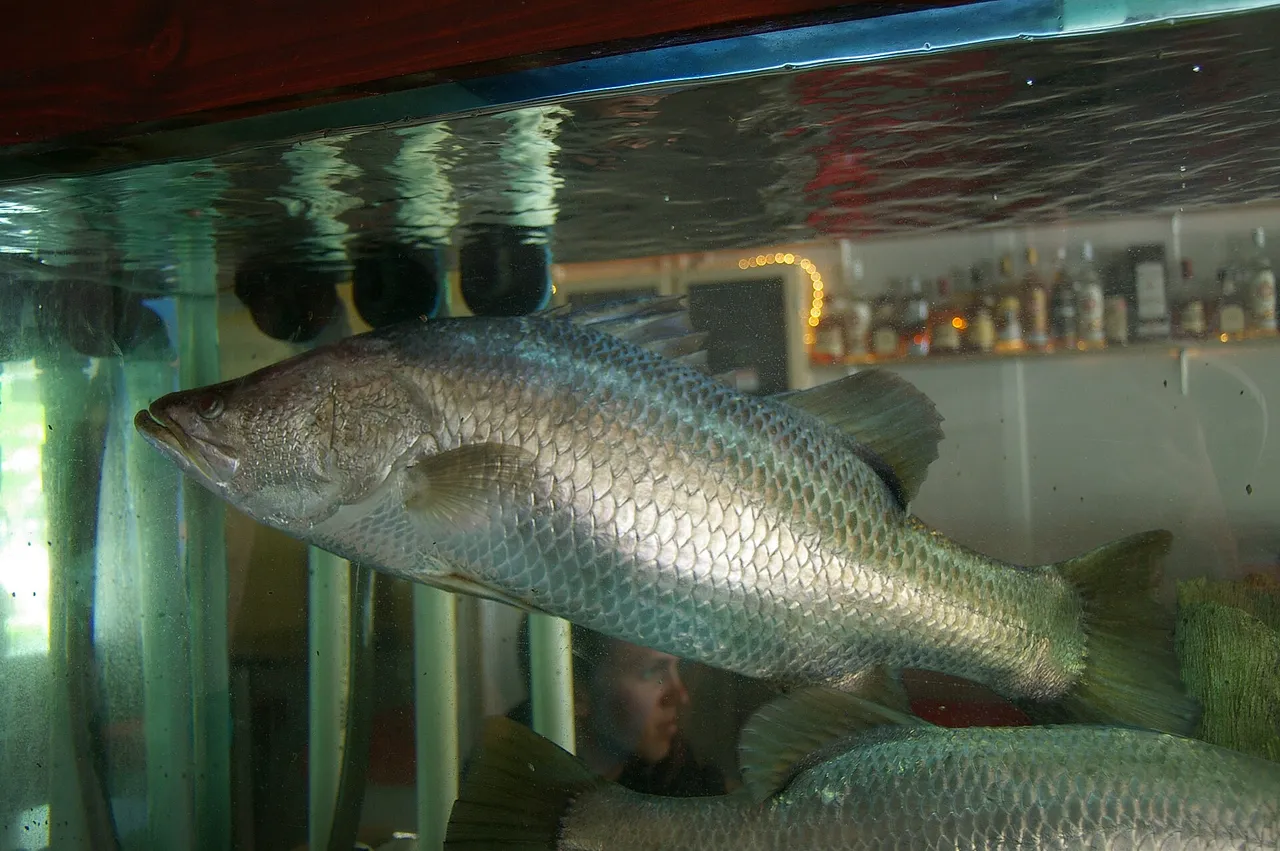
Identified by: Full lateral view showing the dished head profile, pointed snout, large silver scales and rounded caudal fin. Photographed through aquarium glass; the caption says so.John Robert McPherson — CC0 1.0 Public Domain Dedication, via Wikimedia Commons — source, licenceLook at this first
Read the head profile. A barramundi's forehead is dished — concave between the snout and the dorsal origin — over a large obliquely angled mouth. Nothing else in a northern Australian estuary has that scooped outline.
Diagnostic — settles it on its own
Each of these settles the identification on its own. If one is clear, you have your answer.
A concave head profile
The line from the point of the snout back to the dorsal fin dips inward rather than running straight or bulging. It is structural, present at every size, and unaffected by the water the fish came from — which matters more here than for most species.
A deeply notched dorsal fin
The dorsal is divided almost to the back between its spiny and soft halves, so it reads as two fins on a quick look. Combined with the head profile it names the fish without reference to colour at all.
Supporting — use with other characters
Real characters that are not conclusive by themselves. Use two or three together.
A large protrusible oblique mouth
The mouth is big, angled upward, and extends forward when the fish feeds. It is the apparatus of an ambush predator that takes prey above it, and it separates barramundi from the jacks and grunters sharing the same snags.
A serrated gill cover with a pointed operculum
The rear edge of the gill plate is saw-toothed and the operculum ends in a point. Identifying, and the specific feature that cuts hands — it is why the fish is held by the jaw with the body supported rather than gripped behind the head.
Suggestive only — varies with condition
Hints only. These vary with condition, season, water and how long the fish has been out of it, and a fish that contradicts them is still the same species.
How dark the fish is
Barramundi from clear water are olive-brown and heavily pigmented; the same species from a turbid estuary is bright silver. Two correctly identified fish can look nothing alike, which is why this page ranks the head shape first.
What it gets confused with
- Other Lates species across the Indo-West Pacific, which share the head profile and are separated by range and by fin counts.
- Large mangrove jack in the same snags, which is deep red with an entirely different head.
- Farmed barramundi from outside the natural range, where provenance rather than anatomy is the question.
Where this stops working
The genus extends across the Indo-West Pacific and several Lates are similar; range does much of the work that anatomy cannot. Colour is close to useless. Where an upper size limit protects large fish, those are the breeding females and the correct identification of a fish near the limit carries a real consequence — the rules vary by jurisdiction and by water and are not something a page should state.
The full record
This page covers identification only. The Barramundi record covers behaviour, lifecycle, distribution, handling and the sources behind all of it.
Reviewed 2026-08-14.
More about this fish
Telling it apart is one question. Here are the others.
How it is caught
- Kayak fishingMangrove creeks are shallow, narrow, overhung and frequently unreachable by a boat with a motor, which makes a kayak the practical craft for the estuarine barramundi fishing a visitor can actually do.
- SpinningBarramundi sit behind snags and rock bars in current and intercept, so lures are cast to structure and worked past it. The fish is located by reading the structure rather than by covering water.
- TrollingTrolling covers the long snag lines and creek edges of northern Australian systems where casting to every piece of structure is impractical.
Where it lives
- EstuaryBarramundi are estuarine before they are anything else, holding against snags, mangrove roots and drain mouths where tidal flow delivers prey past a fixed ambush point.
- MangroveJuveniles use mangrove and associated wetland as nursery habitat, and adults hunt the root edges and creek mouths on a falling tide. FishingHQ described this in prose for four sprints and had nothing to point at.
- Tropical estuary and tidal creekThe defining fish of the wet-dry tropical estuary and the reason the run-off has a name. Catadromous: it must reach salt water to breed, which is why connection through the system matters more to it than habitat quality in any one part of it.
Where you will find it
- AustraliaBarramundi are the defining recreational species of tropical northern Australia, and much of what the rest of the world knows about fishing for them comes from there.
- South-East Asian fishingAn estuarine and impoundment fish across the region, and one that moves between fresh and salt water through its life.
- Sri LankaIn the lagoon, estuary and mangrove systems, which are substantial on several parts of the coast.
- ThailandThe inshore and estuarine predator that most visiting lure anglers are actually fishing for, in mangrove creek, river mouth and coastal lagoon on both coasts.
- The Coral TriangleOccupies the estuarine and mangrove systems of the region's larger islands, moving between fresh and salt water.
- The Great Barrier ReefOccupies the inshore tidal creeks, mangrove systems and coastal shallows along the mainland coast rather than the reef itself.
- The Indian subcontinent coastsUses the backwaters, estuaries and river mouths along both seaboards, and is the principal target of the region's growing estuary lure fishery.
- The Mekong systemUses the delta and the lower brackish reaches, moving between fresh and salt water as its catadromous life history requires.
Why the 14 connections on this page are here, and the sources
How it is caught
What experienced anglers do — 3 connections
Widely and independently recommended by experienced anglers and specialist sources. This is real angling knowledge, not proof: controlled evidence for it is limited, and FishingHQ records it as convention rather than as a demonstrated effect.
Kayak fishing
What anglers actually use a method for, recorded as convention.
- General angling website restatements of established technique — Various (Credible secondary source)Relied on for: Widely restated descriptions of technique, ground and fish behaviour, recorded as consensus rather than as scholarship.Background and mechanism onlyCitation checked — the work exists and is described correctly
- Sea Angler — Bauer Media (Specialist angling publication)Relied on for: Contemporary angling practice as reported by practitioners: ground, tackle, presentation and seasonal timing.States this directlyCitation checked — the work exists and is described correctly
Spinning
Established angling practice for this species, recorded as convention. The note states the property of the animal or its water that makes the method the answer.
- IGFA International Angling Rules and World Record Requirements — International Game Fish Association (Angling or fisheries organisation)Relied on for: Recognition of the species as an established sport fish and the angling methods and tackle classes conventionally used for it.States this directlyPassage read and verified
- General angling website restatements of established technique — Various (Credible secondary source)Relied on for: Widely restated practice connecting this species and method.Background and mechanism onlyCitation checked — the work exists and is described correctly
Trolling
Established angling practice for this species, recorded as convention. The note states the property of the animal or its water that makes the method the answer.
- IGFA International Angling Rules and World Record Requirements — International Game Fish Association (Angling or fisheries organisation)Relied on for: Recognition of the species as an established sport fish and the angling methods and tackle classes conventionally used for it.States this directlyPassage read and verified
- General angling website restatements of established technique — Various (Credible secondary source)Relied on for: Widely restated practice connecting this species and method.Background and mechanism onlyCitation checked — the work exists and is described correctly
Where it lives
Backed by research — 3 connections
Supported by peer-reviewed research or fisheries science. The sources are listed and can be checked.
Estuary
A habitat claim held to a scientific standard.
- FishBase: a global information system on fishes — Froese, R. and D. Pauly, eds. — FishBase Consortium (Scientific institute)Relied on for: Recorded habitat use of Lates calcarifer across estuarine, riverine and coastal environments.States this directlyPassage read and verified
- JNCC species and habitat conservation advice — Joint Nature Conservation Committee (Conservation authority)Relied on for: The general characterisation of estuarine habitat and its productivity.Background and mechanism onlyCitation checked — the work exists and is described correctly
Mangrove
A habitat association resting on the regional identification and fisheries literature rather than on angling report.
- FAO Species Identification Guides for Fishery Purposes and the FAO Species Catalogues — Food and Agriculture Organization of the United Nations (Scientific institute)Relied on for: Habitat association, depth range and distribution of the species concerned as set out in the FAO species identification sheets for the region.States this directlyCitation checked — the work exists and is described correctly
- The World's Mangroves and their Fisheries — FAO Forestry and Fisheries assessments — Food and Agriculture Organization of the United Nations, Rome (Standards body)Relied on for: The dependence of tropical coastal fisheries species on mangrove and estuarine habitat, including the nursery function.States this directlyCitation checked — the work exists and is described correctly
Tropical estuary and tidal creek
A habitat association resting on the regional identification and fisheries literature rather than on angling report.
- FAO Species Identification Guides for Fishery Purposes and the FAO Species Catalogues — Food and Agriculture Organization of the United Nations (Scientific institute)Relied on for: Habitat association, depth range and distribution of the species concerned as set out in the FAO species identification sheets for the region.States this directlyCitation checked — the work exists and is described correctly
- The World's Mangroves and their Fisheries — FAO Forestry and Fisheries assessments — Food and Agriculture Organization of the United Nations, Rome (Standards body)Relied on for: The dependence of tropical coastal fisheries species on mangrove and estuarine habitat, including the nursery function.States this directlyCitation checked — the work exists and is described correctly
Where you will find it
Backed by research — 8 connections
Supported by peer-reviewed research or fisheries science. The sources are listed and can be checked.
Australia
A distribution claim held to a scientific standard.
- FishBase: a global information system on fishes — Froese, R. and D. Pauly, eds. — FishBase Consortium (Scientific institute)Relied on for: The Indo-West Pacific distribution of Lates calcarifer including northern Australia.States this directlyPassage read and verified
- The IUCN Red List of Threatened Species — International Union for Conservation of Nature (Conservation authority)Relied on for: The assessed range of the species. NOTE: the Red List was not reachable during this review; the category and range were read from FishBase's republication.Background and mechanism onlyCitation checked — the work exists and is described correctly
South-East Asian fishing
A distributional claim taken from reference sources on the species rather than from angling report. It states presence and asserts nothing about a fishery.
- FishBase: a global information system on fishes — Froese, R. and D. Pauly, eds. — FishBase Consortium (Scientific institute)Relied on for: Distribution, habitat association, depth range and life history recorded for the species concerned.States this directlyPassage read and verified
- The IUCN Red List of Threatened Species — International Union for Conservation of Nature (Conservation authority)Relied on for: Global distribution, population trend and extinction-risk assessment for the species concerned.States this directlyCitation checked — the work exists and is described correctly
Sri Lanka
A distributional claim about where a species occurs, resting on the regional identification literature rather than on angling report. It says nothing about where a reader should fish.
- FAO Species Identification Guides for Fishery Purposes and the FAO Species Catalogues — Food and Agriculture Organization of the United Nations (Scientific institute)Relied on for: Species composition, habitat association and distribution for the region concerned, as set out in the FAO species identification sheets.States this directlyCitation checked — the work exists and is described correctly
- The IUCN Red List of Threatened Species — International Union for Conservation of Nature (Conservation authority)Relied on for: Global assessment and distribution for the species concerned.States this directlyCitation checked — the work exists and is described correctly
Thailand
That a species occurs in these waters, drawn from distribution science. It is a statement about where the animal lives and is not a statement that anybody will catch one, still less where.
- FAO Species Identification Guides for Fishery Purposes and the FAO Species Catalogues — Food and Agriculture Organization of the United Nations (Scientific institute)Relied on for: Identification, distribution and habitat association of the fishes and invertebrates of the tropical region named.States this directlyCitation checked — the work exists and is described correctly
- FishBase: a global information system on fishes — Froese, R. and D. Pauly, eds. — FishBase Consortium (Scientific institute)Relied on for: Recorded distribution, depth range and habitat association of the species named, including its occurrence in the waters concerned.States this directlyPassage read and verified
The Coral Triangle
A distribution association between an animal and a kind of water, rather than a claim about any named mark.
- FAO Species Identification Guides for Fishery Purposes and the FAO Species Catalogues — Food and Agriculture Organization of the United Nations (Scientific institute)Relied on for: Distribution, habitat, depth and fishery accounts for the species in the FAO regional identification guides for the ocean area concerned.States this directlyCitation checked — the work exists and is described correctly
- FishBase: a global information system on fishes — Froese, R. and D. Pauly, eds. — FishBase Consortium (Scientific institute)Relied on for: Distribution, habitat association and depth range recorded for the species.States this directlyPassage read and verified
The Great Barrier Reef
A distribution association between an animal and a kind of water, rather than a claim about any named mark.
- FishBase: a global information system on fishes — Froese, R. and D. Pauly, eds. — FishBase Consortium (Scientific institute)Relied on for: Distribution, habitat association and depth range recorded for the species, including its occurrence in the water body concerned.States this directlyPassage read and verified
- The IUCN Red List of Threatened Species — International Union for Conservation of Nature (Conservation authority)Relied on for: Assessment and range account for the species, including the systems and coasts it occupies.Background and mechanism onlyCitation checked — the work exists and is described correctly
The Indian subcontinent coasts
A distribution association between an animal and a kind of water, rather than a claim about any named mark.
- FAO Species Identification Guides for Fishery Purposes and the FAO Species Catalogues — Food and Agriculture Organization of the United Nations (Scientific institute)Relied on for: Distribution, habitat, depth and fishery accounts for the species in the FAO regional identification guides for the ocean area concerned.States this directlyCitation checked — the work exists and is described correctly
- FishBase: a global information system on fishes — Froese, R. and D. Pauly, eds. — FishBase Consortium (Scientific institute)Relied on for: Distribution, habitat association and depth range recorded for the species.States this directlyPassage read and verified
The Mekong system
A distribution association between an animal and a kind of water, rather than a claim about any named mark.
- The IUCN Red List of Threatened Species — International Union for Conservation of Nature (Conservation authority)Relied on for: Assessment and habitat account for the species, including the river or lake system it occupies and the pressures acting on it.States this directlyCitation checked — the work exists and is described correctly
- FishBase: a global information system on fishes — Froese, R. and D. Pauly, eds. — FishBase Consortium (Scientific institute)Relied on for: Distribution, habitat association, size and life history recorded for the species in the system concerned.States this directlyPassage read and verified
Safety
Species that bite — Can cause serious injury or death
Across much of the barramundi's range, the water it lives in also holds saltwater crocodiles. Estuarine and mangrove systems in northern Australia and parts of Southeast Asia present a genuine and serious predation risk to people at the water's edge, and the fish are found precisely where the crocodiles are.
What reduces it: Treat local warnings and signage as authoritative. Do not stand at the water's edge, clean fish at the water, or enter the water in crocodile country. Keep well back from banks, vary your habits rather than fishing the same spot at the same time daily, and follow the guidance of the relevant local authority — this is a hazard where local knowledge is not optional.
Injury while handling fish — Can cause injury needing treatment
The serrated preoperculum and gill covers of a barramundi are genuinely sharp and cause deep cuts to hands and forearms, usually when somebody grips the fish behind the head.
What reduces it: Never put a hand near the gill covers. Hold by the lower jaw with the other hand supporting the belly. Wet hands, and use a knotless landing net or a lip grip with the weight supported.