Atlantic tarpon
Fish · Last reviewed 2026-08-10
A huge, ancient, air-breathing fish of tropical Atlantic coasts that jumps repeatedly when hooked and is almost never eaten — fished purely for the encounter.
Safety: injury while handling fish — can cause injury needing treatment. 5 more points apply here.
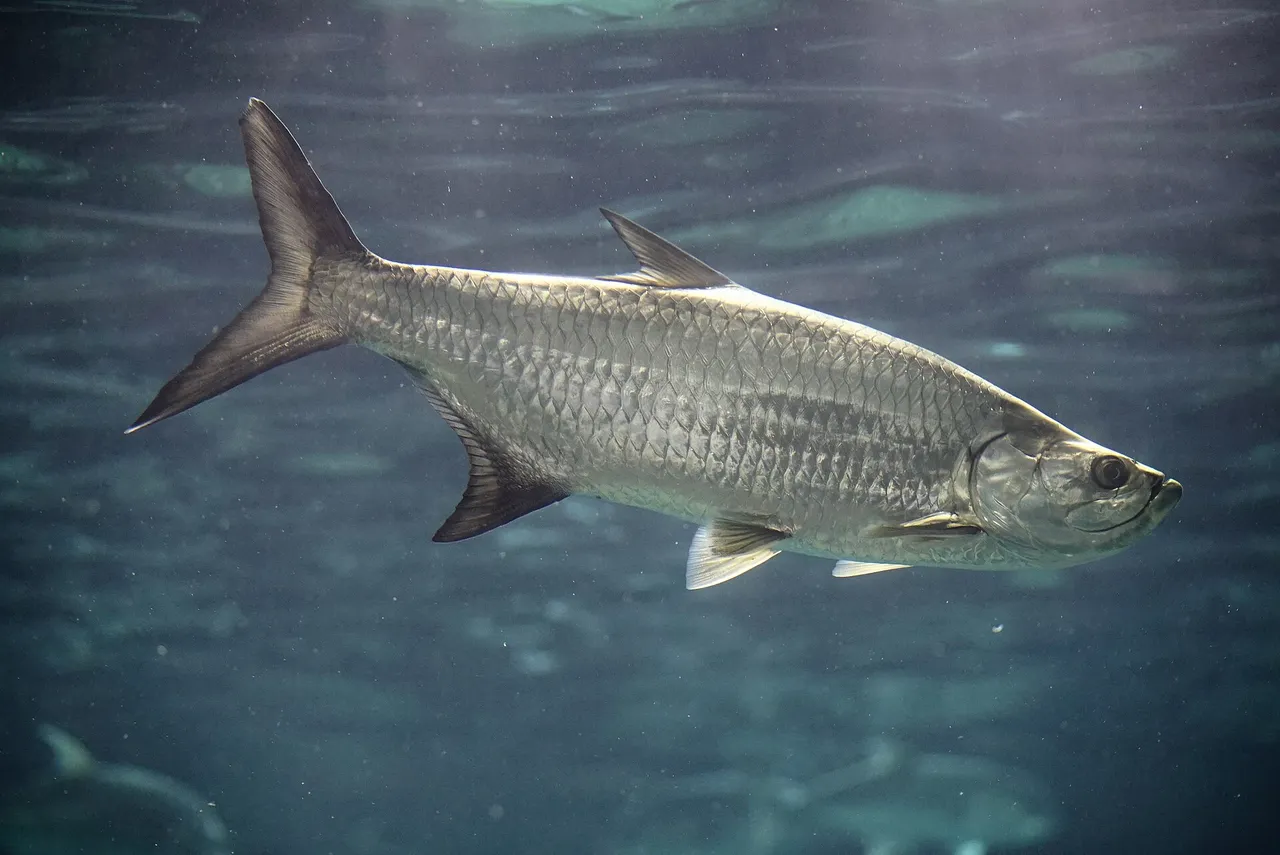
How this was identified, and who took it
Identified by: Full lateral view. Very large silver scales, superior upturned mouth, deeply forked tail and the elongated last dorsal ray are all visible — that trailing filament is the character most often missing from tarpon photographs.Daiju Azuma — CC BY-SA 4.0, via Wikimedia Commons — source, licence
Catching Atlantic tarpon
Everything here on fishing for it. Each entry opens the page behind it.
- Where
- 4 places FishingHQ documents — strongest claim anywhere: repeatedly reported · From the shore, From a boat, Fly fishing
The tarpon is one of the strangest and most compelling fish an angler can pursue. It reaches two and a half metres, it is armoured in enormous silver scales, and when hooked it leaves the water repeatedly and violently — which is both the reason people fish for it and the reason so few are landed.
It is also physiologically remarkable. The swim bladder is connected to the oesophagus and can be filled directly with air, letting the fish breathe atmospheric oxygen and survive in water too deoxygenated for almost anything else. That is why tarpon live in stagnant backwaters, mangrove lagoons and warm shallow creeks where no fish of that size has any business being, and why they can be seen rolling at the surface — they are breathing.
The larva is a leptocephalus: a transparent, ribbon-like form that drifts in the plankton before shrinking and metamorphosing, a developmental route shared with eels and bonefish and with almost nothing else an angler meets.
The flesh is bony and poorly regarded, so essentially the entire recreational fishery is catch-and-release. That gives the species an unusual economic position — worth a great deal alive and repeatedly, and very little dead — and it is one of the clearest illustrations available of why that distinction matters.
How it is caught
- Saltwater fly fishingSight-casting a fly to a visible, moving tarpon on a flat is among the most developed traditions in fly fishing, and everything about the tackle follows from a hard bony mouth and a fish that jumps.
- Livebaiting at seaA live bait presented in a channel or a pass intercepts tarpon moving with the tide, which is how the fish's predictable movement rather than its location is fished.
Where Atlantic tarpon is documented
Places where public sources describe this species as fished, with how it is fished and how strongly the evidence supports it. This is not a range map and it is not a recommendation — it is what has been written down about a fishery rather than a record of any individual catch, and being listed is never permission to fish.
Florida
4 documented places
Bridge
Repeatedly reported
From the shore · From a boat
Bridge
Repeatedly reported
From the shore · From a boat
Shallow flat
Repeatedly reported
Fly fishing · From a boat
Mangrove shore
Repeatedly reported
From a boat · Fly fishing
What these strengths mean
- Repeatedly reported
- Several independent public accounts. Enough to say it happens more than once; not enough to call it a fishery.
Identification
- Scientific name
- Megalops atlanticus
- Family
- Megalopidae
- Water
- Saltwater, Brackish, Freshwater
- Conservation status
- Vulnerable
- Regions
- Caribbean, North America, Central & South America, West Africa
- Very large silver scales, unmistakable at any size and the origin of the name silver king.
- Strongly upturned, superior mouth with a projecting lower jaw — a fish built to feed upward.
- A single dorsal fin with the last ray extended into a long trailing filament.
- Deeply forked tail; large eye; body compressed and deep in profile.
- Adults are frequently seen rolling at the surface to gulp air, which is diagnostic behaviour rather than feeding.
Size
- Typical
- 10–30 kg (22–66 lb)
- Large
- 45–70 kg (100–155 lb)
Exceptional: Over 100 kg (220 lb); maximum published weight 161 kg
The fish that should not be lifted at all
Tarpon are the clearest case on FishingHQ where the correct handling is to do less rather than to do it better.
A large tarpon must not be taken out of the water. The fish's own weight, unsupported by water, damages internal structures — and a fish of a hundred kilograms cannot be adequately supported by a person in any case. Photographs are taken with the fish in the water, and that is not a preference.
Control comes from the lower jaw, which is bony and hard, with the body supported and the fish kept alongside. The hazards to the angler are real and are mostly about size and unpredictability: a tarpon jumps, sometimes into boats, and a fish that size arriving at head height is a serious injury. The gill plates are hard-edged and the mouth is abrasive rather than toothed.
The part that is easy to get wrong is the end. A tarpon released before it has recovered is highly likely to be taken by a shark, frequently in front of the angler, and exhausted tarpon attract them. Recovery time is therefore not a courtesy — it is the difference between a released fish and a fed shark, and it is the reason a short fight matters more here than the fight's quality.
Official guidance — why, and the sources (2)
Stated by a fisheries authority, scientific institute or recognised angling body. Authoritative, but summarising rather than demonstrating.
- IGFA International Angling Rules and World Record Requirements — International Game Fish Association (Angling or fisheries organisation)Relied on for: Handling and release conventions for large game fish, including in-water handling.Background and mechanism onlyPassage read and verified
- Understanding the Complexity of Catch-and-Release in Recreational Fishing — Reviews in Fisheries Science 15:75–167, 2007 (Scientific literature)Relied on for: Post-release predation and recovery as determinants of catch-and-release survival.States this directlyCitation checked — the work exists and is described correctly
A cold-intolerant fish with a thermal refuge problem, and a window rather than a season
Tarpon seasonality is governed by a single physiological constraint that is unusual in a fish of this size and durability: they cannot tolerate cold.
THE CONSTRAINT. Tarpon are tropical and subtropical animals with a low tolerance for cool water, and the effect is not gradual. Below a threshold they become torpid, and cold events have historically produced substantial tarpon kills at the edges of the range. That vulnerability is remarkable in a fish that is otherwise extraordinarily robust — tarpon possess a modified swim bladder that functions as an air-breathing organ, allowing them to gulp atmospheric air and to survive in water with almost no dissolved oxygen, which is why they thrive in stagnant backwaters, mangrove creeks and canals that would kill nearly anything else their size.
SO THE YEAR IS A MAP OF WHERE THE WARM WATER IS. Tarpon retreat from the poleward edges of the range as water cools, concentrating into warm shallow bays, canals, springs and other thermal refuges, and they push back out as it warms. In the core of the range they are present year-round; at the margins they have a distinct window, and the window is set by temperature rather than by date.
THE MIGRATIONS FOLLOW WARMING WATER AND BAIT along coasts, and the well-known concentrations that particular fisheries are built on are the visible part of that movement — fish staging in passes, along beaches and around channels as they move. The timing shifts between years with conditions.
AND THE AIR-BREATHING IS AN ANGLING FACT AS WELL AS A PHYSIOLOGICAL ONE. Tarpon roll at the surface to gulp air, visibly, and that behaviour is how the fish are located in water that is otherwise opaque. It is also a reason they are more oxygen-independent than their size suggests, which matters when a fish is fought hard in warm shallow water — the constraint that would limit most species is partly lifted here.
TIDE GOVERNS THE DAILY FISHING wherever the ground is tidal, for the ordinary reason: moving water concentrates prey in passes, channels and along beaches, and tarpon position themselves to intercept it.
Backed by research — why, and the sources (4)
Supported by peer-reviewed research or fisheries science. The sources are listed and can be checked.
- FishBase: a global information system on fishes — Froese, R. and D. Pauly, eds. — FishBase Consortium (Scientific institute)Relied on for: Depth range, migration, spawning season and temperature association recorded for the species.States this directlyPassage read and verified
- ICES Advice on fishing opportunities, catch and effort — International Council for the Exploration of the Sea (Scientific institute)Relied on for: Stock distribution, seasonal movement between spawning and feeding grounds, and the assessment basis for the stock.States this directlyCitation checked — the work exists and is described correctly
- FishBase: a global information system on fishes — Froese, R. and D. Pauly, eds. — FishBase Consortium (Scientific institute)Relied on for: Temperature association, migration, flood-cycle response and spawning season recorded for the species.States this directlyPassage read and verified
- IGFA International Angling Rules and World Record Requirements — International Game Fish Association (Angling or fisheries organisation)Relied on for: Recognition of the species as an established sport fish and the seasonal conventions of its recognised fisheries.Background and mechanism onlyPassage read and verified
A leptocephalus larva, a mangrove nursery, and a bottleneck no angler can see
Tarpon reproduction runs through a habitat bottleneck that has almost nothing to do with the adults, and it is the reason adult protection alone does not secure the species.
THE SPAWNING IS OFFSHORE AND BROADCAST. Adults move well away from the coast to spawn in open water, releasing eggs that develop into a leptocephalus larva — the transparent, ribbon-shaped, leaf-like form shared with eels and bonefish. That larva drifts in the plankton for a period before making its way inshore and metamorphosing.
AND THEN IT NEEDS SOMEWHERE VERY SPECIFIC. Juvenile tarpon recruit into shallow, warm, sheltered, frequently stagnant backwater — mangrove creeks, lagoons, ditches, salt ponds, isolated pools. This is not incidental. Those waters are low in oxygen and would kill most fish, and juvenile tarpon can live there precisely because they can breathe air with their modified swim bladder. The habitat's hostility is the point: it excludes predators, and the tarpon's air-breathing lets it exploit a refuge nothing else can use.
WHICH MAKES THE SPECIES ACUTELY SENSITIVE TO COASTAL DEVELOPMENT. Mangrove clearance, ditching, filling, road causeways cutting off backwaters, and the hardening of shorelines all remove exactly this nursery habitat — and they remove it for reasons that have nothing to do with fishing and are not affected by any fisheries rule. A coast can hold plenty of adult tarpon, kill essentially none of them, and still fail to produce a next generation because the creeks the juveniles need have gone.
THAT IS THE POINT WORTH TAKING FROM THIS PAGE. Tarpon are among the most thoroughly catch-and-release fish in the world — the flesh is not eaten, the fishery is entirely about the fight and the sight of the animal — and a recreational sector that kills almost nothing is still watching a species whose recruitment is decided by planning decisions. Handling practice matters for the individual fish; the nursery habitat matters for the population, and they are not substitutes for each other.
Adult tarpon are also extremely long-lived and slow to mature, so a recruitment failure takes many years to become visible in the adult population — by which time the habitat is long gone.
Backed by research — why, and the sources (2)
Supported by peer-reviewed research or fisheries science. The sources are listed and can be checked.
- FishBase: a global information system on fishes — Froese, R. and D. Pauly, eds. — FishBase Consortium (Scientific institute)Relied on for: Reproductive mode, spawning season, fecundity, parental care, sex-change pattern and larval development recorded for the species.States this directlyPassage read and verified
- The IUCN Red List of Threatened Species — International Union for Conservation of Nature (Conservation authority)Relied on for: Assessment, population trend, and the life-history traits — age at maturity, longevity, reproductive strategy — that determine sensitivity to exploitation.States this directlyCitation checked — the work exists and is described correctly
Air-breathing into water nothing else can use, and the nursery that decides everything
Tarpon habitat spans open ocean and stagnant ditches, and the extremes are connected by one piece of physiology.
THE ADULT HABITAT IS COASTAL AND WIDE. Tarpon use nearshore waters, beaches, passes, bays, estuaries, mangrove systems, rivers and canals across the tropical and subtropical Atlantic, moving with warm water and bait. They tolerate the full salinity range from fresh to marine and cross it freely, which is why the same fish can be caught in an ocean pass and forty kilometres up a river.
THE JUVENILE HABITAT IS THE INTERESTING ONE AND IT IS ALMOST UNINHABITABLE. Young tarpon recruit into shallow, warm, sheltered, poorly flushed backwater — mangrove creeks, lagoons, ditches, borrow pits, salt ponds, isolated pools — where dissolved oxygen is very low and temperature is high. Most fish cannot live there. That is precisely the point: the habitat's hostility excludes predators, and a juvenile tarpon in a stagnant ditch is a juvenile tarpon nothing can reach.
THE ENABLING TRAIT IS A LUNG. Tarpon possess a modified, vascularised swim bladder that functions as an air-breathing organ, and they gulp atmospheric air at the surface — the rolling behaviour by which adults are located and by which juveniles survive water with almost no oxygen in it. The same equipment that makes a big tarpon visible on a flat is what makes a small one able to occupy the refuge.
WHICH MAKES THE NURSERY THE CONSTRAINT ON THE WHOLE POPULATION. Mangrove clearance, ditching and filling, road causeways cutting off backwaters, and shoreline hardening remove exactly this habitat — for reasons that have nothing to do with fishing and are unaffected by any fisheries rule. A coastline can hold plenty of adult tarpon, kill essentially none of them, and quietly stop recruiting.
AND THE THERMAL LIMIT SETS THE RANGE EDGES. Tarpon are intolerant of cold and retreat from the poleward margins as water cools, concentrating into thermal refuges — deep canals, warm springs, power station outflows — where a cold snap can otherwise kill them. Those refuges are habitat in the strict sense: without them the range would contract.
Backed by research — why, and the sources (2)
Supported by peer-reviewed research or fisheries science. The sources are listed and can be checked.
- NOAA National Ocean Service education on estuaries and the National Estuarine Research Reserve System — National Oceanic and Atmospheric Administration, United States (Government fisheries body)Relied on for: Estuarine structure and function, the salinity gradient, turbidity maxima, and the nursery role of estuarine habitat.States this directlyCitation checked — the work exists and is described correctly
- FishBase: a global information system on fishes — Froese, R. and D. Pauly, eds. — FishBase Consortium (Scientific institute)Relied on for: Salinity tolerance, habitat association and life-stage distribution for the species.States this directlyPassage read and verified
Lifecycle and reproduction
Spawns offshore, and the transparent leptocephalus larvae migrate into estuaries and settle into shallow, warm, often stagnant backwater habitat where the air-breathing capacity gives juveniles a refuge from predators that cannot survive there. Growth is slow and the species is very long-lived, with large individuals representing decades — which is the central fact behind its vulnerability and its assessment as Vulnerable.
Offshore broadcast spawning, with larval recruitment into estuarine and backwater nursery habitat. The reliance on shallow coastal nursery habitat — mangrove, lagoon and creek — makes the species acutely sensitive to coastal development, and loss of that habitat affects recruitment independently of how many adults are present or how few are killed.
Feeding and senses
Feeds on schooling fish including sardines, anchovies, mullets, snook and cichlids, and on crabs. The upturned mouth suits feeding on prey above the fish, and tarpon frequently work bait from beneath, which is why a fly or lure that moves across and above a fish is more convincing than one dragged past its nose.
Very large eyes adapted to low light, and tarpon feed hard at dawn, dusk and at night around lights and current lines where bait is concentrated. In turbid backwater the lateral line carries more of the load. The rolling behaviour that gives the fish away to anglers is respiration rather than feeding, and a rolling fish is not necessarily a catchable one.
Through the year
Movements are driven by water temperature: tarpon are intolerant of cold and retreat from the northern and southern edges of the range as water cools, concentrating in warm shallow water and thermal refuges. Seasonal migrations along coasts follow warming water and bait, and in many places the fishery has a distinct window rather than being year-round. Tidal flow governs the daily fishing wherever the ground is tidal.
Distribution
Atlantic Ocean: western Atlantic from Nova Scotia and Bermuda to Brazil; eastern Atlantic from Mauritania to Angola, with occasional records from Portugal, the Azores and southern France. Occurs in coastal waters, bays, estuaries, mangrove-lined lagoons and rivers, usually in the top fifteen metres.
This is a biological range — where the species occurs, not a prediction that you will catch one. To browse the fishing geography FishingHQ holds, start at fishing places.
Why anglers care
One of the world's great sport fish and the basis of a very high-value recreational fishery across the Caribbean, the Gulf of Mexico and parts of West Africa. Fished on fly, lure and bait from boats and from shore. Almost entirely catch-and-release, since the flesh is bony and little valued, which makes it one of the clearest cases anywhere of a fish worth vastly more alive than dead.
Handling and returning
Large tarpon should not be lifted from the water at all — the fish's own weight out of water damages internal structures, and a fish of this size cannot be supported adequately by a person. Keep it in the water, hold it by the lower jaw with the body supported, minimise the fight where possible, and revive properly. Exhausted tarpon are highly vulnerable to sharks immediately after release, so recovery time is not optional.
Going further
- What does atlantic tarpon eat? — feeding biology, kept separate from what anglers infer from it.
- Atlantic tarpon vs Bonefish — how to tell them apart.
Safety
Injury while handling fish — Can cause injury needing treatment
A very large, powerful fish that jumps unpredictably, sometimes into boats. The bony mouth and hard gill plates cause injuries, and a jumping fish of this size is genuinely dangerous at close quarters.
What reduces it: Never lift a large tarpon from the water. Keep clear of a green fish at boatside and be ready for it to jump. Handle by the lower jaw with the body supported in the water, and use gloves.
Encounters with marine life — Can cause injury needing treatment
Exhausted tarpon attract sharks, and this frequently happens beside the angler during the fight or immediately after release.
What reduces it: Shorten the fight with appropriate tackle rather than playing the fish out. Revive properly before release. Be prepared to move away from an area where sharks are actively working.
Precautions that always apply here
- Support the fish's weight along its body, keep it out of the water for as short a time as possible, and hold it over something soft.
- Wet your hands before touching a fish. Dry hands strip the protective mucus layer that keeps infection out.
- Keep fingers out of the gills and clear of the teeth. Gill damage is usually fatal to the fish, and several species will remove skin from a finger.
- Tell somebody where you are going and when you expect to be back.
Check the rules before you fish
Fishing laws, bylaws, access rules, seasons, bait restrictions and permitted methods vary by location and can change. Check the current rules from the relevant authority and the water you intend to fish before fishing.
Check with:
- Current national or regional law for where you are fishing
- Current local bylaws
- The relevant fisheries authority
- The landowner, club or fishery whose water it is
- Any restrictions specific to the species or the method you intend to use
Where to go next
Similar and related fish
- Atlantic menhadenTarpon feed on menhaden and other clupeids in coastal water, and migrating tarpon are frequently found where bait shoals concentrate.
- BonefishBoth produce transparent ribbon-like leptocephalus larvae that drift in the plankton before metamorphosing — a developmental route shared with eels and with almost nothing else an angler meets.
- Scaled sardineScaled sardines are a principal prey in the shallow coastal and estuarine water tarpon use, and the seasonal availability of the bait shapes the fishery's calendar.
Where it lives
- EstuaryAir-breathing lets tarpon live in stagnant backwaters and mangrove lagoons where no fish of that size otherwise could — the swim bladder connects to the oesophagus and is filled directly.
- MangroveJuvenile tarpon occupy mangrove-fringed backwaters and low-oxygen creeks that few predators can tolerate — the swim bladder they can breathe through is what makes that possible — and adults hunt the channels.
- Tropical estuary and tidal creekMoves freely between salt, brackish and fresh water, and is one of the few large fish that tolerates the low-oxygen backwaters a tropical estuary produces in the dry season.
Where you will find it
- CubaIn the mangrove creeks of the cays and in the mainland wetland on the southern coast, which is one of the largest in the Caribbean.
- East and West African fishingThe West African coast and its lagoons hold tarpon at substantial size, which is the region's best-known sport fishery and one very few anglers associate with Africa.
- FloridaMoves along both coasts and through the Keys on a well-defined seasonal migration, supporting one of the most intense sport fisheries in North America.
- The West African coastOccurs along this coast in quantity, using estuaries, lagoons and river mouths, and the region holds some of the largest recorded fish.
- The Yucatán and Mexican Caribbean coastJuveniles resident year-round in the brackish lagoons and mangrove channels behind the coast, adults on the flats and in the channels seasonally.
Understanding this fish
Told apart from
Environment and conservation
Sources and evidence
- FishBase: a global information system on fishes — Froese, R. and D. Pauly, eds. — FishBase Consortium (Scientific institute)Relied on for: Scientific name, family placement in the Megalopidae, maximum length of 250 cm and maximum published weight of 161 kg, Atlantic distribution from Nova Scotia and Bermuda to Brazil and from Mauritania to Angola with occasional records off Portugal, the Azores and southern France, habitat in coastal waters, bays, estuaries, mangrove-lined lagoons and rivers at 0 to 15 m.States this directlyPassage read and verified
- FishBase: a global information system on fishes — Froese, R. and D. Pauly, eds. — FishBase Consortium (Scientific institute)Relied on for: The IUCN Red List category — Vulnerable, assessed 12 June 2018 — is taken from FishBase's republication.States this directlyPassage read and verified
- Understanding the Complexity of Catch-and-Release in Recreational Fishing — Reviews in Fisheries Science 15:75–167, 2007 (Scientific literature)Relied on for: That handling practice, fight duration and air exposure materially affect the survival and condition of released fish.FishingHQ's interpretation of what it saysCitation checked — the work exists and is described correctly
Why the 17 connections on this page are here, and the sources
Similar and related fish
Backed by research — 3 connections
Supported by peer-reviewed research or fisheries science. The sources are listed and can be checked.
Atlantic menhaden
Recorded diet evidence identifies Brevoortia tyrannus as a food item of this predator at species level. The edge is written at that granularity and no further.
- FishBase: a global information system on fishes — Froese, R. and D. Pauly, eds. — FishBase Consortium (Scientific institute)Relied on for: Food items recorded for this predator, including Brevoortia tyrannus.States this directlyPassage read and verified
- FAO Species Identification Guides for Fishery Purposes and the FAO Species Catalogues — Food and Agriculture Organization of the United Nations (Scientific institute)Relied on for: Species account describing the diet of this predator in the region where Brevoortia tyrannus occurs.Background and mechanism onlyCitation checked — the work exists and is described correctly
Bonefish
A developmental-biology claim that links two flagship flats species through something a reader would never guess from looking at them.
- FishBase: a global information system on fishes — Froese, R. and D. Pauly, eds. — FishBase Consortium (Scientific institute)Relied on for: That transparent leptocephalus larvae of Megalops atlanticus migrate into estuaries, and that Albula vulpes has a leptocephalus larval stage.States this directlyPassage read and verified
Scaled sardine
Recorded diet evidence identifies Harengula jaguana as a food item of this predator at species level. The edge is written at that granularity and no further.
- FishBase: a global information system on fishes — Froese, R. and D. Pauly, eds. — FishBase Consortium (Scientific institute)Relied on for: Food items recorded for this predator, including Harengula jaguana.States this directlyPassage read and verified
- FAO Species Identification Guides for Fishery Purposes and the FAO Species Catalogues — Food and Agriculture Organization of the United Nations (Scientific institute)Relied on for: Species account describing the diet of this predator in the region where Harengula jaguana occurs.Background and mechanism onlyCitation checked — the work exists and is described correctly
How it is caught
What experienced anglers do — 2 connections
Widely and independently recommended by experienced anglers and specialist sources. This is real angling knowledge, not proof: controlled evidence for it is limited, and FishingHQ records it as convention rather than as a demonstrated effect.
Saltwater fly fishing
Established angling practice for this species, recorded as convention. The note states the property of the animal or its water that makes the method the answer.
- IGFA International Angling Rules and World Record Requirements — International Game Fish Association (Angling or fisheries organisation)Relied on for: Recognition of the species as an established sport fish and the angling methods and tackle classes conventionally used for it.States this directlyPassage read and verified
- General angling website restatements of established technique — Various (Credible secondary source)Relied on for: Widely restated practice connecting this species and method.Background and mechanism onlyCitation checked — the work exists and is described correctly
A statement about how a species is fished, which is angling convention rather than biology and is labelled as such.
- Still Water Fly-Fishing — Andre Deutsch, 1952 (Specialist angling publication)Relied on for: Fly-fishing practice from a practitioner tradition: line control, depth management, retrieve and the reading of water.States this directlyCitation checked — the work exists and is described correctly
- Sea Angler — Bauer Media (Specialist angling publication)Relied on for: Contemporary UK sea angling practice as reported by practitioners: ground, tackle, presentation and seasonal timing.States this directlyCitation checked — the work exists and is described correctly
Livebaiting at sea
Established angling practice for this species, recorded as convention. The note states the property of the animal or its water that makes the method the answer.
- IGFA International Angling Rules and World Record Requirements — International Game Fish Association (Angling or fisheries organisation)Relied on for: Recognition of the species as an established sport fish and the angling methods and tackle classes conventionally used for it.States this directlyPassage read and verified
- General angling website restatements of established technique — Various (Credible secondary source)Relied on for: Widely restated practice connecting this species and method.Background and mechanism onlyCitation checked — the work exists and is described correctly
Gear for this fish
What experienced anglers do — 1 connection
Widely and independently recommended by experienced anglers and specialist sources. This is real angling knowledge, not proof: controlled evidence for it is limited, and FishingHQ records it as convention rather than as a demonstrated effect.
Streamers
A practitioner claim about which lure family answers this species' feeding or holding behaviour.
- IGFA International Angling Rules and World Record Requirements — International Game Fish Association (Angling or fisheries organisation)Relied on for: Recognition of the species as an established sport fish taken on artificial lures, and the line and tackle classes used for it.States this directlyPassage read and verified
- General angling website restatements of established technique — Various (Credible secondary source)Relied on for: Widely restated lure practice for this species.Background and mechanism onlyCitation checked — the work exists and is described correctly
Where it lives
Backed by research — 3 connections
Supported by peer-reviewed research or fisheries science. The sources are listed and can be checked.
Estuary
A physiological and habitat claim held to a scientific standard, because the air-breathing capacity is the explanation for the distribution rather than a curiosity beside it.
- FishBase: a global information system on fishes — Froese, R. and D. Pauly, eds. — FishBase Consortium (Scientific institute)Relied on for: That Megalops atlanticus occurs in coastal waters, bays, estuaries, mangrove-lined lagoons and rivers, and that the swim bladder attached to the oesophagus can be filled directly with air permitting the fish to live in oxygen-poor waters.States this directlyPassage read and verified
Mangrove
A habitat association resting on the regional identification and fisheries literature rather than on angling report.
- FAO Species Identification Guides for Fishery Purposes and the FAO Species Catalogues — Food and Agriculture Organization of the United Nations (Scientific institute)Relied on for: Habitat association, depth range and distribution of the species concerned as set out in the FAO species identification sheets for the region.States this directlyCitation checked — the work exists and is described correctly
- The World's Mangroves and their Fisheries — FAO Forestry and Fisheries assessments — Food and Agriculture Organization of the United Nations, Rome (Standards body)Relied on for: The dependence of tropical coastal fisheries species on mangrove and estuarine habitat, including the nursery function.States this directlyCitation checked — the work exists and is described correctly
Tropical estuary and tidal creek
A habitat association resting on the regional identification and fisheries literature rather than on angling report.
- FAO Species Identification Guides for Fishery Purposes and the FAO Species Catalogues — Food and Agriculture Organization of the United Nations (Scientific institute)Relied on for: Habitat association, depth range and distribution of the species concerned as set out in the FAO species identification sheets for the region.States this directlyCitation checked — the work exists and is described correctly
- The World's Mangroves and their Fisheries — FAO Forestry and Fisheries assessments — Food and Agriculture Organization of the United Nations, Rome (Standards body)Relied on for: The dependence of tropical coastal fisheries species on mangrove and estuarine habitat, including the nursery function.States this directlyCitation checked — the work exists and is described correctly
Where you will find it
Backed by research — 5 connections
Supported by peer-reviewed research or fisheries science. The sources are listed and can be checked.
Cuba
That a species occurs in these waters, drawn from distribution science. It is a statement about where the animal lives and is not a statement that anybody will catch one, still less where.
- FAO Species Identification Guides for Fishery Purposes and the FAO Species Catalogues — Food and Agriculture Organization of the United Nations (Scientific institute)Relied on for: Identification, distribution and habitat association of the fishes and invertebrates of the tropical region named.States this directlyCitation checked — the work exists and is described correctly
- FishBase: a global information system on fishes — Froese, R. and D. Pauly, eds. — FishBase Consortium (Scientific institute)Relied on for: Recorded distribution, depth range and habitat association of the species named, including its occurrence in the waters concerned.States this directlyPassage read and verified
East and West African fishing
A distributional claim taken from reference sources on the species rather than from angling report. It states presence and asserts nothing about a fishery.
- FishBase: a global information system on fishes — Froese, R. and D. Pauly, eds. — FishBase Consortium (Scientific institute)Relied on for: Distribution, habitat association, depth range and life history recorded for the species concerned.States this directlyPassage read and verified
- The IUCN Red List of Threatened Species — International Union for Conservation of Nature (Conservation authority)Relied on for: Global distribution, population trend and extinction-risk assessment for the species concerned.States this directlyCitation checked — the work exists and is described correctly
Florida
A distribution association between an animal and a kind of water, rather than a claim about any named mark.
- NOAA National Ocean Service education on estuaries and the National Estuarine Research Reserve System — National Oceanic and Atmospheric Administration, United States (Government fisheries body)Relied on for: Estuarine, seagrass and coastal habitat function in North American waters, and the nursery role of shallow habitat for the species concerned.Background and mechanism onlyCitation checked — the work exists and is described correctly
- FishBase: a global information system on fishes — Froese, R. and D. Pauly, eds. — FishBase Consortium (Scientific institute)Relied on for: Distribution, habitat association, depth range and life history recorded for the species.States this directlyPassage read and verified
The West African coast
A distribution association between an animal and a kind of water, rather than a claim about any named mark.
- FAO Species Identification Guides for Fishery Purposes and the FAO Species Catalogues — Food and Agriculture Organization of the United Nations (Scientific institute)Relied on for: Distribution, habitat, depth and fishery accounts for the species in the FAO regional identification guides for the ocean area concerned.States this directlyCitation checked — the work exists and is described correctly
- FishBase: a global information system on fishes — Froese, R. and D. Pauly, eds. — FishBase Consortium (Scientific institute)Relied on for: Distribution, habitat association and depth range recorded for the species.States this directlyPassage read and verified
The Yucatán and Mexican Caribbean coast
That a species occurs in these waters, drawn from distribution science. It is a statement about where the animal lives and is not a statement that anybody will catch one, still less where.
- FAO Species Identification Guides for Fishery Purposes and the FAO Species Catalogues — Food and Agriculture Organization of the United Nations (Scientific institute)Relied on for: Identification, distribution and habitat association of the fishes and invertebrates of the tropical region named.States this directlyCitation checked — the work exists and is described correctly
- FishBase: a global information system on fishes — Froese, R. and D. Pauly, eds. — FishBase Consortium (Scientific institute)Relied on for: Recorded distribution, depth range and habitat association of the species named, including its occurrence in the waters concerned.States this directlyPassage read and verified
Understanding this fish
What experienced anglers do — 1 connection
Widely and independently recommended by experienced anglers and specialist sources. This is real angling knowledge, not proof: controlled evidence for it is limited, and FishingHQ records it as convention rather than as a demonstrated effect.
Fly fishing for warm-water and tropical species
A fish or a water joined to the fly-fishing mechanism it is a worked example of, written only where the subject's own behaviour or physical character is what this page explains. The direction is the one FishingHQ writes this kind of connection in, and the one it already uses 176 times, and it is also the semantically correct one: the mechanism explains the fish, not the reverse.
- FAO Species Identification Guides for Fishery Purposes and the FAO Species Catalogues — Food and Agriculture Organization of the United Nations (Scientific institute)Relied on for: Distribution, habitat association and feeding biology of tropical inshore and reef species, from regional identification guides prepared for fishery purposes.States this directlyCitation checked — the work exists and is described correctly
- FishBase: a global information system on fishes — Froese, R. and D. Pauly, eds. — FishBase Consortium (Scientific institute)Relied on for: Recorded environment, depth range, feeding biology and distribution of the tropical species named.States this directlyPassage read and verified
Told apart from
Backed by research — 1 connection
Supported by peer-reviewed research or fisheries science. The sources are listed and can be checked.
Giant snakehead
A physiological comparison naming both binomials, and one that explains a shared distribution pattern rather than noting a coincidence.
- FishBase: a global information system on fishes — Froese, R. and D. Pauly, eds. — FishBase Consortium (Scientific institute)Relied on for: That Channa micropeltes is an obligate air-breather of standing or slowly flowing lowland water, and that the swim bladder of Megalops atlanticus attaches to the oesophagus and can be filled directly with air, permitting the fish to live in oxygen-poor waters.States this directlyPassage read and verified
Environment and conservation
Backed by research — 1 connection
Supported by peer-reviewed research or fisheries science. The sources are listed and can be checked.
Fish stocks and sustainability
A conservation claim resting on an assessment and on documented life history.
- FishBase: a global information system on fishes — Froese, R. and D. Pauly, eds. — FishBase Consortium (Scientific institute)Relied on for: The IUCN Red List category for Megalops atlanticus — Vulnerable, assessed 12 June 2018 — as republished by FishBase, together with the species' habitat use of estuaries and mangrove-lined lagoons.States this directlyPassage read and verified
- Good Fish Guide — Marine Conservation Society (Conservation authority)Relied on for: That longevity, slow growth and dependence on restricted nursery habitat are material to whether a stock can sustain harvest.FishingHQ's interpretation of what it saysCitation checked — the work exists and is described correctly
How FishingHQ labels evidence is explained in the evidence policy.