What does atlantic tarpon eat?
What is established about how atlantic tarpon feeds, kept separate from what anglers infer from it.
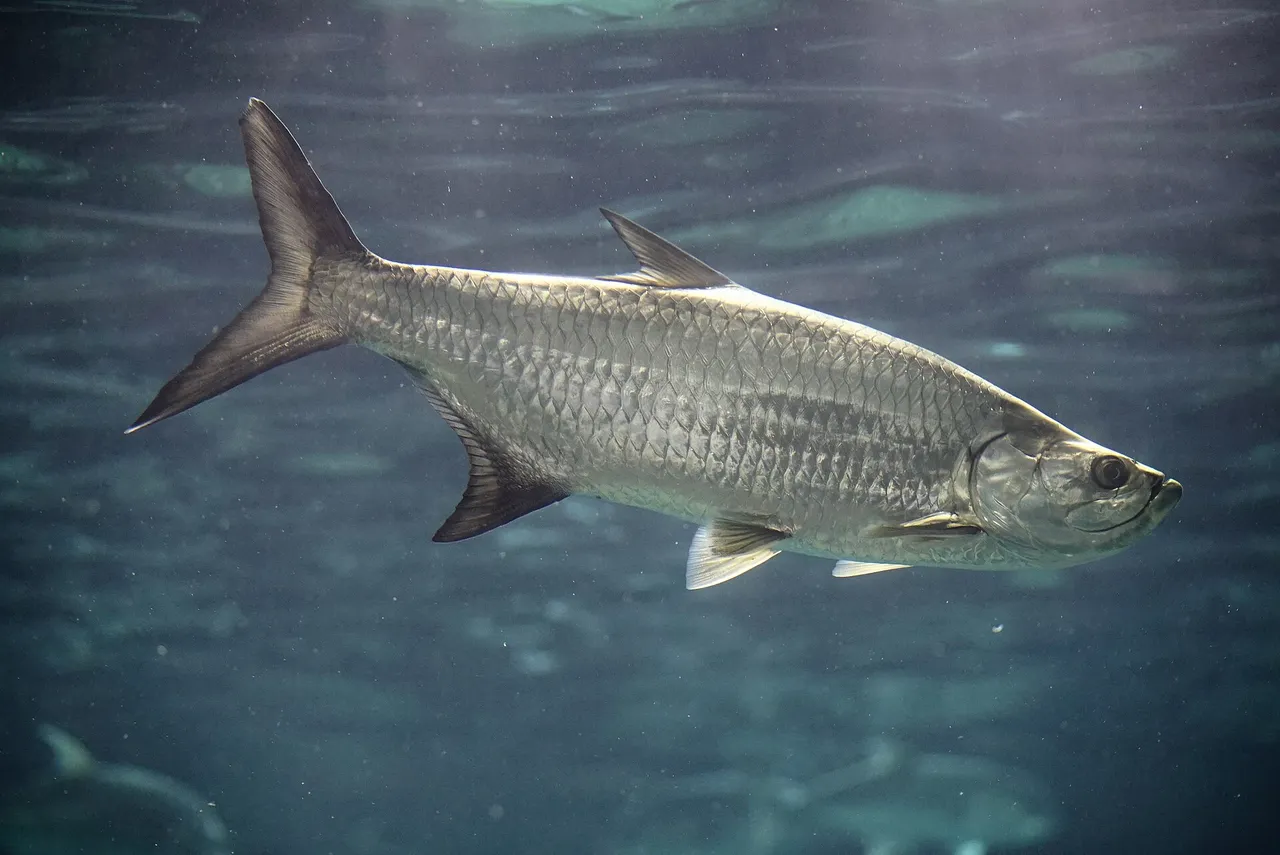
How this was identified, and who took it
Identified by: Full lateral view. Very large silver scales, superior upturned mouth, deeply forked tail and the elongated last dorsal ray are all visible — that trailing filament is the character most often missing from tarpon photographs.Daiju Azuma — CC BY-SA 4.0, via Wikimedia Commons — source, licenceWhat is known about how it feeds
A tarpon eats upwards, and its mouth says so before anything else does.
The lower jaw projects and the mouth is set at an upward angle, which suits taking prey silhouetted above the fish. Tarpon work bait from beneath, rising through the water column into a shoal, and the feeding takes place against the light rather than along the bottom.
The two verified relationships are both dense-shoaling clupeids taken that way — menhaden in coastal water and scaled sardines in the shallow coastal and estuarine habitat the species uses. Crabs are a major item too, particularly during the crab flushes on outgoing tides that produce some of the most predictable feeding of the year.
The other thing that shapes the diet is the swim bladder. A tarpon's is modified for air breathing, which allows the fish to occupy water with dissolved oxygen levels that would exclude its competitors — backwaters, canals, stagnant creeks. In those places a tarpon is feeding on prey that has nowhere else to go and no other predator on it.
The rolling behaviour at the surface is that same adaptation being used, and it is the most reliable way of locating fish that are not visibly feeding.
Growth is slow and the fish is very long-lived, so a large tarpon represents decades. That fact governs how the fishery is conducted more than any dietary consideration does.
The food
Prey with a verified dietary link to this fish. Each entry carries its own evidence, and each is written at the precision the source actually used: a named species where the source named one, a group or food category where it said “polychaetes”, “crustaceans” or “detritus” and meant it. That is why this list is shorter than the animal’s real diet rather than longer.
- Atlantic menhaden — Brevoortia tyrannus
Tarpon feed on menhaden and other clupeids in coastal water, and migrating tarpon are frequently found where bait shoals concentrate.
- Scaled sardine — Harengula jaguana
Scaled sardines are a principal prey in the shallow coastal and estuarine water tarpon use, and the seasonal availability of the bait shapes the fishery's calendar.
Food with no page of its own here yet
These are real components of the diet, listed as plain text because FishingHQ has no page for them yet. Inventing pages to make the list look fuller would be the fabrication this whole approach exists to prevent.
- mullet
- crabs, particularly during outgoing-tide flushes
- shrimp
- cichlids in fresh and brackish water
- small catfish
What anglers do with this
Everything below is interpretation, not finding. It is what experienced anglers conclude from the biology above, and the reasoning is usually sound and almost never tested. It is separated from the biology deliberately.
The upward feeding orientation is the fact the fly and lure fisheries are built on, and the inference is specific: a presentation that moves across and above a fish is convincing where one dragged past or below it is not. That is convention with a clear anatomical basis.
The crab flushes on outgoing tides are among the most predictable feeding events on FishingHQ, and anglers plan around them.
Rolling as a location method follows from the air-breathing physiology and is observation rather than inference.
The handling position is not interpretation. Tarpon are almost entirely a catch-and-release fishery, large fish are decades old, and in several jurisdictions removing one from the water is restricted. What applies is a question for the relevant authority.
What this does not establish
Two relationships for a broad opportunistic diet that includes a substantial crustacean component not represented here. Composition varies between coastal, estuarine and freshwater habitat and with the size of the fish. Nothing here establishes proportions.
Where this connects
These are the baits, lures, methods and explainers FishingHQ already joins to this fish — which is why the list is sometimes short. They are not chosen for this page, and a link here means an evidenced relationship exists, not that it follows from the diet.
Lures recorded for this species
Methods used for it
Where it lives
The science behind the feeding
This page covers feeding. The Atlantic tarpon record covers identification, lifecycle, seasonal behaviour, handling and the sources behind all of it.
Reviewed 2026-08-12.