Lake trout
Fish · Last reviewed 2026-08-10
A deep, cold, slow-growing char of northern lakes that can live decades and takes a very long time to replace anything removed.
Safety: barotrauma and pressure injury — can cause serious injury or death. 5 more points apply here.
Barotrauma and pressure injury — Can cause serious injury or death
Lake trout are frequently caught from considerable depth and suffer swim bladder expansion that they cannot correct, so a fish released after a deep-water capture may not survive whatever the handling.
What reduces it: Where release is intended, fish shallower, retrieve at a moderate rate, and use a descending device. Decide before fishing deep whether you are prepared to keep what comes up, because that is effectively the choice being made.
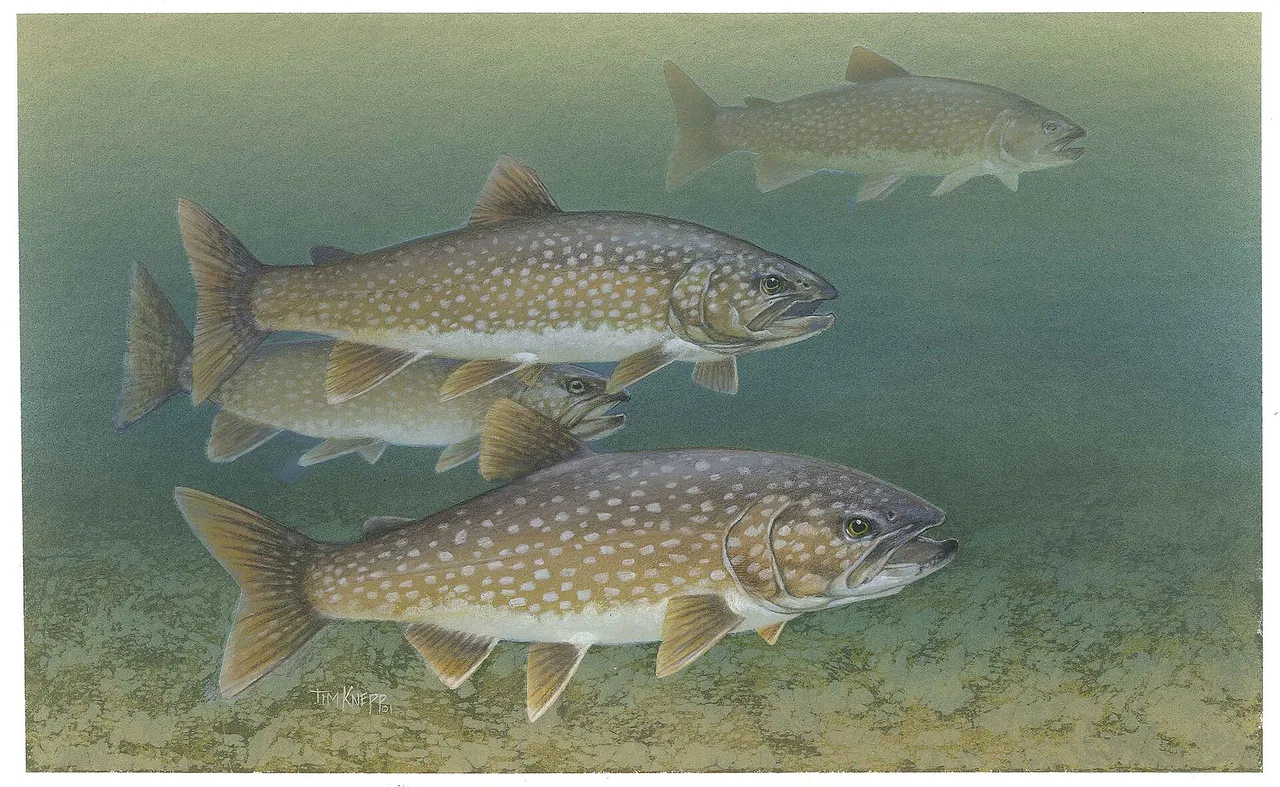
How this was identified, and who took it
Identified by: A US Fish and Wildlife Service scientific illustration, not a photograph, and catalogued as illustrative for that reason. Pale spots without vermiculation and the deeply forked tail are both accurately drawn.Knepp Timothy, U.S. Fish and Wildlife Service — Public domain, via Wikimedia Commons — source, licence
Catching Lake trout
Everything here on fishing for it. Each entry opens the page behind it.
The lake trout is the char of big cold northern lakes, and its defining characteristic is time. It grows slowly, matures late, lives for decades, and inhabits water that is cold and unproductive by definition — because that is the only water it can tolerate. Everything about how it should be fished follows from that.
It is a fish of depth and temperature rather than of structure in the usual sense. Lake trout hold in the layer of water that suits them, which in summer means deep and in winter and early spring means anywhere from the surface down. That single fact governs the fishery: the same lake gives up fish in five metres in April and forty metres in August, and an angler who has not thought about the thermal profile is fishing the wrong depth regardless of what they have on the end.
Its fisheries have a difficult history. Lake trout in the Great Lakes were devastated by a combination of overfishing and the invasion of the parasitic sea lamprey, and the restoration effort there is one of the largest and longest-running freshwater fishery programmes anywhere. Elsewhere in the north, remote populations that have never been heavily fished can be depleted by surprisingly modest pressure, because a twenty-year-old fish is not replaced in a season.
How it is caught
- Ice fishingIn much of their range lake trout are most accessible in winter, when the whole lake is at a uniform cold temperature and the fish are shallower than at any other time of year.
- JiggingVertical jigging over deep structure is the standard static approach, and the lift-and-fall is taken on the drop by a fish rising from below.
- TrollingLake trout hold at a depth set by temperature and follow it through the season, and trolling with downriggers or wire is how that band is found and held.
Gear for this fish
- Metal jigsVertical jigging over deep structure is the standard non-trolling approach, and the lift-and-drop is taken on the fall by a fish that has come up from below.
- SpoonsLake trout hold deep and feed on single large prey items, and a heavy trolled or jigged spoon reaches that depth while retaining the wide, slow action a cold-water fish will move to.
Identification
- Scientific name
- Salvelinus namaycush
- Family
- Salmonidae
- Water
- Freshwater
- Conservation status
- Least Concern
- Regions
- North America, Arctic & Subarctic
- PALE spots on a dark grey to green ground, as in all char, but without the red spots and blue haloes of a brook trout.
- Deeply forked tail — the clearest separation from brook trout, whose tail is square.
- Body long and comparatively slender for its weight; large mouth extending past the eye.
- Fins may show a pale leading edge but without the strong white-and-black band of a brook trout.
- Adipose fin present. Colour varies enormously between lakes, so shape and spotting are the reliable characters.
Size
- Typical
- 1–3 kg (2–6.5 lb)
- Large
- 6–12 kg (13–26 lb)
Exceptional: Over 20 kg (44 lb); maximum published weight 32.7 kg
Deep water, cold water, and a fish that is hurt by both ends of the trip
Lake trout are pursued in deep water for most of the open-water season, and that produces a handling problem with two independent halves.
THE PRESSURE HALF. A char taken from thirty metres or more can suffer the same gas expansion that afflicts marine deep-water species: distended bladder, buoyancy the fish cannot overcome, and an injury that is invisible until the fish will not go down. Deep-caught lake trout have measurably poorer release survival than shallow-caught ones, and the difference is depth rather than fight length. Where a fishery is release-oriented and the fish are deep, a descending device is as relevant on a lake as it is on a reef.
THE TEMPERATURE HALF. These are cold-water fish, and in summer the water they are taken from may be fifteen degrees colder than the water at the surface and colder still than the air. A fish brought up quickly through a thermocline and then held in warm air is subjected to a thermal shock on top of the pressure one. Air exposure matters more here than for most freshwater species.
WHAT FOLLOWS PRACTICALLY. Decide before the fish is hooked. If you are fishing deep and intend to release, use a descender and keep the fish in the water. If you are keeping fish, keep the deep ones and release the shallow ones rather than the other way round, which is the opposite of what size-selection instinct suggests.
AND HANDLE THEM AS THE SLOW-GROWING FISH THEY ARE. Lake trout are long-lived and late-maturing, and large individuals in northern lakes may be several decades old. The species does not restock itself quickly from a good year, and a population fished as though it does declines quietly.
Backed by research — why, and the sources (2)
Supported by peer-reviewed research or fisheries science. The sources are listed and can be checked.
- Do we need species-specific guidelines for catch-and-release recreational angling? — Biodiversity and Conservation 14:1195–1209, 2005 (Scientific literature)Relied on for: That post-release mortality varies with species, capture depth, water temperature, air exposure and handling, and that species-specific guidance outperforms general guidance.States this directlyCitation checked — the work exists and is described correctly
- A review of catch-and-release angling mortality with implications for no-take reserves — Reviews in Fish Biology and Fisheries 15:129–154, 2005 (Scientific literature)Relied on for: Review of hooking and release mortality across fisheries, including the contribution of depth of capture and handling duration.States this directlyCitation checked — the work exists and is described correctly
Cold, deep and oxygen-rich: the narrowest habitat window of any North American freshwater fish
Lake trout occupy a habitat defined by two requirements that are in direct conflict in most lakes, and that conflict explains where they are and where they are disappearing from.
THEY NEED COLD WATER AND THEY NEED OXYGEN IN IT. Lake trout are the coldest-water char of the continent, requiring temperatures well below what most freshwater fish prefer, together with high dissolved oxygen. In a stratified lake in summer, cold water is in the hypolimnion below the thermocline — but the hypolimnion is also where oxygen is consumed and not replaced. So lake trout summer habitat is the band that is both cold enough and oxygenated enough, and in many lakes that band is narrow.
WHICH RESTRICTS THEM TO LARGE, DEEP, CLEAN, NUTRIENT-POOR LAKES. Big, deep, oligotrophic waters have enough volume of cold oxygenated water to sustain them: the Great Lakes, the great Canadian shield lakes, deep glacial lakes across the northern range. Shallow, warm or productive lakes do not, however far north they are, because a productive lake consumes its deep oxygen.
AND IT MAKES NUTRIENT ENRICHMENT LETHAL WITHOUT ANY DIRECT POLLUTION. Adding nutrients to a lake increases production, which increases the organic matter settling into the hypolimnion, which consumes the oxygen down there. The surface looks fine; the lake trout habitat has been removed from below. This is the classic mechanism by which lake trout are lost from lakes that still look pristine.
SEASON MOVES THEM DRAMATICALLY. In cold water — early spring, late autumn, under ice — lake trout use the whole lake including the shallows, and are catchable near the surface. As the lake stratifies they retreat to depth and stay there. The same fish is a shallow-water fish for two months and a deep-water fish for four, which is why lake trout fishing is so strongly seasonal in method as well as in timing.
SPAWNING IS ON CLEAN ROCKY SHOALS IN AUTUMN, in relatively shallow water, with eggs dropped into the spaces between cobble and boulder. Those shoals must be clean — sedimented or algae-covered rubble does not work — and shoal degradation is a recognised limit on natural reproduction in several major lakes.
IN THE GREAT LAKES SPECIFICALLY the habitat story is inseparable from a century of sea lamprey, overfishing and invasive-species change, and natural reproduction there has had to be rebuilt on the same physical shoals that were always there.
Backed by research — why, and the sources (2)
Supported by peer-reviewed research or fisheries science. The sources are listed and can be checked.
- Freshwater Fishes of the British Isles — HarperCollins (New Naturalist 75), 1992 (Reference work)Relied on for: Habitat association, distribution and ecology of European freshwater fishes, including position within a water body.States this directlyCitation checked — the work exists and is described correctly
- FishBase: a global information system on fishes — Froese, R. and D. Pauly, eds. — FishBase Consortium (Scientific institute)Relied on for: Habitat association, depth range and water-type tolerance recorded for the species.States this directlyPassage read and verified
Autumn spawning on clean rocky shoals, and the slowest recovery of any freshwater fish
Lake trout reproduction is unusual among salmonids in almost every respect, and every one of those differences makes the species less able to recover from anything.
THEY DO NOT BUILD REDDS. Unlike stream salmonids, lake trout do not excavate a nest. Eggs are broadcast over clean cobble and boulder shoals in autumn, at night, and fall into the interstices between the rocks where they overwinter. The rock does the protecting; the fish does nothing after spawning.
WHICH MAKES SHOAL CONDITION THE ENTIRE REQUIREMENT. The substrate must be clean, with open spaces between stones, and free of accumulated silt, algal growth and organic sludge. Sedimented shoals lose their interstitial space, the eggs sit exposed or suffocate, and reproduction fails on ground that still looks like a rocky shoal.
DEVELOPMENT TAKES THE WHOLE WINTER, in cold water, which is the longest incubation of the freshwater fish on FishingHQ and a very long exposure to anything going wrong on the shoal.
MATURITY IS LATE AND LONGEVITY IS EXTREME. Lake trout take many years to mature, spawn in some populations only every second or third year rather than annually, and live a very long time. Put those together and the reproductive output per fish per year is tiny by comparison with almost anything else in fresh water.
WHICH IS WHY THE SPECIES IS SO EASILY LOST AND SO SLOWLY REGAINED. A population fished down, or hit by an introduced predator or parasite, rebuilds over decades rather than years, and several major lake systems have required sustained stocking, sea lamprey control and long closures before natural reproduction resumed on the same physical shoals that were always there.
SITE FIDELITY IS STRONG. Lake trout return to particular shoals, and knowledge of those sites is inherited within a population rather than being general to the species — so extirpating a local population can effectively remove use of a shoal even when suitable habitat and other lake trout remain.
AND THE MANAGEMENT IS CORRESPONDINGLY CAUTIOUS AND VARIABLE, with closed seasons, slot limits, quotas and lake-specific arrangements common across the range. Nothing above states what any of them currently are.
Backed by research — why, and the sources (2)
Supported by peer-reviewed research or fisheries science. The sources are listed and can be checked.
- Freshwater Fishes of the British Isles — HarperCollins (New Naturalist 75), 1992 (Reference work)Relied on for: Spawning behaviour, substrate requirements, timing and recruitment of European freshwater fishes.States this directlyCitation checked — the work exists and is described correctly
- FishBase: a global information system on fishes — Froese, R. and D. Pauly, eds. — FishBase Consortium (Scientific institute)Relied on for: Reproductive mode, spawning season, fecundity and maturity for the species.States this directlyPassage read and verified
Two seasons, two fisheries: shallow when the lake is cold and deep when it is not
Lake trout methods divide absolutely on whether the lake is stratified, and the two halves have almost nothing in common.
WHEN THE WHOLE LAKE IS COLD, THE FISH ARE ACCESSIBLE. In the weeks after ice-out and again in late autumn, lake trout use the entire water column including the shallows, and they can be taken by casting from shore, by shallow trolling and by fly fishing. This is a short window and it is when the species is available to anglers without specialised equipment.
WHEN THE LAKE STRATIFIES, EVERYTHING MOVES DEEP. The record's habitat section explains the squeeze: lake trout need water that is both cold enough and oxygenated enough, and in summer that band can be narrow and a long way down. Reaching it requires downriggers, leadcore, wire line or heavy jigging, and the fishery becomes a matter of finding a depth before finding a place.
VERTICAL JIGGING OVER STRUCTURE IS THE PRECISION APPROACH — locating fish on structure at depth and working a heavy jig or spoon to them. It is efficient and it is entirely dependent on finding fish first.
TROLLING SOLVES THE SEARCH AT SCALE on big water, covering ground at a controlled depth along contours, and it is why the discipline is so equipment-intensive on the great lakes of North America.
ICE FISHING IS A MAJOR AND DISTINCT DISCIPLINE in the northern range, and it works for the same reason the spring fishery does: under ice the whole water column is cold, so the fish are not confined to a deep band and can be reached through a hole.
DEPTH MAKES RELEASE DIFFICULT AND THAT SHAPES THE ETHICS. A lake trout brought quickly from substantial depth suffers barotrauma, and the record's spawning section explains why this species recovers from losses more slowly than almost any freshwater fish — late maturity, intermittent spawning, extreme longevity. Anglers intending to release should be thinking about the depth they fish before the method.
AND SEASONS, SLOT LIMITS AND LAKE-SPECIFIC ARRANGEMENTS ARE COMMON AND VARIABLE, set by the competent authority for each water.
Official guidance — why, and the sources (2)
Stated by a fisheries authority, scientific institute or recognised angling body. Authoritative, but summarising rather than demonstrating.
- Freshwater Fishing — Macdonald & Jane's, 1975 (Specialist angling publication)Relied on for: Game angling technique, including the relationship between method choice and the water being fished.States this directlyCitation checked — the work exists and is described correctly
- Trout & Salmon — Bauer Media (Specialist angling publication)Relied on for: Contemporary game angling practice, method and presentation.States this directlyCitation checked — the work exists and is described correctly
Accessible when the lake is cold, unreachable when it is not
Lake trout seasonality is the sharpest access cycle of any freshwater fish on FishingHQ, and it is entirely a consequence of thermal stratification.
WHEN THE LAKE IS UNIFORMLY COLD, THE FISH ARE EVERYWHERE. After ice-out in spring and again in late autumn, the water column is close to uniform in temperature, and lake trout use the whole lake including the shallows and the surface. This is when they are accessible from shore, on light tackle and near the top — a genuinely different fish from the one that exists in July.
AS THE LAKE STRATIFIES THEY RETREAT TO A NARROW BAND. The record's habitat section sets out the squeeze: cold enough and oxygenated enough coincide only in part of the hypolimnion, and in many lakes that band is thin and deep. Through midsummer the fish are confined to it and everything shallower is empty.
WHICH MAKES THE SEASON A MATTER OF WHERE RATHER THAN WHETHER, and it explains why lake trout fishing changes method completely between May and July rather than merely becoming harder.
AUTUMN BRINGS THE SPAWNING MOVE TO SHALLOW ROCKY SHOALS, which concentrates fish in shallow water again and is when they are most vulnerable. Many jurisdictions close or restrict the fishery around it; whether any does is a matter for the competent authority.
WINTER UNDER ICE RETURNS THEM TO THE WHOLE WATER COLUMN, which is why the ice fishery works: the thermal barrier is gone, and fish can be reached through a hole at ordinary depths.
THE PATTERN INVERTS THE INTUITION FOR MOST ANGLERS. For a warm-water fish, summer is the accessible season; for lake trout, summer is the closed door and the cold months are the open one. Anybody carrying temperate coarse-fishing assumptions to a lake trout water will fish it backwards.
AND THE CLIMATE IMPLICATION IS DIRECT. A warming lake has a thinner and deeper habitable band for longer each year, which extends the inaccessible period and, more seriously, squeezes the habitat itself.
Backed by research — why, and the sources (2)
Supported by peer-reviewed research or fisheries science. The sources are listed and can be checked.
- Freshwater Fishes of the British Isles — HarperCollins (New Naturalist 75), 1992 (Reference work)Relied on for: Habitat association, spawning behaviour, seasonal activity and ecology of freshwater fishes, including position within a water body.States this directlyCitation checked — the work exists and is described correctly
- FishBase: a global information system on fishes — Froese, R. and D. Pauly, eds. — FishBase Consortium (Scientific institute)Relied on for: Habitat association, spawning season, temperature tolerance and water-type tolerance recorded for the species.States this directlyPassage read and verified
Lifecycle and reproduction
Very slow-growing and long-lived, with a maximum reported age around forty years and maturity commonly delayed to six or seven years and later in the far north. Spawns in autumn over clean rocky shoals, without building a redd — eggs simply fall into the interstices of the rock. That combination of late maturity, great longevity and dependence on clean rock makes populations extremely slow to rebuild and disproportionately affected by the removal of large old fish.
Autumn broadcast spawning over rocky shoals in shallow water at night, with no redd and no parental care. Eggs develop in the rock over winter. Recruitment depends on the shoals staying clean and on eggs surviving several months, which is why siltation and altered water levels affect this species so severely, and why hatchery support has been necessary in restoration programmes.
Feeding and senses
Piscivorous where forage fish are available, taking ciscoes, smelt, sculpins and whatever else the lake supports, and switching to invertebrates and plankton in lakes with no suitable prey — which produces the small, slow-growing populations characteristic of infertile northern waters. The diet flexibility is what lets the species occupy lakes that support almost nothing else of its size.
Adapted to low light and cold, feeding effectively at depth where light is minimal, using the lateral line as much as sight. This is why lake trout are catchable through the ice and in deep water where visual predators are not, and why trolling with attractors and vibration-producing lures works at depths where colour is meaningless.
Through the year
Follows temperature through the water column, which is the whole of the practical seasonality. In cold water after ice-out the fish are shallow and accessible; as the lake stratifies through summer they descend to the layer that suits them and become a deep-water fishery; in autumn they return to shallow rocky ground to spawn. Under ice they are accessible again. Northern-hemisphere calendar throughout the native range.
Distribution
North America: widely distributed across Canada and the northern United States, from Alaska across the Northwest Territories to the Atlantic provinces and south into the Great Lakes and New England. Introduced elsewhere in North America, South America and Europe, where it has in places displaced native fish.
This is a biological range — where the species occurs, not a prediction that you will catch one. To browse the fishing geography FishingHQ holds, start at fishing places.
Why anglers care
A principal target of deep trolling, jigging and ice fishing across the Canadian and northern American lakes, and the basis of a substantial remote-lodge fishery. Highly regarded as a large freshwater sport fish and increasingly fished catch-and-release for big individuals, which is the appropriate response to a fish that takes twenty years to grow.
Handling and returning
Fish taken from depth suffer barotrauma, and a lake trout brought up quickly from forty metres frequently cannot be released successfully. Where release is intended, fish shallower water, retrieve slowly, and consider a descending device. Support large fish horizontally, keep them in the water and minimise air time — and where a fish is clearly damaged by depth, keeping it within the rules is more honest than releasing it to die.
Going further
- What does lake trout eat? — feeding biology, kept separate from what anglers infer from it.
- Lake trout vs Brook trout — how to tell them apart.
Safety
Barotrauma and pressure injury is set out at the top of this page, where it cannot be missed.
Cold water shock — Can cause serious injury or death
This is fishing on large, cold, often remote northern lakes, including through ice. Immersion is rapidly incapacitating and help is frequently far away.
What reduces it: Wear a flotation suit rather than a lifejacket alone in cold water. Check ice thickness rather than assuming it, and carry ice picks. File a plan ashore and carry a means of calling for help that works beyond phone coverage.
Precautions that always apply here
- Wear a buoyancy aid or lifejacket. Cold water incapacitates strong swimmers within a minute, long before swimming ability matters.
- Support the fish's weight along its body, keep it out of the water for as short a time as possible, and hold it over something soft.
- Tell somebody where you are going and when you expect to be back.
- Carry a charged phone in a waterproof case, or another means of calling for help.
Check the rules before you fish
Fishing laws, bylaws, access rules, seasons, bait restrictions and permitted methods vary by location and can change. Check the current rules from the relevant authority and the water you intend to fish before fishing.
Check with:
- Current national or regional law for where you are fishing
- Current local bylaws
- The relevant fisheries authority
- The landowner, club or fishery whose water it is
- Any restrictions specific to the species or the method you intend to use
Where to go next
Similar and related fish
- AlewifeIn the Great Lakes alewife became the dominant prey after establishing there, and lake trout restoration has been complicated by the thiamine deficiency associated with an alewife-dominated diet.
- Brook troutBoth are char, genus Salvelinus, not trout — pale spots on a dark ground rather than the reverse. The tail separates them: brook trout squared, lake trout deeply forked.
- CiscoCisco is the native forage species lake trout evolved alongside, and lake trout in waters with intact cisco populations grow measurably faster than those without.
- Rainbow smeltWhere smelt have been introduced they frequently replace cisco as the principal prey, with consequences for lake trout growth and for the native forage community.
Where it lives
- Deep cold lakesA large coldwater char of deep lakes, holding below the thermocline through the stratified season and spawning on offshore rocky shoals rather than in tributaries.
- Lowland stillwatersA fish of big cold northern lakes that follows the temperature layer rather than the structure — shallow after ice-out, deep in summer, and back shallow to spawn.
Where you will find it
- CanadaThe defining deep cold-water species of the Canadian Shield lakes and the Great Lakes basin, and the fish most of the country's northern lake fishing is built around.
- The Great LakesThe native apex predator of the offshore food web, collapsed across most of the system by sea lamprey predation and commercial fishing, and now partly restored by sustained lamprey control and stocking.
Sources and evidence
- FishBase: a global information system on fishes — Froese, R. and D. Pauly, eds. — FishBase Consortium (Scientific institute)Relied on for: Scientific name, family placement in the Salmonidae, a maximum length of 150 cm TL, a maximum published weight of 32.7 kg, a maximum reported age of 50 years.States this directlyPassage read and verified
- FishBase: a global information system on fishes — Froese, R. and D. Pauly, eds. — FishBase Consortium (Scientific institute)Relied on for: Environment, climate zone and depth range as recorded: Freshwater; benthopelagic; potamodromous ; depth range 3 - 61 m , usually 18 - 53 m . Temperate; 4°C - 13°C ; 75°N - 38°N, 168°W - 67°WStates this directlyPassage read and verified
- FishBase: a global information system on fishes — Froese, R. and D. Pauly, eds. — FishBase Consortium (Scientific institute)Relied on for: The IUCN Red List category for Salvelinus namaycush — Least Concern, assessed 05 September 2020 — as republished by FishBase, the Red List itself being unreachable during review.States this directlyPassage read and verified
- Understanding the Complexity of Catch-and-Release in Recreational Fishing — Reviews in Fisheries Science 15:75–167, 2007 (Scientific literature)Relied on for: That barotrauma from depth is a principal cause of post-release mortality and that release survival depends on the physical trauma of capture.States this directlyCitation checked — the work exists and is described correctly
- Good Fish Guide — Marine Conservation Society (Conservation authority)Relied on for: That longevity and late maturity are material to whether a population can sustain harvest.FishingHQ's interpretation of what it saysCitation checked — the work exists and is described correctly
Why the 13 connections on this page are here, and the sources
Similar and related fish
Backed by research — 4 connections
Supported by peer-reviewed research or fisheries science. The sources are listed and can be checked.
Alewife
Recorded diet evidence identifies Alosa pseudoharengus as a food item of this predator at species level. The edge is written at that granularity and no further.
- FishBase: a global information system on fishes — Froese, R. and D. Pauly, eds. — FishBase Consortium (Scientific institute)Relied on for: Food items recorded for this predator, including Alosa pseudoharengus.States this directlyPassage read and verified
- FAO Species Identification Guides for Fishery Purposes and the FAO Species Catalogues — Food and Agriculture Organization of the United Nations (Scientific institute)Relied on for: Species account describing the diet of this predator in the region where Alosa pseudoharengus occurs.Background and mechanism onlyCitation checked — the work exists and is described correctly
Brook trout
A taxonomic and identification comparison naming both binomials.
- FishBase: a global information system on fishes — Froese, R. and D. Pauly, eds. — FishBase Consortium (Scientific institute)Relied on for: That Salvelinus fontinalis and Salvelinus namaycush are congeners in the genus Salvelinus, distinct from the true trouts of Salmo and Oncorhynchus.States this directlyPassage read and verified
Cisco
Recorded diet evidence identifies Coregonus artedi as a food item of this predator at species level. The edge is written at that granularity and no further.
- FishBase: a global information system on fishes — Froese, R. and D. Pauly, eds. — FishBase Consortium (Scientific institute)Relied on for: Food items recorded for this predator, including Coregonus artedi.States this directlyPassage read and verified
- FAO Species Identification Guides for Fishery Purposes and the FAO Species Catalogues — Food and Agriculture Organization of the United Nations (Scientific institute)Relied on for: Species account describing the diet of this predator in the region where Coregonus artedi occurs.Background and mechanism onlyCitation checked — the work exists and is described correctly
Rainbow smelt
Recorded diet evidence identifies Osmerus mordax as a food item of this predator at species level. The edge is written at that granularity and no further.
- FishBase: a global information system on fishes — Froese, R. and D. Pauly, eds. — FishBase Consortium (Scientific institute)Relied on for: Food items recorded for this predator, including Osmerus mordax.States this directlyPassage read and verified
- FAO Species Identification Guides for Fishery Purposes and the FAO Species Catalogues — Food and Agriculture Organization of the United Nations (Scientific institute)Relied on for: Species account describing the diet of this predator in the region where Osmerus mordax occurs.Background and mechanism onlyCitation checked — the work exists and is described correctly
How it is caught
What experienced anglers do — 3 connections
Widely and independently recommended by experienced anglers and specialist sources. This is real angling knowledge, not proof: controlled evidence for it is limited, and FishingHQ records it as convention rather than as a demonstrated effect.
Ice fishing
Established angling practice for this species, recorded as convention. The note states the property of the animal or its water that makes the method the answer.
- IGFA International Angling Rules and World Record Requirements — International Game Fish Association (Angling or fisheries organisation)Relied on for: Recognition of the species as an established sport fish and the angling methods and tackle classes conventionally used for it.States this directlyPassage read and verified
- General angling website restatements of established technique — Various (Credible secondary source)Relied on for: Widely restated practice connecting this species and method.Background and mechanism onlyCitation checked — the work exists and is described correctly
Jigging
Established angling practice for this species, recorded as convention. The note states the property of the animal or its water that makes the method the answer.
- IGFA International Angling Rules and World Record Requirements — International Game Fish Association (Angling or fisheries organisation)Relied on for: Recognition of the species as an established sport fish and the angling methods and tackle classes conventionally used for it.States this directlyPassage read and verified
- General angling website restatements of established technique — Various (Credible secondary source)Relied on for: Widely restated practice connecting this species and method.Background and mechanism onlyCitation checked — the work exists and is described correctly
Trolling
Established angling practice for this species, recorded as convention. The note states the property of the animal or its water that makes the method the answer.
- IGFA International Angling Rules and World Record Requirements — International Game Fish Association (Angling or fisheries organisation)Relied on for: Recognition of the species as an established sport fish and the angling methods and tackle classes conventionally used for it.States this directlyPassage read and verified
- General angling website restatements of established technique — Various (Credible secondary source)Relied on for: Widely restated practice connecting this species and method.Background and mechanism onlyCitation checked — the work exists and is described correctly
Gear for this fish
What experienced anglers do — 2 connections
Widely and independently recommended by experienced anglers and specialist sources. This is real angling knowledge, not proof: controlled evidence for it is limited, and FishingHQ records it as convention rather than as a demonstrated effect.
Metal jigs
A practitioner claim about which lure family answers this species' feeding or holding behaviour.
- General angling website restatements of established technique — Various (Credible secondary source)Relied on for: Widely restated North American lure practice for this species.Background and mechanism onlyCitation checked — the work exists and is described correctly
- IGFA International Angling Rules and World Record Requirements — International Game Fish Association (Angling or fisheries organisation)Relied on for: Recognition of the species as an established sport fish taken on artificial lures, and the tackle conventions used for it.States this directlyPassage read and verified
Spoons
A practitioner claim about which lure family answers this species' feeding or holding behaviour.
- General angling website restatements of established technique — Various (Credible secondary source)Relied on for: Widely restated North American lure practice for this species.Background and mechanism onlyCitation checked — the work exists and is described correctly
- IGFA International Angling Rules and World Record Requirements — International Game Fish Association (Angling or fisheries organisation)Relied on for: Recognition of the species as an established sport fish taken on artificial lures, and the tackle conventions used for it.States this directlyPassage read and verified
Where it lives
Backed by research — 2 connections
Supported by peer-reviewed research or fisheries science. The sources are listed and can be checked.
Deep cold lakes
A claim that the species depends on the cold layer below the summer thermocline, which is a thermal-tolerance claim about the animal rather than an angling observation, and rests on the reference literature accordingly.
- FishBase: a global information system on fishes — Froese, R. and D. Pauly, eds. — FishBase Consortium (Scientific institute)Relied on for: Recorded depth range, temperature tolerance and habitat association for the species outside north-west Europe.States this directlyPassage read and verified
- The IUCN Red List of Threatened Species — International Union for Conservation of Nature (Conservation authority)Relied on for: Global conservation assessment, range and recorded threats for the species.States this directlyCitation checked — the work exists and is described correctly
Lowland stillwaters
A habitat claim held to a scientific standard.
- FishBase: a global information system on fishes — Froese, R. and D. Pauly, eds. — FishBase Consortium (Scientific institute)Relied on for: That Salvelinus namaycush is a freshwater benthopelagic potamodromous species occupying depths from 3 to 61 m.States this directlyPassage read and verified
Where you will find it
Backed by research — 2 connections
Supported by peer-reviewed research or fisheries science. The sources are listed and can be checked.
Canada
A distribution association between an animal and a kind of water, rather than a claim about any named mark.
- FishBase: a global information system on fishes — Froese, R. and D. Pauly, eds. — FishBase Consortium (Scientific institute)Relied on for: Distribution, habitat association and depth range recorded for the species, including its occurrence in the water body concerned.States this directlyPassage read and verified
- The IUCN Red List of Threatened Species — International Union for Conservation of Nature (Conservation authority)Relied on for: Assessment and range account for the species, including the systems and coasts it occupies.Background and mechanism onlyCitation checked — the work exists and is described correctly
The Great Lakes
Occurrence of the species in this system or along this coast: a statement about the animal's distribution, not a venue recommendation.
- FishBase: a global information system on fishes — Froese, R. and D. Pauly, eds. — FishBase Consortium (Scientific institute)Relied on for: Distribution, salinity tolerance and habitat association recorded for the species, including its occurrence in this system.States this directlyPassage read and verified
- The IUCN Red List of Threatened Species — International Union for Conservation of Nature (Conservation authority)Relied on for: Assessment and range description for the species, including the waters in which it occurs.Background and mechanism onlyCitation checked — the work exists and is described correctly
How FishingHQ labels evidence is explained in the evidence policy.