What does lake trout eat?
What is established about how lake trout feeds, kept separate from what anglers infer from it.
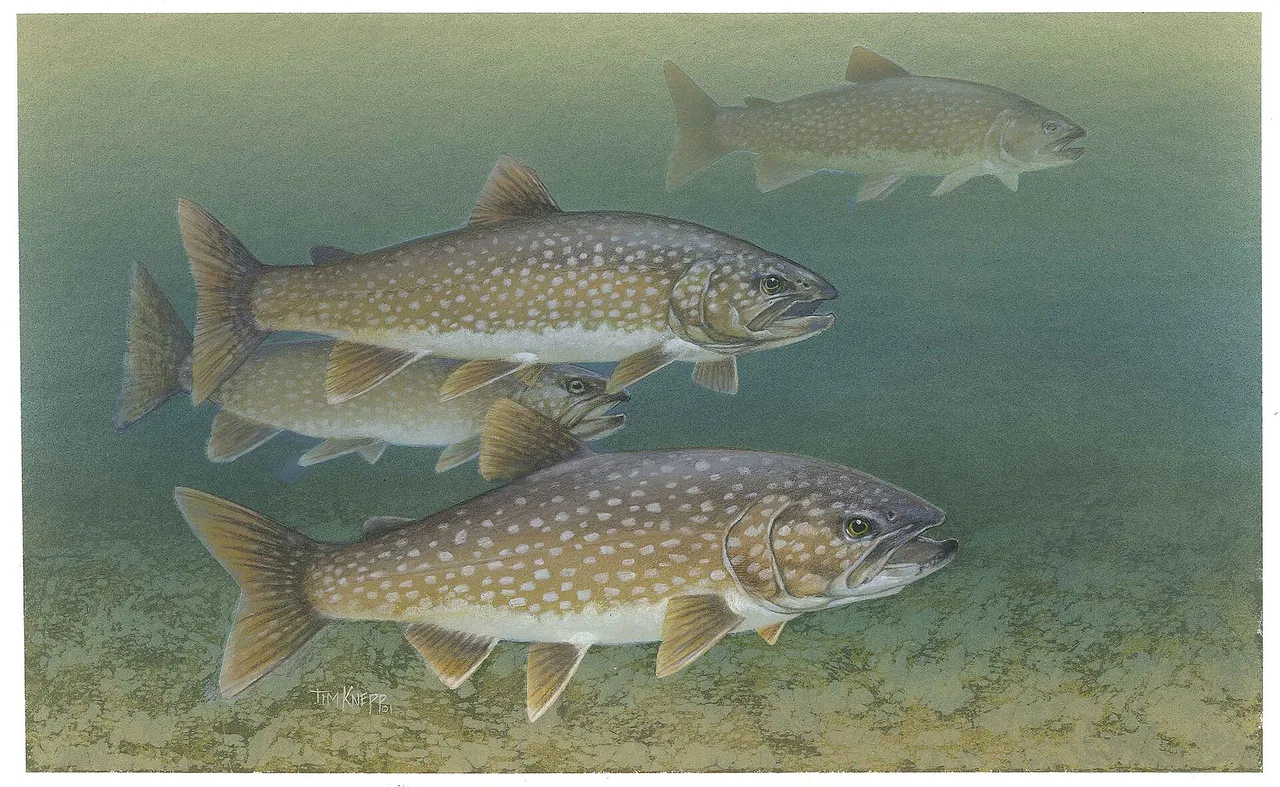
How this was identified, and who took it
Identified by: A US Fish and Wildlife Service scientific illustration, not a photograph, and catalogued as illustrative for that reason. Pale spots without vermiculation and the deeply forked tail are both accurately drawn.Knepp Timothy, U.S. Fish and Wildlife Service — Public domain, via Wikimedia Commons — source, licenceWhat is known about how it feeds
The lake trout is the clearest case on FishingHQ of a fish whose entire life outcome is set by what its lake contains.
Where a suitable forage fish is present, lake trout are piscivorous, grow quickly and reach substantial size. Where none is, they feed on invertebrates and plankton and produce the small, slow-growing populations characteristic of infertile northern lakes. It is the same species in both cases.
The three verified relationships are the three principal forage options, and they are not equivalent. Cisco is the native prey the species evolved alongside and supports the best growth. Rainbow smelt, frequently introduced, substitutes for it and has displaced native forage in several systems. Alewife, which established in the Great Lakes and became dominant there, carries a specific complication: an alewife-dominated diet is associated with thiamine deficiency in lake trout, which impairs the survival of the young and has been a genuine obstacle to restoring native populations.
So this is one of the few diet pages in FishingHQ where the prey is not merely food but a management problem.
The physical constraint underneath is temperature and oxygen. Lake trout require cold, well-oxygenated deep water, and in summer they are confined to the layer where both coincide — which is also where the cisco and smelt are, so predator and prey are squeezed into the same band.
Growth is slow, maturity is late, and a large lake trout is very old.
The food
Prey with a verified dietary link to this fish. Each entry carries its own evidence, and each is written at the precision the source actually used: a named species where the source named one, a group or food category where it said “polychaetes”, “crustaceans” or “detritus” and meant it. That is why this list is shorter than the animal’s real diet rather than longer.
- Cisco — Coregonus artedi
Cisco is the native forage species lake trout evolved alongside, and lake trout in waters with intact cisco populations grow measurably faster than those without.
- Rainbow smelt — Osmerus mordax
Where smelt have been introduced they frequently replace cisco as the principal prey, with consequences for lake trout growth and for the native forage community.
- Alewife — Alosa pseudoharengus
In the Great Lakes alewife became the dominant prey after establishing there, and lake trout restoration has been complicated by the thiamine deficiency associated with an alewife-dominated diet.
Food with no page of its own here yet
These are real components of the diet, listed as plain text because FishingHQ has no page for them yet. Inventing pages to make the list look fuller would be the fabrication this whole approach exists to prevent.
- sculpins
- opossum shrimp
- juvenile whitefish
- insect larvae, in lakes without forage fish
- zooplankton, in unproductive lakes
What anglers do with this
Everything below is interpretation, not finding. It is what experienced anglers conclude from the biology above, and the reasoning is usually sound and almost never tested. It is separated from the biology deliberately.
The temperature-and-oxygen constraint is the location method, and it is unusually precise: the fish are in the layer where cold water and adequate oxygen coincide, and finding that layer finds the fish. Anglers do this with temperature profiles and it is inference from well-established physiology.
The forage-base dependence converts into an expectation about size. A lake with an intact cisco population produces different fish from one without, and anglers use that as a rough predictor.
The age of large fish is the argument for release that the fisheries agencies make, and it is not interpretation: a trophy lake trout may be several decades old and is irreplaceable within a human timescale.
What this does not establish
Three relationships describe the principal forage options rather than the whole diet, and in lakes without forage fish none of them applies at all. Composition varies between lakes more than for almost any species on FishingHQ, and nothing here describes a particular water.
Where this connects
These are the baits, lures, methods and explainers FishingHQ already joins to this fish — which is why the list is sometimes short. They are not chosen for this page, and a link here means an evidenced relationship exists, not that it follows from the diet.
Lures recorded for this species
Methods used for it
Where it lives
This page covers feeding. The Lake trout record covers identification, lifecycle, seasonal behaviour, handling and the sources behind all of it.
Reviewed 2026-08-12.