Alewife
Fish · Last reviewed 2026-08-11
An anadromous river herring of eastern North America that has also formed permanent landlocked populations, becoming a principal prey fish in the Great Lakes.
Background, not a fishing profile
This page is here so FishingHQ can describe a biological relationship accurately — usually because a fish covered elsewhere on the site feeds on this. It covers what it is, where it lives and the evidence behind that relationship, and deliberately nothing about methods, bait or tackle. Its presence here is not a statement that anybody fishes for it.
The alewife has two quite different existences. In its native form it is an anadromous river herring: it lives at sea, runs into coastal rivers in spring to spawn, and returns. Those runs were once enormous and are now much reduced, chiefly by dams blocking access to spawning water, and river herring restoration is a substantial conservation programme along the American east coast.
In its second form it is landlocked. Alewives established permanent freshwater populations in the Laurentian Great Lakes and in many stocked reservoirs, where they became the dominant forage fish and reshaped the fisheries around them. Pacific salmon were introduced to the Great Lakes in part to control alewife abundance, and the entire Great Lakes salmon fishery now rests on that prey base.
That second history is why alewife appears in the diets of lake trout, chinook and coho salmon and striped bass on FishingHQ, and why the record was needed.
Identification
No photograph of Alewife has passed identity review yet, so none is shown. A photograph is published only once somebody has checked the animal in it against the diagnostic features described on this page.
- Scientific name
- Alosa pseudoharengus
- Family
- Clupeidae
- Water
- Moves between fresh and salt water, Freshwater
- Conservation status
- Vulnerable
- Regions
- North America
- Silver, laterally compressed clupeid with a sharply serrated belly keel and a single dark shoulder spot.
- Large eye, noticeably wider than the distance from eye to snout tip, which separates it from the blueback herring.
- Grey-green back with faint darker lines along the upper flanks.
- Peritoneum pale rather than dark, a distinction used to separate it from closely related river herrings.
Size
- Typical
- 20–28 cm at sea; 12–18 cm in landlocked populations
- Large
- up to about 35 cm
Lifecycle and reproduction
Anadromous alewives mature at three to five years and may spawn in several successive years. Landlocked populations mature earlier and at a much smaller size, and their abundance can swing sharply with winter severity.
Runs into fresh water in spring to spawn over gravel, sand and vegetation in slow reaches, ponds and lake margins, releasing adhesive eggs. Landlocked fish undertake a comparable spawning movement into tributaries and shallows.
Feeding and senses
Feeds on zooplankton, principally copepods and cladocerans, together with mysids, small crustaceans and fish eggs and larvae. In the Great Lakes their zooplankton feeding is intense enough to restructure the plankton community.
Vision for particulate zooplankton feeding, together with strong schooling behaviour. Landlocked alewives are notably sensitive to cold and suffer large winter die-offs, which is a physiological rather than a sensory constraint but the one that governs their populations.
Through the year
Spring spawning runs into fresh water followed by a return to open water. In the Great Lakes, alewives move offshore and deep in summer and into shallower water in spring and autumn, and the salmon fishery follows them.
Distribution
The western Atlantic from South Carolina to Newfoundland and their tributary rivers, together with introduced and landlocked populations in the Laurentian Great Lakes and numerous reservoirs.
This is a biological range — where the species occurs, not a prediction that you will catch one. To browse the fishing geography FishingHQ holds, start at fishing places.
Why anglers care
Taken by anglers with nets and small hooks for bait during spawning runs, where local rules permit, and otherwise significant as the forage base that determines where Great Lakes salmon and trout are found. Not a rod-and-line species.
Handling and returning
Delicate and quick to die out of water. River herring runs are regulated and in several jurisdictions closed entirely; check with the relevant fisheries authority before taking any.
Where to go next
Similar and related fish
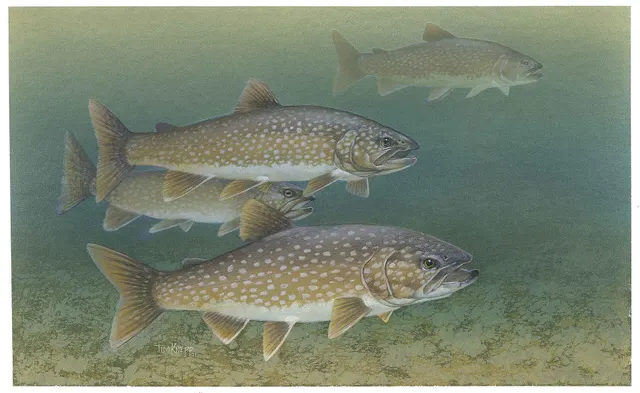 Lake troutIn the Great Lakes alewife became the dominant prey after establishing there, and lake trout restoration has been complicated by the thiamine deficiency associated with an alewife-dominated diet.
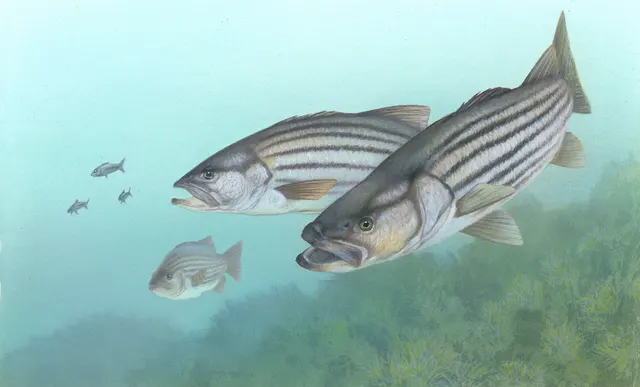 Striped bassRiver herring runs are a major spring feeding opportunity for striped bass in coastal rivers, and landlocked striped bass populations depend on alewife almost entirely.
Where you will find it
More fish
Not related to this page — just the rest of the section. There is little else joined to this subject yet, and a short page should still lead somewhere.
Sources and evidence
- FishBase: a global information system on fishes — Froese, R. and D. Pauly, eds. — FishBase Consortium (Scientific institute)Relied on for: Species identity, binomial, family placement, size, distribution and recorded biology for this species.States this directlyPassage read and verified
- FAO Species Identification Guides for Fishery Purposes and the FAO Species Catalogues — Food and Agriculture Organization of the United Nations (Scientific institute)Relied on for: The regional species account describing identity, distribution and the role of this species in the fisheries and food webs it belongs to.States this directlyCitation checked — the work exists and is described correctly
Why the 3 connections on this page are here, and the sources
Similar and related fish
Backed by research — 2 connections
Supported by peer-reviewed research or fisheries science. The sources are listed and can be checked.
Lake trout
Recorded diet evidence identifies Alosa pseudoharengus as a food item of this predator at species level. The edge is written at that granularity and no further.
- FishBase: a global information system on fishes — Froese, R. and D. Pauly, eds. — FishBase Consortium (Scientific institute)Relied on for: Food items recorded for this predator, including Alosa pseudoharengus.States this directlyPassage read and verified
- FAO Species Identification Guides for Fishery Purposes and the FAO Species Catalogues — Food and Agriculture Organization of the United Nations (Scientific institute)Relied on for: Species account describing the diet of this predator in the region where Alosa pseudoharengus occurs.Background and mechanism onlyCitation checked — the work exists and is described correctly
Striped bass
Recorded diet evidence identifies Alosa pseudoharengus as a food item of this predator at species level. The edge is written at that granularity and no further.
- FishBase: a global information system on fishes — Froese, R. and D. Pauly, eds. — FishBase Consortium (Scientific institute)Relied on for: Food items recorded for this predator, including Alosa pseudoharengus.States this directlyPassage read and verified
- FAO Species Identification Guides for Fishery Purposes and the FAO Species Catalogues — Food and Agriculture Organization of the United Nations (Scientific institute)Relied on for: Species account describing the diet of this predator in the region where Alosa pseudoharengus occurs.Background and mechanism onlyCitation checked — the work exists and is described correctly
Where you will find it
Backed by research — 1 connection
Supported by peer-reviewed research or fisheries science. The sources are listed and can be checked.
The Great Lakes
Occurrence of the species in this system or along this coast: a statement about the animal's distribution, not a venue recommendation.
- FishBase: a global information system on fishes — Froese, R. and D. Pauly, eds. — FishBase Consortium (Scientific institute)Relied on for: Distribution, salinity tolerance and habitat association recorded for the species, including its occurrence in this system.States this directlyPassage read and verified
- The IUCN Red List of Threatened Species — International Union for Conservation of Nature (Conservation authority)Relied on for: Assessment and range description for the species, including the waters in which it occurs.Background and mechanism onlyCitation checked — the work exists and is described correctly
How FishingHQ labels evidence is explained in the evidence policy.