Patagonia
Fishing regions · Last reviewed 2026-08-14
A cold, windy, thinly populated end of a continent where introduced trout became one of the world's great fisheries, and where sea-run brown trout reach sizes that exist almost nowhere else.
Safety: weather and lightning — can cause serious injury or death. 3 more points apply here.
Being listed here is not permission to fish. What that meansClose
Access, fishing rights, seasons, licences, local bylaws and permitted methods vary and can change. Check current access, permission, local regulations, closures and restrictions before you travel or fish. FishingHQ describes what the ground is and names who holds the answer; it does not hold the answer itself.
Find the authority for a jurisdiction · What FishingHQ does and does not cover
Patagonia qualifies as a coast-tier record in the broad sense the tier allows: a region where ground, climate, exposure and fauna change together across two countries and where the fishing is one coherent story.
THE WIND IS THE FIRST FACT. The southern westerlies blow across this latitude with almost nothing to stop them, and they are relentless. Casting, boat handling, wading and comfort are all organised around wind in a way that has no equivalent in the northern fisheries FishingHQ mostly describes.
THE ANDES SPLIT IT INTO TWO CLIMATES. The Chilean side is wet, forested and fjorded, with high rainfall and a broken coast of channels and islands. The Argentine side is in the rain shadow: dry, open steppe with clear rivers running east across it. The same mountain range produces temperate rainforest on one side and near-desert on the other.
THE TROUT ARE INTRODUCED AND THE FISHERY IS WORLD-CLASS. Brown, rainbow and brook trout were stocked in the late nineteenth and early twentieth centuries into rivers and lakes that held no comparable native predator, and they thrived. The resulting fishery — big rivers, big lakes, big fish, few anglers — became internationally significant within a few decades.
THE SEA-RUN BROWN TROUT ARE THE SPECIALITY. On a small number of rivers, principally in Tierra del Fuego, brown trout adopted an anadromous life history and reach sizes that occur almost nowhere else on earth. It is one of the most remarkable outcomes of any fish introduction.
AND THE NATIVE FAUNA IS THE PART THE REPUTATION OBSCURES. Native galaxiids and perch-like fishes were affected by the introductions, and the marine coast has its own fishery — hake, kingclip, southern king crab and the enormous shellfish resources of the channels — which has nothing to do with trout at all.
What fishing here is like
A cold, extremely windy, sparsely populated region split by the Andes into a wet fjorded western side and a dry steppe eastern one. The freshwater fishery is built on introduced trout in big clear rivers and deep lakes, with a sea-run brown trout fishery in the far south that is internationally exceptional. The marine coast supports hake, shellfish and a major southern king crab fishery. Angling here is a wind-management discipline first and a fish-finding one second.
What dominates
Fly fishing on rivers and lakes for brown, rainbow and brook trout, which is the discipline the region is known for. Sea-run brown trout fly fishing on the far southern rivers, a specialised and heavily managed fishery. Lure and spinning fishing on lakes and larger rivers. Boat fishing and trolling on the large glacial lakes. Sea fishing from shore and small boats along the Atlantic coast for rays, sharks and inshore species. Potting for southern king crab in the southern channels, a substantial commercial fishery. Shellfish gathering and diving in the Chilean channels, subject to biotoxin closures.
The water available
Large, clear, cold, spring- and snow-fed rivers running east across steppe; very large deep glacial lakes on both sides of the Andes; temperate rainforest rivers and fjord systems on the Chilean side with high rainfall; open windswept steppe with few trees and no shelter; a long Atlantic coast of cliffs, gravel beaches and enormous tidal ranges in the gulfs; the channels, islands and fjords of the southern Pacific coast; and, at the southern extremity, the Beagle Channel and the approaches to Cape Horn.
How the rules are structured
The region spans two countries, each with its own framework, and inland fishing is administered provincially or regionally rather than nationally in both. Angling licences, seasons, permitted methods, catch limits and — importantly — the requirement to release are set at that level, and they differ between adjacent provinces and between the two countries. Fly-fishing-only water, barbless-hook requirements, mandatory release and rod-day limits on particular rivers are common instruments, and the best sea-trout rivers are typically managed as strictly limited-rod fisheries with access controlled by the landowner or concession holder. Biosecurity is a serious and enforced concern in both countries because of invasive algae in the rivers, and disinfection of waders and gear between waters is a standard requirement. National parks cover substantial areas of both sides of the Andes and carry their own fishing rules. Marine fishing and shellfish harvesting are separately regulated, with biotoxin monitoring closing shellfish grounds at short notice. FishingHQ does not state what any current rule is.
Who to ask
- The provincial or regional fisheries and wildlife authority, which sets angling licences, seasons, methods and limits for inland waters.
- The national park administration where the water lies inside a national park, which applies its own rules.
- The landowner or fishing concession holder, whose permission governs access to most of the productive river water in the region.
- The national fisheries authority for marine fishing, shellfish and the crab fishery.
- The public health or fisheries laboratory operating biotoxin monitoring, which decides when shellfish grounds close.
Words you will meet
- Estancia
- A large sheep or cattle ranch. Much of the finest river water in Argentine Patagonia runs through estancia land, and access is a matter of the landowner's permission rather than a public right, which is the central practical fact about fishing here.
- Sea-run brown trout
- Brown trout that adopt an anadromous life history, feeding at sea and returning to fresh water to spawn. On a small number of far southern rivers they reach sizes that occur almost nowhere else, and those rivers are managed as strictly limited fisheries.
- Didymo
- An invasive freshwater alga that forms thick mats on riverbeds and is spread on damp gear between waters. Its presence is the reason wader and boot disinfection between rivers is a serious and enforced requirement in this region.
- Boca
- The mouth of a river where it enters or leaves a lake. These are the concentrating features of the Patagonian lake fishery, holding trout that intercept food moving between the two water bodies.
- Centolla
- Southern king crab, taken in pots in the southern channels and around Tierra del Fuego. A high-value commercial fishery and a regional food speciality, and a reminder that this coast's fishery is not only about trout.
Conditions and hazards
Wind is the defining hazard and it is easy to underestimate: the southern westerlies blow hard and persistently, they make small boats on large lakes genuinely dangerous, and a lake here can raise a steep breaking sea within a short time. Water temperature is low year-round and cold water shock is the immediate risk after immersion. Wading big clear rivers in strong wind is harder than it looks, and the clarity makes depth difficult to judge. The region is remote and thinly populated: distances between towns are long, mobile coverage is patchy, and help is far away. Weather changes fast and can bring snow in any month at altitude or in the far south. Sun exposure is severe because of low ozone at high southern latitudes, and sunburn happens quickly in cool air. On the Atlantic coast, tidal ranges in the gulfs are among the largest in the southern hemisphere and cut-off is a real hazard.
One mountain range, two climates, and a wind that never stops
Patagonia's fishing environments are the direct product of geography operating at a latitude with no land in the way of the wind.
THE SOUTHERN WESTERLIES ARE THE CONSTANT. At these latitudes the wind circles the globe with almost no continental interruption, and it arrives here having crossed the Pacific. It blows hard, it blows persistently, and it blows from a consistent direction. Every practical aspect of fishing — how you cast, which bank you fish, whether you launch, how you rig a boat — follows from it.
THE ANDES CREATE TWO REGIONS FROM ONE. The mountains intercept the moisture, so the Chilean side is temperate rainforest with very high rainfall, deep fjords and a broken coast of channels and islands. Fifty kilometres east, the Argentine side is in the rain shadow: open, dry, treeless steppe.
THE ARGENTINE RIVERS ARE THE CLASSIC WATER. Clear, cold, snow- and spring-fed rivers running east across the steppe, with gravel beds, defined pools and riffles, and almost no vegetation to obstruct a cast. They are large, they are open, and they fish like an enormous chalk stream with the wind turned up.
THE LAKES ARE GLACIAL AND VERY DEEP. Large, cold, clear lakes on both sides of the range hold trout that grow large on a limited food supply, and the boca — the river mouth where water enters or leaves — is the concentrating feature that structures the lake fishery.
THE ATLANTIC COAST IS EXPOSED AND ENORMOUSLY TIDAL. Gravel beaches, cliffs and gulfs with some of the largest tidal ranges in the southern hemisphere, with a fishery for rays, sharks and inshore species.
AND THE SOUTHERN CHANNELS ARE A WORLD OF THEIR OWN: sheltered water among islands, high rainfall, kelp, shellfish and southern king crab, running down to the Beagle Channel and Cape Horn.
Backed by research — why, and the sources (2)
Supported by peer-reviewed research or fisheries science. The sources are listed and can be checked.
- NASCO conservation and management of North Atlantic salmon — North Atlantic Salmon Conservation Organization (Government fisheries body)Relied on for: Anadromous salmonid biology, run timing, freshwater habitat requirements and the management principles applied to them.Background and mechanism onlyCitation checked — the work exists and is described correctly
- FishBase: a global information system on fishes — Froese, R. and D. Pauly, eds. — FishBase Consortium (Scientific institute)Relied on for: Distribution, habitat association, migratory behaviour and life history of the salmonid species concerned.States this directlyPassage read and verified
Introduced trout, sea-run browns and the natives underneath
The species story here is an introduction story, and telling it honestly means starting with what was there first.
THE NATIVE FRESHWATER FAUNA IS SMALL AND SPECIALISED. Galaxiids — small, scaleless, southern-hemisphere fishes — and a few perch-like species occupied these rivers and lakes. Several galaxiids are themselves migratory, and some are of conservation concern. They did not include a large piscivorous fish of the salmonid type, which is precisely why the introductions worked so well.
BROWN, RAINBOW AND BROOK TROUT WERE STOCKED from the late nineteenth century onwards, and they encountered abundant food, cold clean water and no comparable competitor. Populations established quickly and became self-sustaining, and by the mid-twentieth century the fishery had an international reputation.
THE FISH GROW LARGE AND FIGHT WELL because the rivers are productive, the growing season is adequate and the population densities are moderate. Big rivers and big lakes with few anglers on them is a combination that no longer exists in most of the northern hemisphere.
THE SEA-RUN BROWN TROUT ARE THE EXTRAORDINARY PART. On a small number of far southern rivers, brown trout adopted an anadromous life history — feeding at sea, returning to spawn — and reach sizes that occur almost nowhere else in the world. These runs are the basis of a strictly managed, strictly limited, release-only fishery.
CHINOOK SALMON HAVE ESTABLISHED FERAL POPULATIONS on the Chilean side, escaping from or being introduced alongside the salmon farming industry, and they now run some rivers. That is a self-sustaining introduction of a large anadromous predator into a system that had none, and its consequences are still being studied.
AND THE MARINE FAUNA IS ITS OWN STORY: hake, kingclip, southern rays and sharks, and the enormous shellfish and king crab resources of the southern channels. A record of Patagonia that stopped at trout would describe the reputation rather than the region.
Backed by research — why, and the sources (2)
Supported by peer-reviewed research or fisheries science. The sources are listed and can be checked.
- FishBase: a global information system on fishes — Froese, R. and D. Pauly, eds. — FishBase Consortium (Scientific institute)Relied on for: Distribution, habitat association, depth range and life history recorded for the species occurring in the area.States this directlyPassage read and verified
- The IUCN Red List of Threatened Species — International Union for Conservation of Nature (Conservation authority)Relied on for: Assessment and range account for the species of the region, including the habitats they depend on and the pressures acting on them.States this directlyCitation checked — the work exists and is described correctly
Casting into wind, and everything else this region is fished for
The disciplines here are dominated by fly fishing but are not exhausted by it.
RIVER FLY FISHING IS THE CENTRAL DISCIPLINE and it is a wind discipline. Big open rivers with no back-cast obstruction and a constant strong wind produce a distinctive style: heavy rods, weight-forward lines, low tight loops, and a willingness to fish the bank the wind allows rather than the bank that looks best. Dry fly, nymph and streamer all have their place, and the region's big attractor dry flies are a genuine local development.
SEA-TROUT FISHING IN THE FAR SOUTH IS A SEPARATE AND SPECIALISED PRACTICE. Heavy tackle, sinking lines, structured beat rotation and strict release, on rivers where rod numbers are tightly limited. It is closer in organisation to Atlantic salmon fishing than to trout fishing.
LAKE FISHING WORKS THE BOCAS AND THE DROP-OFFS, from bank and boat, with fly and lure, for fish that are frequently larger than the river fish and considerably harder to locate.
SPINNING AND LURE FISHING IS ORDINARY PRACTICE on lakes and larger rivers and is what most local anglers do, notwithstanding the international fly-fishing reputation.
SHORE SEA FISHING ON THE ATLANTIC COAST targets rays, sharks and inshore species from gravel beaches and cliffs in conditions where wind and tidal range are the constraints.
POTTING FOR SOUTHERN KING CRAB is a substantial commercial fishery in the southern channels and around Tierra del Fuego.
SHELLFISH DIVING AND GATHERING in the Chilean channels is significant and is subject to biotoxin closures that can come at short notice, which FishingHQ's shellfish material explains.
AND BIOSECURITY IS A DISCIPLINE IN ITSELF HERE. Cleaning and disinfecting waders, boots and gear between waters is standard, enforced practice because of invasive algae in the rivers, and treating it as optional is both a legal and an ethical failure.
What experienced anglers do — why, and the sources (2)
Widely and independently recommended by experienced anglers and specialist sources. This is real angling knowledge, not proof: controlled evidence for it is limited, and FishingHQ records it as convention rather than as a demonstrated effect.
- FAO fishing gear types and fishing technology information — Food and Agriculture Organization of the United Nations (Scientific institute)Relied on for: Descriptions of fishing gear types and their operation, including the small-scale gears used in the region.States this directlyCitation checked — the work exists and is described correctly
- IGFA International Angling Rules and World Record Requirements — International Game Fish Association (Angling or fisheries organisation)Relied on for: International recreational angling practice, tackle categories and the conventions applied to recognised catches.Background and mechanism onlyPassage read and verified
A southern-hemisphere season, and why the months mislead
This is a southern-hemisphere fishery and a northern reader will get every date wrong unless the seasons are stated as states rather than as months.
THE SEASON RUNS THROUGH THE SOUTHERN SUMMER, which straddles the turn of the calendar year. Opening is in the southern spring and closing in the southern autumn, and the exact dates are set provincially and differ between waters.
EARLY SEASON IS HIGH, COLD SNOWMELT WATER. Rivers run full and cold as the snowpack melts, fish are recovering from spawning, and the fishing is a matter of finding fish in heavy water. Some waters are unfishable at this stage.
MIDSUMMER IS THE SETTLED PERIOD. Rivers drop and clear, terrestrial insects — beetles, hoppers, dragonflies — become the dominant food on the steppe rivers, and the big dry fly fishing this region is known for happens here. Wind is at its strongest and most persistent in this period, which is the trade-off.
LATE SEASON IS THE BIG-FISH PERIOD. Cooling water, autumn colour, aggressive pre-spawning brown trout, and lower angling pressure. Many experienced anglers prefer it.
THE SEA-TROUT RUNS ARE THEIR OWN CALENDAR. Fish enter the far southern rivers through the southern summer and autumn, with run timing depending on water level and on the year, and the fishery is organised into a short concentrated season around them.
WINTER IS CLOSED AND SEVERE. Most water is closed, the weather is genuinely hostile, and the region is not a winter fishing destination.
AND THE HEMISPHERE POINT IS WORTH MAKING EXPLICITLY. A northern angler who reads 'the spring fishing' and thinks of April will arrive six months out. FishingHQ models seasons as biological and hydrological states for exactly this reason, and Patagonia is the clearest case of why.
Backed by research — why, and the sources (2)
Supported by peer-reviewed research or fisheries science. The sources are listed and can be checked.
- NASCO conservation and management of North Atlantic salmon — North Atlantic Salmon Conservation Organization (Government fisheries body)Relied on for: Anadromous salmonid biology, run timing, freshwater habitat requirements and the management principles applied to them.Background and mechanism onlyCitation checked — the work exists and is described correctly
- FishBase: a global information system on fishes — Froese, R. and D. Pauly, eds. — FishBase Consortium (Scientific institute)Relied on for: Distribution, habitat association, migratory behaviour and life history of the salmonid species concerned.States this directlyPassage read and verified
Provincial licences, private banks and disinfected boots
The governance framework here has three features that matter more to a visiting angler than any catch limit.
LICENSING IS PROVINCIAL OR REGIONAL, NOT NATIONAL. Both countries devolve inland fishing administration, so licences, seasons, methods and limits are set at provincial or regional level and differ between adjacent jurisdictions. A licence valid in one province is frequently not valid in the next.
ACCESS IS PRIVATE. Much of the river water in Argentine Patagonia runs through estancia land, and permission comes from the landowner or from the lodge or concession that holds the fishing. On the best sea-trout rivers, rod numbers are strictly limited and access is allocated. There is no general public right to fish these waters, and this is the single most important practical fact for anybody planning a trip.
MANDATORY RELEASE AND METHOD RESTRICTIONS ARE COMMON. Fly-only water, barbless hooks and compulsory release apply on many rivers, particularly the premium ones, and these are rules rather than conventions.
BIOSECURITY IS ENFORCED. Invasive algae in the rivers of both countries have made disinfection of waders, boots and gear between waters a standard and checked requirement. Felt soles are restricted in places. FishingHQ's biosecurity material explains the mechanism, and here it is a legal obligation rather than good practice.
NATIONAL PARKS COVER LARGE AREAS on both sides of the Andes and apply their own fishing rules on top of the provincial framework.
MARINE AND SHELLFISH FISHING IS SEPARATELY REGULATED, and shellfish grounds close at short notice on biotoxin monitoring results — a public health decision rather than a fisheries one.
AND FISHINGHQ DOES NOT STATE WHAT ANY OF THIS CURRENTLY PERMITS. On water where access depends on a landowner and rules are set provincially, the durable answer is the list of authorities above.
Official guidance — why, and the sources (2)
Stated by a fisheries authority, scientific institute or recognised angling body. Authoritative, but summarising rather than demonstrating.
- Good Fish Guide — Marine Conservation Society (Conservation authority)Relied on for: Assessment of fisheries and the management measures applied to them, including gear selectivity and spatial protection.Background and mechanism onlyCitation checked — the work exists and is described correctly
- Code of Conduct for Responsible Fisheries — Food and Agriculture Organization of the United Nations, Rome, 1995 (Standards body)Relied on for: Principles for responsible fisheries management, precaution and the treatment of small-scale, shared and highly variable stocks.States this directlyCitation checked — the work exists and is described correctly
Estancia, boca, centolla: the words that structure a trip
The vocabulary here is Spanish with a strong angling-specific overlay, and a few terms decide how a visiting angler's week actually works.
ESTANCIA NAMES THE LAND AND THEREFORE THE ACCESS. A large sheep or cattle ranch through which a river runs is the unit of fishing access in much of Argentine Patagonia, and understanding that the word describes who controls the bank is more useful than any map.
BOCA NAMES A RIVER MOUTH AT A LAKE, and it is the key structural feature of the lake fishery. Food moving between river and lake concentrates there, and so do trout. An angler told to fish the boca has been given a precise instruction, not a vague one.
CENTOLLA NAMES THE SOUTHERN KING CRAB, and it is worth knowing because it is the region's other famous fishery and its principal seafood.
DIDYMO NAMES THE PROBLEM THAT MADE BIOSECURITY MANDATORY. An invasive freshwater alga forming thick mats on riverbeds, spread on damp gear between waters, it is the reason disinfection is checked and felt soles are restricted. Learning the word is part of learning why the rule exists.
SEA-RUN OR ANADROMOUS BROWN TROUT IS A DESCRIPTION RATHER THAN A SPECIES, and it matters that a reader understands these are brown trout with a different life history rather than a different fish. It is the same species FishingHQ holds for European rivers, behaving in a way that produces very much larger fish.
AND THE WIND HAS NO SINGLE WORD BUT IT HAS A CONSTANT PRESENCE IN CONVERSATION. Local advice about a river will begin with what the wind is doing, and a visitor who treats that as small talk has misread it.
What experienced anglers do — why, and the sources (2)
Widely and independently recommended by experienced anglers and specialist sources. This is real angling knowledge, not proof: controlled evidence for it is limited, and FishingHQ records it as convention rather than as a demonstrated effect.
- FAO fishing gear types and fishing technology information — Food and Agriculture Organization of the United Nations (Scientific institute)Relied on for: Descriptions of fishing gear types and their operation, including the small-scale gears used in the region.States this directlyCitation checked — the work exists and is described correctly
- IGFA International Angling Rules and World Record Requirements — International Game Fish Association (Angling or fisheries organisation)Relied on for: International recreational angling practice, tackle categories and the conventions applied to recognised catches.Background and mechanism onlyPassage read and verified
A hundred years of introduced fish, and the reckoning with it
The history of Patagonian angling is short, deliberate and now being reassessed.
THE INTRODUCTIONS WERE PLANNED AND OFFICIAL. From the late nineteenth century, both countries stocked salmonids into rivers and lakes as a matter of policy, with the intention of creating a sport fishery and a food resource where the native fauna offered neither at scale. Hatcheries were built and stocking was systematic.
THE FISHERY DEVELOPED FASTER THAN THE INFRASTRUCTURE. Trout established and spread, and by the mid-twentieth century Patagonia was known internationally among fly anglers. Lodges, guides and a specialist travel industry followed, and it is now a significant part of the regional economy in places.
THE SEA-TROUT FISHERY IS A LATER DISCOVERY. That brown trout in certain far southern rivers had gone anadromous and were reaching exceptional sizes became widely known within the second half of the twentieth century, and the resulting fishery was organised from the start as a limited-rod, release-only one.
SALMON FARMING TRANSFORMED THE CHILEAN SIDE from the 1980s. It became a major industry in the fjords and channels, with substantial economic weight and substantial environmental controversy — escapes, disease, sea lice and benthic impacts among them. Feral chinook populations now running Chilean rivers are part of that legacy.
THE ECOLOGICAL RECKONING IS RECENT AND ONGOING. The effect of introduced salmonids on native galaxiids and on the invertebrate communities of these waters is now studied seriously, and some native species are of conservation concern partly because of it. A region whose economy depends on introduced fish and whose ecology was altered by them is holding two things at once, and the literature reflects that tension honestly.
AND BIOSECURITY BECAME URGENT WITHIN THE LAST TWO DECADES, as invasive algae spread through rivers on both sides of the Andes, prompting the disinfection requirements that now govern how anglers move between waters.
Official guidance — why, and the sources (2)
Stated by a fisheries authority, scientific institute or recognised angling body. Authoritative, but summarising rather than demonstrating.
- Good Fish Guide — Marine Conservation Society (Conservation authority)Relied on for: Assessment of fisheries and the management measures applied to them, including gear selectivity and spatial protection.Background and mechanism onlyCitation checked — the work exists and is described correctly
- Code of Conduct for Responsible Fisheries — Food and Agriculture Organization of the United Nations, Rome, 1995 (Standards body)Relied on for: Principles for responsible fisheries management, precaution and the treatment of small-scale, shared and highly variable stocks.States this directlyCitation checked — the work exists and is described correctly
Lodges, guides and a fishing culture built for visitors
The angling culture of Patagonia is unusual in that a large part of it was constructed for people who do not live there, and that shapes everything about it.
THE GUIDED LODGE MODEL DOMINATES THE PREMIUM FISHERY. Access is largely through lodges and concessions, with professional guides, rotation between beats and a structured week. It produces high-quality fishing and it also means the visiting angler experiences the region through an intermediary.
THE LOCAL ANGLING CULTURE IS DIFFERENT AND LESS VISIBLE. Argentine and Chilean anglers fish public access points, lakes and roadside water with spinning gear as often as fly, and the local relationship with these fisheries is more ordinary and less ceremonious than the international literature suggests.
RELEASE IS THE NORM ON THE PREMIUM WATER and is frequently mandatory. On the sea-trout rivers it is absolute. That is a management outcome rather than a cultural preference, and it has become cultural through being enforced.
THE WIND IS A SHARED EXPERIENCE AND A SHARED JOKE. It defines the fishing, it defeats visitors who cannot cast into it, and adapting to it is the region's initiation.
BIOSECURITY DISCIPLINE HAS BECOME PART OF THE CULTURE, and guides are frequently the enforcement mechanism. An angler who resists disinfecting gear here will be corrected, and correctly.
THE FOOD CULTURE IS LAMB AND CRAB RATHER THAN TROUT. Southern king crab is the regional seafood speciality and lamb is the land one; trout, in a release fishery, is largely not eaten.
AND THE REMOTENESS IS THE ATTRACTION AND THE RISK. Long distances, few people, poor communications and severe weather are what make the fishing what it is, and they are also why self-reliance here is not optional.
What experienced anglers do — why, and the sources (2)
Widely and independently recommended by experienced anglers and specialist sources. This is real angling knowledge, not proof: controlled evidence for it is limited, and FishingHQ records it as convention rather than as a demonstrated effect.
- FAO fishing gear types and fishing technology information — Food and Agriculture Organization of the United Nations (Scientific institute)Relied on for: Descriptions of fishing gear types and their operation, including the small-scale gears used in the region.States this directlyCitation checked — the work exists and is described correctly
- IGFA International Angling Rules and World Record Requirements — International Game Fish Association (Angling or fisheries organisation)Relied on for: International recreational angling practice, tackle categories and the conventions applied to recognised catches.Background and mechanism onlyPassage read and verified
The wind is not weather here, it is the climate
Almost everything that goes wrong here is the wind doing it, and the mistake visitors make is treating wind as a condition that comes and goes rather than as the permanent state of the place that occasionally relents.
THE SOUTHERN WESTERLIES BLOW HARD AND CONTINUOUSLY. There is very little land in these latitudes to slow them down, so they arrive with an ocean's worth of momentum and they do not stop for the afternoon. A visiting angler's instinct — wait an hour and it will drop — is the wrong model. The correct question is not whether the wind will ease but whether today's is workable, and planning a day that depends on it easing is planning to be caught out.
ON THE BIG LAKES THAT BECOMES A BOAT PROBLEM QUICKLY. Large glacial lakes have long fetches, and a hard wind across a long fetch raises a steep breaking sea in a short time. The shore may be a long way off, there may be no shelter along it, and a small boat that could make ground twenty minutes ago cannot now. That is the sequence: the wind does not have to change for the situation to, because as the sea builds, the craft's ability to work against it falls.
WADING BIG CLEAR RIVERS IN WIND IS HARDER THAN IT LOOKS, and the clarity is the second disguise. Very clear water makes depth genuinely difficult to judge — the bottom looks closer than it is — so a step taken confidently can be much deeper than intended, and the wind is meanwhile pushing on a standing person and a raised rod. Then cold water does the rest: temperatures are low year-round, and a wading fall produces the gasp and hyperventilation response with the loss of swimming ability inside the first minute.
THE SUN IS THE THIRD DISGUISE. Ultraviolet at these southern latitudes is high and arrives in cool air, so the heat cue that prompts people to cover up is absent. Sunburn happens fast on a cold windy day, and wind adds to dehydration and fatigue.
THE ATLANTIC SIDE ADDS A SEPARATE MECHANISM. Tidal ranges in the gulfs are among the largest in the southern hemisphere, so cut-off is a real hazard rather than a theoretical one.
AND THE CONSEQUENCE MULTIPLIER IS REMOTENESS. Towns are far apart, coverage is patchy, weather can bring snow in any month at altitude, and medical help can be many hours away. That does not make anything more likely; it makes everything more expensive.
WHAT ACTUALLY HELPS. Plan the day around the wind rather than around the fishing, and have a plan for the water you will fish when it is blowing rather than a hope that it will not be. Fix a turnaround time and a landing shore before launching on any large lake, and go in early rather than late. Wear flotation. Wade with a staff and a fastened wading belt, and treat clear water as deeper than it looks. Cover up against the sun regardless of the temperature. Tell somebody the plan and the return time, and check the current forecast on the day.
Official guidance — why, and the sources (3)
Stated by a fisheries authority, scientific institute or recognised angling body. Authoritative, but summarising rather than demonstrating.
- RNLI water safety guidance: cold water shock and Float to Live — Royal National Lifeboat Institution (Water-safety or diver-training authority)Relied on for: Cold water shock and the immersion response, and water-safety guidance for shore anglers and small-craft users.States this directlyPassage read and verified
- NOAA National Weather Service marine forecasts and marine weather services — National Oceanic and Atmospheric Administration, United States (Government fisheries body)Relied on for: Marine forecasting, warning products, sea state and swell information, and the coastal and offshore zones at which those forecasts are issued.States this directlyCitation checked — the work exists and is described correctly
- General angling website restatements of established technique — Various (Credible secondary source)Relied on for: Widely restated descriptions of regional angling practice and of the conditions under which it is undertaken, recorded as practitioner consensus rather than as scholarship.Background and mechanism onlyCitation checked — the work exists and is described correctly
Some of what lives here
Fish recorded here that FishingHQ holds a reviewed photograph of. It is not a complete list of what Patagonia holds, and it is not a prediction that you will catch any of them — it is a way in to the ones we can show you.
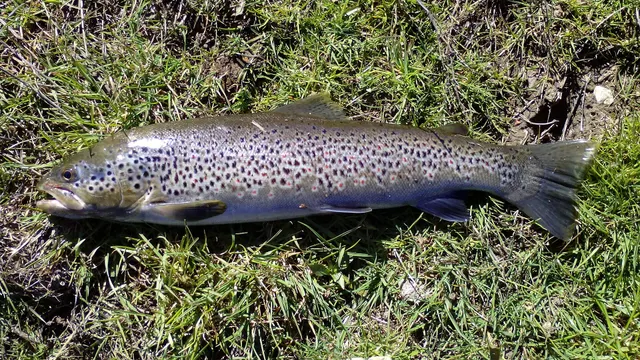 Brown troutA single, extraordinarily plastic species that appears as a tiny hill-stream fish, a deep-bodied loch trout and a silver sea-run migrant — all the same animal.
Robermix, CC0, via Wikimedia Commons
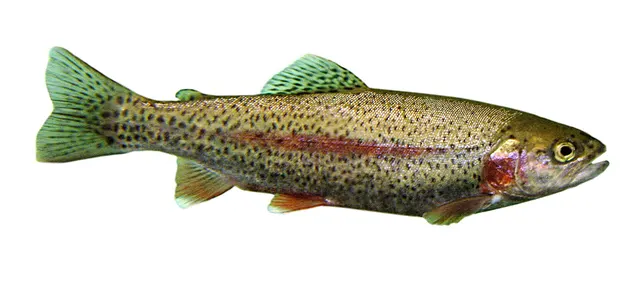 Rainbow troutThe most widely introduced sport fish on Earth — a Pacific salmonid now stocked on every continent except Antarctica, and the same species as the steelhead.
Jonathunder — CC BY-SA 3.0, via Wikimedia Commons
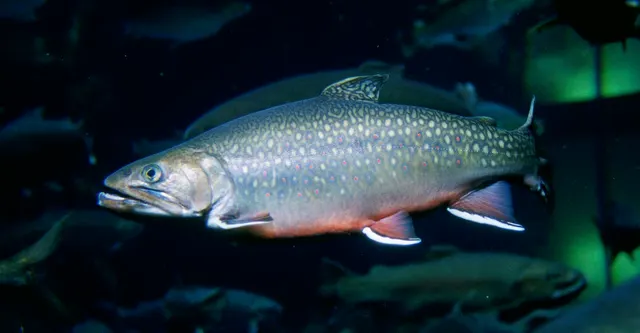 Brook troutA char rather than a true trout, native to cold clean eastern North American streams, and one of the most reliable indicators of water quality there is.
Engbretson, Eric — Public domain, via Wikimedia Commons
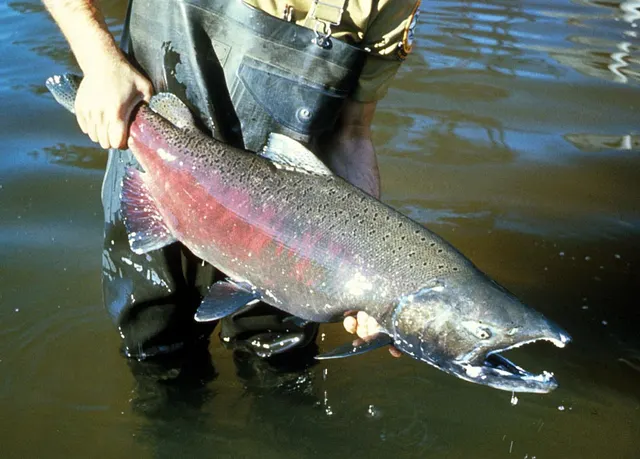 Chinook salmonThe largest Pacific salmon, reaching over sixty kilograms, and the one whose runs carry the most cultural and ecological weight on that coast.
U.S. Geological Survey — public domain, via Wikimedia Commons
Safety
Weather and lightning — Can cause serious injury or death
The southern westerlies blow hard and persistently, and large glacial lakes can raise a steep breaking sea within a short time. Small boats caught out on a big lake in a rising wind are in serious difficulty, and the shore may be a long way off with no shelter along it.
What reduces it: Treat the wind forecast as the governing constraint on any lake or boat plan, stay within reach of a lee shore, and go ashore early rather than late. Accept that a fishable morning can become an unfishable afternoon within an hour.
Worse when:
- Midsummer, when the westerlies are strongest and most persistent.
- On the large glacial lakes, where fetch is long enough to build a genuine sea.
- In a small open boat with a single engine and no shelter to run to.
Cold water shock — Can cause serious injury or death
Water temperatures are low year-round. Sudden immersion — from a wading fall in a big clear river, or from a boat — triggers gasping and hyperventilation, and swimming ability is lost in the first minute. Clear water makes depth hard to judge, so a wading step can be much deeper than it looks.
What reduces it: Wade with a staff and a wading belt, cross facing upstream, and do not wade to the limit of your balance in a strong wind. Wear a buoyancy aid in a boat. If immersed, float and control breathing before trying to swim.
Fishing alone — Can cause serious injury or death
The region is remote and thinly populated. Distances between towns are long, mobile coverage is patchy, weather changes fast, and medical help can be many hours away. An injury that would be minor near a town is a serious problem here.
What reduces it: Do not fish alone in remote water, tell somebody your plan and a return time they will act on, carry a signalling device that does not depend on a mobile network, and carry more warm clothing and food than the day appears to need.
Sun, dehydration and fatigue — Can cause injury needing treatment
Ultraviolet exposure at high southern latitudes is severe, and it happens in cool air that gives no warning. Wind adds to dehydration and to fatigue over a long day.
What reduces it: Use high-factor protection and cover exposed skin regardless of air temperature, wear eye protection, and drink more than thirst suggests in dry windy conditions.
Further safety reading
- Cold water shock and immersion — Water temperatures are low year-round, so immersion from a wading fall or a boat incapacitates within the first minute.
- Fishing alone — Long distances, patchy communications, fast weather changes and medical help many hours away make an ordinary injury a serious problem here.
- Wading safely — Big clear rivers make depth hard to judge, and wading to the limit of balance in a strong wind is how people get into difficulty here.
- Weather, lightning and open water — The southern westerlies can raise a steep breaking sea on a large glacial lake within a short time, and the shore may be a long way off with no shelter along it.
Check the rules before you fish
Fishing laws, bylaws, access rules, seasons, bait restrictions and permitted methods vary by location and can change. Check the current rules from the relevant authority and the water you intend to fish before fishing.
Check with:
- Current national or regional law for where you are fishing
- Current local bylaws
- The relevant fisheries authority
- The landowner, club or fishery whose water it is
- Any restrictions specific to the species or the method you intend to use
Where to go next
What swims here
- Brook troutEstablished in some of the colder headwaters and smaller streams of the region as a further product of the same stocking programmes.
- Brown troutIntroduced from the late nineteenth century and now the region's principal target, including the anadromous populations of the far southern rivers that reach exceptional sizes.
- Chinook salmonNow running a number of Chilean rivers as feral self-sustaining populations, a large anadromous predator in a system that previously had none.
- Rainbow troutEstablished across the region's rivers and lakes following deliberate stocking, and self-sustaining in most of them.
How people fish here
- Fly fishingFly fishing in a constant strong wind is the region's defining discipline, and its heavy rods, weight-forward lines and low tight loops are a direct adaptation to it.
- Lure fishingSpinning and lure fishing on lakes and larger rivers is what most local anglers do, notwithstanding the international fly-fishing reputation.
How this compares
Rules and access
- Licences and permissionLicensing is provincial or regional in both countries and access to most river water is a landowner or concession matter rather than a public right.
- Method and bait restrictionsFly-only water, barbless hooks and compulsory release are common instruments here and are rules rather than conventions.
Environment and conservation
- Fish stocks and sustainabilityA region whose economy depends on introduced salmonids and whose native galaxiid fauna was altered by them is holding two things at once, and the literature says so.
- Invasive species and biosecurityInvasive freshwater algae spread on damp gear between rivers have made disinfection of waders and boots a checked legal requirement in both countries.
Sources and evidence
- NASCO conservation and management of North Atlantic salmon — North Atlantic Salmon Conservation Organization (Government fisheries body)Relied on for: Anadromous salmonid biology, run timing, freshwater habitat requirements and the management principles applied to them.Background and mechanism onlyCitation checked — the work exists and is described correctly
- FishBase: a global information system on fishes — Froese, R. and D. Pauly, eds. — FishBase Consortium (Scientific institute)Relied on for: Distribution, habitat association, migratory behaviour and life history of the salmonid species concerned.States this directlyPassage read and verified
- Good Fish Guide — Marine Conservation Society (Conservation authority)Relied on for: Assessment of fisheries and the management measures applied to them, including gear selectivity and spatial protection.Background and mechanism onlyCitation checked — the work exists and is described correctly
- Code of Conduct for Responsible Fisheries — Food and Agriculture Organization of the United Nations, Rome, 1995 (Standards body)Relied on for: Principles for responsible fisheries management, precaution and the treatment of small-scale, shared and highly variable stocks.States this directlyCitation checked — the work exists and is described correctly
- RNLI water safety guidance: cold water shock and Float to Live — Royal National Lifeboat Institution (Water-safety or diver-training authority)Relied on for: Cold water shock, the physiological response to sudden immersion, and the guidance issued to recreational water users about it.States this directlyPassage read and verified
- RoSPA water safety information and UK accidental drowning statistics — Royal Society for the Prevention of Accidents (Water-safety or diver-training authority)Relied on for: Accidental drowning statistics and the circumstances in which recreational water users are most often killed, including immersion in cold water.Background and mechanism onlyPassage read and verified
Why the 15 connections on this page are here, and the sources
What swims here
Backed by research — 4 connections
Supported by peer-reviewed research or fisheries science. The sources are listed and can be checked.
Brook trout
A distribution association between an animal and a kind of water, rather than a claim about any named mark.
- The IUCN Red List of Threatened Species — International Union for Conservation of Nature (Conservation authority)Relied on for: Assessment and habitat account for the species, including the river or lake system it occupies and the pressures acting on it.States this directlyCitation checked — the work exists and is described correctly
- FishBase: a global information system on fishes — Froese, R. and D. Pauly, eds. — FishBase Consortium (Scientific institute)Relied on for: Distribution, habitat association, size and life history recorded for the species in the system concerned.States this directlyPassage read and verified
Brown trout
A distribution association between an animal and a kind of water, rather than a claim about any named mark.
- The IUCN Red List of Threatened Species — International Union for Conservation of Nature (Conservation authority)Relied on for: Assessment and habitat account for the species, including the river or lake system it occupies and the pressures acting on it.States this directlyCitation checked — the work exists and is described correctly
- FishBase: a global information system on fishes — Froese, R. and D. Pauly, eds. — FishBase Consortium (Scientific institute)Relied on for: Distribution, habitat association, size and life history recorded for the species in the system concerned.States this directlyPassage read and verified
Chinook salmon
A distribution association between an animal and a kind of water, rather than a claim about any named mark.
- The IUCN Red List of Threatened Species — International Union for Conservation of Nature (Conservation authority)Relied on for: Assessment and habitat account for the species, including the river or lake system it occupies and the pressures acting on it.States this directlyCitation checked — the work exists and is described correctly
- FishBase: a global information system on fishes — Froese, R. and D. Pauly, eds. — FishBase Consortium (Scientific institute)Relied on for: Distribution, habitat association, size and life history recorded for the species in the system concerned.States this directlyPassage read and verified
Rainbow trout
A distribution association between an animal and a kind of water, rather than a claim about any named mark.
- The IUCN Red List of Threatened Species — International Union for Conservation of Nature (Conservation authority)Relied on for: Assessment and habitat account for the species, including the river or lake system it occupies and the pressures acting on it.States this directlyCitation checked — the work exists and is described correctly
- FishBase: a global information system on fishes — Froese, R. and D. Pauly, eds. — FishBase Consortium (Scientific institute)Relied on for: Distribution, habitat association, size and life history recorded for the species in the system concerned.States this directlyPassage read and verified
How people fish here
What experienced anglers do — 2 connections
Widely and independently recommended by experienced anglers and specialist sources. This is real angling knowledge, not proof: controlled evidence for it is limited, and FishingHQ records it as convention rather than as a demonstrated effect.
Fly fishing
A discipline that is characteristic of the place rather than merely possible there, joined so a reader can move between the place and the practice.
- General angling website restatements of established technique — Various (Credible secondary source)Relied on for: Widely restated practice associating this discipline with this place, recorded as practitioner consensus rather than as tested fact.Background and mechanism onlyCitation checked — the work exists and is described correctly
- Fishers' Craft and Lettered Art: Tracts on Fishing from the End of the Middle Ages — University of Toronto Press, 1997 (Scientific literature)Relied on for: That fishing traditions develop around the water and fish available to them, and the historical method of reading such traditions.States this directlyCitation checked — the work exists and is described correctly
Lure fishing
A discipline that is characteristic of the place rather than merely possible there, joined so a reader can move between the place and the practice.
- General angling website restatements of established technique — Various (Credible secondary source)Relied on for: Widely restated practice associating this discipline with this place, recorded as practitioner consensus rather than as tested fact.Background and mechanism onlyCitation checked — the work exists and is described correctly
- Fishers' Craft and Lettered Art: Tracts on Fishing from the End of the Middle Ages — University of Toronto Press, 1997 (Scientific literature)Relied on for: That fishing traditions develop around the water and fish available to them, and the historical method of reading such traditions.States this directlyCitation checked — the work exists and is described correctly
How this compares
What experienced anglers do — 1 connection
Widely and independently recommended by experienced anglers and specialist sources. This is real angling knowledge, not proof: controlled evidence for it is limited, and FishingHQ records it as convention rather than as a demonstrated effect.
South American fishing
A continental overview joined to a record it sits above, so that the synthesis and the detail are reachable from one another rather than duplicating each other.
- FAO fishing gear types and fishing technology information — Food and Agriculture Organization of the United Nations (Scientific institute)Relied on for: Classification and description of world fishing gears and the regions in which each is used.States this directlyCitation checked — the work exists and is described correctly
- General angling website restatements of established technique — Various (Credible secondary source)Relied on for: Widely restated descriptions of regional angling practice, recorded as consensus rather than as scholarship.Background and mechanism onlyCitation checked — the work exists and is described correctly
Safety reading
Official guidance — 4 connections
Stated by a fisheries authority, scientific institute or recognised angling body. Authoritative, but summarising rather than demonstrating.
Cold water shock and immersion
A place is joined to the safety topic that explains a hazard genuinely characteristic of it, so the mechanism is reachable rather than restated as a weak warning.
- RNLI water safety guidance: cold water shock and Float to Live — Royal National Lifeboat Institution (Water-safety or diver-training authority)Relied on for: Cold water shock and the immersion response, shore angling hazards, small-craft guidance and the circumstances in which water users are most often killed.States this directlyPassage read and verified
- RoSPA water safety information and UK accidental drowning statistics — Royal Society for the Prevention of Accidents (Water-safety or diver-training authority)Relied on for: Accidental drowning statistics and the circumstances in which recreational water users are most often killed.Background and mechanism onlyPassage read and verified
Fishing alone
A place is joined to the safety topic that explains a hazard genuinely characteristic of it, so the mechanism is reachable rather than restated as a weak warning.
- RNLI water safety guidance: cold water shock and Float to Live — Royal National Lifeboat Institution (Water-safety or diver-training authority)Relied on for: Cold water shock and the immersion response, shore angling hazards, small-craft guidance and the circumstances in which water users are most often killed.States this directlyPassage read and verified
- RoSPA water safety information and UK accidental drowning statistics — Royal Society for the Prevention of Accidents (Water-safety or diver-training authority)Relied on for: Accidental drowning statistics and the circumstances in which recreational water users are most often killed.Background and mechanism onlyPassage read and verified
Wading safely
A place is joined to the safety topic that explains a hazard genuinely characteristic of it, so the mechanism is reachable rather than restated as a weak warning.
- RNLI water safety guidance: cold water shock and Float to Live — Royal National Lifeboat Institution (Water-safety or diver-training authority)Relied on for: Cold water shock and the immersion response, shore angling hazards, small-craft guidance and the circumstances in which water users are most often killed.States this directlyPassage read and verified
- RoSPA water safety information and UK accidental drowning statistics — Royal Society for the Prevention of Accidents (Water-safety or diver-training authority)Relied on for: Accidental drowning statistics and the circumstances in which recreational water users are most often killed.Background and mechanism onlyPassage read and verified
Weather, lightning and open water
A place is joined to the safety topic that explains a hazard genuinely characteristic of it, so the mechanism is reachable rather than restated as a weak warning.
- RNLI water safety guidance: cold water shock and Float to Live — Royal National Lifeboat Institution (Water-safety or diver-training authority)Relied on for: Cold water shock and the immersion response, shore angling hazards, small-craft guidance and the circumstances in which water users are most often killed.States this directlyPassage read and verified
- RoSPA water safety information and UK accidental drowning statistics — Royal Society for the Prevention of Accidents (Water-safety or diver-training authority)Relied on for: Accidental drowning statistics and the circumstances in which recreational water users are most often killed.Background and mechanism onlyPassage read and verified
Rules and access
Official guidance — 2 connections
Stated by a fisheries authority, scientific institute or recognised angling body. Authoritative, but summarising rather than demonstrating.
Licences and permission
A place joined to the regulatory concept whose structure it illustrates. The edge asserts that the concept applies here, never what any current rule says.
- Code of Conduct for Responsible Fisheries — Food and Agriculture Organization of the United Nations, Rome, 1995 (Standards body)Relied on for: Principles for the management of fisheries, including licensing, closed seasons, size limits and the treatment of small-scale and shared stocks.States this directlyCitation checked — the work exists and is described correctly
- Good Fish Guide — Marine Conservation Society (Conservation authority)Relied on for: Assessment of fisheries and the management measures applied to them, including the instruments used and their purpose.Background and mechanism onlyCitation checked — the work exists and is described correctly
Method and bait restrictions
A place joined to the regulatory concept whose structure it illustrates. The edge asserts that the concept applies here, never what any current rule says.
- Code of Conduct for Responsible Fisheries — Food and Agriculture Organization of the United Nations, Rome, 1995 (Standards body)Relied on for: Principles for the management of fisheries, including licensing, closed seasons, size limits and the treatment of small-scale and shared stocks.States this directlyCitation checked — the work exists and is described correctly
- Good Fish Guide — Marine Conservation Society (Conservation authority)Relied on for: Assessment of fisheries and the management measures applied to them, including the instruments used and their purpose.Background and mechanism onlyCitation checked — the work exists and is described correctly
Environment and conservation
Backed by research — 2 connections
Supported by peer-reviewed research or fisheries science. The sources are listed and can be checked.
Fish stocks and sustainability
An environmental pressure that is specific to this place rather than general to fishing, joined so the issue is anchored to a real example.
- The IUCN Red List of Threatened Species — International Union for Conservation of Nature (Conservation authority)Relied on for: Assessment of the species and habitats affected, and the pressures acting on them, including habitat change and exploitation.States this directlyCitation checked — the work exists and is described correctly
- Code of Conduct for Responsible Fisheries — Food and Agriculture Organization of the United Nations, Rome, 1995 (Standards body)Relied on for: Principles for responsible fisheries management, precaution, gear selectivity and the treatment of shared and small-scale fisheries.Background and mechanism onlyCitation checked — the work exists and is described correctly
Invasive species and biosecurity
An environmental pressure that is specific to this place rather than general to fishing, joined so the issue is anchored to a real example.
- The IUCN Red List of Threatened Species — International Union for Conservation of Nature (Conservation authority)Relied on for: Assessment of the species and habitats affected, and the pressures acting on them, including habitat change and exploitation.States this directlyCitation checked — the work exists and is described correctly
- Code of Conduct for Responsible Fisheries — Food and Agriculture Organization of the United Nations, Rome, 1995 (Standards body)Relied on for: Principles for responsible fisheries management, precaution, gear selectivity and the treatment of shared and small-scale fisheries.Background and mechanism onlyCitation checked — the work exists and is described correctly
How FishingHQ labels evidence is explained in the evidence policy.