How to identify brook trout
Salvelinus fontinalis · Salmonidae
The characters that identify brook trout, ranked by how far each one can be trusted on its own.
Safety: fish welfare — can cause injury needing treatment. One more point applies here.
How this was identified, and who took it
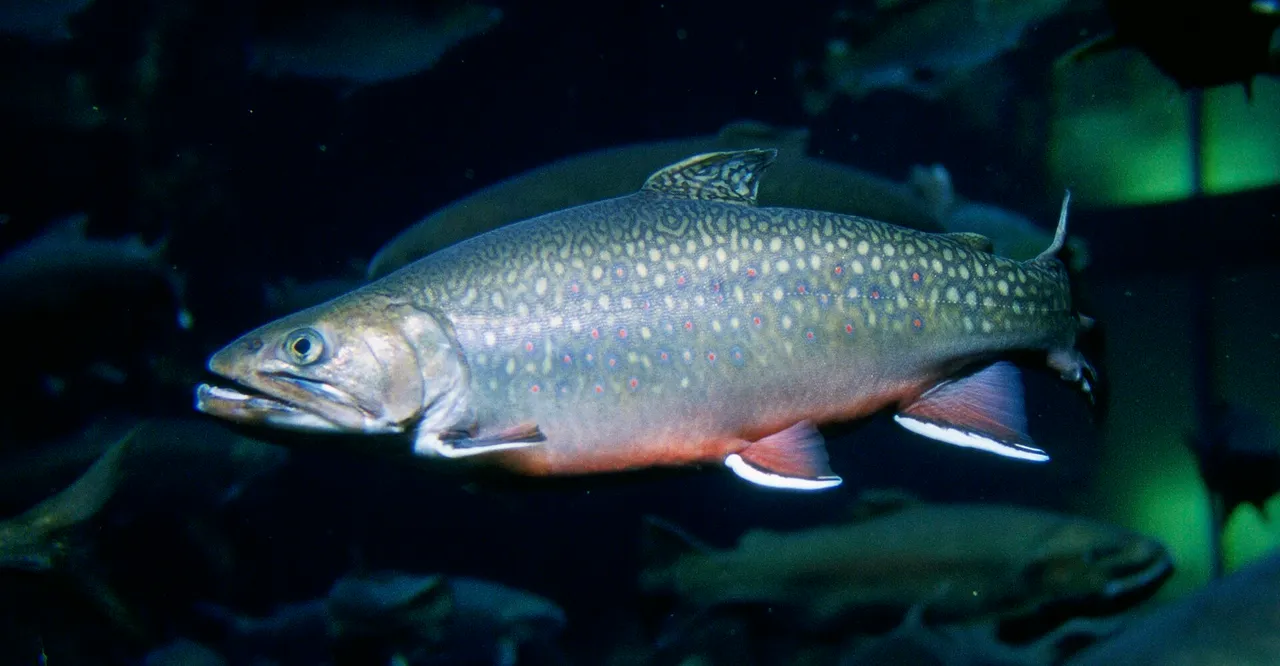
Identified by: Every diagnostic character of the species in one frame: pale vermiculation over the back and dorsal fin, red spots with blue haloes, and white leading edges backed by black on the lower fins.Engbretson, Eric — Public domain, via Wikimedia Commons — source, licenceLook at this first
Look at the lower fins. A brook trout has a clean white leading edge on each, backed by a black line, over orange or red — and nothing else in fresh water carries that combination. It is visible at any size, in any condition, from several feet away.
Diagnostic — settles it on its own
Each of these settles the identification on its own. If one is clear, you have your answer.
White leading edges on the lower fins
The pelvic, anal and pectoral fins each carry a crisp white front edge with a black stripe immediately behind it. Unmistakable, present from parr size to adult, and unaffected by season.
Pale spots on a dark ground
The char character, and the reverse of every true trout. Brook trout carry light marks over a dark flank, with wavy pale vermiculation across the back and dorsal fin. A brown or rainbow trout shows dark spots on a light ground.
Supporting — use with other characters
Real characters that are not conclusive by themselves. Use two or three together.
Red spots ringed in blue
Scattered along the flank, each red dot sitting inside a distinct blue halo. Striking, consistent, and a good confirmation once the fin edges have told you what you are looking at.
A square-cut tail
Barely forked, which is where the American name squaretail comes from. Useful in a photograph where the fins are not clearly resolved.
What it gets confused with
- Brown trout in the same streams — but the spotting is the reverse pattern, dark on light rather than light on dark.
- Arctic char and other Salvelinus, which share the char pattern and the pale fin edges. Range usually separates them.
- Tiger trout, the brook × brown hybrid, which shows heavy vermiculation and no clean pale spots.
Side by side: Brook trout vs Arctic char, Brook trout vs Bull trout, Brook trout vs Lake trout.
Where this stops working
Brook trout is a char rather than a trout, which is why the spotting runs the opposite way, and where it shares water with other Salvelinus the fin-edge character stops being decisive. Hybrids with brown trout occur naturally and in hatcheries; a fish with maze-like vermiculation and no distinct pale spots is likely one. Spawning males are far more intensely coloured than the same fish in summer.
The full record
This page covers identification only. The Brook trout record covers behaviour, lifecycle, distribution, handling and the sources behind all of it.
Reviewed 2026-08-13.
More about this fish
Telling it apart is one question. Here are the others.
Similar and related fish
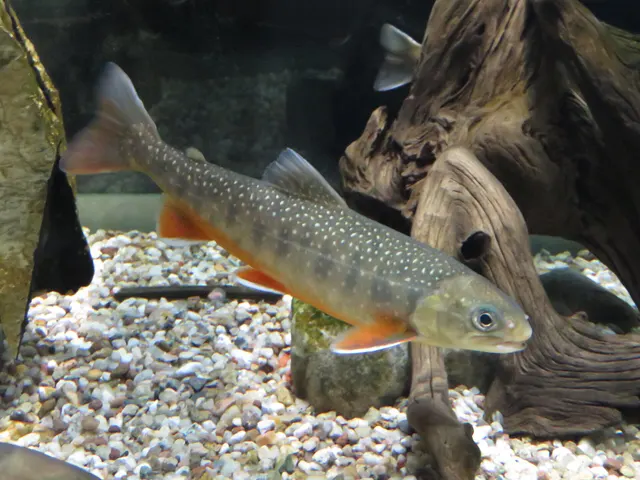 Arctic charCongeneric chars separated by vermiculation on the back and by tail shape.
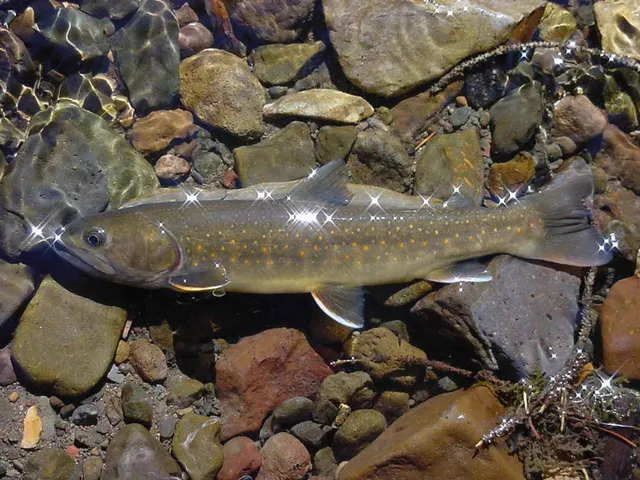 Bull troutBoth chars with pale spots on a dark ground, separated by vermiculation and by tail fork.
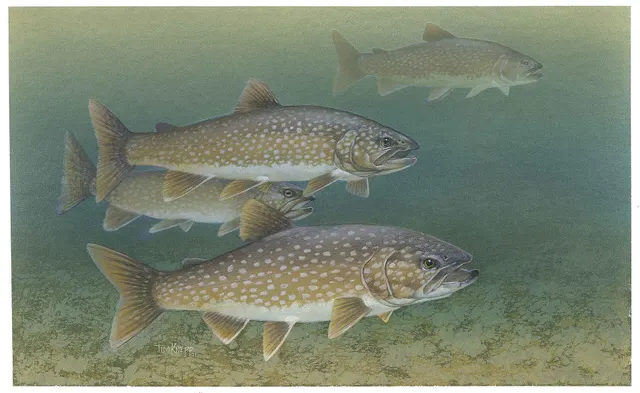 Lake troutBoth are char, genus Salvelinus, not trout — pale spots on a dark ground rather than the reverse. The tail separates them: brook trout squared, lake trout deeply forked.
- Rainbow smeltWhere smelt occur, larger brook trout feed on them heavily, which is what produces the exceptional sizes reached in some smelt lakes.
How it is caught
- Dry fly fishingBrook trout in their native headwaters rise freely and unselectively, which makes a dry fly both effective and the only practical way to fish tight, shallow, fast water without snagging.
- NymphingMost of a brook trout's food arrives as drifting invertebrates below the surface, and short-line nymphing matches the drift in the pocket water they hold in.
Where it lives
Where you will find it
Why the 8 connections on this page are here, and the sources
Similar and related fish
Backed by research — 4 connections
Supported by peer-reviewed research or fisheries science. The sources are listed and can be checked.
Arctic char
An identification comparison naming both binomials: Salvelinus alpinus and Salvelinus fontinalis.
- FishBase: a global information system on fishes — Froese, R. and D. Pauly, eds. — FishBase Consortium (Scientific institute)Relied on for: Morphological and distributional data for Salvelinus alpinus and for Salvelinus fontinalis.States this directlyPassage read and verified
- The IUCN Red List of Threatened Species — International Union for Conservation of Nature (Conservation authority)Relied on for: Separate assessments treating Salvelinus alpinus and Salvelinus fontinalis as distinct species.States this directlyCitation checked — the work exists and is described correctly
Bull trout
An identification comparison naming both binomials: Salvelinus confluentus and Salvelinus fontinalis.
- FishBase: a global information system on fishes — Froese, R. and D. Pauly, eds. — FishBase Consortium (Scientific institute)Relied on for: Morphological and distributional data for Salvelinus confluentus and for Salvelinus fontinalis.States this directlyPassage read and verified
- The IUCN Red List of Threatened Species — International Union for Conservation of Nature (Conservation authority)Relied on for: Separate assessments treating Salvelinus confluentus and Salvelinus fontinalis as distinct species.States this directlyCitation checked — the work exists and is described correctly
Lake trout
A taxonomic and identification comparison naming both binomials.
- FishBase: a global information system on fishes — Froese, R. and D. Pauly, eds. — FishBase Consortium (Scientific institute)Relied on for: That Salvelinus fontinalis and Salvelinus namaycush are congeners in the genus Salvelinus, distinct from the true trouts of Salmo and Oncorhynchus.States this directlyPassage read and verified
Rainbow smelt
Recorded diet evidence identifies Osmerus mordax as a food item of this predator at species level. The edge is written at that granularity and no further.
- FishBase: a global information system on fishes — Froese, R. and D. Pauly, eds. — FishBase Consortium (Scientific institute)Relied on for: Food items recorded for this predator, including Osmerus mordax.States this directlyPassage read and verified
- FAO Species Identification Guides for Fishery Purposes and the FAO Species Catalogues — Food and Agriculture Organization of the United Nations (Scientific institute)Relied on for: Species account describing the diet of this predator in the region where Osmerus mordax occurs.Background and mechanism onlyCitation checked — the work exists and is described correctly
How it is caught
What experienced anglers do — 2 connections
Widely and independently recommended by experienced anglers and specialist sources. This is real angling knowledge, not proof: controlled evidence for it is limited, and FishingHQ records it as convention rather than as a demonstrated effect.
Dry fly fishing
Established angling practice for this species, recorded as convention. The note states the property of the animal or its water that makes the method the answer.
- Trout & Salmon — Bauer Media (Specialist angling publication)Relied on for: Established salmonid angling technique and its application to this species.States this directlyCitation checked — the work exists and is described correctly
- General angling website restatements of established technique — Various (Credible secondary source)Relied on for: Widely restated practice connecting this species and method.Background and mechanism onlyCitation checked — the work exists and is described correctly
Nymphing
Established angling practice for this species, recorded as convention. The note states the property of the animal or its water that makes the method the answer.
- Trout & Salmon — Bauer Media (Specialist angling publication)Relied on for: Established salmonid angling technique and its application to this species.States this directlyCitation checked — the work exists and is described correctly
- General angling website restatements of established technique — Various (Credible secondary source)Relied on for: Widely restated practice connecting this species and method.Background and mechanism onlyCitation checked — the work exists and is described correctly
Where it lives
Backed by research — 1 connection
Supported by peer-reviewed research or fisheries science. The sources are listed and can be checked.
Lowland rivers
A habitat and tolerance claim held to a scientific standard because FishingHQ uses it as an indicator elsewhere.
- FishBase: a global information system on fishes — Froese, R. and D. Pauly, eds. — FishBase Consortium (Scientific institute)Relied on for: That Salvelinus fontinalis occupies marine, fresh and brackish benthopelagic habitat with an anadromous life history in part of the range, in temperate water from 0 to 25 degrees.States this directlyPassage read and verified
Where you will find it
Backed by research — 1 connection
Supported by peer-reviewed research or fisheries science. The sources are listed and can be checked.
Patagonia
A distribution association between an animal and a kind of water, rather than a claim about any named mark.
- The IUCN Red List of Threatened Species — International Union for Conservation of Nature (Conservation authority)Relied on for: Assessment and habitat account for the species, including the river or lake system it occupies and the pressures acting on it.States this directlyCitation checked — the work exists and is described correctly
- FishBase: a global information system on fishes — Froese, R. and D. Pauly, eds. — FishBase Consortium (Scientific institute)Relied on for: Distribution, habitat association, size and life history recorded for the species in the system concerned.States this directlyPassage read and verified
Safety
Fish welfare — Can cause injury needing treatment
Brook trout are among the least tolerant of warm water of any salmonid, and fish caught from summer thermal refuges frequently die after release even when handling is careful.
What reduces it: Do not fish for them in warm water. Where summer concentrations are known, leave them alone. Play quickly, keep the fish wet, use barbless hooks, and treat the water temperature as the deciding factor rather than the technique.
Biosecurity and disease transfer — Can cause injury needing treatment
Introduced brook trout displace native fish in parts of the western United States, South America and Europe, and stocking and equipment move pathogens between headwaters that are otherwise isolated.
What reduces it: Never move live fish or water between waters. Clean, drain and dry equipment between catchments — headwater streams are exactly the isolated systems that suffer most from an introduced pathogen.