What does brook trout eat?
What is established about how brook trout feeds, kept separate from what anglers infer from it.
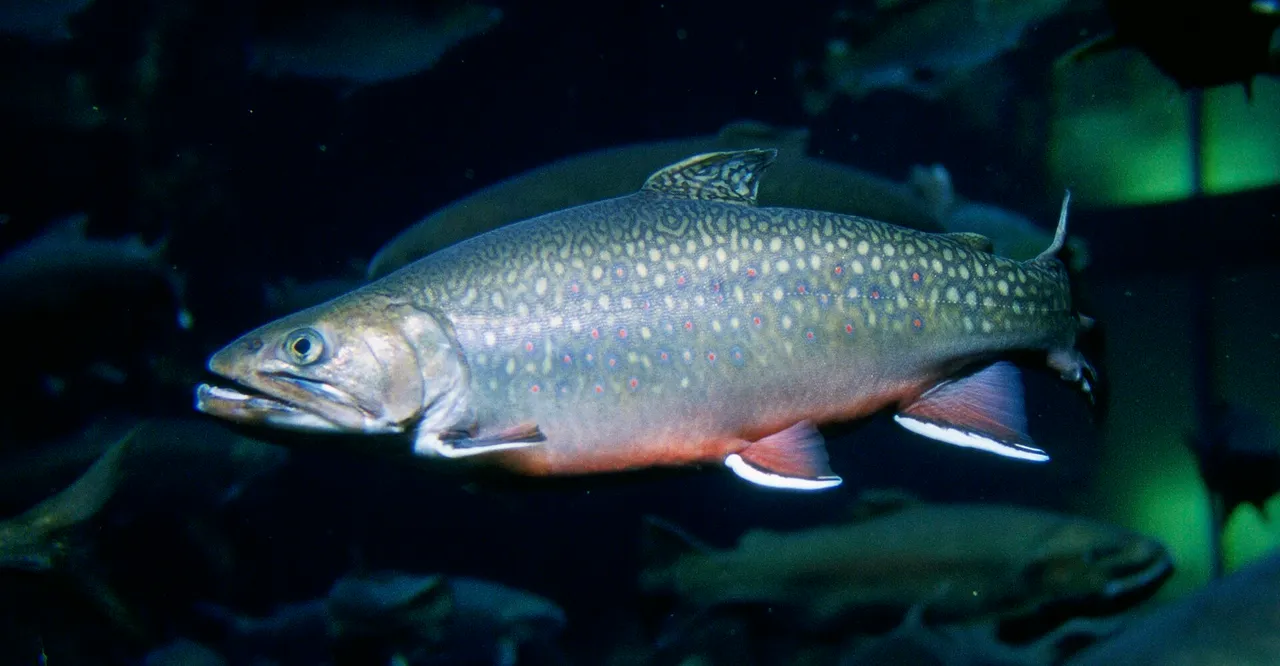
How this was identified, and who took it
Identified by: Every diagnostic character of the species in one frame: pale vermiculation over the back and dorsal fin, red spots with blue haloes, and white leading edges backed by black on the lower fins.Engbretson, Eric — Public domain, via Wikimedia Commons — source, licenceWhat is known about how it feeds
A brook trout's size is a statement about what its water contains, and the two verified relationships mark the two ends of the range.
In the small, cold, clean headwater streams the species is most associated with, the diet is aquatic insect larvae taken from the drift, and a mature fish may be a modest length after several years. Those populations are numerous, short-lived and small.
Where a forage fish is available — and rainbow smelt is the relationship FishingHQ records — brook trout become piscivorous and reach sizes that look like a different species. The large brook trout of certain northern lakes and of the smelt waters are the same animal with access to a different food.
The requirement underneath is water quality. Brook trout need cold, well-oxygenated, clean water and are among the first species lost when a stream warms or is polluted, which makes their presence an indicator rather than merely a fishery.
Feeding in streams follows the same drift economics as any salmonid: a station is held, the current delivers, and the fish moves in proportion to what is worth moving for. The species is notably opportunistic within that, taking terrestrial insects readily.
It is worth stating that the brook trout is a char rather than a trout, which is why it hybridises with lake trout and why its habitat requirements sit closer to those of Arctic char than to those of a brown trout.
The food
Prey with a verified dietary link to this fish. Each entry carries its own evidence, and each is written at the precision the source actually used: a named species where the source named one, a group or food category where it said “polychaetes”, “crustaceans” or “detritus” and meant it. That is why this list is shorter than the animal’s real diet rather than longer.
- Rainbow smelt — Osmerus mordax
Where smelt occur, larger brook trout feed on them heavily, which is what produces the exceptional sizes reached in some smelt lakes.
- Aquatic insect larvae as prey — a group rather than a species: the evidence names the group
In streams the diet is dominated by aquatic insect larvae taken from the drift, as it is for stream salmonids generally.
Food with no page of its own here yet
These are real components of the diet, listed as plain text because FishingHQ has no page for them yet. Inventing pages to make the list look fuller would be the fabrication this whole approach exists to prevent.
- terrestrial insects
- small minnows and sculpins
- freshwater shrimp
- fish eggs
- small crayfish
What anglers do with this
Everything below is interpretation, not finding. It is what experienced anglers conclude from the biology above, and the reasoning is usually sound and almost never tested. It is separated from the biology deliberately.
The drift economics converts into stream tactics in the same way it does for brown trout: find where food is delivered and present something that behaves as though it is being delivered.
The forage-fish relationship is the reasoning behind quite different approaches on smelt lakes and large northern waters, where the target is a piscivorous fish rather than an insect feeder. Anglers treat these as separate fisheries and they are.
The water-quality sensitivity has a practical consequence that is not interpretation: brook trout are frequently caught in very cold, very clean small waters where the population is small and slow to replace, and the case for careful handling and release is correspondingly stronger.
What this does not establish
Both relationships describe different populations rather than one diet, and the insect relationship is group-level. Composition varies enormously between headwater streams, ponds and large lakes, and nothing here establishes proportions or describes a particular water.
Where this connects
These are the baits, lures, methods and explainers FishingHQ already joins to this fish — which is why the list is sometimes short. They are not chosen for this page, and a link here means an evidenced relationship exists, not that it follows from the diet.
Lures recorded for this species
Methods used for it
Where it lives
The science behind the feeding
This page covers feeding. The Brook trout record covers identification, lifecycle, seasonal behaviour, handling and the sources behind all of it.
Reviewed 2026-08-12.