How to identify arctic grayling
Thymallus arcticus · Salmonidae
The characters that identify arctic grayling, ranked by how far each one can be trusted on its own.
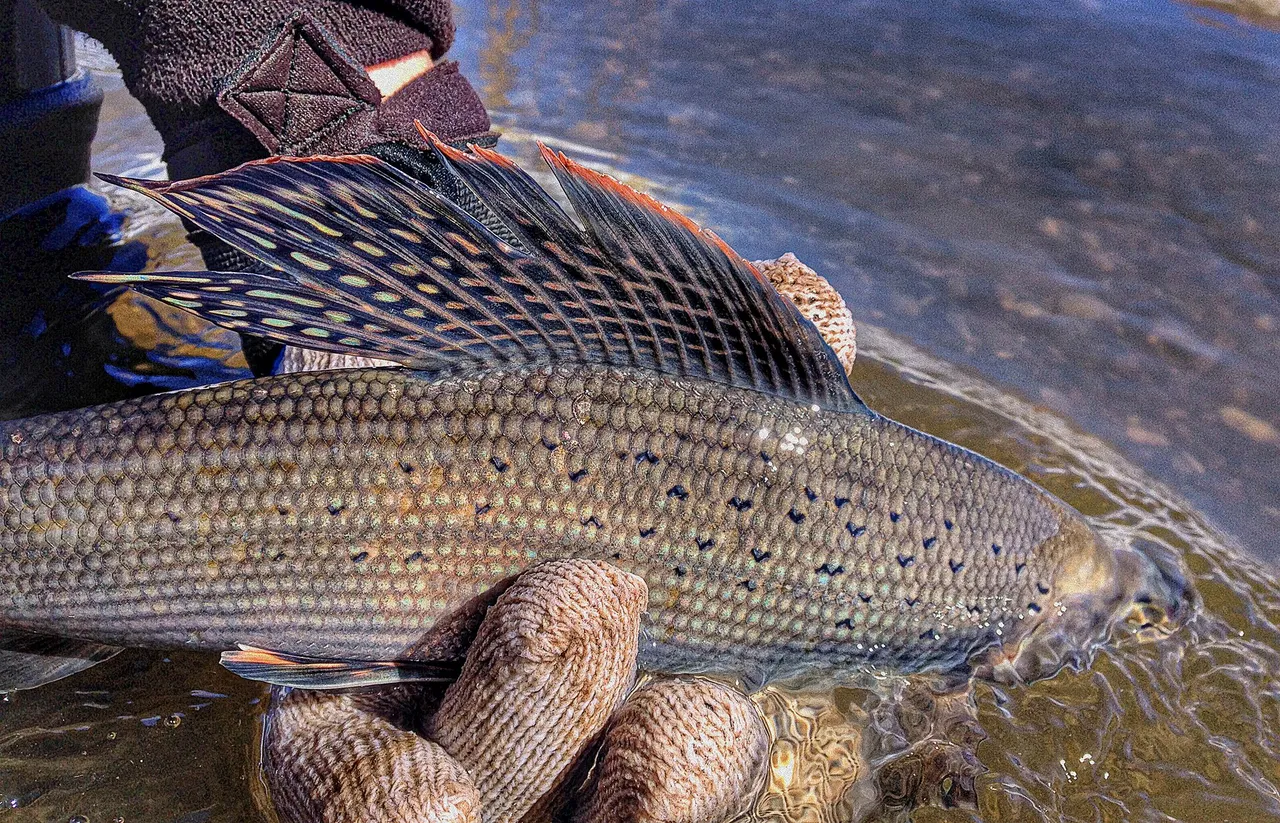
How this was identified, and who took it
Identified by: The genus is unambiguous: nothing else in range carries a dorsal of this size marked with rows of iridescent ocelli and fringed orange. Within Thymallus, the very large sail-like dorsal with multiple spot rows suits T. arcticus rather than the smaller-finned T. thymallus, and provenance — a male trapped on Red Rock Creek, Montana, by USFWS — is inside the native range and outside the European species' range. The dark shoulder chevrons are supporting only; their number varies.U.S. Fish and Wildlife Service — public domain, via Wikimedia Commons — source, licenceLook at this first
The dorsal fin does the whole job. A grayling carries an enormous sail of a dorsal, far larger than any other freshwater fish of its size, marked with regular rows of iridescent spots and usually fringed with orange or red. Nothing else looks like it. Which grayling it is, is then a question of where you are.
Diagnostic — settles it on its own
Each of these settles the identification on its own. If one is clear, you have your answer.
The outsized dorsal fin
Tall, long-based and sail-like, carrying several rows of round iridescent spots and a coloured trailing margin. This identifies the genus Thymallus instantly and unambiguously at any size and in any condition, and it is visible in a photograph taken at a distance.
Range, for the species rather than the genus
The two graylings FishingHQ holds do not overlap: Arctic grayling occupy northern North America and northern Asia, European grayling occupy Europe. Where you are caught the fish is therefore the species-level character, which is unusual and is stated plainly rather than dressed up as anatomy.
Supporting — use with other characters
Real characters that are not conclusive by themselves. Use two or three together.
A larger dorsal with more spot rows than the European fish
Arctic grayling generally carry a bigger dorsal fin with more rows of spots and a stronger coloured margin, particularly in males. It is a real difference and it is one of degree, so it works when the two are seen side by side and not when a single fish is in hand.
Suggestive only — varies with condition
Hints only. These vary with condition, season, water and how long the fish has been out of it, and a fish that contradicts them is still the same species.
Dark chevron spots on the shoulder
Scattered small dark V-shaped marks on the forward flank. Present on most fish, absent on some, and variable in number between populations — a supporting impression rather than a check.
What it gets confused with
- European grayling, which is the same genus and is separated by range rather than by any field character an angler can apply.
- Whitefish and cisco in North America, which share the small mouth and silvery flank and carry an ordinary small dorsal fin.
- Nothing else, really — the dorsal fin removes every other candidate.
Side by side: Arctic grayling vs Grayling.
Where this stops working
The genus is trivially identifiable and the species is not, and this page does not pretend otherwise: within Thymallus the separation is largely geographic, several additional species are recognised across northern Asia that no field character available here will resolve, and the taxonomy of the group continues to move. In practice a grayling caught in Alaska, Yukon, the Northwest Territories, Montana's Centennial Valley or Siberia is an Arctic grayling and one caught in a European river is not, and that is the whole of what can be said reliably.
The full record
This page covers identification only. The Arctic grayling record covers behaviour, lifecycle, distribution, handling and the sources behind all of it.
Reviewed 2026-08-13.
More about this fish
Telling it apart is one question. Here are the others.
Similar and related fish
How it is caught
Where it lives
Where you will find it
- AlaskaOccupies interior and northern rivers, moving seasonally between spawning tributaries, summer feeding reaches and deep overwintering water.
- CanadaOccupies cold, clean, connected rivers across the north and west, requiring separate spawning, feeding and overwintering habitat within reach of one another.
Why the 7 connections on this page are here, and the sources
Similar and related fish
Backed by research — 1 connection
Supported by peer-reviewed research or fisheries science. The sources are listed and can be checked.
Grayling
An identification comparison naming both binomials: Thymallus arcticus and Thymallus thymallus.
- FishBase: a global information system on fishes — Froese, R. and D. Pauly, eds. — FishBase Consortium (Scientific institute)Relied on for: Morphological and distributional data for Thymallus arcticus and for Thymallus thymallus.States this directlyPassage read and verified
- The IUCN Red List of Threatened Species — International Union for Conservation of Nature (Conservation authority)Relied on for: Separate assessments treating Thymallus arcticus and Thymallus thymallus as distinct species.States this directlyCitation checked — the work exists and is described correctly
How it is caught
What experienced anglers do — 2 connections
Widely and independently recommended by experienced anglers and specialist sources. This is real angling knowledge, not proof: controlled evidence for it is limited, and FishingHQ records it as convention rather than as a demonstrated effect.
Dry fly fishing
A practitioner claim about how Thymallus arcticus is commonly fished, following from where and how it feeds.
- General angling website restatements of established technique — Various (Credible secondary source)Relied on for: Widely restated practitioner accounts of fishing for arctic grayling.Citation checked — the work exists and is described correctly
- Sea Angler — Bauer Media (Specialist angling publication)Relied on for: Practitioner treatment of the methods used for arctic grayling and comparable species.Citation checked — the work exists and is described correctly
Nymphing
A practitioner claim about how Thymallus arcticus is commonly fished, following from where and how it feeds.
- General angling website restatements of established technique — Various (Credible secondary source)Relied on for: Widely restated practitioner accounts of fishing for arctic grayling.Citation checked — the work exists and is described correctly
- Sea Angler — Bauer Media (Specialist angling publication)Relied on for: Practitioner treatment of the methods used for arctic grayling and comparable species.Citation checked — the work exists and is described correctly
Where it lives
Backed by research — 2 connections
Supported by peer-reviewed research or fisheries science. The sources are listed and can be checked.
Chalk streams
A habitat association for Thymallus arcticus taken from the environment and distribution data on its FishBase summary.
- FishBase: a global information system on fishes — Froese, R. and D. Pauly, eds. — FishBase Consortium (Scientific institute)Relied on for: The environment, depth range and habitat description recorded for Thymallus arcticus.States this directlyPassage read and verified
Lowland rivers
A habitat association for Thymallus arcticus taken from the environment and distribution data on its FishBase summary.
- FishBase: a global information system on fishes — Froese, R. and D. Pauly, eds. — FishBase Consortium (Scientific institute)Relied on for: The environment, depth range and habitat description recorded for Thymallus arcticus.States this directlyPassage read and verified
Where you will find it
Backed by research — 2 connections
Supported by peer-reviewed research or fisheries science. The sources are listed and can be checked.
Alaska
A distribution association between an animal and a kind of water, rather than a claim about any named mark.
- FishBase: a global information system on fishes — Froese, R. and D. Pauly, eds. — FishBase Consortium (Scientific institute)Relied on for: Distribution, habitat association and depth range recorded for the species, including its occurrence in the water body concerned.States this directlyPassage read and verified
- The IUCN Red List of Threatened Species — International Union for Conservation of Nature (Conservation authority)Relied on for: Assessment and range account for the species, including the systems and coasts it occupies.Background and mechanism onlyCitation checked — the work exists and is described correctly
Canada
A distribution association between an animal and a kind of water, rather than a claim about any named mark.
- FishBase: a global information system on fishes — Froese, R. and D. Pauly, eds. — FishBase Consortium (Scientific institute)Relied on for: Distribution, habitat association and depth range recorded for the species, including its occurrence in the water body concerned.States this directlyPassage read and verified
- The IUCN Red List of Threatened Species — International Union for Conservation of Nature (Conservation authority)Relied on for: Assessment and range account for the species, including the systems and coasts it occupies.Background and mechanism onlyCitation checked — the work exists and is described correctly