Algae and biofilm as food
Explainer · Last reviewed 2026-08-12
The thin living film of algae, diatoms and bacteria coating every submerged surface — an abundant, continuously renewing food source that a fish has to be built to exploit.
Background, not a fishing profile
This page is here so FishingHQ can describe a biological relationship accurately — usually because a fish covered elsewhere on the site feeds on this. It covers what it is, where it lives and the evidence behind that relationship, and deliberately nothing about methods, bait or tackle. Its presence here is not a statement that anybody fishes for it.
Every submerged surface that receives light carries a film: benthic diatoms, filamentous and single-celled algae, bacteria, and the microscopic animals living among them. Limnologists call it periphyton or aufwuchs; anglers rarely call it anything, because the fish that eat it are mostly the ones that are hardest to catch.
The material is nutritionally reasonable and mechanically awkward. It is thinly spread, bound to a surface, and mixed with the sediment it grows on, so exploiting it requires either a scraping mouth, a grinding stomach, a very long gut, or all three. Both grey mullets on FishingHQ have a muscular gizzard-like stomach region for exactly that reason, and they ingest sand and mud along with the food.
That is the direct explanation for the fishery problem the mullet records describe: a grazing animal working a surface film has no interest in a discrete item of food, which is why conventional bait fails and why the approaches that do work are those presenting something of comparable texture and consistency.
The scope is algae and the associated microbial film — benthic diatoms, epiphytic and filamentous algae, and periphyton generally. Free-floating phytoplankton consumed by filter feeders is included. Vascular plants are covered separately.
Where to go next
Fish this applies to
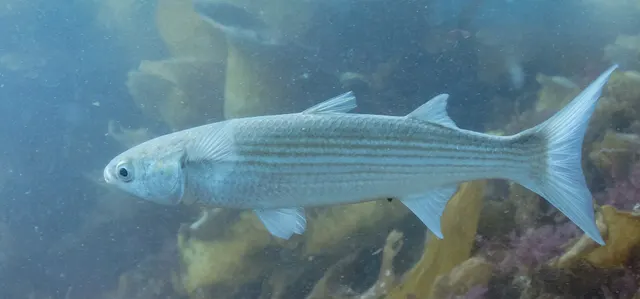 Flathead grey mulletMicroalgae and the surface film are taken alongside the sediment itself, and no diet study separates the two cleanly because the fish does not either.
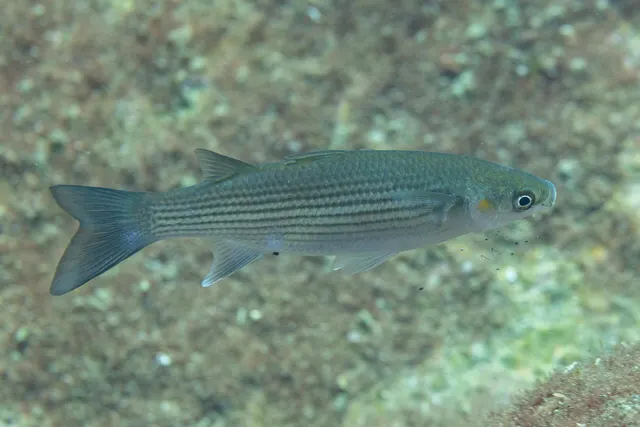 Thick-lipped grey mulletThis is a grazing animal working algae off surfaces, and the long gut and grinding stomach region are what a diet of algae and sediment requires.
- Thin-lipped grey mulletGrey mullet graze the surface film of diatoms, algae and detritus off mud, stone, weed and structure, which is what the modelled prey category exists to hold.
More explainers
Not related to this page — just the rest of the section. There is little else joined to this subject yet, and a short page should still lead somewhere.
Sources and evidence
- FishBase: a global information system on fishes — Froese, R. and D. Pauly, eds. — FishBase Consortium (Scientific institute)Relied on for: Recorded food items for the species this category is cited for, at the granularity the database records them.States this directlyPassage read and verified
- FAO Species Identification Guides for Fishery Purposes and the FAO Species Catalogues — Food and Agriculture Organization of the United Nations (Scientific institute)Relied on for: Species accounts describing feeding, given as food category or broad taxon where that is what the account states.States this directlyCitation checked — the work exists and is described correctly
Why the 3 connections on this page are here, and the sources
Fish this applies to
Backed by research — 3 connections
Supported by peer-reviewed research or fisheries science. The sources are listed and can be checked.
Flathead grey mullet
Recorded diet evidence identifies microalgae and the organic film on sediment surfaces as food for this species, at group level rather than as a named organism. The edge uses `consumes` rather than `preys_on` because nothing here is hunted, and it points at the category record so the granularity is visible.
- FishBase: a global information system on fishes — Froese, R. and D. Pauly, eds. — FishBase Consortium (Scientific institute)Relied on for: Food items recorded for this species, given as microalgae and the organic film on sediment surfaces.States this directlyPassage read and verified
- FAO Species Identification Guides for Fishery Purposes and the FAO Species Catalogues — Food and Agriculture Organization of the United Nations (Scientific institute)Relied on for: Species account describing this species' feeding, recorded as microalgae and the organic film on sediment surfaces.Background and mechanism onlyCitation checked — the work exists and is described correctly
Thick-lipped grey mullet
Recorded diet evidence identifies benthic diatoms and epiphytic algae as food for this species, at group level rather than as a named organism. The edge uses `consumes` rather than `preys_on` because nothing here is hunted, and it points at the category record so the granularity is visible.
- FishBase: a global information system on fishes — Froese, R. and D. Pauly, eds. — FishBase Consortium (Scientific institute)Relied on for: Food items recorded for this species, given as benthic diatoms and epiphytic algae.States this directlyPassage read and verified
- FAO Species Identification Guides for Fishery Purposes and the FAO Species Catalogues — Food and Agriculture Organization of the United Nations (Scientific institute)Relied on for: Species account describing this species' feeding, recorded as benthic diatoms and epiphytic algae.Background and mechanism onlyCitation checked — the work exists and is described correctly
Thin-lipped grey mullet
A diet claim recorded at group level, pointed at a modelled prey CATEGORY, because the reference works describe the diet as a group rather than by species. Naming a particular species FishingHQ happens to hold would invent a precision the evidence never had.
- The Fishes of the British Isles and North-West Europe — Macmillan, 1969 (Reference work)Relied on for: Distribution, habitat association, identification and biology of the fishes and inshore fauna of the British Isles and north-west Europe.States this directlyCitation checked — the work exists and is described correctly
- FAO Species Identification Guides for Fishery Purposes and the FAO Species Catalogues — Food and Agriculture Organization of the United Nations (Scientific institute)Relied on for: Diagnostic characters, family placement, habitat and depth range as set out in the FAO species identification sheets for the eastern Atlantic and Mediterranean.States this directlyCitation checked — the work exists and is described correctly
How FishingHQ labels evidence is explained in the evidence policy.