Cast netting
Method · Last reviewed 2026-08-13
A weighted circular net thrown by hand so that it opens flat and sinks over a shoal. Ancient, worldwide, and the source of most live bait in most warm-water fisheries.
Safety: entanglement — can cause injury needing treatment. One more point applies here.
A cast net is a circle of fine mesh with lead weights around its whole circumference and a line running from the centre to the thrower's wrist. Thrown correctly it opens into a flat disc in the air, lands as a circle, and sinks fast at the edges. Pulling the line closes the weighted rim into a purse and everything inside comes up with it.
It is one of the oldest fishing devices there is, it appears independently across most of the inhabited warm-water world, and the throw is genuinely difficult — a net that does not open lands as a rope and catches nothing, and learning to open one reliably takes most people a considerable number of attempts.
WHAT IT IS ACTUALLY FOR, most of the time, is bait. The great majority of cast netting anywhere in the world is somebody catching mullet, sardines, shad, menhaden, anchovies or prawns to use as bait for something else, and in fisheries where live bait is the standard approach — much of the American south-east, the Gulf, the Caribbean, South and Southeast Asia — the cast net is the piece of equipment the day starts with.
Where it is used for the table, the fish is usually the same: shoaling fish that feed in shallow, clear, hard-bottomed water and cannot practically be taken on a hook in numbers. Mullet are the archetype, and the reason is that they feed on fine material and detritus and are famously difficult to catch on a bait.
THE LEGAL POSITION IS THE FIRST QUESTION AND IT IS NOT A SMALL ONE. Cast nets are recreational equipment in some jurisdictions, licensed in others, restricted by mesh, radius and season in many, and completely prohibited in some — including for most freshwater use in Britain, where netting fish is generally an offence without specific authorisation. There is no international norm and the rule is frequently county-level.
What it is
A circular net, weighted around its entire circumference, thrown by hand so that it opens flat above the water and sinks over a shoal. A hand line to the net's centre closes the weighted rim into a purse and retrieves the catch. Used worldwide, principally for gathering small shoaling fish and prawns.
What it is for
It solves the problem of catching quantities of small shoaling fish that will not take a hook, in shallow water, without a boat. Nothing else does that with one person and no other equipment, which is why the device is universal and why almost every live-bait fishery in the world begins with it.
Setting it up
- Mesh is chosen for the fish, not for the net's size — too fine and it holds every scrap of weed, too coarse and the bait swims through it.
- Radius is chosen for what the thrower can actually open. A large net thrown badly covers less water than a small one thrown well.
- The hand line goes on the wrist before the first throw and stays there, because a net that leaves with the throw is gone.
- It is a shallow, hard-bottom device. Over deep water it sinks past nothing useful, and over soft mud or heavy weed it comes back full of the bottom.
- Establish what is legal where you are before buying one, because the rules on mesh, radius, season, waters and species are local and frequently strict.
What it catches
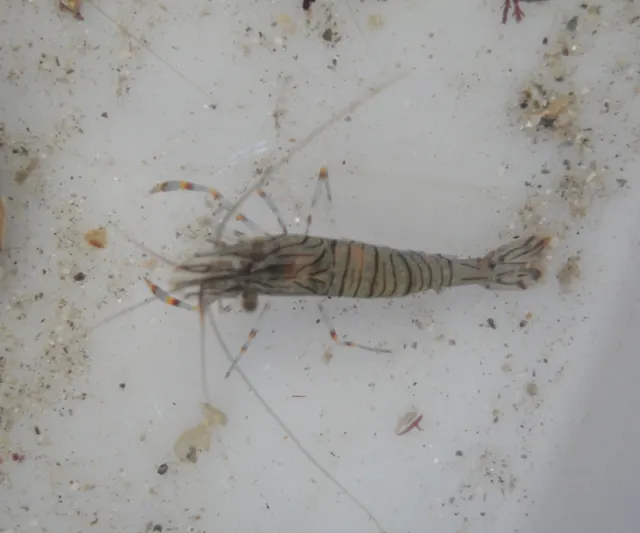 Common prawnWhere prawns concentrate over shallow eelgrass and rock in clear water, a fine-meshed cast net takes them in numbers, and the same net is used for the small fish sharing that ground.
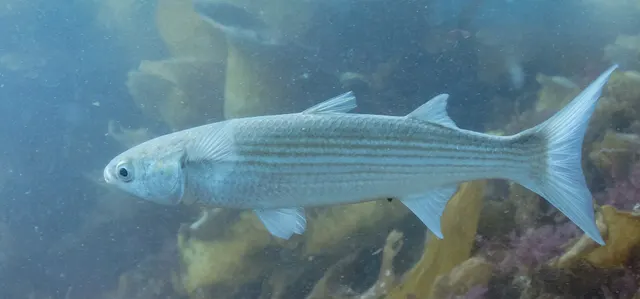 Flathead grey mulletMullet are the cast net's archetypal catch across the warm temperate and tropical world. They shoal densely in shallow, clear, hard-bottomed water — estuary margins, harbour edges, sand flats — where a thrown net can be seen to land and can enclose a whole shoal, and they are almost impossible to take in numbers any other way because of how selectively they feed.
How it works
Everything depends on the net opening fully before it lands. A net thrown as a bundle sinks as a bundle; a net opened into a disc lands as a circle several metres across and its lead line reaches the bottom in a fraction of a second, enclosing the water column beneath it before the fish inside can leave.
The closing action is what makes it a trap rather than a cover. The hand line runs to the centre of the net and, through a system of brail lines, to the lead line at the rim. Pulling it draws the leads together underneath, so the net becomes a bag. Fish that have swum toward the perimeter — which is what fish do — are gathered into the pockets formed around the rim rather than escaping under it.
Mesh size is the selectivity control and it is why mesh is regulated. A fine mesh takes anchovies and holds prawns; a coarse mesh lets them through and takes only larger fish. Radius decides how much water is covered and how hard the net is to throw: a large net is heavier, opens less easily, and is beyond most people's ability to throw well.
Conditions
Shallow water over sand, shell, gravel or firm mud, clear enough to see a shoal, and calm enough to see into. Wind ruins both the throw and the visibility. It is most productive where shoaling fish are concentrated by structure or tide — a harbour wall, a channel edge, a bar, a bridge light at night. It is useless in deep water, in heavy weed, in a strong current that carries the net before it sinks, and over rough ground that snags the lead line.
Common mistakes
- Throwing a net that has not been loaded properly. Most failures to open happen before the net leaves the hand.
- Not putting the hand line on the wrist. Nets are lost this way on the first throw of a first session.
- Using it over ground that will snag or tear it — rock, timber, and anything with a lot of weed.
- Emptying the net on the bank rather than in the water, which kills everything that was going to be released.
- Assuming it is legal. It very often is not, and cast netting is one of the practices most likely to be enforced against.
Advantages
- It takes quantities of small shoaling fish that cannot practically be taken on a hook.
- One person, no boat, no bait, and the whole apparatus rolls into a bucket.
- Selectivity is genuinely controllable through mesh size, unlike most netting.
- Unwanted fish can be released immediately and in good condition if the net is emptied in the water rather than on the bank.
Limitations
- The throw is a real skill and most people are bad at it for a long time.
- It only works in shallow, reasonably clear water over clean bottom, which is a narrow set of conditions.
- It is heavily regulated almost everywhere and prohibited in many waters entirely.
- It is unselective within its mesh size — everything of that size in the circle comes up, whether it was the target or not.
Terms you will meet
- Brail lines
- The lines running from the net's centre to the lead line, which draw the weighted rim closed into a purse when the hand line is pulled.
- Lead line
- The weighted rope around the net's circumference. Its weight per unit length decides how fast the net sinks, which decides what it can catch.
- Horn
- The fitting at the centre of the net where the brail lines and the hand line meet.
- Atarraya
- The Spanish name for a cast net, and the one most commonly seen on nets sold in the Americas.
History, and what it says about the people who used it
The cast net is one of a small number of fishing devices that appear independently almost everywhere, and it is depicted in Egyptian tomb painting, described in classical Greek and Roman texts, and recorded across South Asia, Southeast Asia, West Africa, the Mediterranean and the Americas long before those regions were in contact in any systematic way. It is a device that gets invented repeatedly because the problem it solves — a shoal of small fish in shallow water, and no way to hook them — occurs everywhere there is a coast or a river.
What is more interesting than its spread is its social position. Across a great many of those cultures the cast net is subsistence and small-scale commercial equipment rather than sport equipment, and it is frequently the tool of the person fishing for their own table. That has left a mark on how it is regulated: in societies where recreational fishing was codified by people who fished with rods, netting was frequently restricted or prohibited outright, and the restriction often fell hardest on the people who had always used it.
In Britain the outcome is stark. Netting freshwater fish is generally an offence without specific authorisation, and the cast net effectively does not exist as a recreational practice, while remaining ordinary equipment a short distance away across the Channel and unremarkable across most of the world. That is a legal and historical fact about Britain rather than a fact about the net.
What experienced anglers do — why, and the sources (2)
Widely and independently recommended by experienced anglers and specialist sources. This is real angling knowledge, not proof: controlled evidence for it is limited, and FishingHQ records it as convention rather than as a demonstrated effect.
- Fishers' Craft and Lettered Art: Tracts on Fishing from the End of the Middle Ages — University of Toronto Press, 1997 (Scientific literature)Relied on for: The long documentary record of traditional and pre-industrial fishing practices, and how such traditions are read.States this directlyCitation checked — the work exists and is described correctly
- Words of the Lagoon: Fishing and Marine Lore in the Palau District of Micronesia — University of California Press, Berkeley, 1981 (Reference work)Relied on for: That traditional fishing practices encode detailed knowledge of fish behaviour, and that the practice is frequently the record of the biology.Background and mechanism onlyCitation checked — the work exists and is described correctly
Safety
Entanglement — Can cause injury needing treatment
The hand line is attached to the thrower's wrist and the net is heavy. A net thrown from a boat, a wall or a rock with the line fouled, or thrown while standing in water, can pull the thrower in, and a person in the water inside or beside a weighted net is entangled with something that sinks.
What reduces it: Check the line is clear before every throw, never attach it to anything that is not a wrist loop you can shed, and do not throw from a height or from an unstable position over deep water.
Slips, trips and falls — Can cause injury needing treatment
Cast netting is done from harbour walls, rocks, jetties and the water's edge, with a heavy net, a rotating throw and wet ground underfoot. The throw itself moves the thrower's weight.
What reduces it: Choose a stable footing with room to turn, and treat wet stone, weed-covered rock and steep banks as places not to throw from.
Check the rules before you fish
Fishing laws, bylaws, access rules, seasons, bait restrictions and permitted methods vary by location and can change. Check the current rules from the relevant authority and the water you intend to fish before fishing.
Check with:
- Current national or regional law for where you are fishing
- Current local bylaws
- The relevant fisheries authority
- The landowner, club or fishery whose water it is
- Any restrictions specific to the species or the method you intend to use
Where to go next
Related techniques
Compared with
History and culture
More methods
Not related to this page — just the rest of the section. There is little else joined to this subject yet, and a short page should still lead somewhere.
Sources and evidence
- FAO fishing gear types and fishing technology information — Food and Agriculture Organization of the United Nations (Scientific institute)Relied on for: Classification, construction and operating principle of this gear type in the FAO gear taxonomy.States this directlyCitation checked — the work exists and is described correctly
- Fishers' Craft and Lettered Art: Tracts on Fishing from the End of the Middle Ages — University of Toronto Press, 1997 (Scientific literature)Relied on for: That fishing practices develop around the fish and water available to them, and the historical method of reading such traditions.Background and mechanism onlyCitation checked — the work exists and is described correctly
- Fishers' Craft and Lettered Art: Tracts on Fishing from the End of the Middle Ages — University of Toronto Press, 1997 (Scientific literature)Relied on for: The long documentary record of traditional and pre-industrial fishing practices, and how such traditions are read.States this directlyCitation checked — the work exists and is described correctly
- Words of the Lagoon: Fishing and Marine Lore in the Palau District of Micronesia — University of California Press, Berkeley, 1981 (Reference work)Relied on for: That traditional fishing practices encode detailed knowledge of fish behaviour, and that the practice is frequently the record of the biology.Background and mechanism onlyCitation checked — the work exists and is described correctly
Why the 5 connections on this page are here, and the sources
What it catches
What experienced anglers do — 2 connections
Widely and independently recommended by experienced anglers and specialist sources. This is real angling knowledge, not proof: controlled evidence for it is limited, and FishingHQ records it as convention rather than as a demonstrated effect.
Common prawn
Established angling practice for this species, recorded as convention. The note states the property of the animal or its water that makes the method the answer.
- Fishers' Craft and Lettered Art: Tracts on Fishing from the End of the Middle Ages — University of Toronto Press, 1997 (Scientific literature)Relied on for: That fishing practices develop around the fish and water available to them, and the historical method of reading such traditions.Background and mechanism onlyCitation checked — the work exists and is described correctly
- FAO fishing gear types and fishing technology information — Food and Agriculture Organization of the United Nations (Scientific institute)Relied on for: Classification and operation of the gear type described.States this directlyCitation checked — the work exists and is described correctly
Flathead grey mullet
Established angling practice for this species, recorded as convention. The note states the property of the animal or its water that makes the method the answer.
- Fishers' Craft and Lettered Art: Tracts on Fishing from the End of the Middle Ages — University of Toronto Press, 1997 (Scientific literature)Relied on for: That fishing practices develop around the fish and water available to them, and the historical method of reading such traditions.Background and mechanism onlyCitation checked — the work exists and is described correctly
- FAO fishing gear types and fishing technology information — Food and Agriculture Organization of the United Nations (Scientific institute)Relied on for: Classification and operation of the gear type described.States this directlyCitation checked — the work exists and is described correctly
Related techniques
What experienced anglers do — 1 connection
Widely and independently recommended by experienced anglers and specialist sources. This is real angling knowledge, not proof: controlled evidence for it is limited, and FishingHQ records it as convention rather than as a demonstrated effect.
Traditional net fishing
Gear classification is documented by an intergovernmental body whose purpose is exactly that, and the placement claim here does not go beyond the classification.
- FAO fishing gear types and fishing technology information — Food and Agriculture Organization of the United Nations (Scientific institute)Relied on for: Classification and description of world fishing gears, including cast nets, push nets, traps and their operation.States this directlyCitation checked — the work exists and is described correctly
- Words of the Lagoon: Fishing and Marine Lore in the Palau District of Micronesia — University of California Press, Berkeley, 1981 (Reference work)Relied on for: Traditional fishing knowledge and practice in Pacific island communities, including gear, timing and customary management.Background and mechanism onlyCitation checked — the work exists and is described correctly
Compared with
What experienced anglers do — 1 connection
Widely and independently recommended by experienced anglers and specialist sources. This is real angling knowledge, not proof: controlled evidence for it is limited, and FishingHQ records it as convention rather than as a demonstrated effect.
Prawn push-netting
Two records a reader would reasonably weigh against one another, joined where reading both teaches something neither says alone.
- Freshwater Fishing — Macdonald & Jane's, 1975 (Specialist angling publication)Relied on for: Comprehensive angling practice including tackle, presentation and the reasoning behind terminal tackle choices.States this directlyCitation checked — the work exists and is described correctly
- Angling Times — Bauer Media (Specialist angling publication)Relied on for: Contemporary UK angling practice as reported by practitioners, including tackle convention, rig use and technique.Background and mechanism onlyCitation checked — the work exists and is described correctly
History and culture
What experienced anglers do — 1 connection
Widely and independently recommended by experienced anglers and specialist sources. This is real angling knowledge, not proof: controlled evidence for it is limited, and FishingHQ records it as convention rather than as a demonstrated effect.
Indigenous fishing knowledge and practice
A record joined to the history behind it. Historical placement rests on the documentary and scholarly sources cited; where the tradition is living rather than documented, the claim is kept at the level those sources support.
- Words of the Lagoon: Fishing and Marine Lore in the Palau District of Micronesia — University of California Press, Berkeley, 1981 (Reference work)Relied on for: Systematic documentation of traditional fishing knowledge and customary marine management in Pacific island communities.States this directlyCitation checked — the work exists and is described correctly
- Code of Conduct for Responsible Fisheries — Food and Agriculture Organization of the United Nations, Rome, 1995 (Standards body)Relied on for: International principles for responsible fisheries including recognition of traditional and small-scale fisheries and their knowledge.States this directlyCitation checked — the work exists and is described correctly
How FishingHQ labels evidence is explained in the evidence policy.