Common prawn
Fish · Last reviewed 2026-08-12
The translucent rock-pool prawn taken by hand net and drop net around Atlantic Europe, and the animal behind a shore practice FishingHQ modelled only as bait.
Safety: slips, trips and falls — can cause injury needing treatment. 3 more points apply here.
How this was identified, and who took it
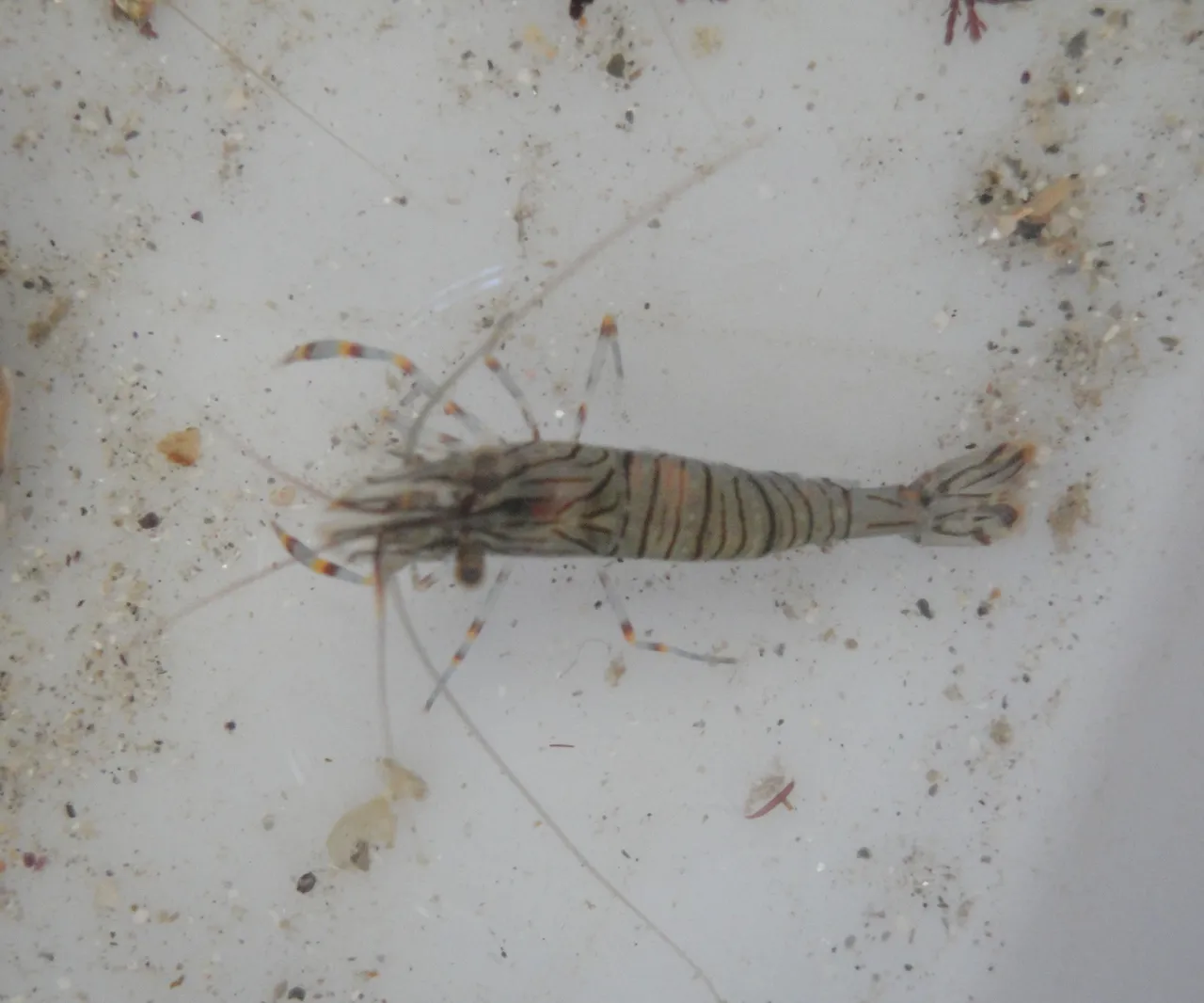
Identified by: The record's character is unmistakable here: an almost transparent body carrying fine reddish-brown longitudinal and oblique lines over the carapace and abdomen, with banded orange-and-white antennae and walking legs, and no trace of the pink that only cooking produces. The whole animal including the tail fan is in frame against a plain ground.Donald Davesne — CC BY, via iNaturalist — source, licenceCatching Common prawn
Everything here on fishing for it. Each entry opens the page behind it.
The common prawn is almost transparent in life, marked with fine reddish-brown lines, and it is the animal most people in Britain, Ireland and Atlantic Europe catch when they take a net to a harbour or a rock pool. It is a small, active, scavenging crustacean that shelters in weed, under overhangs and among rock during the day and moves out to feed as the light goes.
It is caught by working a fine-meshed hand net through weed and along walls, by baited drop nets in harbours, and in some places by traps. The technique is simple and the knowledge is not: prawns hold in specific kinds of cover, they move with the tide and the light, and a net worked the wrong way through weed catches nothing while the same net worked upward from beneath the cover fills.
FishingHQ modelled this animal as `prawn-and-shrimp-bait` for twenty-seven sprints — as something to put on a hook. A very large number of people catch prawns to eat them, and until an earlier pass there was no category for that.
How it is caught
- Cast nettingWhere prawns concentrate over shallow eelgrass and rock in clear water, a fine-meshed cast net takes them in numbers, and the same net is used for the small fish sharing that ground.
- Prawn push-nettingThe foot-rope disturbs them off clean sand and their backwards escape flick carries them into the net following behind.
Identification
- Scientific name
- Palaemon serratus
- Family
- Palaemonidae
- Water
- Saltwater, Brackish
- Conservation status
- Not assessed
- Regions
- Britain & Ireland, Northern Europe, Western Europe, Mediterranean, North Africa
- Almost transparent body marked with fine reddish-brown longitudinal lines, turning pink only on cooking.
- A long, upward-curving, serrated rostrum projecting between the eyes and beyond the antennal scale — the feature the species name refers to and the most reliable identifier.
- Two pairs of slender pincered legs at the front, unlike the shrimp of soft ground.
- Large stalked eyes and very long antennae, frequently longer than the body.
- Distinguished from the brown shrimp of sandy ground, which is opaque, sandy-coloured, flattened and has a short rostrum.
Size
- Typical
- 6–8 cm total length for animals commonly netted.
- Large
- Over 9 cm.
Exceptional: Total lengths around 11 cm are recorded for large females in the scientific literature. Prawn sizes are quoted as total length including the rostrum, which is why figures vary between sources that measure differently.
How big prawns get, and why the figures disagree
Prawn sizes are quoted as TOTAL LENGTH, and the disagreement between sources comes from where the measurement starts: the rostrum — the serrated spike projecting forward between the eyes — is a substantial fraction of the animal, and not everybody includes it.
ORDINARY ANIMALS netted from harbours and rock pools run six to eight centimetres.
A GOOD ONE is over nine centimetres, which in a net full of prawns is immediately obvious.
THE EXCEPTIONAL END reaches around eleven centimetres, recorded for large females. Females grow larger than males in this species, so the big ones in any catch are predominantly female and frequently berried.
GROWTH IS BY MOULTING and is rapid in warm conditions, with animals surviving around three years. That is a short life and a fast turnover, and it means abundance in a given harbour can change markedly between years without any obvious cause — a good breeding season and a mild winter show up in the nets within months.
THERE IS USUALLY NO STATUTORY MINIMUM SIZE for recreational prawning, which puts the judgement entirely on the person holding the net. The sensible working rule is the practical one: small prawns are fiddly, they yield almost nothing, and returning them costs nothing. A net worked over the same ground repeatedly through a season will show you whether you are taking too many, and the answer arrives faster than it does with any fish.
AND BERRIED FEMALES — carrying eggs attached beneath the abdomen, easily seen against the translucent body — are worth returning even where no rule requires it. They are the visible part of next year's catch, and in a small harbour worked by a few people it is a decision that genuinely shows.
Backed by research — why, and the sources (2)
Supported by peer-reviewed research or fisheries science. The sources are listed and can be checked.
- FishBase: a global information system on fishes — Froese, R. and D. Pauly, eds. — FishBase Consortium (Scientific institute)Relied on for: Size, growth, moult biology, life history and measurement convention for the species, with SeaLifeBase as its sister database for non-finfish taxa.States this directlyPassage read and verified
- Code of Conduct for Responsible Fisheries — Food and Agriculture Organization of the United Nations, Rome, 1995 (Standards body)Relied on for: That minimum sizes are set against size at maturity and are specified on a body dimension particular to each taxon, which is why the measurement convention is the rule rather than a convention.Background and mechanism onlyCitation checked — the work exists and is described correctly
Handling prawns, and the hour that decides whether they are worth eating
Prawns cannot hurt you in any meaningful way and they are the easiest catch on FishingHQ to ruin. Almost everything about handling them is about time and temperature.
THE ONLY THING THAT PRICKS is the rostrum, the serrated spike between the eyes, which will mark a palm if an animal is gripped hard. Pick them up rather than grabbing them and it does not arise.
NOW THE PART THAT MATTERS. Decapod tissue breaks down after death far faster than fish does, through the animal's own enzymes, and in prawns it is fast enough to be measured in hours rather than days. A prawn left in a warm bucket goes soft, the flesh separates from the shell, and the head darkens. None of that is spoilage in the bacterial sense and all of it makes the catch unpleasant.
SO THERE ARE TWO ACCEPTABLE STATES: alive and cool, or dead and cold. Keep them in cool aerated seawater changed regularly, or kill and chill them immediately — a short immersion in iced seawater does both at once and is what commercial handling does for the same reason. Cook within hours rather than overnight.
DO NOT CROWD THEM. A bucket packed with prawns in warm water deoxygenates within minutes, not hours, and the catch dies before you have finished netting. This is the same failure that kills crabbing catches and it happens faster with prawns because they are smaller and more active.
RETURNING THEM. Put unwanted prawns back into cover — weed, under an overhang, into the shadow of a wall — rather than into open water. A prawn dropped into the open in daylight is taken immediately, which turns a release into a feeding of the local wrasse.
AND THE GROUND IS THE ACTUAL HAZARD IN THIS FISHERY. Prawning happens on weed-covered harbour steps, wet rock and pier ladders, usually at dusk, usually while looking down into water rather than at your feet. The prawn is harmless; the surface you are standing on is not.
Backed by research — why, and the sources (2)
Supported by peer-reviewed research or fisheries science. The sources are listed and can be checked.
- FishBase: a global information system on fishes — Froese, R. and D. Pauly, eds. — FishBase Consortium (Scientific institute)Relied on for: Morphology, moult biology and behaviour underlying the handling described, with SeaLifeBase as its sister database for non-finfish taxa.States this directlyPassage read and verified
- General angling website restatements of established technique — Various (Credible secondary source)Relied on for: Widely restated handling practice for this species, recorded as practitioner consensus rather than as tested fact.Background and mechanism onlyCitation checked — the work exists and is described correctly
Weed, rock pool and pier piling: an animal that lives in the structure rather than on the ground
Common prawns occupy the three-dimensional space inside coastal structure rather than a surface, which is why they are found by putting a net into something rather than by looking at the bottom.
THE HABITAT IS SHALLOW, SHELTERED, STRUCTURALLY COMPLEX INSHORE WATER. Prawns use rock pools, gullies, weed beds, eelgrass, kelp stipes, harbour walls, pier and jetty pilings, pontoons, breakwaters and any other submerged structure that carries growth. What they need is cover to hide in and surfaces to forage over, and they are as content on an artificial wall as on natural reef — which is why harbours are among the most reliable prawn ground anywhere.
TRANSPARENCY IS THE HABITAT ADAPTATION. A common prawn is almost invisible against weed and shadow, and its concealment strategy depends on being in among something rather than on running away. That is why they hold tight to structure, why they are far more numerous than they appear, and why the way to establish whether a wall holds prawns is to work a net through the weed on it rather than to look.
THEY MOVE UP AND DOWN THE SHORE WITH THE TIDE AND WITH THE SEASON. Prawns work into the intertidal on the flood and retreat with the ebb, using pools as refuges when the tide leaves them behind. Over the year they tend to move offshore into deeper water in winter and return to the shallows as water warms, so shore ground that is thick with prawns in late summer may be empty in February — a seasonal absence rather than a decline.
SALINITY TOLERANCE EXTENDS THE RANGE INTO ESTUARIES, where prawns occupy the lower and middle reaches wherever there is structure, sharing that ground with the more strongly estuarine shrimps.
AND THE PRAWN'S HABITAT IS ALSO ITS ECOLOGICAL ROLE. Prawns are both scavenger-grazers cleaning surfaces of detritus and small organisms, and prey for almost every inshore predator — bass, pollack, wrasse, cod, cuttlefish. Their concentration in structure is precisely why those predators hunt structure. Anybody thinking about where a bass sits around a harbour wall at night is, in effect, thinking about prawn habitat.
Backed by research — why, and the sources (2)
Supported by peer-reviewed research or fisheries science. The sources are listed and can be checked.
- Cefas science, advice and data on marine and freshwater environments — Centre for Environment, Fisheries and Aquaculture Science (Government fisheries body)Relied on for: Habitat, ground type, depth and distribution of commercially and recreationally gathered shellfish in British and north-west European waters.States this directlyCitation checked — the work exists and is described correctly
- Good Fish Guide — Marine Conservation Society (Conservation authority)Relied on for: Stock and fishery assessment, including the ground the species occupies.Background and mechanism onlyCitation checked — the work exists and is described correctly
Inshore in summer, offshore in winter, and a berried female in the cold months
Prawn seasonality is one of the most reliable inshore patterns on a temperate coast, and it is driven by temperature acting on a short-lived animal.
THE MOVEMENT IS SHALLOW-IN-SUMMER, DEEP-IN-WINTER. Common prawns work into the intertidal and shallow inshore structure as water warms through spring, reach peak abundance in the shallows through late summer and autumn, and retreat to deeper water as the shallows cool. A harbour wall that is thick with prawns in September holds almost none in February, and the prawns have not died — they have moved down.
WHICH MAKES LATE SUMMER AND AUTUMN THE PRODUCTIVE WINDOW for anybody working shore structure, and it is also when the animals are largest, because a season's growth has accumulated.
THE BREEDING CYCLE RUNS THROUGH THE COLDER MONTHS in most populations, which is the opposite of what people assume. Females carry eggs attached beneath the abdomen — the 'berried' condition — through winter and into spring, releasing larvae into the plankton as the water warms and the food supply arrives. So the animals in deeper water in the cold months are the reproducing ones, and the shallow summer population is a feeding and growing population.
GROWTH IS FAST AND LIFE IS SHORT, which makes the seasonal signal unusually sharp. A prawn population turns over quickly, so abundance in any given autumn reflects that year's recruitment rather than a long accumulation, and prawn numbers swing between years accordingly.
MOULTING IS THE OTHER SEASONAL PROCESS AND IT IS TEMPERATURE-DRIVEN. Prawns grow by moulting, moulting frequency rises with temperature, and a freshly moulted prawn is soft and hides until the shell hardens. Warm-water periods therefore produce both faster growth and periodic dips in how many animals are out in the open.
AND FOR THE PREDATORS THAT MATTERS AS MUCH AS FOR THE PRAWNS. The late-summer concentration of prawns in shallow structure is a substantial food pulse for bass, pollack, wrasse and cuttlefish, and a good deal of inshore autumn fishing is really an expression of prawn seasonality. Where prawns may be gathered, in what quantity and by what method is a separate question with a local answer.
Backed by research — why, and the sources (2)
Supported by peer-reviewed research or fisheries science. The sources are listed and can be checked.
- Cefas science, advice and data on marine and freshwater environments — Centre for Environment, Fisheries and Aquaculture Science (Government fisheries body)Relied on for: Seasonal condition, reproductive cycle and gathering considerations for shellfish in British and north-west European waters.States this directlyCitation checked — the work exists and is described correctly
- Good Fish Guide — Marine Conservation Society (Conservation authority)Relied on for: Stock and fishery assessment, including the seasonal condition of the animal and the periods of greatest sensitivity.Background and mechanism onlyCitation checked — the work exists and is described correctly
Eggs carried through the winter, larvae released into the spring plankton
Prawn reproduction is a compact and efficient cycle in a short-lived animal, and its timing is the reverse of what most people assume.
THE FEMALE CARRIES THE EGGS AND SHE CARRIES THEM THROUGH THE COLD. After mating — which, as in most decapods, occurs when the female has recently moulted and her shell is soft — the eggs are attached to appendages beneath the abdomen and brooded there. In common prawns this brooding takes place largely through the autumn and winter months, so the berried females are in deeper water in the cold season rather than in the shallow summer population.
LARVAE ARE RELEASED INTO THE PLANKTON AS THE WATER WARMS, timed to coincide with the spring production that will feed them. They pass through several planktonic larval stages before settling into the shallow structured habitat the adults use. That timing is the whole reproductive strategy: brood through the unproductive months, release into the productive ones.
WHICH MEANS THE ANIMAL A GATHERER MEETS IN LATE SUMMER IS THE GROWING GENERATION, not the breeding one. The large prawns of autumn are that year's recruits fattened up; the breeding stock is elsewhere and deeper.
GROWTH AND REPRODUCTION BOTH DEPEND ON MOULTING, and a prawn cannot grow without shedding its shell. A female cannot moult while berried, so reproductive investment directly costs growth, and heavily reproducing individuals stay smaller.
LIFE IS SHORT AND TURNOVER IS FAST, so the population is rebuilt over a small number of years and abundance responds quickly to conditions. A poor larval year shows up in the shore population the following autumn rather than several years later, which makes prawn numbers unusually volatile and unusually responsive.
AND THE ECOLOGICAL CONSEQUENCE IS LARGER THAN THE ANIMAL. The spring release of prawn larvae and the summer growth of juveniles is a substantial contribution to inshore productivity, feeding everything from small fish to cuttlefish. Prawn reproduction is, in effect, part of the food supply of the whole inshore system.
WHERE PRAWNS MAY BE GATHERED, BY WHAT METHOD AND IN WHAT QUANTITY is a separate question with a local answer, and it is not derivable from the cycle above.
Backed by research — why, and the sources (2)
Supported by peer-reviewed research or fisheries science. The sources are listed and can be checked.
- Cefas science, advice and data on marine and freshwater environments — Centre for Environment, Fisheries and Aquaculture Science (Government fisheries body)Relied on for: Reproductive cycle, berried condition, larval development and recruitment of shellfish in British and north-west European waters.States this directlyCitation checked — the work exists and is described correctly
- Good Fish Guide — Marine Conservation Society (Conservation authority)Relied on for: Stock and fishery assessment, including the reproductive parameters that govern how a stock replaces itself.Background and mechanism onlyCitation checked — the work exists and is described correctly
Lifecycle and reproduction
Short-lived, with most animals surviving around three years. Growth is by moulting and is rapid in warm conditions. Females grow larger than males. The species produces several broods, and populations turn over quickly enough that abundance in a given harbour or stretch of shore can change markedly between years without any obvious cause.
Females carry fertilised eggs attached beneath the abdomen for some weeks before releasing planktonic larvae, and berried females are common in the catch through the warmer months. Breeding occurs over an extended season rather than in a single event. Returning berried females is not usually a legal requirement at this scale but is straightforward and worth doing, particularly where a small area is worked repeatedly.
Feeding and senses
An omnivorous scavenger taking algae, detritus, small invertebrates and carrion, working surfaces and weed with the small front pincers. Scent draws them readily, which is why a baited drop net works and why an oily bait outfishes a bland one.
Chemoreception through the antennae and antennules dominates food-finding, and the very long antennae are also a contact and flow sense used continuously while moving through cover. The compound eyes are good at detecting movement and shadow — which is why an approaching net or a shadow cast over a pool empties it — and poor at resolving detail.
Through the year
Prawns move into shallow inshore ground and rock pools as water warms and retreat to deeper water in winter, so the practical season is the warmer half of the year in the northern part of the range. Within a day they emerge from cover as light falls, and a harbour that appears empty in bright afternoon sun can be full at dusk. Tide matters as much: the flood brings them up onto ground the ebb leaves dry.
Distribution
Eastern Atlantic from Denmark and the southern North Sea south to Mauritania, including all around Britain and Ireland, and throughout the Mediterranean and into the Black Sea. Found from the intertidal to around forty metres, associated with weed, rock, harbour structure and any complex cover.
This is a biological range — where the species occurs, not a prediction that you will catch one. To browse the fishing geography FishingHQ holds, start at fishing places.
Why anglers care
Taken with fine hand nets and baited drop nets from harbours, rock pools and pier walls, and one of the most accessible forms of shore fishing there is — no rod, no licence in most places, and a real catch. It is also a prized bait, which is how FishingHQ came to hold `prawn-and-shrimp-bait` and nothing about catching them for the table.
Handling and returning
Prawns are harmless to handle, though the serrated rostrum will prick a palm if one is gripped tightly. The real handling question is keeping them.
They deteriorate extremely fast. Enzymatic breakdown after death is rapid in decapods, and prawns left in a warm bucket become soft and unpleasant within an hour or two. Keep them alive in cool aerated seawater changed regularly, or kill and chill them immediately — a brief immersion in iced seawater does both. They should be cooked within hours rather than kept overnight.
Do not crowd them. A bucket packed with prawns in warm water deoxygenates quickly and the catch dies before it is home. Where animals are being returned, do it promptly and into cover rather than into open water, since a prawn dropped in the open is taken immediately.
Safety
Slips, trips and falls — Can cause injury needing treatment
Prawning happens on wet rock, weed-covered harbour steps and pier ladders, usually while looking down into water and often at dusk. The animal is harmless; the ground is the hazard.
What reduces it: Footwear with grip, care on weed and on harbour steps, and a light if working into dusk. Do not lean over an edge to reach a net.
Tides and being cut off — Can cause injury needing treatment
Rock-pool and low-water prawning takes people onto ground that the flood covers, and the flood can fill a gully behind somebody who is concentrating on a pool.
What reduces it: Know the state of the tide and the exit before starting, and set a time to leave rather than leaving when the fishing slows.
Precautions that always apply here
- Check the tide before you go and know your exit route. Being cut off is the commonest way a shore session becomes a rescue.
- Tell somebody where you are going and when you expect to be back.
Check the rules before you fish
Fishing laws, bylaws, access rules, seasons, bait restrictions and permitted methods vary by location and can change. Check the current rules from the relevant authority and the water you intend to fish before fishing.
Check with:
- Current national or regional law for where you are fishing
- Current local bylaws
- The relevant fisheries authority
- The landowner, club or fishery whose water it is
- Any restrictions specific to the species or the method you intend to use
Where to go next
Where it lives
- Harbours, piers and breakwatersHarbour walls, steps and pier structure hold prawns in the weed and among the stone, and the baited drop net worked from above is the standard way of taking them. They move out of cover as the light goes, so a wall that looks empty in the afternoon is not at dusk.
- Rocky shores and reefsWeed-filled rock pools and overhangs on the low shore are the classic hand-net ground, and the prawns are in the cover rather than in the open water of the pool.
Told apart from
More fish
Not related to this page — just the rest of the section. There is little else joined to this subject yet, and a short page should still lead somewhere.
Sources and evidence
- FishBase: a global information system on fishes — Froese, R. and D. Pauly, eds. — FishBase Consortium (Scientific institute)Relied on for: Taxonomy, distribution, depth range, size and life-history data for the species, with SeaLifeBase as its sister database for non-finfish taxa.States this directlyPassage read and verified
Why the 5 connections on this page are here, and the sources
How it is caught
What experienced anglers do — 2 connections
Widely and independently recommended by experienced anglers and specialist sources. This is real angling knowledge, not proof: controlled evidence for it is limited, and FishingHQ records it as convention rather than as a demonstrated effect.
Cast netting
Established angling practice for this species, recorded as convention. The note states the property of the animal or its water that makes the method the answer.
- Fishers' Craft and Lettered Art: Tracts on Fishing from the End of the Middle Ages — University of Toronto Press, 1997 (Scientific literature)Relied on for: That fishing practices develop around the fish and water available to them, and the historical method of reading such traditions.Background and mechanism onlyCitation checked — the work exists and is described correctly
- FAO fishing gear types and fishing technology information — Food and Agriculture Organization of the United Nations (Scientific institute)Relied on for: Classification and operation of the gear type described.States this directlyCitation checked — the work exists and is described correctly
Prawn push-netting
The method is the established way this species is taken recreationally.
- General angling website restatements of established technique — Various (Credible secondary source)Relied on for: Widely restated practice connecting this species to this method.Background and mechanism onlyCitation checked — the work exists and is described correctly
- FAO fishing gear types and fishing technology information — Food and Agriculture Organization of the United Nations (Scientific institute)Relied on for: Gear classification and operating principle for the method described.States this directlyCitation checked — the work exists and is described correctly
Where it lives
Backed by research — 2 connections
Supported by peer-reviewed research or fisheries science. The sources are listed and can be checked.
Harbours, piers and breakwaters
Habitat association recorded for the species rather than inferred from the fishery.
- FishBase: a global information system on fishes — Froese, R. and D. Pauly, eds. — FishBase Consortium (Scientific institute)Relied on for: Habitat association, depth range, diet and distribution for the species, with SeaLifeBase as its sister database for non-finfish taxa.States this directlyPassage read and verified
A claim that a place contains the ground and conditions the animal is associated with. It is a distributional statement about the world and rests on reference works, and it deliberately asserts nothing about access or permission.
- The Fishes of the British Isles and North-West Europe — Macmillan, 1969 (Reference work)Relied on for: Distribution and habitat association of the inshore fauna of the British Isles and the north-east Atlantic.States this directlyCitation checked — the work exists and is described correctly
- FishBase: a global information system on fishes — Froese, R. and D. Pauly, eds. — FishBase Consortium (Scientific institute)Relied on for: Recorded distribution and habitat association for the species where held.Background and mechanism onlyPassage read and verified
- The IUCN Red List of Threatened Species — International Union for Conservation of Nature (Conservation authority)Relied on for: Range and recorded threats for the species where assessed.Background and mechanism onlyCitation checked — the work exists and is described correctly
Rocky shores and reefs
Habitat association recorded for the species rather than inferred from the fishery.
- FishBase: a global information system on fishes — Froese, R. and D. Pauly, eds. — FishBase Consortium (Scientific institute)Relied on for: Habitat association, depth range, diet and distribution for the species, with SeaLifeBase as its sister database for non-finfish taxa.States this directlyPassage read and verified
A claim that a place contains the ground and conditions the animal is associated with. It is a distributional statement about the world and rests on reference works, and it deliberately asserts nothing about access or permission.
- The Fishes of the British Isles and North-West Europe — Macmillan, 1969 (Reference work)Relied on for: Distribution and habitat association of the inshore fauna of the British Isles and the north-east Atlantic.States this directlyCitation checked — the work exists and is described correctly
- FishBase: a global information system on fishes — Froese, R. and D. Pauly, eds. — FishBase Consortium (Scientific institute)Relied on for: Recorded distribution and habitat association for the species where held.Background and mechanism onlyPassage read and verified
- The IUCN Red List of Threatened Species — International Union for Conservation of Nature (Conservation authority)Relied on for: Range and recorded threats for the species where assessed.Background and mechanism onlyCitation checked — the work exists and is described correctly
Told apart from
What experienced anglers do — 1 connection
Widely and independently recommended by experienced anglers and specialist sources. This is real angling knowledge, not proof: controlled evidence for it is limited, and FishingHQ records it as convention rather than as a demonstrated effect.
Brown shrimp
A comparison a reader with the animal or the decision in front of them actually needs, joining two records that resolve one another.
- The Fishes of the British Isles and North-West Europe — Macmillan, 1969 (Reference work)Relied on for: Distribution, habitat association, identification and biology of the fishes and inshore fauna of the British Isles and north-west Europe.States this directlyCitation checked — the work exists and is described correctly
- FAO Species Identification Guides for Fishery Purposes and the FAO Species Catalogues — Food and Agriculture Organization of the United Nations (Scientific institute)Relied on for: Diagnostic characters, family placement, habitat and depth range as set out in the FAO species identification sheets for the eastern Atlantic and Mediterranean.States this directlyCitation checked — the work exists and is described correctly
Backed by research — 1 connection
Supported by peer-reviewed research or fisheries science. The sources are listed and can be checked.
Brown shrimp
Taxonomic and practical relatedness recorded because confusable species matter more to a reader than a shared family does, with the evidence naming the species the edge is about.
- The Fishes of the British Isles and North-West Europe — Macmillan, 1969 (Reference work)Relied on for: Identification characters, family placement and biology of Palaemon serratus and of the species it is confused with, as set out for the fauna of the British Isles and north-west Europe.States this directlyCitation checked — the work exists and is described correctly
- FAO Species Identification Guides for Fishery Purposes and the FAO Species Catalogues — Food and Agriculture Organization of the United Nations (Scientific institute)Relied on for: Diagnostic characters and family placement of Palaemon serratus as set out in the FAO species identification sheets for the region concerned.States this directlyCitation checked — the work exists and is described correctly
How FishingHQ labels evidence is explained in the evidence policy.