Prawn push-netting
Method · Last reviewed 2026-08-12
A beam-framed net pushed ahead of a wader over shallow sand, disturbing shrimp and prawns off the bottom and into the mouth — one of the oldest shore practices in northern Europe.
Safety: drowning and immersion — can cause serious injury or death. 6 more points apply here.
A push net is a wide, shallow, beam-framed net with a long handle and a weighted or chain foot-rope along its leading edge, pushed ahead of somebody wading in shallow water over clean sand. The foot-rope scrapes and disturbs the surface, shrimp and prawns buried or resting there flick backwards — which is their escape response — and the mouth of the net, following immediately behind, collects them.
That escape reflex is the whole mechanism, and it is why the design has not changed in centuries. A shrimp that flees forwards would escape; one that flees backwards goes into the net. The gear is passive and the operator supplies the movement, which is the opposite of every net FishingHQ otherwise models.
It is worked on a falling or low tide over firm clean sand, usually in shallow water no deeper than the thigh, and the catch is sorted on the spot. Undersized shrimp and the juvenile flatfish that inevitably come with them go straight back, which is the whole of the conservation content of the practice and the reason several jurisdictions restrict net dimensions or the ground it may be worked over.
The practice survives in the Low Countries, northern France, parts of Britain and Ireland, and in different forms across South and Southeast Asia. It is niche, it is genuinely traditional, and FishingHQ had no category for it until the domain-first pass went looking.
What it is
A wide, shallow, beam-framed net with a long handle and a weighted or chain foot-rope along its leading edge, pushed ahead of somebody wading in shallow water over clean sand. It is among the oldest shore practices in northern Europe and it survives in the Low Countries, northern France, parts of Britain and Ireland, and in different forms across South and Southeast Asia.
What it is for
It takes an animal that no hook reaches and no baited trap concentrates, from ground that holds it in numbers, using equipment anybody can make. It is also a food practice rather than a sport one, which is part of why writing that treats fishing as rod-and-line angling has no category for it.
Setting it up
- A beam wide enough to cover ground and narrow enough to push against the water without exhausting the operator.
- A foot-rope heavy enough to stay in contact with the sand and light enough not to dig in.
- Mesh fine enough to hold shrimp and coarse enough to let sand and water pass, or the net becomes unpushable.
- A handle long enough to work the net ahead of you rather than beneath you, which is what keeps disturbed sediment behind it.
- Something to sort the catch into on the spot, because sorting later is what kills the bycatch.
What it catches
- Brown shrimpThe method page that existed with nothing to push a net for. A wide frame pushed ahead of a wader disturbs the sediment so that buried shrimp break out into the bag.
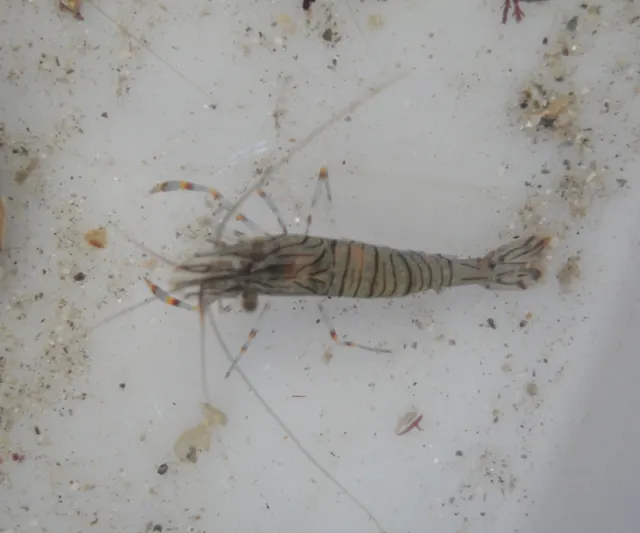 Common prawnThe foot-rope disturbs them off clean sand and their backwards escape flick carries them into the net following behind.
How it works
The foot-rope scrapes and disturbs the surface of the sand. Shrimp and prawns resting or buried there flee — and their escape response is a sharp backwards flick of the abdomen, which carries them upward and behind, directly into the mouth of the net following immediately after.
That reflex is the whole mechanism, and it is why the design has not needed to change in centuries. An animal that fled forwards would escape; one that flees backwards catches itself. The gear is passive and the operator supplies all the movement, which is the reverse of every other net on FishingHQ.
Conditions
Suits firm, clean, gently shelving sand in water no deeper than the thigh, on a falling or low tide, in the warmer part of the year, with slightly coloured water an advantage. Ruled out by soft mud, weed and broken ground, by depth, by cold, and by any surf or current strong enough to move a person — which is the condition that matters most, because the operator is wading and facing away from the shore.
Common mistakes
- Pushing too fast. The foot-rope needs time to disturb the bottom, and a net driven quickly passes over the catch.
- Lifting the beam. The foot-rope must stay in contact with the sand; a net riding above it catches nothing.
- Working out of depth. The hazard in this practice is entirely about wading, and a wader concentrating on a net does not notice depth increasing or a channel opening.
- Leaving the sorting until later. Juvenile flatfish and undersized shrimp survive if returned immediately and do not survive a bucket.
- Assuming it is unregulated because it is old. Net dimensions, permitted ground and permitted seasons are all controlled in some jurisdictions.
Advantages
- It reaches catch that no other recreational method takes in quantity.
- The equipment is simple, cheap and repairable.
- The catch is sorted alive at the point of capture, so returned bycatch genuinely survives.
Limitations
- It works only over firm clean sand, in shallow water, on the right state of tide — a narrow set of conditions.
- It is physically demanding, and the effort increases sharply with depth and with any current.
- It catches juvenile flatfish alongside the shrimp, which is why net dimensions and permitted ground are controlled in some jurisdictions.
Safety
Drowning and immersion — Can cause serious injury or death
The whole practice takes place wading, facing away from the shore, pushing gear, with attention on the net. Depth increases, channels open behind, and the flood covers ground that was dry — all of it unnoticed by somebody looking down.
What reduces it: Know the tide and the exit before starting, and set a time to leave rather than leaving when the catch slows. Never work alone on unfamiliar ground. Stay within depth you would wade without gear in your hands.
Tides and being cut off — Can cause serious injury or death
Push-netting ground is intertidal sand, which floods from behind as well as in front. Somebody working outward on an ebb can be separated from the shore by a filling channel.
What reduces it: Walk the ground at low water first. Identify the channels. Turn back well before the flood rather than at it.
Fish welfare — Can cause injury needing treatment
Push-netting over nursery ground catches juvenile flatfish alongside the shrimp. Left in a bucket while the netting continues, they die.
What reduces it: Sort the net every lift and return everything unwanted immediately, into water rather than onto sand. This is the entire conservation content of the practice.
Precautions that always apply here
- Check the tide before you go and know your exit route. Being cut off is the commonest way a shore session becomes a rescue.
- Do not wade alone. Judge depth and flow from the bank first, and turn back sooner than feels necessary.
- Tell somebody where you are going and when you expect to be back.
- Carry a charged phone in a waterproof case, or another means of calling for help.
Check the rules before you fish
Fishing laws, bylaws, access rules, seasons, bait restrictions and permitted methods vary by location and can change. Check the current rules from the relevant authority and the water you intend to fish before fishing.
Check with:
- Current national or regional law for where you are fishing
- Current local bylaws
- The relevant fisheries authority
- The landowner, club or fishery whose water it is
- Any restrictions specific to the species or the method you intend to use
Where to go next
Related techniques
Compared with
- Cast nettingTwo hand-worked nets that catch by moving the gear rather than by waiting: one pushed through shallow water, one thrown over it. The comparison is where the trade between reach and selectivity becomes visible.
- Crabbing with a line and a drop netTwo shore methods for taking crustaceans by hand-scale gear, and they work on opposite principles. A push net is driven through the water and takes animals that are disturbed off the bottom into it; a drop net sits still and takes animals that choose to walk into it. One is active and covers ground, the other is passive and works a spot.
More methods
Not related to this page — just the rest of the section. There is little else joined to this subject yet, and a short page should still lead somewhere.
Sources and evidence
- General angling website restatements of established technique — Various (Credible secondary source)Relied on for: Widely restated practice for this method, recorded as practitioner consensus rather than as tested fact.Background and mechanism onlyCitation checked — the work exists and is described correctly
- FAO fishing gear types and fishing technology information — Food and Agriculture Organization of the United Nations (Scientific institute)Relied on for: Gear classification and operating principle for the net, trap or jig type described, independently of the recreational literature.States this directlyCitation checked — the work exists and is described correctly
Why the 5 connections on this page are here, and the sources
What it catches
What experienced anglers do — 2 connections
Widely and independently recommended by experienced anglers and specialist sources. This is real angling knowledge, not proof: controlled evidence for it is limited, and FishingHQ records it as convention rather than as a demonstrated effect.
Brown shrimp
Practice, recorded as practice.
- Sea Angler — Bauer Media (Specialist angling publication)Relied on for: Contemporary UK sea angling and shore gathering practice as reported by practitioners: ground, seasonal timing, tackle, bait and method convention.States this directlyCitation checked — the work exists and is described correctly
- General angling website restatements of established technique — Various (Credible secondary source)Relied on for: Widely restated descriptions of technique, fish behaviour and regional practice, recorded as consensus rather than as scholarship.Background and mechanism onlyCitation checked — the work exists and is described correctly
Common prawn
The method is the established way this species is taken recreationally.
- General angling website restatements of established technique — Various (Credible secondary source)Relied on for: Widely restated practice connecting this species to this method.Background and mechanism onlyCitation checked — the work exists and is described correctly
- FAO fishing gear types and fishing technology information — Food and Agriculture Organization of the United Nations (Scientific institute)Relied on for: Gear classification and operating principle for the method described.States this directlyCitation checked — the work exists and is described correctly
Related techniques
What experienced anglers do — 1 connection
Widely and independently recommended by experienced anglers and specialist sources. This is real angling knowledge, not proof: controlled evidence for it is limited, and FishingHQ records it as convention rather than as a demonstrated effect.
Traditional net fishing
Gear classification from an intergovernmental source, with the historical placement supported independently.
- FAO fishing gear types and fishing technology information — Food and Agriculture Organization of the United Nations (Scientific institute)Relied on for: Classification and description of world fishing gears, including push nets and their operation in shallow water.States this directlyCitation checked — the work exists and is described correctly
- Fishers' Craft and Lettered Art: Tracts on Fishing from the End of the Middle Ages — University of Toronto Press, 1997 (Scientific literature)Relied on for: Medieval and early-modern European fishing practice, gear and the communities that used it.Background and mechanism onlyCitation checked — the work exists and is described correctly
Compared with
What experienced anglers do — 1 connection
Widely and independently recommended by experienced anglers and specialist sources. This is real angling knowledge, not proof: controlled evidence for it is limited, and FishingHQ records it as convention rather than as a demonstrated effect.
Cast netting
Two records a reader would reasonably weigh against one another, joined where reading both teaches something neither says alone.
- Freshwater Fishing — Macdonald & Jane's, 1975 (Specialist angling publication)Relied on for: Comprehensive angling practice including tackle, presentation and the reasoning behind terminal tackle choices.States this directlyCitation checked — the work exists and is described correctly
- Angling Times — Bauer Media (Specialist angling publication)Relied on for: Contemporary UK angling practice as reported by practitioners, including tackle convention, rig use and technique.Background and mechanism onlyCitation checked — the work exists and is described correctly
Official guidance — 1 connection
Stated by a fisheries authority, scientific institute or recognised angling body. Authoritative, but summarising rather than demonstrating.
Crabbing with a line and a drop net
Active gear driven through the water and passive gear that waits are the primary division in every gear classification, including the one this citation regulates by. The edge carries the principle and no numbers, because the numbers are Californian and the methods here are northern European.
- Gear restrictions for the recreational take of saltwater crustaceans, California Code of Regulations title 14 § 29.80 — California Fish and Game Commission, as published by the Legal Information Institute (Government fisheries body)Relied on for: A fisheries regulator placing hoop nets, crab traps and crab loop traps in separate gear categories, with a two-hour inspection interval for the attended kind and a nine-day servicing interval, identification markings and escape devices for the kind that is left.Passage read and verified
How FishingHQ labels evidence is explained in the evidence policy.