What does flathead grey mullet eat?
What is established about how flathead grey mullet feeds, kept separate from what anglers infer from it.
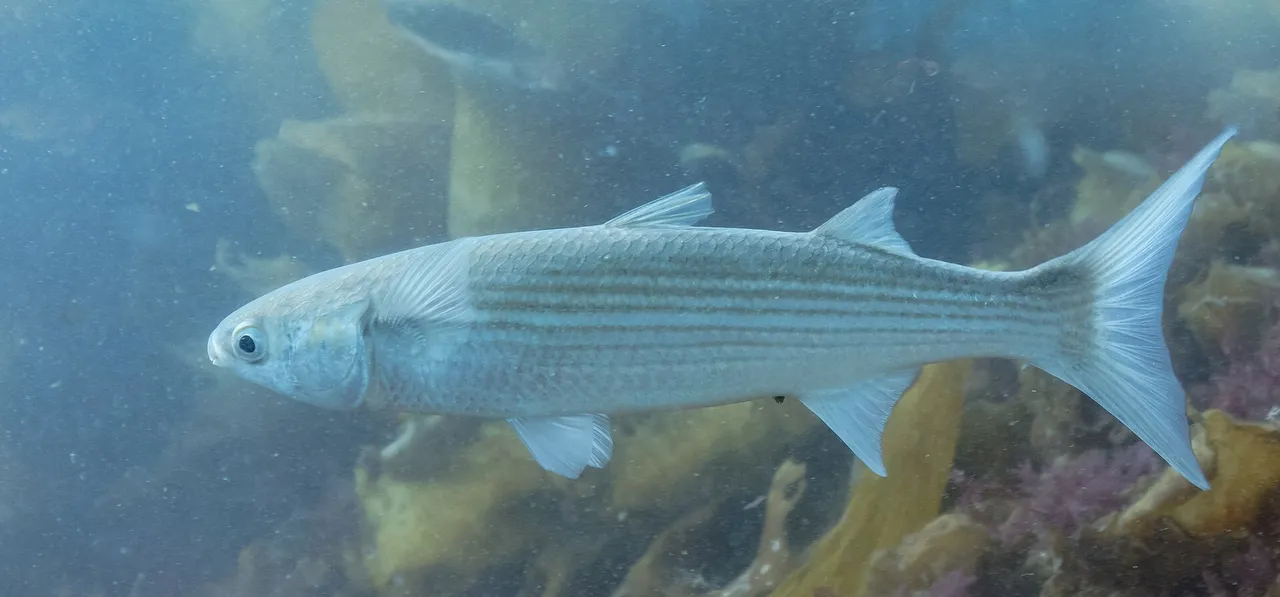
How this was identified, and who took it
Identified by: The adipose eyelid — the pale fatty tissue encroaching over the front and back of the eye — is visible, and it is the character that separates Mugil cephalus from Chelon and Liza. The upper lip is narrow, which rules out thick-lipped grey mullet, the species FishingHQ already holds. Both dorsal fins, the forked tail and the striped flank are in frame.Diego Delso, CC BY-SA 4.0, via Wikimedia Commons — source, licenceWhat is known about how it feeds
Almost every angler who has failed to catch a mullet has failed for the same reason, and it is on this page rather than in a tackle box.
The flathead grey mullet is a detritivore. It feeds on decomposing organic matter, microalgae and the organic film coating sediment surfaces, ingesting sand and mud along with the food and grinding the mixture in a muscular, gizzard-like portion of the stomach. The gut is long, because extracting energy from that material is slow.
What that means is that the fish is not looking for an item of food. It is processing a surface. A discrete object presented in front of it — however well chosen — is not what its feeding behaviour is organised around, and the fish has no reason to treat it as food.
Both verified relationships describe this, and both use `consumes` rather than `preys_on`, because nothing here is hunted. That distinction is not pedantry: FishingHQ previously had no way to state a non-predatory diet at all, and this species was one of the six left blocked because of it.
Juveniles are different animals in this respect, taking zooplankton before the adult feeding apparatus develops.
The ecological consequence is larger than the angling one. Detritivores move energy from the decomposition pathway back into the food web, and in estuaries — where mullet occur in quantity — that is a substantial part of why the system is as productive as it is.
The food
Prey with a verified dietary link to this fish. Each entry carries its own evidence, and each is written at the precision the source actually used: a named species where the source named one, a group or food category where it said “polychaetes”, “crustaceans” or “detritus” and meant it. That is why this list is shorter than the animal’s real diet rather than longer.
- Organic detritus as food — a group rather than a species: the evidence names the group
The mullet ingests sand and mud along with the organic film on it and grinds the mixture in a muscular gizzard-like stomach region, which is the anatomical signature of a detritivore rather than of a predator.
- Algae and biofilm as food — a group rather than a species: the evidence names the group
Microalgae and the surface film are taken alongside the sediment itself, and no diet study separates the two cleanly because the fish does not either.
Food with no page of its own here yet
These are real components of the diet, listed as plain text because FishingHQ has no page for them yet. Inventing pages to make the list look fuller would be the fabrication this whole approach exists to prevent.
- zooplankton, in juveniles
- small benthic invertebrates taken with sediment
- filamentous algae
What anglers do with this
Everything below is interpretation, not finding. It is what experienced anglers conclude from the biology above, and the reasoning is usually sound and almost never tested. It is separated from the biology deliberately.
The reputation of mullet as difficult is well earned and the explanation above is the whole of it: a grazing animal has no feeding response to a single item.
What anglers do about it follows directly, and it is unusually well reasoned for practitioner convention. The successful approaches present something of comparable texture and consistency to what the fish is already processing — bread in its various forms, and algae-based preparations — rather than something that imitates prey. In effect the angler is joining a grazing process rather than triggering a strike.
The second convention is location: mullet are drawn to places where organic material concentrates, and harbours, outfalls and weed-covered structure are fished for that reason rather than for cover.
Both are conventions rather than tested results, and both make more sense once the biology is stated. Mullet are also notably wary in the clear shallow water they favour, which compounds the difficulty and is a separate problem from the feeding one.
What this does not establish
Both relationships are food categories rather than organisms, which is the correct granularity and not a shortfall. Neither establishes proportion, and in practice a feeding mullet takes detritus and living biofilm together in a way no diet study separates cleanly. Composition varies with sediment and location, and the juvenile zooplankton phase is a different diet not described by these relationships.
Where this connects
These are the baits, lures, methods and explainers FishingHQ already joins to this fish — which is why the list is sometimes short. They are not chosen for this page, and a link here means an evidenced relationship exists, not that it follows from the diet.
Methods used for it
This page covers feeding. The Flathead grey mullet record covers identification, lifecycle, seasonal behaviour, handling and the sources behind all of it.
Reviewed 2026-08-12.