Chum salmon
Fish · Last reviewed 2026-08-10
A large Pacific salmon without body spotting, developing striking purple calico bars and enlarged canine teeth at spawning, and the widest-ranging of its genus.
Safety: injury while handling fish — minor injury.
How this was identified, and who took it
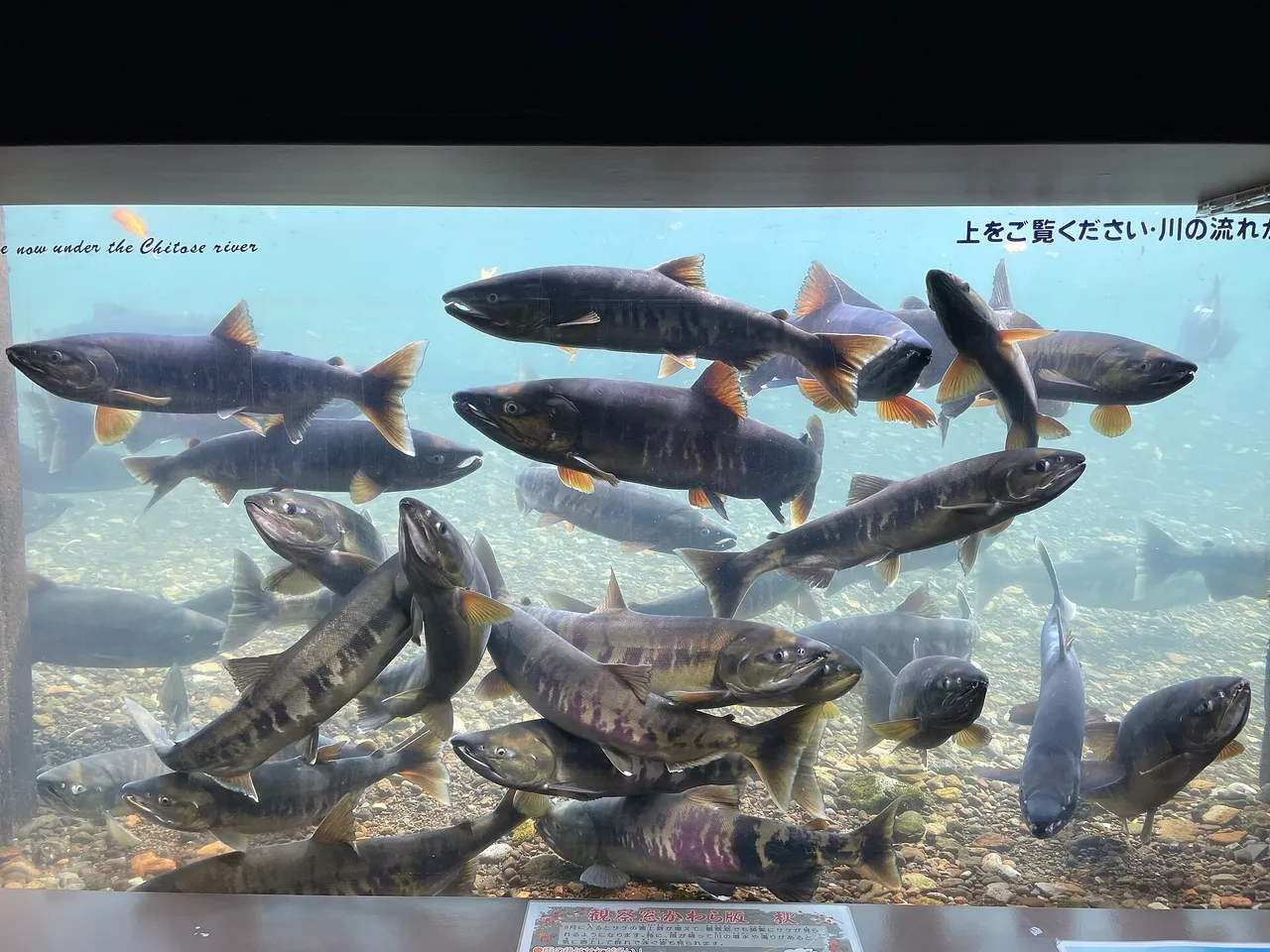
Identified by: Identified first on a negative character, which the record itself calls the one that separates it from every other Pacific salmon: no black spots anywhere on the body or the tail, and that holds across every fish in frame. The bold purple-and-olive calico barring, the pale-tipped anal fins with dark tail edges, and the greatly enlarged canine-like teeth and hooked jaws on several males are all legible. Photographed through the observation window of a river aquarium on a known chum run.Totti — CC BY-SA 4.0, via Wikimedia Commons — source, licenceCatching Chum salmon
Everything here on fishing for it. Each entry opens the page behind it.
Chum salmon is the Pacific salmon that carries no spots. Where chinook, coho and pink all show black spotting on the back or tail, a chum has none — a clean silver fish at sea with faint speckling at most, and dark tips to the tail and fins.
On entering fresh water it transforms more dramatically than any of its relatives. The flanks develop bold purple, green and maroon calico bars, and males grow enormous hooked jaws with pronounced canine teeth, which is where the name dog salmon comes from.
It has the widest natural distribution of any Pacific salmon, running from California around the Pacific rim to Japan and Korea and into Arctic rivers.
How it is caught
Identification
- Scientific name
- Oncorhynchus keta
- Family
- Salmonidae
- Water
- Saltwater, Freshwater, Moves between fresh and salt water
- Conservation status
- Least Concern
- Regions
- North America, East Asia, Arctic & Subarctic
- No black spots anywhere on the body or tail — the character that separates it from every other Pacific salmon.
- White or pale tips on the anal and pelvic fins, with dark edges to the tail.
- Spawning fish develop bold purple and green vertical calico bars along the flank.
- Spawning males grow greatly enlarged canine-like teeth and a heavily hooked jaw.
Size
- Typical
- 3.5–6 kg (7.7–13 lb)
- Large
- 8–12 kg (18–26 lb)
Exceptional: FishBase records a maximum of 100 cm and 18.1 kg
The jaws that develop for fighting other fish, and why they are hard to hold
A spawning male chum is one of the most physically modified fish on FishingHQ, and the modification is the handling problem.
WHAT THE FISH BUILDS, AND WHY. As chum approach spawning the males develop a deep body, prominent calico flank barring, an enlarged hooked snout — the kype — and a set of enlarged canine-like teeth that give the species its North American name of dog salmon. None of this is for feeding: the fish stopped feeding on entering fresh water. It is entirely for competition with other males on the spawning ground, where fish fight, and bite, in earnest.
SO THE ANGLER IS HANDLING A SET OF WEAPONS BUILT FOR USE ON OTHER FISH, on an animal that is aggressive because that is the state it is in. The teeth puncture, the jaws are strong, and the hooked shape means the mouth does not close in a way that lets a hand come out the way it went in. Nothing about it is subtle and nothing about it is safe to put a thumb into.
THE GRIP IS THEREFORE ACROSS THE BODY, never in the mouth and never by the jaw, with the fish supported horizontally and preferably still in the water. Long pliers do the unhooking. The kype gives no purchase and a hand around it is a hand between the jaws.
AND THE CONDITION OF THE FISH DECIDES HOW MUCH IT CAN TAKE. Chum deteriorate rapidly once coloured — the flesh softens, the skin fungus establishes, the reserves go — and a heavily coloured fish handled roughly is a fish that will not make the gravel. The bright fish taken in the lower river is the one that tolerates the process; the one that looks most dramatic is the one that tolerates it least. As with every Pacific salmon, the fixed and unrepayable energy budget makes the length of the fight the first thing to control and everything else the second.
Backed by research — why, and the sources (2)
Supported by peer-reviewed research or fisheries science. The sources are listed and can be checked.
- NASCO conservation and management of North Atlantic salmon — North Atlantic Salmon Conservation Organization (Government fisheries body)Relied on for: Conservation of anadromous salmonids and the handling and release practice adopted in their fisheries.States this directlyCitation checked — the work exists and is described correctly
- FishBase: a global information system on fishes — Froese, R. and D. Pauly, eds. — FishBase Consortium (Scientific institute)Relied on for: Life history of the Pacific salmons, including cessation of feeding on entry to fresh water and post-spawning mortality.States this directlyPassage read and verified
Lifecycle and reproduction
Spends three to five years at sea before returning to spawn once and die. Like pink salmon, fry migrate to sea shortly after emerging with little freshwater rearing, which makes the species less dependent on river habitat quality than coho or chinook.
Spawns in autumn and early winter, typically in the lower reaches of rivers and often in areas of upwelling groundwater. Dies after a single spawning.
Feeding and senses
At sea takes zooplankton, squid and small fish. Feeding stops on entering fresh water, and the fish lives on stored reserves through the spawning migration.
Homes by olfactory memory to natal water, imprinted as a fry before going to sea. Marine feeding is visual, on plankton swarms and small schooling prey, and the fish stops responding to food entirely once it commits to the spawning migration.
Through the year
Returns in autumn and early winter, later than most Pacific salmon in many systems, which extends the salmon season where it runs.
Distribution
North Pacific: Korea , Japan, Okhotsk and Bering Sea , Arctic Alaska south to San Diego, California, USA. Asia: Iran
This is a biological range — where the species occurs, not a prediction that you will catch one. To browse the fishing geography FishingHQ holds, start at fishing places.
Why anglers care
Fished in rivers and estuaries on flies, spoons and jigs, and valued particularly for the strength of its fight — chums fight harder for their size than most Pacific salmon and are increasingly targeted deliberately rather than treated as a by-catch of other runs. Eating quality is best in bright fish; coloured spawning fish deteriorate quickly, and the roe is highly valued.
Handling and returning
Spawning males have large teeth and heavy hooked jaws that are awkward and hazardous to grip. Support the fish horizontally, use pliers, and where fish are to be released keep them in the water. Fish taken in the lower river in bright condition handle better than coloured fish already deteriorating.
Going further
- Chum salmon vs Pink salmon — how to tell them apart.
- Chum salmon vs Sockeye salmon — how to tell them apart.
Safety
Injury while handling fish — Minor injury
Spawning male chum develop large canine-like teeth and powerful hooked jaws capable of causing puncture wounds during unhooking.
What reduces it: Use long pliers, grip across the body rather than the jaw, and keep fingers clear of the mouth.
Where to go next
Similar and related fish

Where it lives
- Lowland riversReturns to the lower reaches of rivers in autumn and early winter.
- Open oceanReturns to the lower reaches of rivers in autumn and early winter.
- Spate riversSpawns in the lower reaches of rain-fed rivers, frequently in areas of upwelling groundwater within the gravel, and depends on autumn flows to enter them.
Where you will find it
- AlaskaReturns to rivers throughout the state and is of particular importance to subsistence fisheries in the western and northern drainages.
- KoreaRuns into a number of east coast rivers, at the southern edge of the species' range on this side of the Pacific.
- The Pacific Northwest coastRuns late in the season and supports both a fishery and, through its carcasses, a substantial nutrient transfer into the region's rivers and forests.
Sources and evidence
- FishBase: a global information system on fishes — Froese, R. and D. Pauly, eds. — FishBase Consortium (Scientific institute)Relied on for: Family, maximum size, depth and environment, distribution and the IUCN assessment for Oncorhynchus keta.States this directlyPassage read and verified
- The IUCN Red List of Threatened Species — International Union for Conservation of Nature (Conservation authority)Relied on for: The Least Concern assessment for Oncorhynchus keta, assessed 23 July 2020.States this directlyCitation checked — the work exists and is described correctly
Why the 10 connections on this page are here, and the sources
Similar and related fish
Backed by research — 2 connections
Supported by peer-reviewed research or fisheries science. The sources are listed and can be checked.
Pink salmon
An identification comparison naming both binomials: Oncorhynchus gorbuscha and Oncorhynchus keta.
- FishBase: a global information system on fishes — Froese, R. and D. Pauly, eds. — FishBase Consortium (Scientific institute)Relied on for: Morphological and distributional data for Oncorhynchus gorbuscha and for Oncorhynchus keta.States this directlyPassage read and verified
- The IUCN Red List of Threatened Species — International Union for Conservation of Nature (Conservation authority)Relied on for: Separate assessments treating Oncorhynchus gorbuscha and Oncorhynchus keta as distinct species.States this directlyCitation checked — the work exists and is described correctly
Sockeye salmon
An identification comparison naming both binomials: Oncorhynchus keta and Oncorhynchus nerka.
- FishBase: a global information system on fishes — Froese, R. and D. Pauly, eds. — FishBase Consortium (Scientific institute)Relied on for: Morphological and distributional data for Oncorhynchus keta and for Oncorhynchus nerka.States this directlyPassage read and verified
- The IUCN Red List of Threatened Species — International Union for Conservation of Nature (Conservation authority)Relied on for: Separate assessments treating Oncorhynchus keta and Oncorhynchus nerka as distinct species.States this directlyCitation checked — the work exists and is described correctly
How it is caught
What experienced anglers do — 2 connections
Widely and independently recommended by experienced anglers and specialist sources. This is real angling knowledge, not proof: controlled evidence for it is limited, and FishingHQ records it as convention rather than as a demonstrated effect.
Spinning
A practitioner claim about how Oncorhynchus keta is commonly fished, following from where and how it feeds.
- General angling website restatements of established technique — Various (Credible secondary source)Relied on for: Widely restated practitioner accounts of fishing for chum salmon.Citation checked — the work exists and is described correctly
- Sea Angler — Bauer Media (Specialist angling publication)Relied on for: Practitioner treatment of the methods used for chum salmon and comparable species.Citation checked — the work exists and is described correctly
Stillwater fly fishing
A practitioner claim about how Oncorhynchus keta is commonly fished, following from where and how it feeds.
- General angling website restatements of established technique — Various (Credible secondary source)Relied on for: Widely restated practitioner accounts of fishing for chum salmon.Citation checked — the work exists and is described correctly
- Sea Angler — Bauer Media (Specialist angling publication)Relied on for: Practitioner treatment of the methods used for chum salmon and comparable species.Citation checked — the work exists and is described correctly
Where it lives
Backed by research — 3 connections
Supported by peer-reviewed research or fisheries science. The sources are listed and can be checked.
Lowland rivers
A habitat association for Oncorhynchus keta taken from the environment and distribution data on its FishBase summary.
- FishBase: a global information system on fishes — Froese, R. and D. Pauly, eds. — FishBase Consortium (Scientific institute)Relied on for: The environment, depth range and habitat description recorded for Oncorhynchus keta.States this directlyPassage read and verified
Open ocean
A habitat association for Oncorhynchus keta taken from the environment and distribution data on its FishBase summary.
- FishBase: a global information system on fishes — Froese, R. and D. Pauly, eds. — FishBase Consortium (Scientific institute)Relied on for: The environment, depth range and habitat description recorded for Oncorhynchus keta.States this directlyPassage read and verified
Spate rivers
A claim that the species uses rain-fed rivers on impermeable geology, resting on documented distribution and spawning habitat rather than on angling report.
- FishBase: a global information system on fishes — Froese, R. and D. Pauly, eds. — FishBase Consortium (Scientific institute)Relied on for: Recorded depth range, temperature tolerance and habitat association for the species outside north-west Europe.States this directlyPassage read and verified
- The IUCN Red List of Threatened Species — International Union for Conservation of Nature (Conservation authority)Relied on for: Global conservation assessment, range and recorded threats for the species.States this directlyCitation checked — the work exists and is described correctly
Where you will find it
Backed by research — 3 connections
Supported by peer-reviewed research or fisheries science. The sources are listed and can be checked.
Alaska
A distribution association between an animal and a kind of water, rather than a claim about any named mark.
- FishBase: a global information system on fishes — Froese, R. and D. Pauly, eds. — FishBase Consortium (Scientific institute)Relied on for: Distribution, habitat association and depth range recorded for the species, including its occurrence in the water body concerned.States this directlyPassage read and verified
- The IUCN Red List of Threatened Species — International Union for Conservation of Nature (Conservation authority)Relied on for: Assessment and range account for the species, including the systems and coasts it occupies.Background and mechanism onlyCitation checked — the work exists and is described correctly
Korea
A distribution association between an animal and a kind of water, rather than a claim about any named mark.
- FishBase: a global information system on fishes — Froese, R. and D. Pauly, eds. — FishBase Consortium (Scientific institute)Relied on for: Distribution, habitat association and depth range recorded for the species, including its occurrence in the water body concerned.States this directlyPassage read and verified
- The IUCN Red List of Threatened Species — International Union for Conservation of Nature (Conservation authority)Relied on for: Assessment and range account for the species, including the systems and coasts it occupies.Background and mechanism onlyCitation checked — the work exists and is described correctly
The Pacific Northwest coast
Occurrence of the species in this system or along this coast: a statement about the animal's distribution, not a venue recommendation.
- FishBase: a global information system on fishes — Froese, R. and D. Pauly, eds. — FishBase Consortium (Scientific institute)Relied on for: Distribution, salinity tolerance and habitat association recorded for the species, including its occurrence in this system.States this directlyPassage read and verified
- The IUCN Red List of Threatened Species — International Union for Conservation of Nature (Conservation authority)Relied on for: Assessment and range description for the species, including the waters in which it occurs.Background and mechanism onlyCitation checked — the work exists and is described correctly
How FishingHQ labels evidence is explained in the evidence policy.