How to identify chum salmon
Oncorhynchus keta · Salmonidae
The characters that identify chum salmon, ranked by how far each one can be trusted on its own.
Safety: injury while handling fish — minor injury.
How this was identified, and who took it
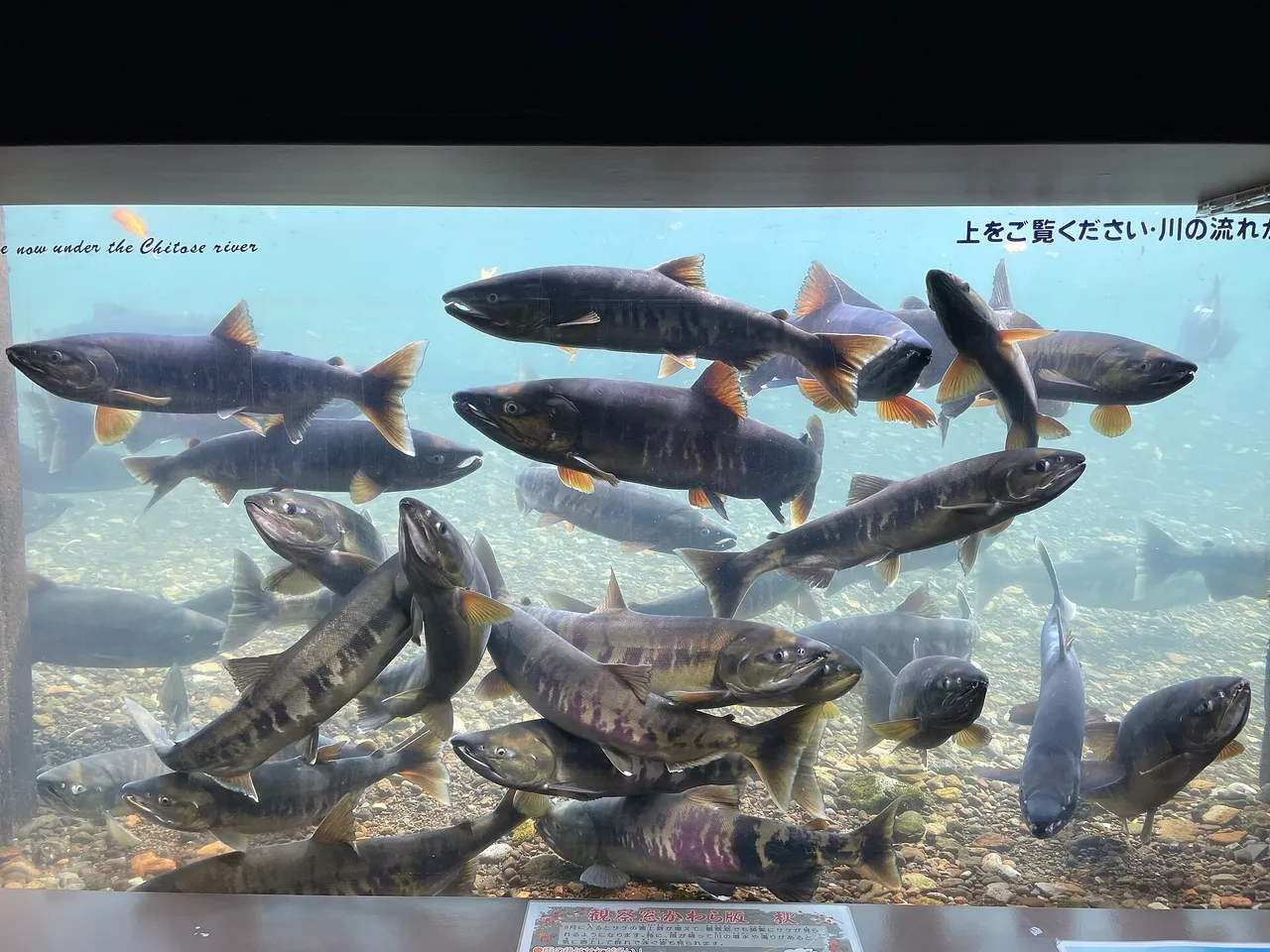
Identified by: Identified first on a negative character, which the record itself calls the one that separates it from every other Pacific salmon: no black spots anywhere on the body or the tail, and that holds across every fish in frame. The bold purple-and-olive calico barring, the pale-tipped anal fins with dark tail edges, and the greatly enlarged canine-like teeth and hooked jaws on several males are all legible. Photographed through the observation window of a river aquarium on a known chum run.Totti — CC BY-SA 4.0, via Wikimedia Commons — source, licenceLook at this first
Look for what is not there. Spread the tail and examine the back: a chum carries no black spotting on either, and every other Pacific salmon carries some. An absence is a weaker instruction than a mark, so confirm it with the pale tips on the anal and pelvic fins before committing.
Diagnostic — settles it on its own
Each of these settles the identification on its own. If one is clear, you have your answer.
No spotting on the back or the tail
Every other Pacific salmon puts black marks somewhere on the upper body or the caudal fin — pink salmon most obviously, on both tail lobes. A chum's back and tail are plain. Check the tail spread rather than folded, because a folded tail can hide a sparse pattern and produce a false chum.
Supporting — use with other characters
Real characters that are not conclusive by themselves. Use two or three together.
Pale tips on the anal and pelvic fins
The leading tips of the anal and pelvic fins carry a white or cream edge against darker fin membrane, and the tail is dark-edged. It is the character that turns the absence of spots from a suspicion into an identification, and it is present in sea-bright as well as spawning fish.
Calico barring in river fish
Fish that have entered fresh water develop bold vertical bars of purple and olive down the flank, quite unlike the even flush of a sockeye or the blotching of a coho. It is the most recognisable state the species has and it applies only to fish already in the river.
Enlarged canine teeth in spawning males
A spawning male grows teeth out of proportion to anything else in the genus, along with a heavily hooked jaw. It is the origin of the name dog salmon and it is unmistakable once seen. It also makes the fish awkward and hazardous to grip, which is a handling matter as much as an identification one.
What it gets confused with
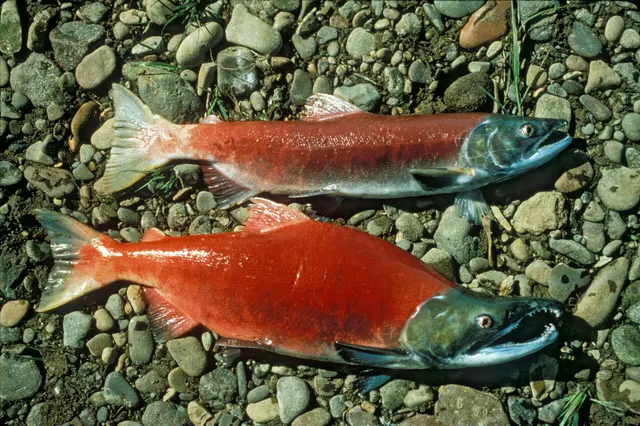
- Sockeye salmon in sea-bright condition, which is also nearly unspotted on the body but has fine speckling and a much more slender caudal peduncle; the pale fin tips separate them.
- Coho salmon, which carries black spots on the back and on the upper lobe of the tail only — check the lower lobe before deciding a fish is unspotted.
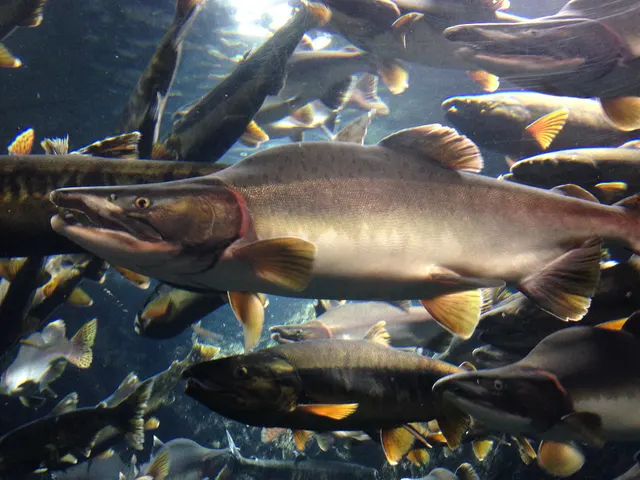
- Pink salmon, whose large oval tail spots are the immediate separation, and which develops a hump a chum never grows.
Side by side: Chum salmon vs Pink salmon, Chum salmon vs Sockeye salmon.
Where this stops working
Chum and pink salmon hybridise where they overlap and the hybrids are fertile, so an intermediate fish in a mixed run is a real possibility rather than a textbook curiosity. A sea-bright chum straight off the tide is a plain silver fish and separating it from a sockeye at a glance is genuinely hard; use the fin tips and the deeper tail wrist. Spawning colour is the easiest state to identify and the worst state to eat, so the identification getting easier and the fish getting worse happen together. Where the fishery is managed by species, and most Pacific salmon fisheries are, verify current local rules before retaining anything.
The full record
This page covers identification only. The Chum salmon record covers behaviour, lifecycle, distribution, handling and the sources behind all of it.
Reviewed 2026-08-15.
More about this fish
Telling it apart is one question. Here are the others.
Similar and related fish
How it is caught
Where it lives
- Lowland riversReturns to the lower reaches of rivers in autumn and early winter.
- Open oceanReturns to the lower reaches of rivers in autumn and early winter.
- Spate riversSpawns in the lower reaches of rain-fed rivers, frequently in areas of upwelling groundwater within the gravel, and depends on autumn flows to enter them.
Where you will find it
- AlaskaReturns to rivers throughout the state and is of particular importance to subsistence fisheries in the western and northern drainages.
- KoreaRuns into a number of east coast rivers, at the southern edge of the species' range on this side of the Pacific.
- The Pacific Northwest coastRuns late in the season and supports both a fishery and, through its carcasses, a substantial nutrient transfer into the region's rivers and forests.
Why the 10 connections on this page are here, and the sources
Similar and related fish
Backed by research — 2 connections
Supported by peer-reviewed research or fisheries science. The sources are listed and can be checked.
Pink salmon
An identification comparison naming both binomials: Oncorhynchus gorbuscha and Oncorhynchus keta.
- FishBase: a global information system on fishes — Froese, R. and D. Pauly, eds. — FishBase Consortium (Scientific institute)Relied on for: Morphological and distributional data for Oncorhynchus gorbuscha and for Oncorhynchus keta.States this directlyPassage read and verified
- The IUCN Red List of Threatened Species — International Union for Conservation of Nature (Conservation authority)Relied on for: Separate assessments treating Oncorhynchus gorbuscha and Oncorhynchus keta as distinct species.States this directlyCitation checked — the work exists and is described correctly
Sockeye salmon
An identification comparison naming both binomials: Oncorhynchus keta and Oncorhynchus nerka.
- FishBase: a global information system on fishes — Froese, R. and D. Pauly, eds. — FishBase Consortium (Scientific institute)Relied on for: Morphological and distributional data for Oncorhynchus keta and for Oncorhynchus nerka.States this directlyPassage read and verified
- The IUCN Red List of Threatened Species — International Union for Conservation of Nature (Conservation authority)Relied on for: Separate assessments treating Oncorhynchus keta and Oncorhynchus nerka as distinct species.States this directlyCitation checked — the work exists and is described correctly
How it is caught
What experienced anglers do — 2 connections
Widely and independently recommended by experienced anglers and specialist sources. This is real angling knowledge, not proof: controlled evidence for it is limited, and FishingHQ records it as convention rather than as a demonstrated effect.
Spinning
A practitioner claim about how Oncorhynchus keta is commonly fished, following from where and how it feeds.
- General angling website restatements of established technique — Various (Credible secondary source)Relied on for: Widely restated practitioner accounts of fishing for chum salmon.Citation checked — the work exists and is described correctly
- Sea Angler — Bauer Media (Specialist angling publication)Relied on for: Practitioner treatment of the methods used for chum salmon and comparable species.Citation checked — the work exists and is described correctly
Stillwater fly fishing
A practitioner claim about how Oncorhynchus keta is commonly fished, following from where and how it feeds.
- General angling website restatements of established technique — Various (Credible secondary source)Relied on for: Widely restated practitioner accounts of fishing for chum salmon.Citation checked — the work exists and is described correctly
- Sea Angler — Bauer Media (Specialist angling publication)Relied on for: Practitioner treatment of the methods used for chum salmon and comparable species.Citation checked — the work exists and is described correctly
Where it lives
Backed by research — 3 connections
Supported by peer-reviewed research or fisheries science. The sources are listed and can be checked.
Lowland rivers
A habitat association for Oncorhynchus keta taken from the environment and distribution data on its FishBase summary.
- FishBase: a global information system on fishes — Froese, R. and D. Pauly, eds. — FishBase Consortium (Scientific institute)Relied on for: The environment, depth range and habitat description recorded for Oncorhynchus keta.States this directlyPassage read and verified
Open ocean
A habitat association for Oncorhynchus keta taken from the environment and distribution data on its FishBase summary.
- FishBase: a global information system on fishes — Froese, R. and D. Pauly, eds. — FishBase Consortium (Scientific institute)Relied on for: The environment, depth range and habitat description recorded for Oncorhynchus keta.States this directlyPassage read and verified
Spate rivers
A claim that the species uses rain-fed rivers on impermeable geology, resting on documented distribution and spawning habitat rather than on angling report.
- FishBase: a global information system on fishes — Froese, R. and D. Pauly, eds. — FishBase Consortium (Scientific institute)Relied on for: Recorded depth range, temperature tolerance and habitat association for the species outside north-west Europe.States this directlyPassage read and verified
- The IUCN Red List of Threatened Species — International Union for Conservation of Nature (Conservation authority)Relied on for: Global conservation assessment, range and recorded threats for the species.States this directlyCitation checked — the work exists and is described correctly
Where you will find it
Backed by research — 3 connections
Supported by peer-reviewed research or fisheries science. The sources are listed and can be checked.
Alaska
A distribution association between an animal and a kind of water, rather than a claim about any named mark.
- FishBase: a global information system on fishes — Froese, R. and D. Pauly, eds. — FishBase Consortium (Scientific institute)Relied on for: Distribution, habitat association and depth range recorded for the species, including its occurrence in the water body concerned.States this directlyPassage read and verified
- The IUCN Red List of Threatened Species — International Union for Conservation of Nature (Conservation authority)Relied on for: Assessment and range account for the species, including the systems and coasts it occupies.Background and mechanism onlyCitation checked — the work exists and is described correctly
Korea
A distribution association between an animal and a kind of water, rather than a claim about any named mark.
- FishBase: a global information system on fishes — Froese, R. and D. Pauly, eds. — FishBase Consortium (Scientific institute)Relied on for: Distribution, habitat association and depth range recorded for the species, including its occurrence in the water body concerned.States this directlyPassage read and verified
- The IUCN Red List of Threatened Species — International Union for Conservation of Nature (Conservation authority)Relied on for: Assessment and range account for the species, including the systems and coasts it occupies.Background and mechanism onlyCitation checked — the work exists and is described correctly
The Pacific Northwest coast
Occurrence of the species in this system or along this coast: a statement about the animal's distribution, not a venue recommendation.
- FishBase: a global information system on fishes — Froese, R. and D. Pauly, eds. — FishBase Consortium (Scientific institute)Relied on for: Distribution, salinity tolerance and habitat association recorded for the species, including its occurrence in this system.States this directlyPassage read and verified
- The IUCN Red List of Threatened Species — International Union for Conservation of Nature (Conservation authority)Relied on for: Assessment and range description for the species, including the waters in which it occurs.Background and mechanism onlyCitation checked — the work exists and is described correctly
Safety
Injury while handling fish — Minor injury
Spawning male chum develop large canine-like teeth and powerful hooked jaws capable of causing puncture wounds during unhooking.
What reduces it: Use long pliers, grip across the body rather than the jaw, and keep fingers clear of the mouth.