Pink salmon
Fish · Last reviewed 2026-08-10
The smallest and most abundant Pacific salmon, running on a strict two-year cycle, and the male developing a pronounced hump at spawning.
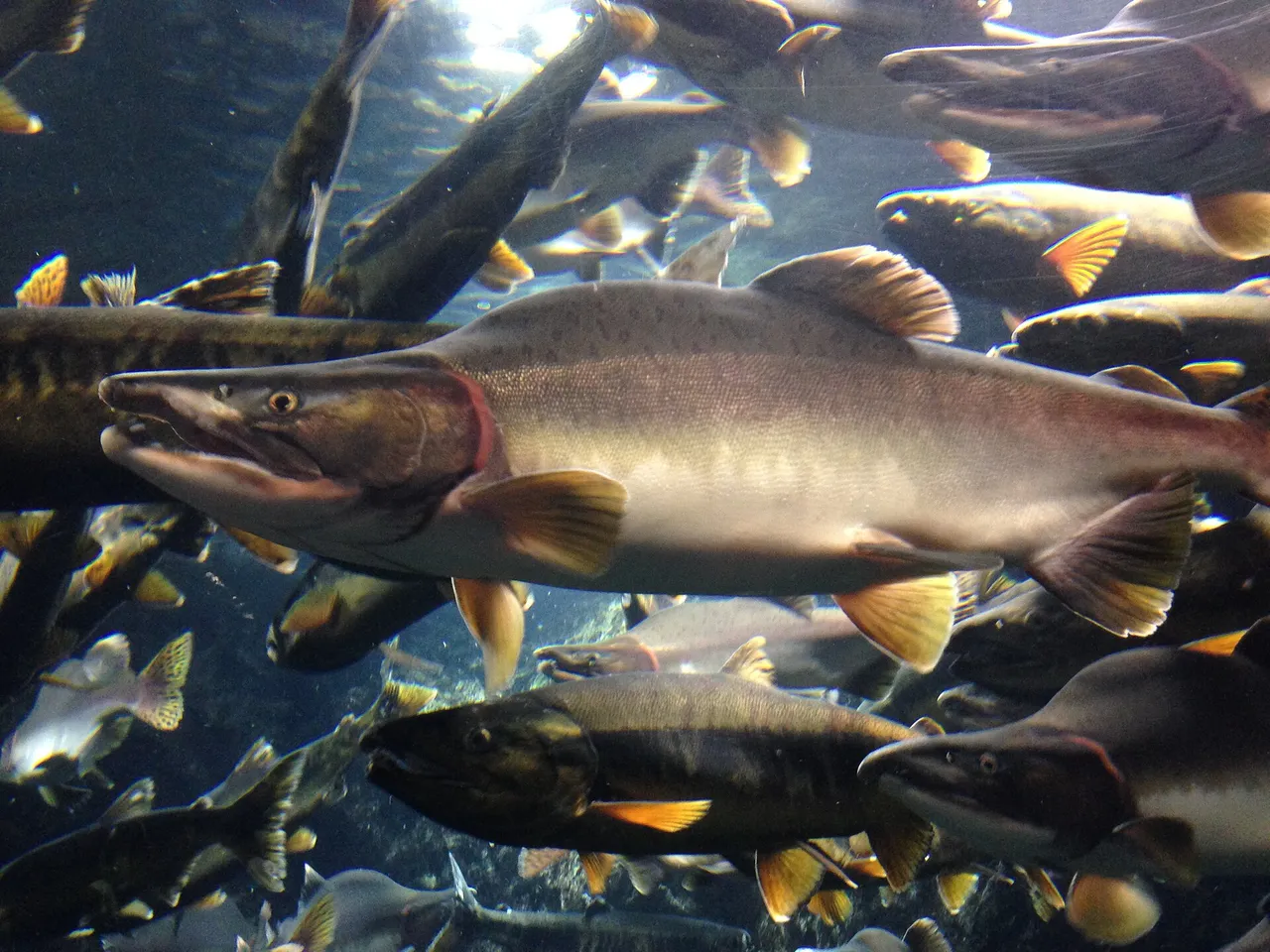
How this was identified, and who took it
Identified by: Identified on the spawning-male form the page names: a pronounced humped back rising steeply behind the head and a long strongly hooked jaw, neither of which any other Pacific salmon develops to this degree, over the very fine scales that also separate it from coho and chinook. The tail is outside the frame, so the large oval tail spots the record lists first are NOT demonstrated by this image and are not claimed for it.Totti — CC BY-SA 4.0, via Wikimedia Commons — source, licence
Catching Pink salmon
Everything here on fishing for it. Each entry opens the page behind it.
Pink salmon is the smallest of the Pacific salmon and by far the most numerous. Its distinguishing feature as a species is not anatomical but temporal: it lives almost exactly two years, so odd-year and even-year runs form genetically separate populations that never meet. In many rivers one of those lines dominates completely and the other is nearly absent.
Spawning males develop an extraordinary humped back and a hooked jaw, which is where the common name humpback salmon comes from and which makes a spawning fish unmistakable.
It carries the largest oval spots of any Pacific salmon on its tail, and the smallest scales — both useful when a bright fish in salt water offers nothing else to go on.
How it is caught
Identification
- Scientific name
- Oncorhynchus gorbuscha
- Family
- Salmonidae
- Water
- Saltwater, Freshwater, Moves between fresh and salt water
- Conservation status
- Least Concern
- Regions
- North America, East Asia, Arctic & Subarctic, Northern Europe
- Large oval spots on both lobes of the tail, bigger than those of any other Pacific salmon.
- Very small scales — noticeably finer than those of coho or chinook.
- Spawning males develop a pronounced humped back and a strongly hooked jaw.
- Bright silver in salt water with a bluish back; no black gums.
Size
- Typical
- 1–2.5 kg (2.2–5.5 lb)
- Large
- 3–4.5 kg (6.6–10 lb)
Exceptional: FishBase records a maximum of 76 cm and 7 kg
The shortest freshwater phase of any Pacific salmon
Pink salmon habitat requirements are the simplest of any Pacific salmon, and the simplicity follows from a two-year life cycle with almost no freshwater residence.
FRY GO TO SEA ALMOST IMMEDIATELY. Pink salmon emerge from the gravel and migrate downstream to salt water within days or weeks, without the months or years of freshwater rearing that coho, chinook and sockeye require. That makes them far less dependent on freshwater habitat quality than any other Pacific salmon.
SO THEY USE SHORT COASTAL STREAMS, including very small ones and the lowest reaches of larger rivers, and they spawn close to tidewater — sometimes in the intertidal zone itself.
ESTUARIES ARE THE CRITICAL NURSERY. Because the fry are tiny when they arrive, estuarine and nearshore habitat and its zooplankton production determine early marine survival, and that is where the year class is made.
AT SEA THEY OCCUPY THE OPEN NORTH PACIFIC, feeding on plankton and small organisms in surface water, and they range widely.
THE TWO-YEAR CYCLE IS ABSOLUTE, which produces genetically separate odd-year and even-year populations in the same river that never interbreed — effectively two populations occupying the same habitat in alternate years, frequently with very different abundances.
AND SPAWNING GRAVEL REQUIREMENTS ARE MODEST relative to larger salmon, which is part of why pinks are the most abundant Pacific salmon and why they colonise new streams readily.
Backed by research — why, and the sources (2)
Supported by peer-reviewed research or fisheries science. The sources are listed and can be checked.
- NASCO conservation and management of North Atlantic salmon — North Atlantic Salmon Conservation Organization (Government fisheries body)Relied on for: Anadromous salmonid biology, run timing, spawning habitat requirements and the management principles applied to them.States this directlyCitation checked — the work exists and is described correctly
- FishBase: a global information system on fishes — Froese, R. and D. Pauly, eds. — FishBase Consortium (Scientific institute)Relied on for: Distribution, habitat association, depth range, size, reproduction and life-history parameters recorded for the species.States this directlyPassage read and verified
Lifecycle and reproduction
A strict two-year life cycle: fry migrate to sea almost immediately after emerging, spend a year and a half feeding in the ocean, and return to spawn and die. Odd-year and even-year runs are reproductively isolated from each other.
Spawns in autumn in gravel, often in the lower reaches of rivers and sometimes in intertidal areas, and dies after a single spawning. Fry go to sea almost immediately, spending little or no time rearing in fresh water.
Feeding and senses
At sea takes plankton, small crustaceans and small fish. Feeding largely ceases once the fish enters fresh water to spawn.
Homes to natal rivers using olfactory memory in the manner of all Pacific salmon, with marine feeding driven by sight on plankton and small prey.
Through the year
Runs in late summer and autumn in enormous, tightly compressed numbers, with the timing of the run varying little between years within a given system.
Distribution
Arctic and Pacific drainages from Mackenzie River delta, Northwest Territories, Canada to Sacramento River drainage, in California, USA; occasionally as far as La Jolla, southern California; also in northeast Asia . On Asia side, from North Korea to Jana and Lena drainages in Artic Russia. In Bering Sea north of about 40°N and from Bering Strait northeast to Point Barrow and northwest to Lena estuary . Introduced elsewhere. Occasionally hybridizes with Oncorhynchus keta producing fertile offspring
This is a biological range — where the species occurs, not a prediction that you will catch one. To browse the fishing geography FishingHQ holds, start at fishing places.
Why anglers care
A heavily fished Pacific salmon, taken on small spoons, spinners and flies in rivers and estuaries, and important precisely because of abundance — a pink run puts very large numbers of accessible fish into rivers within reach of shore anglers. Quality as food declines rapidly once fish enter fresh water and begin to colour, and practitioner consensus is that bright fish taken in salt or in the lower river are a different proposition entirely from coloured fish upstream.
Handling and returning
Fish that have entered fresh water are already committed to dying after spawning, but that does not license rough handling — undersized and unwanted fish should be released with wet hands and minimal air exposure. Spawning males have hard hooked jaws and are awkward to grip; support the body rather than lifting by the jaw.
Going further
- Pink salmon vs Chum salmon — how to tell them apart.
Where to go next
Similar and related fish
Where it lives
Where you will find it
Sources and evidence
- FishBase: a global information system on fishes — Froese, R. and D. Pauly, eds. — FishBase Consortium (Scientific institute)Relied on for: Family, maximum size, depth and environment, distribution and the IUCN assessment for Oncorhynchus gorbuscha.States this directlyPassage read and verified
- The IUCN Red List of Threatened Species — International Union for Conservation of Nature (Conservation authority)Relied on for: The Least Concern assessment for Oncorhynchus gorbuscha, assessed 23 July 2020.States this directlyCitation checked — the work exists and is described correctly
Why the 8 connections on this page are here, and the sources
Similar and related fish
Backed by research — 1 connection
Supported by peer-reviewed research or fisheries science. The sources are listed and can be checked.
Chum salmon
An identification comparison naming both binomials: Oncorhynchus gorbuscha and Oncorhynchus keta.
- FishBase: a global information system on fishes — Froese, R. and D. Pauly, eds. — FishBase Consortium (Scientific institute)Relied on for: Morphological and distributional data for Oncorhynchus gorbuscha and for Oncorhynchus keta.States this directlyPassage read and verified
- The IUCN Red List of Threatened Species — International Union for Conservation of Nature (Conservation authority)Relied on for: Separate assessments treating Oncorhynchus gorbuscha and Oncorhynchus keta as distinct species.States this directlyCitation checked — the work exists and is described correctly
How it is caught
What experienced anglers do — 2 connections
Widely and independently recommended by experienced anglers and specialist sources. This is real angling knowledge, not proof: controlled evidence for it is limited, and FishingHQ records it as convention rather than as a demonstrated effect.
Spinning
A practitioner claim about how Oncorhynchus gorbuscha is commonly fished, following from where and how it feeds.
- General angling website restatements of established technique — Various (Credible secondary source)Relied on for: Widely restated practitioner accounts of fishing for pink salmon.Citation checked — the work exists and is described correctly
- Sea Angler — Bauer Media (Specialist angling publication)Relied on for: Practitioner treatment of the methods used for pink salmon and comparable species.Citation checked — the work exists and is described correctly
Stillwater fly fishing
A practitioner claim about how Oncorhynchus gorbuscha is commonly fished, following from where and how it feeds.
- General angling website restatements of established technique — Various (Credible secondary source)Relied on for: Widely restated practitioner accounts of fishing for pink salmon.Citation checked — the work exists and is described correctly
- Sea Angler — Bauer Media (Specialist angling publication)Relied on for: Practitioner treatment of the methods used for pink salmon and comparable species.Citation checked — the work exists and is described correctly
Where it lives
Backed by research — 3 connections
Supported by peer-reviewed research or fisheries science. The sources are listed and can be checked.
Lowland rivers
A habitat association for Oncorhynchus gorbuscha taken from the environment and distribution data on its FishBase summary.
- FishBase: a global information system on fishes — Froese, R. and D. Pauly, eds. — FishBase Consortium (Scientific institute)Relied on for: The environment, depth range and habitat description recorded for Oncorhynchus gorbuscha.States this directlyPassage read and verified
Open ocean
A habitat association for Oncorhynchus gorbuscha taken from the environment and distribution data on its FishBase summary.
- FishBase: a global information system on fishes — Froese, R. and D. Pauly, eds. — FishBase Consortium (Scientific institute)Relied on for: The environment, depth range and habitat description recorded for Oncorhynchus gorbuscha.States this directlyPassage read and verified
Spate rivers
A claim that the species uses rain-fed rivers on impermeable geology, resting on documented distribution and spawning habitat rather than on angling report.
- FishBase: a global information system on fishes — Froese, R. and D. Pauly, eds. — FishBase Consortium (Scientific institute)Relied on for: Recorded depth range, temperature tolerance and habitat association for the species outside north-west Europe.States this directlyPassage read and verified
- The IUCN Red List of Threatened Species — International Union for Conservation of Nature (Conservation authority)Relied on for: Global conservation assessment, range and recorded threats for the species.States this directlyCitation checked — the work exists and is described correctly
Where you will find it
Backed by research — 2 connections
Supported by peer-reviewed research or fisheries science. The sources are listed and can be checked.
Alaska
A distribution association between an animal and a kind of water, rather than a claim about any named mark.
- FishBase: a global information system on fishes — Froese, R. and D. Pauly, eds. — FishBase Consortium (Scientific institute)Relied on for: Distribution, habitat association and depth range recorded for the species, including its occurrence in the water body concerned.States this directlyPassage read and verified
- The IUCN Red List of Threatened Species — International Union for Conservation of Nature (Conservation authority)Relied on for: Assessment and range account for the species, including the systems and coasts it occupies.Background and mechanism onlyCitation checked — the work exists and is described correctly
The Pacific Northwest coast
Occurrence of the species in this system or along this coast: a statement about the animal's distribution, not a venue recommendation.
- FishBase: a global information system on fishes — Froese, R. and D. Pauly, eds. — FishBase Consortium (Scientific institute)Relied on for: Distribution, salinity tolerance and habitat association recorded for the species, including its occurrence in this system.States this directlyPassage read and verified
- The IUCN Red List of Threatened Species — International Union for Conservation of Nature (Conservation authority)Relied on for: Assessment and range description for the species, including the waters in which it occurs.Background and mechanism onlyCitation checked — the work exists and is described correctly
How FishingHQ labels evidence is explained in the evidence policy.