How to identify pink salmon
Oncorhynchus gorbuscha · Salmonidae
The characters that identify pink salmon, ranked by how far each one can be trusted on its own.
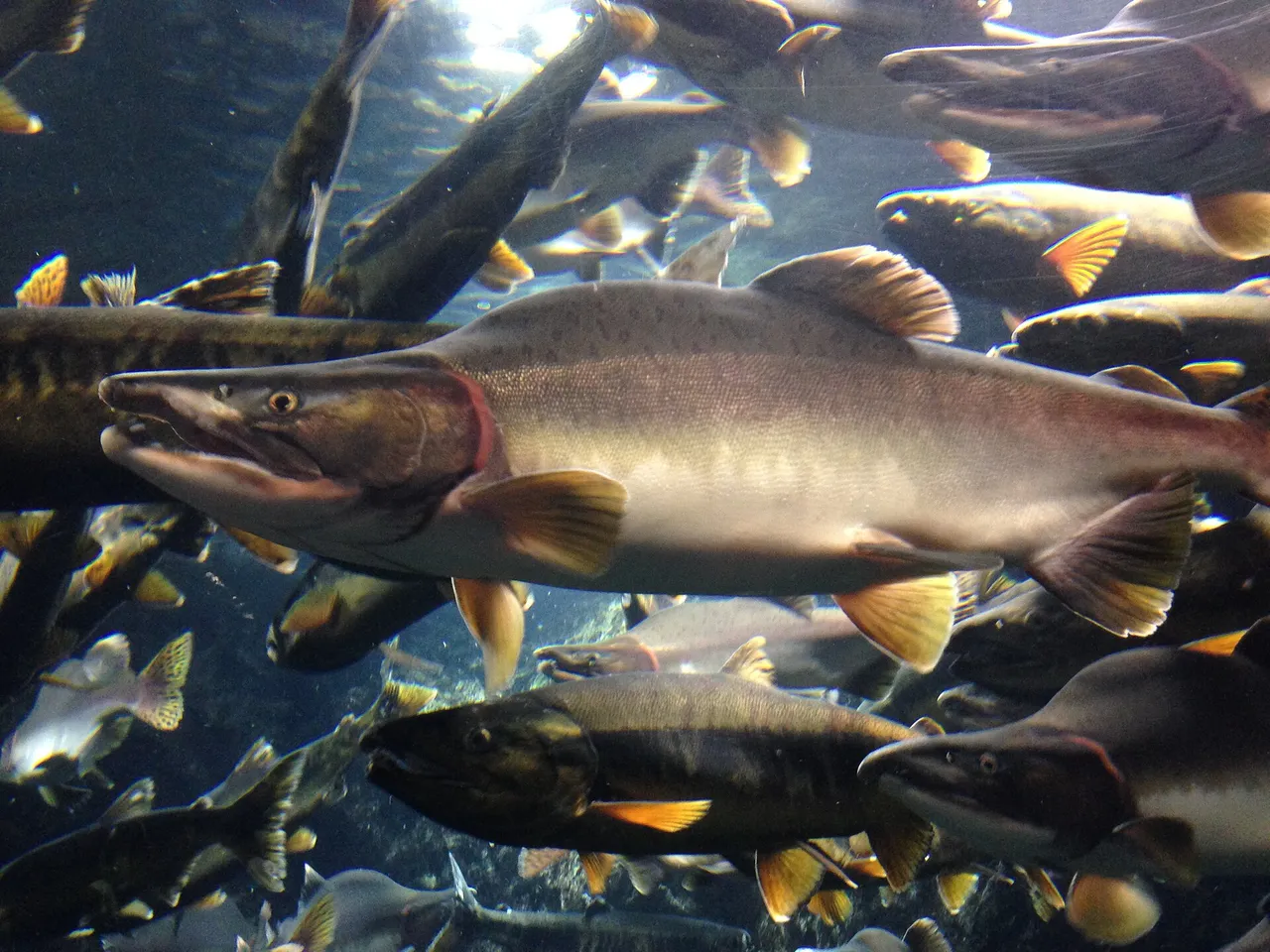
How this was identified, and who took it
Identified by: Identified on the spawning-male form the page names: a pronounced humped back rising steeply behind the head and a long strongly hooked jaw, neither of which any other Pacific salmon develops to this degree, over the very fine scales that also separate it from coho and chinook. The tail is outside the frame, so the large oval tail spots the record lists first are NOT demonstrated by this image and are not claimed for it.Totti — CC BY-SA 4.0, via Wikimedia Commons — source, licenceLook at this first
Spread the tail. Pink salmon carry large oval black spots on both lobes, bigger than any other Pacific salmon's, and that works on a bright fish from the sea as well as a coloured one from the river. The famous hump is a spawning male's feature and it will not help you at the coast.
Diagnostic — settles it on its own
Each of these settles the identification on its own. If one is clear, you have your answer.
Large oval spots on both tail lobes
Spread the caudal fin and look at both halves. Pink salmon spots are conspicuously large and oval, and they appear on the lower lobe as well as the upper. Coho spot the upper lobe only; chinook spot both but with smaller, rounder marks; chum have none at all. This is the character that works on a sea-bright fish, which is where identification actually matters.
Supporting — use with other characters
Real characters that are not conclusive by themselves. Use two or three together.
Very fine scales
Run a thumb along the flank. Pink salmon scales are markedly smaller than a coho's or a chinook's — fine enough that the flank feels smooth rather than tiled. It is a real character and a comparative one, so it needs another salmon to hand or a good memory of one.
Humped back and hooked jaw in spawning males
A male entering the river grows a steep hump behind the head and a long hooked jaw, to a degree no other Pacific salmon approaches. Unmistakable when it is there, and completely absent from females and from every fish still in salt water.
Pale gums
Open the mouth and look at the gum line at the base of the teeth. A chinook's is black, which is the classic separation; a pink salmon's is not. Useful mainly as a way of ruling out a small chinook, which is the confusion that costs anglers a fish.
What it gets confused with
- Small chinook salmon, which also spot both tail lobes — the black gum line separates them, and chinook spots are smaller and rounder.
- Coho salmon, which spots the upper tail lobe only; check the lower lobe before calling a fish a coho.
- Chum salmon, unspotted on body and tail, with which pink salmon hybridises where the two overlap.
Side by side: Pink salmon vs Chum salmon.
Where this stops working
Almost everything anglers know about pink salmon appearance comes from spawning males, and a spawning male is the easiest fish in the genus to identify and the least representative. A sea-bright fish is a plain silver salmon and the tail spotting is the only thing that will settle it. In much of its range the species runs in strict alternate-year cycles, so in an odd or even year a river may hold effectively none, and a lone fish is then more likely to be something else. Pink salmon have also established outside their native range, notably in northern Europe, where they are treated as an invasive species and reporting requirements may apply — check the responsible authority before deciding what to do with one.
The full record
This page covers identification only. The Pink salmon record covers behaviour, lifecycle, distribution, handling and the sources behind all of it.
Reviewed 2026-08-15.
More about this fish
Telling it apart is one question. Here are the others.
Similar and related fish
How it is caught
Where it lives
Where you will find it
Why the 8 connections on this page are here, and the sources
Similar and related fish
Backed by research — 1 connection
Supported by peer-reviewed research or fisheries science. The sources are listed and can be checked.
Chum salmon
An identification comparison naming both binomials: Oncorhynchus gorbuscha and Oncorhynchus keta.
- FishBase: a global information system on fishes — Froese, R. and D. Pauly, eds. — FishBase Consortium (Scientific institute)Relied on for: Morphological and distributional data for Oncorhynchus gorbuscha and for Oncorhynchus keta.States this directlyPassage read and verified
- The IUCN Red List of Threatened Species — International Union for Conservation of Nature (Conservation authority)Relied on for: Separate assessments treating Oncorhynchus gorbuscha and Oncorhynchus keta as distinct species.States this directlyCitation checked — the work exists and is described correctly
How it is caught
What experienced anglers do — 2 connections
Widely and independently recommended by experienced anglers and specialist sources. This is real angling knowledge, not proof: controlled evidence for it is limited, and FishingHQ records it as convention rather than as a demonstrated effect.
Spinning
A practitioner claim about how Oncorhynchus gorbuscha is commonly fished, following from where and how it feeds.
- General angling website restatements of established technique — Various (Credible secondary source)Relied on for: Widely restated practitioner accounts of fishing for pink salmon.Citation checked — the work exists and is described correctly
- Sea Angler — Bauer Media (Specialist angling publication)Relied on for: Practitioner treatment of the methods used for pink salmon and comparable species.Citation checked — the work exists and is described correctly
Stillwater fly fishing
A practitioner claim about how Oncorhynchus gorbuscha is commonly fished, following from where and how it feeds.
- General angling website restatements of established technique — Various (Credible secondary source)Relied on for: Widely restated practitioner accounts of fishing for pink salmon.Citation checked — the work exists and is described correctly
- Sea Angler — Bauer Media (Specialist angling publication)Relied on for: Practitioner treatment of the methods used for pink salmon and comparable species.Citation checked — the work exists and is described correctly
Where it lives
Backed by research — 3 connections
Supported by peer-reviewed research or fisheries science. The sources are listed and can be checked.
Lowland rivers
A habitat association for Oncorhynchus gorbuscha taken from the environment and distribution data on its FishBase summary.
- FishBase: a global information system on fishes — Froese, R. and D. Pauly, eds. — FishBase Consortium (Scientific institute)Relied on for: The environment, depth range and habitat description recorded for Oncorhynchus gorbuscha.States this directlyPassage read and verified
Open ocean
A habitat association for Oncorhynchus gorbuscha taken from the environment and distribution data on its FishBase summary.
- FishBase: a global information system on fishes — Froese, R. and D. Pauly, eds. — FishBase Consortium (Scientific institute)Relied on for: The environment, depth range and habitat description recorded for Oncorhynchus gorbuscha.States this directlyPassage read and verified
Spate rivers
A claim that the species uses rain-fed rivers on impermeable geology, resting on documented distribution and spawning habitat rather than on angling report.
- FishBase: a global information system on fishes — Froese, R. and D. Pauly, eds. — FishBase Consortium (Scientific institute)Relied on for: Recorded depth range, temperature tolerance and habitat association for the species outside north-west Europe.States this directlyPassage read and verified
- The IUCN Red List of Threatened Species — International Union for Conservation of Nature (Conservation authority)Relied on for: Global conservation assessment, range and recorded threats for the species.States this directlyCitation checked — the work exists and is described correctly
Where you will find it
Backed by research — 2 connections
Supported by peer-reviewed research or fisheries science. The sources are listed and can be checked.
Alaska
A distribution association between an animal and a kind of water, rather than a claim about any named mark.
- FishBase: a global information system on fishes — Froese, R. and D. Pauly, eds. — FishBase Consortium (Scientific institute)Relied on for: Distribution, habitat association and depth range recorded for the species, including its occurrence in the water body concerned.States this directlyPassage read and verified
- The IUCN Red List of Threatened Species — International Union for Conservation of Nature (Conservation authority)Relied on for: Assessment and range account for the species, including the systems and coasts it occupies.Background and mechanism onlyCitation checked — the work exists and is described correctly
The Pacific Northwest coast
Occurrence of the species in this system or along this coast: a statement about the animal's distribution, not a venue recommendation.
- FishBase: a global information system on fishes — Froese, R. and D. Pauly, eds. — FishBase Consortium (Scientific institute)Relied on for: Distribution, salinity tolerance and habitat association recorded for the species, including its occurrence in this system.States this directlyPassage read and verified
- The IUCN Red List of Threatened Species — International Union for Conservation of Nature (Conservation authority)Relied on for: Assessment and range description for the species, including the waters in which it occurs.Background and mechanism onlyCitation checked — the work exists and is described correctly