Blackhead seabream
Fish · Last reviewed 2026-08-10
A wary East Asian sparid of harbours and rocky shores, sex-changing as it grows, and the subject of an entire specialised Japanese angling discipline.
Safety: injury while handling fish — minor injury.
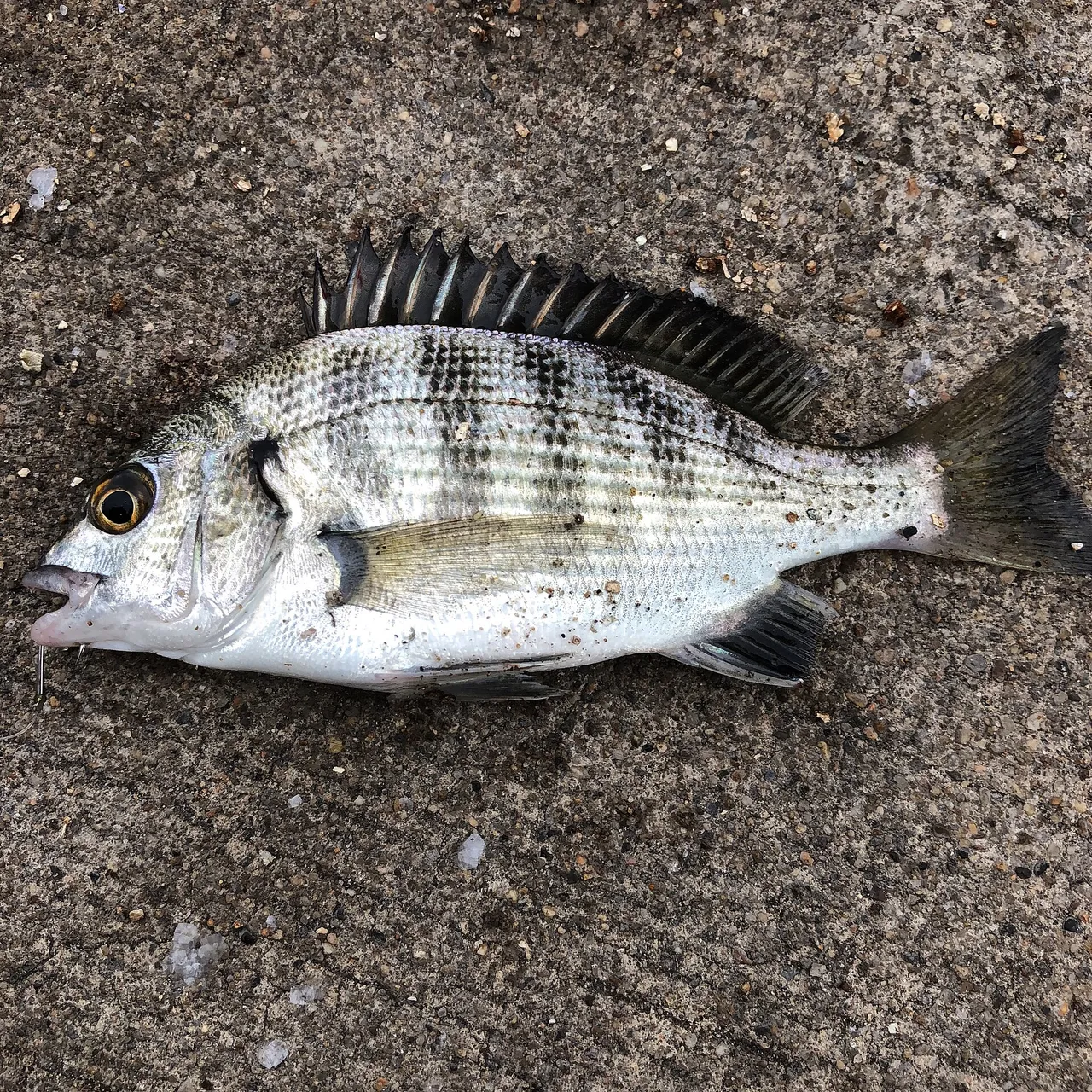
How this was identified, and who took it
Identified by: Placed in Acanthopagrus by body form and the long strongly spined first dorsal. The species-level character used is fin colour: the pelvic and anal fins are DUSKY GREY with no yellow, the standard separation from A. latus, the yellowfin seabream, whose corresponding fins are conspicuously yellow and which overlaps this species across much of its range. Faint vertical banding is supporting only, since it fades after capture. Provenance names kurodai at Kashima port, Japan.Rakurakuda — CC BY-SA 4.0, via Wikimedia Commons — source, licence
Catching Blackhead seabream
Everything here on fishing for it. Each entry opens the page behind it.
Blackhead seabream — kurodai or chinu in Japan — is the sparid around which one of the most refined shore-fishing traditions in the world has grown. It is a dark, deep-bodied sea bream of harbours, breakwaters, rocky shores and estuaries across East Asia, and it is famously suspicious.
That wariness has produced entire specialised disciplines: fine float rigs fished with loose feed over hours, and the dedicated kayaku and chinu lure and fly approaches. The fishing is technical in a way that fishing for a similar-sized fish elsewhere generally is not.
It is protandrous, maturing first as male and changing to female with size, and it tolerates brackish and near-fresh water well enough to be caught far up estuaries.
How it is caught
Identification
- Scientific name
- Acanthopagrus schlegelii
- Family
- Sparidae
- Water
- Saltwater, Brackish
- Conservation status
- Least Concern
- Regions
- East Asia
- Deep, compressed silver-grey body darkening to near-black on the head and back.
- Faint dark longitudinal lines following the scale rows along the flank.
- Strong incisor-like front teeth with rows of molars behind, for crushing shellfish.
- Sharp dorsal spines and a pointed snout, with no gold band between the eyes.
Size
- Typical
- 0.5–1.5 kg (1.1–3.3 lb)
- Large
- 2–3.5 kg (4.4–7.7 lb)
Exceptional: FishBase records a maximum of 50 cm and 3.2 kg
Lifecycle and reproduction
Protandrous — most individuals mature as male and change to female with age and size — and moderately long-lived. Tolerant of low salinity, which lets it use estuaries extensively.
Spawns in spring in coastal waters. The sex-change life history means the largest fish are female and that heavy removal of large fish alters the sex ratio directly.
Feeding and senses
Crushes shellfish, crabs and barnacles with heavy molars, and also takes worms, algae and small fish. Feeds around hard structure and over mixed ground.
An extremely wary close-range visual feeder in clear water, testing baits carefully — which is precisely why the specialised fine-tackle approaches developed around it.
Through the year
Present inshore for much of the year, moving into estuaries and harbours in warm months and deeper in winter. Winter fishing for large fish is a recognised speciality in Japan.
Distribution
Northwest Pacific: southern Hokkaido, Japan to the southern Korean Peninsula, middle and north coast of the Republic of China and Taiwan. Not occurring in the Ryukyu Islands
This is a biological range — where the species occurs, not a prediction that you will catch one. To browse the fishing geography FishingHQ holds, start at fishing places.
Why anglers care
A central species of Japanese and Korean shore angling, fished with fine float tackle and continuous loose feed, and increasingly with dedicated lure and fly approaches. Its significance is technical: the fishing developed around it is among the most refined light shore angling anywhere, and its influence on tackle design has travelled well beyond the region.
Handling and returning
Sharp dorsal spines and powerful crushing jaws. Grip across the body with the spines folded, use pliers, and keep fingers out of the mouth. Widely released by specialist anglers.
Going further
- Blackhead seabream vs Yellowfin bream — how to tell them apart.
Safety
Injury while handling fish — Minor injury
The stiff dorsal spines cause deep punctures and the molar teeth can crush a finger placed in the mouth.
What reduces it: Grip across the body with the spines folded, use pliers for unhooking, and never put fingers in the mouth.
Where to go next
Similar and related fish
Where it lives
Where you will find it
Sources and evidence
- FishBase: a global information system on fishes — Froese, R. and D. Pauly, eds. — FishBase Consortium (Scientific institute)Relied on for: Family, maximum size, depth and environment, distribution and the IUCN assessment for Acanthopagrus schlegelii.States this directlyPassage read and verified
- The IUCN Red List of Threatened Species — International Union for Conservation of Nature (Conservation authority)Relied on for: The Least Concern assessment for Acanthopagrus schlegelii, assessed 03 December 2009.States this directlyCitation checked — the work exists and is described correctly
Why the 6 connections on this page are here, and the sources
Similar and related fish
Backed by research — 1 connection
Supported by peer-reviewed research or fisheries science. The sources are listed and can be checked.
Yellowfin bream
An identification comparison naming both binomials: Acanthopagrus schlegelii and Acanthopagrus australis.
- FishBase: a global information system on fishes — Froese, R. and D. Pauly, eds. — FishBase Consortium (Scientific institute)Relied on for: Morphological and distributional data for Acanthopagrus schlegelii and for Acanthopagrus australis.States this directlyPassage read and verified
- The IUCN Red List of Threatened Species — International Union for Conservation of Nature (Conservation authority)Relied on for: Separate assessments treating Acanthopagrus schlegelii and Acanthopagrus australis as distinct species.States this directlyCitation checked — the work exists and is described correctly
How it is caught
What experienced anglers do — 1 connection
Widely and independently recommended by experienced anglers and specialist sources. This is real angling knowledge, not proof: controlled evidence for it is limited, and FishingHQ records it as convention rather than as a demonstrated effect.
Float fishing
A practitioner claim about how Acanthopagrus schlegelii is commonly fished, following from where and how it feeds.
- General angling website restatements of established technique — Various (Credible secondary source)Relied on for: Widely restated practitioner accounts of fishing for blackhead seabream.Citation checked — the work exists and is described correctly
- Sea Angler — Bauer Media (Specialist angling publication)Relied on for: Practitioner treatment of the methods used for blackhead seabream and comparable species.Citation checked — the work exists and is described correctly
Where it lives
Backed by research — 3 connections
Supported by peer-reviewed research or fisheries science. The sources are listed and can be checked.
Estuary
A habitat association for Acanthopagrus schlegelii taken from the environment and distribution data on its FishBase summary.
- FishBase: a global information system on fishes — Froese, R. and D. Pauly, eds. — FishBase Consortium (Scientific institute)Relied on for: The environment, depth range and habitat description recorded for Acanthopagrus schlegelii.States this directlyPassage read and verified
Harbours, piers and breakwaters
A habitat association for Acanthopagrus schlegelii taken from the environment and distribution data on its FishBase summary.
- FishBase: a global information system on fishes — Froese, R. and D. Pauly, eds. — FishBase Consortium (Scientific institute)Relied on for: The environment, depth range and habitat description recorded for Acanthopagrus schlegelii.States this directlyPassage read and verified
Rocky shores and reefs
A habitat association for Acanthopagrus schlegelii taken from the environment and distribution data on its FishBase summary.
- FishBase: a global information system on fishes — Froese, R. and D. Pauly, eds. — FishBase Consortium (Scientific institute)Relied on for: The environment, depth range and habitat description recorded for Acanthopagrus schlegelii.States this directlyPassage read and verified
Where you will find it
Backed by research — 1 connection
Supported by peer-reviewed research or fisheries science. The sources are listed and can be checked.
Korea
A distribution association between an animal and a kind of water, rather than a claim about any named mark.
- FishBase: a global information system on fishes — Froese, R. and D. Pauly, eds. — FishBase Consortium (Scientific institute)Relied on for: Distribution, habitat association and depth range recorded for the species, including its occurrence in the water body concerned.States this directlyPassage read and verified
- The IUCN Red List of Threatened Species — International Union for Conservation of Nature (Conservation authority)Relied on for: Assessment and range account for the species, including the systems and coasts it occupies.Background and mechanism onlyCitation checked — the work exists and is described correctly
How FishingHQ labels evidence is explained in the evidence policy.