Yellowfin bream
Fish · Last reviewed 2026-08-10
The archetypal Australian estuary sparid, wary, structure-oriented, and the species around which a whole competitive lure discipline has been built.
Safety: injury while handling fish — minor injury.
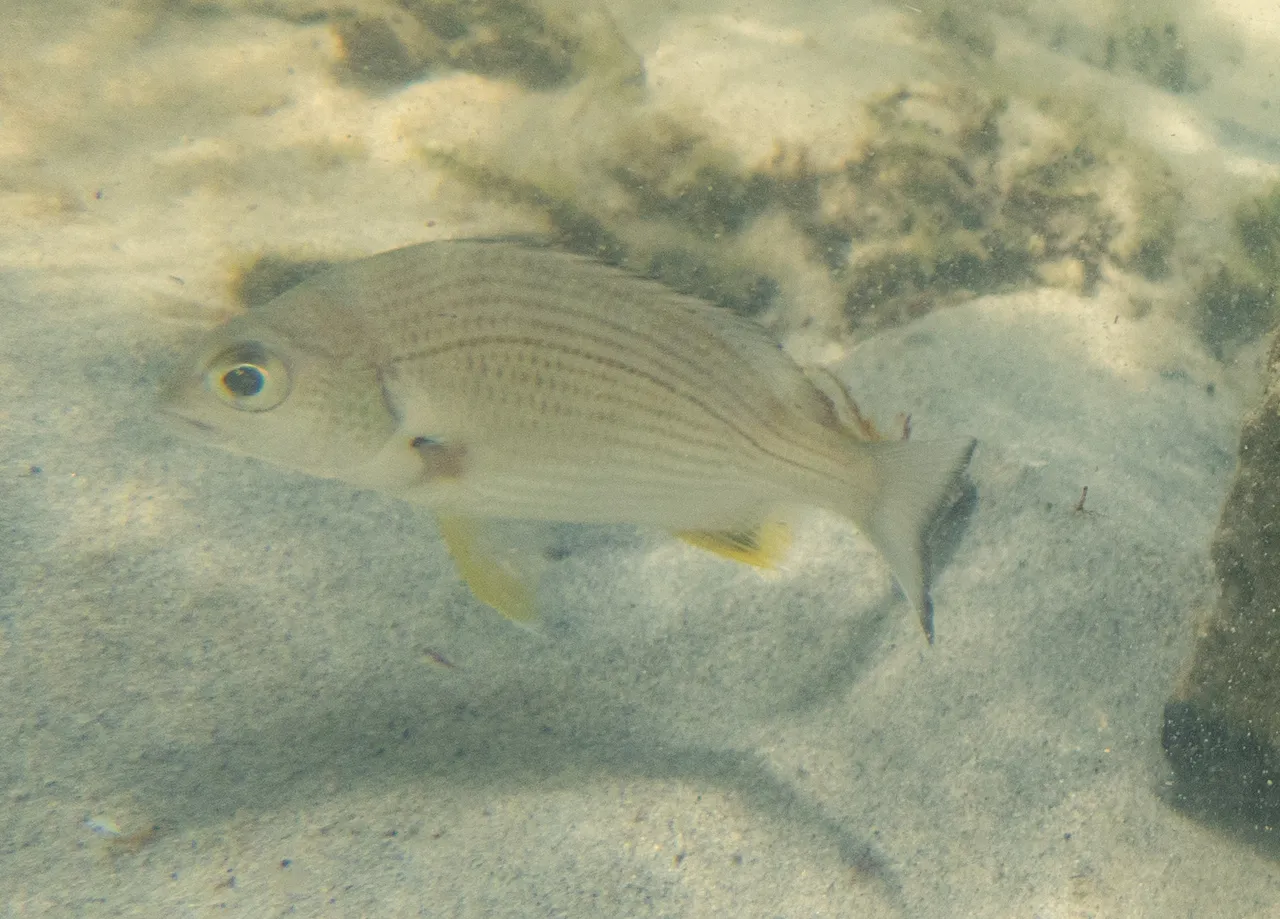
How this was identified, and who took it
Identified by: The record's character survives the water and is unmistakable: the pelvic and anal fins are strongly YELLOW against a silver flank, with a yellow wash on the lower caudal lobe. That is what separates this from the dusky-finned black bream Acanthopagrus butcheri which shares the same estuaries. Faint horizontal lines along the scale rows, dark caudal margin and the large eye all read.Rolf Lawrenz — CC BY, via iNaturalist — source, licenceCatching Yellowfin bream
Everything here on fishing for it. Each entry opens the page behind it.
Yellowfin bream is the fish Australian estuary angling is built on. It is a deep-bodied, silver sparid with distinctly yellow pelvic and anal fins, found in estuaries, harbours, rock walls and surf beaches down the eastern seaboard, and it is famously suspicious.
That wariness has driven an entire competitive discipline. Australian bream tournaments fished with ultra-light lure tackle have shaped rod, reel, line and lure design well beyond Australia, in much the same way Japanese sea bass fishing did.
It spawns near estuary mouths and runs into fresh water at times, and it lives a long time — a large bream is an old fish, which is not obvious from its modest size.
How it is caught
- Float fishingUltra-light lures and baits fished close to structure, the basis of a tournament discipline.
- LedgeringUltra-light lures and baits fished close to structure, the basis of a tournament discipline.
- SpinningUltra-light lures and baits fished close to structure, the basis of a tournament discipline.
Gear for this fish
- Soft plasticsSmall soft plastics fished around estuarine structure are the mainstream bream lure approach in eastern Australia, and the fishery is conducted on very light tackle because the fish inspects closely.
- CrankbaitsSmall shallow crankbaits worked over oyster racks and flats are an established bream technique, deflecting off structure the fish feeds around.
Identification
- Scientific name
- Acanthopagrus australis
- Family
- Sparidae
- Water
- Saltwater, Brackish
- Conservation status
- Least Concern
- Regions
- Australia
- Yellow pelvic and anal fins, and often a yellow wash on the lower tail lobe.
- Deep, compressed silver-grey body with a darker back and faint longitudinal lines.
- Strong incisor-like front teeth with molars behind, for crushing shellfish and crabs.
- Sharp dorsal spines, and no gold band between the eyes.
Size
- Typical
- 300–800 g (10 oz–1.8 lb)
- Large
- 1.2–2 kg (2.6–4.4 lb)
Exceptional: FishBase records a maximum of 66 cm and 4.5 kg
How yellowfin bream are fished, and why
An estuary and inshore opportunist that moves between mangrove, rock, sand and surf, and which has become the foundation of an entire light-lure culture.
SPINNING with small soft plastics and hardbodies is now the dominant approach, and it works because bream are curious, structure-oriented and will follow and inspect a small lure — behaviour that suits finesse presentation and light line far better than heavy tackle.
FLOAT FISHING and LEDGERING with baits remain effective and are how most people start, because the fish feeds readily on crustaceans, molluscs and cut bait on the bottom.
AND THE SPECIES HAS SHAPED TACKLE INTERNATIONALLY. The light-lure techniques developed around estuary bream — very light lines, small lures, long soft rods — were exported and are now used for unrelated species on other continents. That is an unusual case of a modest inshore fish driving a global tackle category, and it happened because the fish is abundant, accessible and hard enough to be interesting.
What experienced anglers do — why, and the sources (2)
Widely and independently recommended by experienced anglers and specialist sources. This is real angling knowledge, not proof: controlled evidence for it is limited, and FishingHQ records it as convention rather than as a demonstrated effect.
- FishBase: a global information system on fishes — Froese, R. and D. Pauly, eds. — FishBase Consortium (Scientific institute)Relied on for: Habitat association, depth range, feeding ecology and prey of the species, from which the method association follows.Background and mechanism onlyPassage read and verified
- IGFA International Angling Rules and World Record Requirements — International Game Fish Association (Angling or fisheries organisation)Relied on for: Recognised angling methods and the tackle classes used for them internationally.Background and mechanism onlyPassage read and verified
Why releasing the big ones matters more than the size of the fish suggests
Yellowfin bream are a small fish with a life history that makes the release decision much more consequential than the animal's size implies, and that is the thing worth understanding about handling them.
THE HAZARD FIRST AND BRIEFLY. A stiff spiny dorsal running most of the back, sharp enough to puncture, met by any hand closing over the fish. Crushing jaws behind incisiform front teeth, built for molluscs and crustaceans, which will hurt a finger and cannot cut one. Grip across the body with the dorsal folded; unhook with pliers.
THE LIFE HISTORY IS THE POINT. Yellowfin bream are slow-growing and long-lived — individuals reach well over two decades — and that combination has a specific consequence: a large bream is an old bream, and old fish cannot be replaced on any timescale that matters to a fishery. A thirty-five-centimetre fish represents years of growth in an estuary; the next one does not arrive next season.
AND OLD FISH CONTRIBUTE DISPROPORTIONATELY TO REPRODUCTION. Fecundity scales steeply with body size in most fish, so a single large female produces very many more eggs than several small ones of the same combined weight, and in many species the eggs are of better quality as well. Removing the big fish therefore removes an outsized share of the population's reproductive output, and it does so from the part of the population that takes longest to rebuild.
WHICH INVERTS THE USUAL HABIT. Most anglers keep the biggest and return the small ones. On a slow-growing, long-lived species the more defensible pattern is the reverse: keep a couple of mid-sized fish for the table if that is the intention, and return the large ones — which is exactly the practice the specialist bream fishery in eastern Australia has largely adopted on its own.
The handling that makes that release work is ordinary and matters: light tackle, a quick fight, wet hands, minimal air, and straight back.
Backed by research — why, and the sources (2)
Supported by peer-reviewed research or fisheries science. The sources are listed and can be checked.
- FishBase: a global information system on fishes — Froese, R. and D. Pauly, eds. — FishBase Consortium (Scientific institute)Relied on for: Morphology, dentition, spination, thermal tolerance, reproductive strategy and depth range recorded for the species.States this directlyPassage read and verified
- The IUCN Red List of Threatened Species — International Union for Conservation of Nature (Conservation authority)Relied on for: Assessment, population trend and the life-history traits — longevity, growth rate, sex structure — that determine a population's sensitivity to the removal of large individuals.Background and mechanism onlyCitation checked — the work exists and is described correctly
A wary estuary fish in clear shallow water, and tackle chosen to be invisible
Yellowfin bream tackle is finesse tackle in salt water, and the reason is behavioural: these are cautious fish in clear, shallow, heavily fished estuarine water, and they detect and reject anything that feels wrong.
THE FISH INSPECTS AND EJECTS. Bream mouth a bait or a lure and drop it the moment resistance appears, which is why light line, small hooks and minimal terminal hardware consistently out-fish heavier arrangements. This is not about breaking strain — a bream is not going to break sensible tackle in open water — it is about what the fish feels before it commits.
FLUOROCARBON LEADER IS DOING TWO JOBS AT ONCE and both are real. It is less visible in clear shallow water, and it resists abrasion against oyster racks, rock walls, pontoons and the shell-encrusted structure bream live around. That second job is the one that decides the diameter: too light and the leader parts on oyster, too heavy and the presentation suffers.
STRUCTURE IS WHY THE FIGHT IS SHORT AND SHARP. Bream run for cover immediately, and around oyster leases and pylons the difference between landing and losing is measured in the first second. That is the tension in the whole outfit: fine enough to get a bite, strong enough to turn a fish away from something that cuts.
SMALL LURES AND LIGHT JIG HEADS FOLLOW FROM THE DIET. Bream take crustaceans, molluscs and small prey off structure and bottom, and the presentations that work are small, slow and close to something. The tackle is specified by the weight of a very small lure, which is what sets the rod's casting range.
STEALTH IN SHALLOW WATER IS PART OF THE TACKLE DECISION. Long casts in clear flats water matter because the fish are disturbed by a boat or a wading angler, so a rod that casts a light lure a long way accurately is doing more work than a rod that fights well.
AND HOOK QUALITY MATTERS DISPROPORTIONATELY at this scale — a small hook must be genuinely sharp and strong enough not to open under pressure from a fish heading into structure.
What experienced anglers do — why, and the sources (2)
Widely and independently recommended by experienced anglers and specialist sources. This is real angling knowledge, not proof: controlled evidence for it is limited, and FishingHQ records it as convention rather than as a demonstrated effect.
- Sea Angler — Bauer Media (Specialist angling publication)Relied on for: Established shore and boat angling practice, including tackle selection and the reasoning behind it.States this directlyCitation checked — the work exists and is described correctly
- General angling website restatements of established technique — Various (Credible secondary source)Relied on for: The widely restated tackle practice for this species, recorded as a consensus position rather than as an original observation.States this directlyCitation checked — the work exists and is described correctly
Very small lures worked very slowly against something hard
Yellowfin bream lure fishing is the finesse end of saltwater lure angling, and it exists because a fish that was assumed to be a bait species turned out to respond well to extremely small, extremely slow presentations.
THE DIET SETS THE SIZE. Bream take crustaceans, molluscs, worms and small prey from structure and bottom, so the lures that work are small — small soft plastics, tiny crankbaits, blades and surface lures at the smallest end of what is manufactured. Anything scaled to a predator is ignored.
STRUCTURE IS THE TARGET AND IT IS UNFORGIVING. Oyster racks and leases, rock walls, bridge and jetty pylons, pontoons and mangrove roots hold bream, and a lure has to be fished hard against them. That costs terminal tackle and it is the price of the fishery — anglers fishing far enough out to avoid losses are fishing empty water.
SLOW IS THE WHOLE TECHNIQUE. Bream inspect before committing, and a lure that keeps moving away is refused. Long pauses, a lure allowed to sit, and a retrieve that is closer to a series of nudges than a swim are what convert follows into takes. Anglers coming from predator fishing consistently fish too fast.
SURFACE FISHING IN SHALLOW WATER IS A GENUINE AND UNDERUSED OPTION. Bream in skinny flats water take small surface lures readily at dawn and dusk, and it is one of the most rewarding light-tackle sights available in an estuary.
CLARITY AND PRESSURE ARGUE FOR STEALTH. These are wary fish in clear shallow heavily-fished water, so long accurate casts and a quiet approach matter more than lure selection — the record's tackle section explains why the outfit is built to deliver a very light lure a long way.
AND THE FIGHT IS DECIDED IMMEDIATELY. A hooked bream runs for cover instantly, and around oyster the leader either survives the first second or it does not. Fishing lighter than the structure allows loses fish with lures in them, which is the argument for the heaviest leader that still gets bites.
What experienced anglers do — why, and the sources (2)
Widely and independently recommended by experienced anglers and specialist sources. This is real angling knowledge, not proof: controlled evidence for it is limited, and FishingHQ records it as convention rather than as a demonstrated effect.
- Sea Angler — Bauer Media (Specialist angling publication)Relied on for: Established shore and boat angling practice, including method selection and the reasoning behind it.States this directlyCitation checked — the work exists and is described correctly
- General angling website restatements of established technique — Various (Credible secondary source)Relied on for: The widely restated practice for this species, recorded as a consensus position rather than as an original observation.States this directlyCitation checked — the work exists and is described correctly
Lifecycle and reproduction
Slow-growing and long-lived, with fish recorded past twenty years. Protandrous in part, with some individuals changing sex with age. A 40-centimetre bream is a genuinely old fish.
Spawns near estuary mouths and in coastal waters in winter, with juveniles moving up into estuaries and sometimes into fresh water to grow.
Feeding and senses
Crushes crabs, shellfish and worms with heavy molars, and takes small fish and prawns. Feeds tight to structure — rock walls, oyster racks, pontoons and snags.
An extremely cautious close-range visual feeder in clear estuarine water, which is exactly why ultra-light leaders and small natural-looking presentations dominate the fishery.
Through the year
Moves downstream toward estuary mouths to spawn in winter and disperses through estuaries and into rivers in warmer months.
Distribution
Southwest Pacific: endemic to eastern Australia, from Townsville in Queensland to the Gippsland Lakes in Victoria . Occurrence in Japan and Ryukyu Islands and Taiwan need verification
This is a biological range — where the species occurs, not a prediction that you will catch one. To browse the fishing geography FishingHQ holds, start at fishing places.
Why anglers care
The central species of Australian estuary angling, taken on light lures, soft plastics, surface lures and natural baits fished tight to structure, and the basis of a long-running tournament circuit. Its significance to tackle development is unusually large: the demands of finesse bream fishing drove a generation of light rod, braid and lure design that has been exported worldwide.
Handling and returning
Sharp dorsal spines and crushing jaws. Grip across the body with the spines folded, use pliers, and keep fingers out of the mouth. Given the species' longevity, releasing large fish matters more than the size suggests.
Going further
- Yellowfin bream vs Blackhead seabream — how to tell them apart.
Safety
Injury while handling fish — Minor injury
The stiff dorsal spines cause deep punctures when the fish is gripped carelessly, particularly when landing over rocks.
What reduces it: Grip across the body with the spines folded, use a wet cloth or lip grip, and unhook with pliers.
Where to go next
Similar and related fish
Where it lives
Sources and evidence
- FishBase: a global information system on fishes — Froese, R. and D. Pauly, eds. — FishBase Consortium (Scientific institute)Relied on for: Family, maximum size, depth and environment, distribution and the IUCN assessment for Acanthopagrus australis.States this directlyPassage read and verified
- The IUCN Red List of Threatened Species — International Union for Conservation of Nature (Conservation authority)Relied on for: The Least Concern assessment for Acanthopagrus australis, assessed 04 December 2009.States this directlyCitation checked — the work exists and is described correctly
Why the 9 connections on this page are here, and the sources
Similar and related fish
Backed by research — 1 connection
Supported by peer-reviewed research or fisheries science. The sources are listed and can be checked.
Blackhead seabream
An identification comparison naming both binomials: Acanthopagrus schlegelii and Acanthopagrus australis.
- FishBase: a global information system on fishes — Froese, R. and D. Pauly, eds. — FishBase Consortium (Scientific institute)Relied on for: Morphological and distributional data for Acanthopagrus schlegelii and for Acanthopagrus australis.States this directlyPassage read and verified
- The IUCN Red List of Threatened Species — International Union for Conservation of Nature (Conservation authority)Relied on for: Separate assessments treating Acanthopagrus schlegelii and Acanthopagrus australis as distinct species.States this directlyCitation checked — the work exists and is described correctly
How it is caught
What experienced anglers do — 3 connections
Widely and independently recommended by experienced anglers and specialist sources. This is real angling knowledge, not proof: controlled evidence for it is limited, and FishingHQ records it as convention rather than as a demonstrated effect.
Float fishing
A practitioner claim about how Acanthopagrus australis is commonly fished, following from where and how it feeds.
- General angling website restatements of established technique — Various (Credible secondary source)Relied on for: Widely restated practitioner accounts of fishing for yellowfin bream.Citation checked — the work exists and is described correctly
- Sea Angler — Bauer Media (Specialist angling publication)Relied on for: Practitioner treatment of the methods used for yellowfin bream and comparable species.Citation checked — the work exists and is described correctly
Ledgering
A practitioner claim about how Acanthopagrus australis is commonly fished, following from where and how it feeds.
- General angling website restatements of established technique — Various (Credible secondary source)Relied on for: Widely restated practitioner accounts of fishing for yellowfin bream.Citation checked — the work exists and is described correctly
- Sea Angler — Bauer Media (Specialist angling publication)Relied on for: Practitioner treatment of the methods used for yellowfin bream and comparable species.Citation checked — the work exists and is described correctly
Spinning
A practitioner claim about how Acanthopagrus australis is commonly fished, following from where and how it feeds.
- General angling website restatements of established technique — Various (Credible secondary source)Relied on for: Widely restated practitioner accounts of fishing for yellowfin bream.Citation checked — the work exists and is described correctly
- Sea Angler — Bauer Media (Specialist angling publication)Relied on for: Practitioner treatment of the methods used for yellowfin bream and comparable species.Citation checked — the work exists and is described correctly
Gear for this fish
What experienced anglers do — 2 connections
Widely and independently recommended by experienced anglers and specialist sources. This is real angling knowledge, not proof: controlled evidence for it is limited, and FishingHQ records it as convention rather than as a demonstrated effect.
Soft plastics
A practitioner claim about tackle commonly used for Acanthopagrus australis.
- General angling website restatements of established technique — Various (Credible secondary source)Relied on for: Widely restated practitioner accounts of this presentation for yellowfin bream.Citation checked — the work exists and is described correctly
- Angling Times — Bauer Media (Specialist angling publication)Relied on for: Practitioner treatment of comparable presentations for the species group.Citation checked — the work exists and is described correctly
A practitioner claim about which lure family answers this species' feeding or holding behaviour.
- IGFA International Angling Rules and World Record Requirements — International Game Fish Association (Angling or fisheries organisation)Relied on for: Recognition of the species as an established sport fish taken on artificial lures, and the line and tackle classes used for it.States this directlyPassage read and verified
- General angling website restatements of established technique — Various (Credible secondary source)Relied on for: Widely restated lure practice for this species.Background and mechanism onlyCitation checked — the work exists and is described correctly
Crankbaits
A practitioner claim about which lure family answers this species' feeding or holding behaviour.
- IGFA International Angling Rules and World Record Requirements — International Game Fish Association (Angling or fisheries organisation)Relied on for: Recognition of the species as an established sport fish taken on artificial lures, and the line and tackle classes used for it.States this directlyPassage read and verified
- General angling website restatements of established technique — Various (Credible secondary source)Relied on for: Widely restated lure practice for this species.Background and mechanism onlyCitation checked — the work exists and is described correctly
Where it lives
Backed by research — 3 connections
Supported by peer-reviewed research or fisheries science. The sources are listed and can be checked.
Estuary
A habitat association for Acanthopagrus australis taken from the environment and distribution data on its FishBase summary.
- FishBase: a global information system on fishes — Froese, R. and D. Pauly, eds. — FishBase Consortium (Scientific institute)Relied on for: The environment, depth range and habitat description recorded for Acanthopagrus australis.States this directlyPassage read and verified
Rocky shores and reefs
A habitat association for Acanthopagrus australis taken from the environment and distribution data on its FishBase summary.
- FishBase: a global information system on fishes — Froese, R. and D. Pauly, eds. — FishBase Consortium (Scientific institute)Relied on for: The environment, depth range and habitat description recorded for Acanthopagrus australis.States this directlyPassage read and verified
Surf beaches
A habitat association for Acanthopagrus australis taken from the environment and distribution data on its FishBase summary.
- FishBase: a global information system on fishes — Froese, R. and D. Pauly, eds. — FishBase Consortium (Scientific institute)Relied on for: The environment, depth range and habitat description recorded for Acanthopagrus australis.States this directlyPassage read and verified
How FishingHQ labels evidence is explained in the evidence policy.