How to identify yellowfin bream
Acanthopagrus australis · Sparidae
The characters that identify yellowfin bream, ranked by how far each one can be trusted on its own.
Safety: injury while handling fish — minor injury.
How this was identified, and who took it
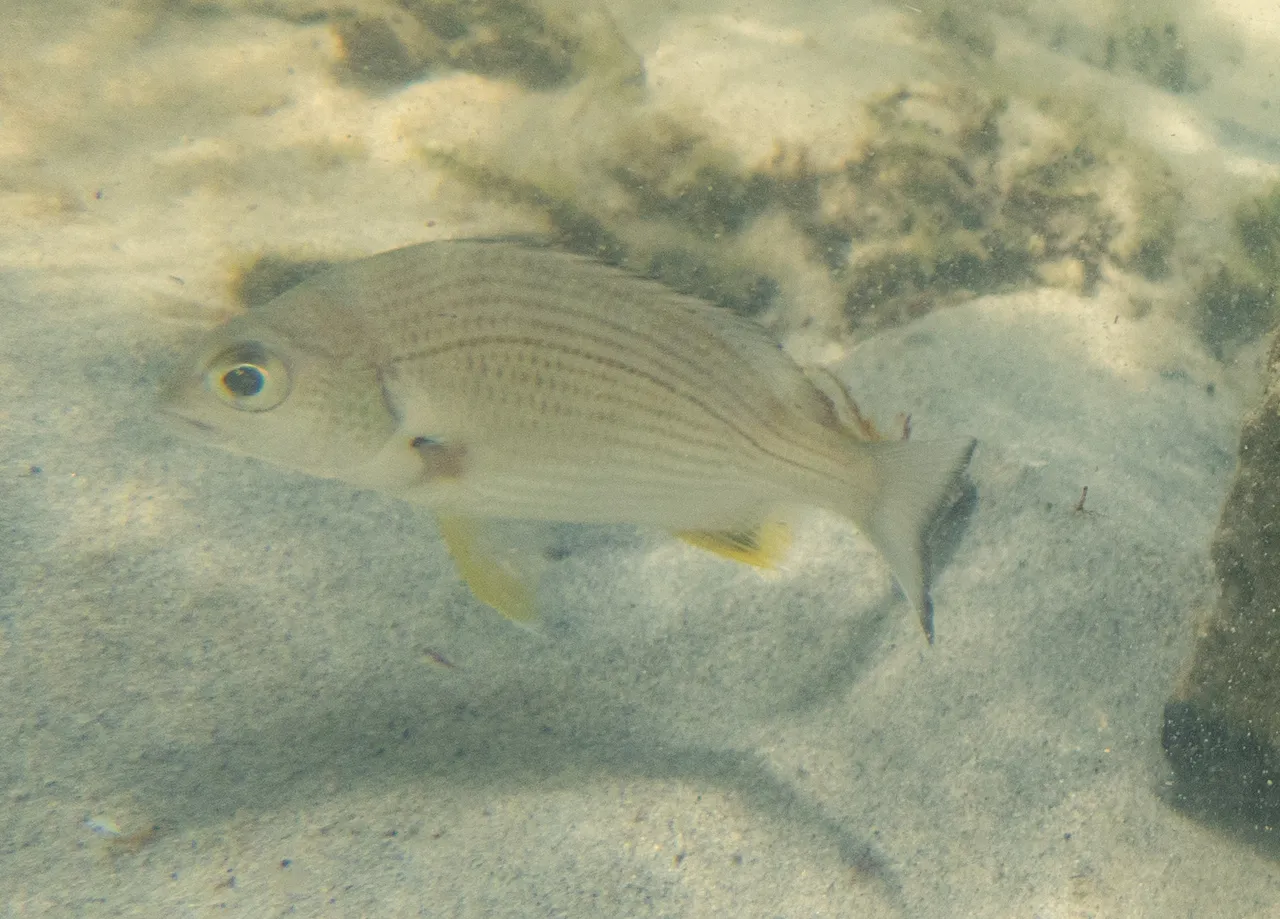
Identified by: The record's character survives the water and is unmistakable: the pelvic and anal fins are strongly YELLOW against a silver flank, with a yellow wash on the lower caudal lobe. That is what separates this from the dusky-finned black bream Acanthopagrus butcheri which shares the same estuaries. Faint horizontal lines along the scale rows, dark caudal margin and the large eye all read.Rolf Lawrenz — CC BY, via iNaturalist — source, licenceAbout the image above: The photograph is an in-water frame shot through a metre of warm-tinted water. The fin yellow the page leads on is strong enough to survive that; nothing else about the tone in the image should be relied on.
Look at this first
Turn the fish belly-up and look at the pelvic and anal fins. On a yellowfin bream they are properly yellow, and there is usually a yellow wash low in the tail as well. On the black bream that shares the same estuaries those fins are dusky grey. Then check between the eyes, where a yellowfin bream carries no gold band.
Diagnostic — settles it on its own
Each of these settles the identification on its own. If one is clear, you have your answer.
Yellow pelvic and anal fins
The paired fins under the body and the anal fin behind them carry real yellow, and in a fish in condition the lower lobe of the tail is washed with it too. Black bream's are dusky to grey-black. This is a colour and it is admissible here because it is strong, because it holds on a fish in the water and a fish in the hand, and because the alternative characters separating these two congeners are worse. It does fade after death.
Supporting — use with other characters
Real characters that are not conclusive by themselves. Use two or three together.
No gold band between the eyes
Look across the top of the head. Tarwhine, which is the other bream a reader will meet in the same water, carries a distinct gold or bronze band between the eyes and gold horizontal lines along the flank. Yellowfin bream carries neither. It is an absence, which is a weaker instruction, so use it as the second check rather than the first.
Incisor-like front teeth with molars behind
Open the mouth. The front of the jaw carries flattened cutting teeth and the back carries rounded crushing molars — the apparatus of a fish that eats crabs, prawns and shellfish. This places the animal in the breams and away from the trevallies and whiting of the same flats, and it is worth seeing because it explains the whole of the species' behaviour.
A deep compressed silver-grey body with faint longitudinal lines
The body is deep, flattened side to side, silver-grey with a darker back and fine horizontal lines following the scale rows. It is the standard Acanthopagrus silhouette. Recognising it gets you to the genus quickly and settles nothing within it.
What it gets confused with
- Black bream, Acanthopagrus butcheri, which shares the estuaries in the south of the range and has dusky rather than yellow paired fins.
- Tarwhine, which is separated by the gold band between the eyes and the gold flank lines, and which has a blunter snout.
- Yellowfin × black bream hybrids, common where the two ranges overlap in southern New South Wales and Victoria, which carry intermediate fin colour.
- Pikey bream in the north of the range, a further Acanthopagrus that overlaps and is genuinely difficult.
Side by side: Yellowfin bream vs Blackhead seabream.
Where this stops working
Yellowfin bream and black bream hybridise freely where their ranges meet along the south-eastern Australian coast, and hybrid populations are established in several systems. In those waters fin colour is intermediate and unreliable, and no field character resolves it. Fin yellow also dulls after death and can be weak in fish from dark tannin-stained water, so a bream from an upstream reach with grey-looking fins is not necessarily a black bream. In the north of the range further Acanthopagrus overlap and the separation becomes a specialist question. Size and bag rules for bream differ by state and change; the current rules of the state fisheries authority are the only source for what a reader may do with one.
The full record
This page covers identification only. The Yellowfin bream record covers behaviour, lifecycle, distribution, handling and the sources behind all of it.
Reviewed 2026-08-16.
More about this fish
Telling it apart is one question. Here are the others.
Similar and related fish
How it is caught
- Float fishingUltra-light lures and baits fished close to structure, the basis of a tournament discipline.
- LedgeringUltra-light lures and baits fished close to structure, the basis of a tournament discipline.
- SpinningUltra-light lures and baits fished close to structure, the basis of a tournament discipline.
Where it lives
Why the 7 connections on this page are here, and the sources
Similar and related fish
Backed by research — 1 connection
Supported by peer-reviewed research or fisheries science. The sources are listed and can be checked.
Blackhead seabream
An identification comparison naming both binomials: Acanthopagrus schlegelii and Acanthopagrus australis.
- FishBase: a global information system on fishes — Froese, R. and D. Pauly, eds. — FishBase Consortium (Scientific institute)Relied on for: Morphological and distributional data for Acanthopagrus schlegelii and for Acanthopagrus australis.States this directlyPassage read and verified
- The IUCN Red List of Threatened Species — International Union for Conservation of Nature (Conservation authority)Relied on for: Separate assessments treating Acanthopagrus schlegelii and Acanthopagrus australis as distinct species.States this directlyCitation checked — the work exists and is described correctly
How it is caught
What experienced anglers do — 3 connections
Widely and independently recommended by experienced anglers and specialist sources. This is real angling knowledge, not proof: controlled evidence for it is limited, and FishingHQ records it as convention rather than as a demonstrated effect.
Float fishing
A practitioner claim about how Acanthopagrus australis is commonly fished, following from where and how it feeds.
- General angling website restatements of established technique — Various (Credible secondary source)Relied on for: Widely restated practitioner accounts of fishing for yellowfin bream.Citation checked — the work exists and is described correctly
- Sea Angler — Bauer Media (Specialist angling publication)Relied on for: Practitioner treatment of the methods used for yellowfin bream and comparable species.Citation checked — the work exists and is described correctly
Ledgering
A practitioner claim about how Acanthopagrus australis is commonly fished, following from where and how it feeds.
- General angling website restatements of established technique — Various (Credible secondary source)Relied on for: Widely restated practitioner accounts of fishing for yellowfin bream.Citation checked — the work exists and is described correctly
- Sea Angler — Bauer Media (Specialist angling publication)Relied on for: Practitioner treatment of the methods used for yellowfin bream and comparable species.Citation checked — the work exists and is described correctly
Spinning
A practitioner claim about how Acanthopagrus australis is commonly fished, following from where and how it feeds.
- General angling website restatements of established technique — Various (Credible secondary source)Relied on for: Widely restated practitioner accounts of fishing for yellowfin bream.Citation checked — the work exists and is described correctly
- Sea Angler — Bauer Media (Specialist angling publication)Relied on for: Practitioner treatment of the methods used for yellowfin bream and comparable species.Citation checked — the work exists and is described correctly
Where it lives
Backed by research — 3 connections
Supported by peer-reviewed research or fisheries science. The sources are listed and can be checked.
Estuary
A habitat association for Acanthopagrus australis taken from the environment and distribution data on its FishBase summary.
- FishBase: a global information system on fishes — Froese, R. and D. Pauly, eds. — FishBase Consortium (Scientific institute)Relied on for: The environment, depth range and habitat description recorded for Acanthopagrus australis.States this directlyPassage read and verified
Rocky shores and reefs
A habitat association for Acanthopagrus australis taken from the environment and distribution data on its FishBase summary.
- FishBase: a global information system on fishes — Froese, R. and D. Pauly, eds. — FishBase Consortium (Scientific institute)Relied on for: The environment, depth range and habitat description recorded for Acanthopagrus australis.States this directlyPassage read and verified
Surf beaches
A habitat association for Acanthopagrus australis taken from the environment and distribution data on its FishBase summary.
- FishBase: a global information system on fishes — Froese, R. and D. Pauly, eds. — FishBase Consortium (Scientific institute)Relied on for: The environment, depth range and habitat description recorded for Acanthopagrus australis.States this directlyPassage read and verified
Safety
Injury while handling fish — Minor injury
The stiff dorsal spines cause deep punctures when the fish is gripped carelessly, particularly when landing over rocks.
What reduces it: Grip across the body with the spines folded, use a wet cloth or lip grip, and unhook with pliers.