How to identify blackhead seabream
Acanthopagrus schlegelii · Sparidae
The characters that identify blackhead seabream, ranked by how far each one can be trusted on its own.
Safety: injury while handling fish — minor injury.
How this was identified, and who took it
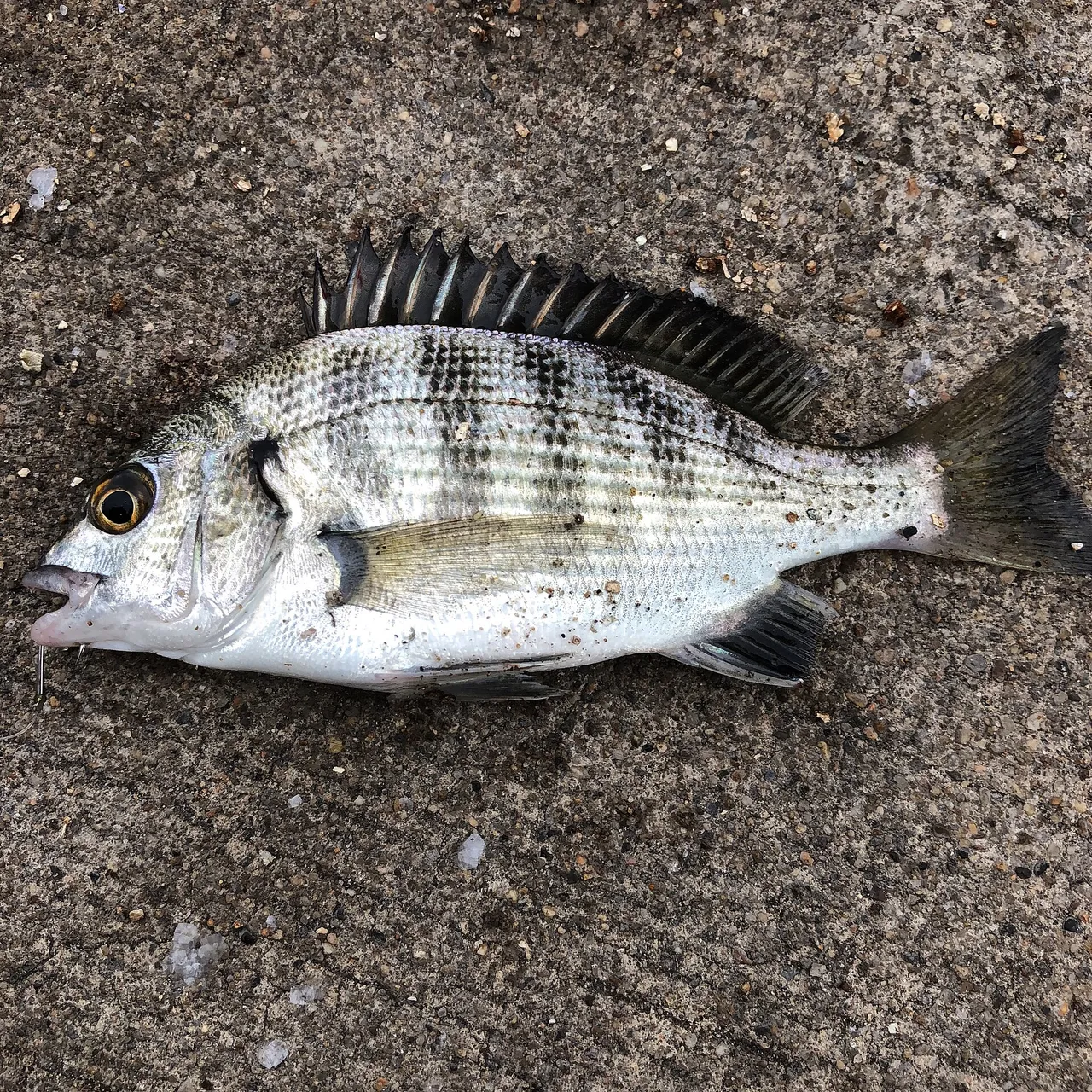
Identified by: Placed in Acanthopagrus by body form and the long strongly spined first dorsal. The species-level character used is fin colour: the pelvic and anal fins are DUSKY GREY with no yellow, the standard separation from A. latus, the yellowfin seabream, whose corresponding fins are conspicuously yellow and which overlaps this species across much of its range. Faint vertical banding is supporting only, since it fades after capture. Provenance names kurodai at Kashima port, Japan.Rakurakuda — CC BY-SA 4.0, via Wikimedia Commons — source, licenceLook at this first
Look at the pelvic and anal fins on the underside and ask one question: is there yellow in them? On a blackhead seabream they are dusky grey with none. On a yellowfin seabream, which shares much of the range, they are conspicuously yellow. That is the separation, and it is the weakest kind of reliable character.
Diagnostic — settles it on its own
Each of these settles the identification on its own. If one is clear, you have your answer.
Dusky grey pelvic and anal fins
The lower fins carry no yellow. This is the standard separation from Acanthopagrus latus, the yellowfin seabream, whose corresponding fins are unmistakably yellow, and the two overlap widely in East Asian coastal waters. It is presence-or-absence of a pigment rather than a shade, which is why it is usable where a hue judgement would not be.
Supporting — use with other characters
Real characters that are not conclusive by themselves. Use two or three together.
A long, strongly spined first dorsal
Eleven or so stiff spines running along the back in a continuous fin. This places the fish in Acanthopagrus and in the sparids generally, and it is what makes the genus recognisable at a glance from a deep silver body and a spiny back.
Suggestive only — varies with condition
Hints only. These vary with condition, season, water and how long the fish has been out of it, and a fish that contradicts them is still the same species.
Faint dark vertical banding on the upper flank
Five or six indistinct darker bars are often visible on a fresh fish. They fade quickly after capture and are absent on many individuals, so they support an identification already made and cannot carry one.
Overall darkness of the fish
The English name and the Japanese kurodai both mean black, and the fish is frequently not black. Colour ranges from dark slate to bright silver depending on the ground the fish came off, the season and how long it has been dead. It is not an identification character.
What it gets confused with
- Yellowfin seabream, across most of the shared range. Fin colour, and essentially nothing else at the field level.
- Other Acanthopagrus of East Asia and Australasia, several of which are recently separated and which this page does not attempt.
- Gilthead bream in the Mediterranean, which does not overlap in range and carries a gold bar between the eyes.
Side by side: Blackhead seabream vs Yellowfin bream.
Where this stops working
Acanthopagrus is a genus that has been repeatedly split and is still moving, and several species are separated on characters — scale row counts, gill raker counts, subtle head profile differences — that require the fish in hand and a key rather than a page. Fin colour works for the common pair and does not settle the genus. Juveniles are considerably harder than adults and the fin colour character is less developed in them. Where a fish is going to be retained and the local rules distinguish between Acanthopagrus species, this page is not sufficient.
The full record
This page covers identification only. The Blackhead seabream record covers behaviour, lifecycle, distribution, handling and the sources behind all of it.
Reviewed 2026-08-13.
More about this fish
Telling it apart is one question. Here are the others.
Similar and related fish
How it is caught
Where it lives
Where you will find it
Why the 6 connections on this page are here, and the sources
Similar and related fish
Backed by research — 1 connection
Supported by peer-reviewed research or fisheries science. The sources are listed and can be checked.
Yellowfin bream
An identification comparison naming both binomials: Acanthopagrus schlegelii and Acanthopagrus australis.
- FishBase: a global information system on fishes — Froese, R. and D. Pauly, eds. — FishBase Consortium (Scientific institute)Relied on for: Morphological and distributional data for Acanthopagrus schlegelii and for Acanthopagrus australis.States this directlyPassage read and verified
- The IUCN Red List of Threatened Species — International Union for Conservation of Nature (Conservation authority)Relied on for: Separate assessments treating Acanthopagrus schlegelii and Acanthopagrus australis as distinct species.States this directlyCitation checked — the work exists and is described correctly
How it is caught
What experienced anglers do — 1 connection
Widely and independently recommended by experienced anglers and specialist sources. This is real angling knowledge, not proof: controlled evidence for it is limited, and FishingHQ records it as convention rather than as a demonstrated effect.
Float fishing
A practitioner claim about how Acanthopagrus schlegelii is commonly fished, following from where and how it feeds.
- General angling website restatements of established technique — Various (Credible secondary source)Relied on for: Widely restated practitioner accounts of fishing for blackhead seabream.Citation checked — the work exists and is described correctly
- Sea Angler — Bauer Media (Specialist angling publication)Relied on for: Practitioner treatment of the methods used for blackhead seabream and comparable species.Citation checked — the work exists and is described correctly
Where it lives
Backed by research — 3 connections
Supported by peer-reviewed research or fisheries science. The sources are listed and can be checked.
Estuary
A habitat association for Acanthopagrus schlegelii taken from the environment and distribution data on its FishBase summary.
- FishBase: a global information system on fishes — Froese, R. and D. Pauly, eds. — FishBase Consortium (Scientific institute)Relied on for: The environment, depth range and habitat description recorded for Acanthopagrus schlegelii.States this directlyPassage read and verified
Harbours, piers and breakwaters
A habitat association for Acanthopagrus schlegelii taken from the environment and distribution data on its FishBase summary.
- FishBase: a global information system on fishes — Froese, R. and D. Pauly, eds. — FishBase Consortium (Scientific institute)Relied on for: The environment, depth range and habitat description recorded for Acanthopagrus schlegelii.States this directlyPassage read and verified
Rocky shores and reefs
A habitat association for Acanthopagrus schlegelii taken from the environment and distribution data on its FishBase summary.
- FishBase: a global information system on fishes — Froese, R. and D. Pauly, eds. — FishBase Consortium (Scientific institute)Relied on for: The environment, depth range and habitat description recorded for Acanthopagrus schlegelii.States this directlyPassage read and verified
Where you will find it
Backed by research — 1 connection
Supported by peer-reviewed research or fisheries science. The sources are listed and can be checked.
Korea
A distribution association between an animal and a kind of water, rather than a claim about any named mark.
- FishBase: a global information system on fishes — Froese, R. and D. Pauly, eds. — FishBase Consortium (Scientific institute)Relied on for: Distribution, habitat association and depth range recorded for the species, including its occurrence in the water body concerned.States this directlyPassage read and verified
- The IUCN Red List of Threatened Species — International Union for Conservation of Nature (Conservation authority)Relied on for: Assessment and range account for the species, including the systems and coasts it occupies.Background and mechanism onlyCitation checked — the work exists and is described correctly
Safety
Injury while handling fish — Minor injury
The stiff dorsal spines cause deep punctures and the molar teeth can crush a finger placed in the mouth.
What reduces it: Grip across the body with the spines folded, use pliers for unhooking, and never put fingers in the mouth.