How to identify korean rockfish
Sebastes schlegelii · Sebastidae
The characters that identify korean rockfish, ranked by how far each one can be trusted on its own.
Safety: venomous and spined species — can cause injury needing treatment.
How this was identified, and who took it
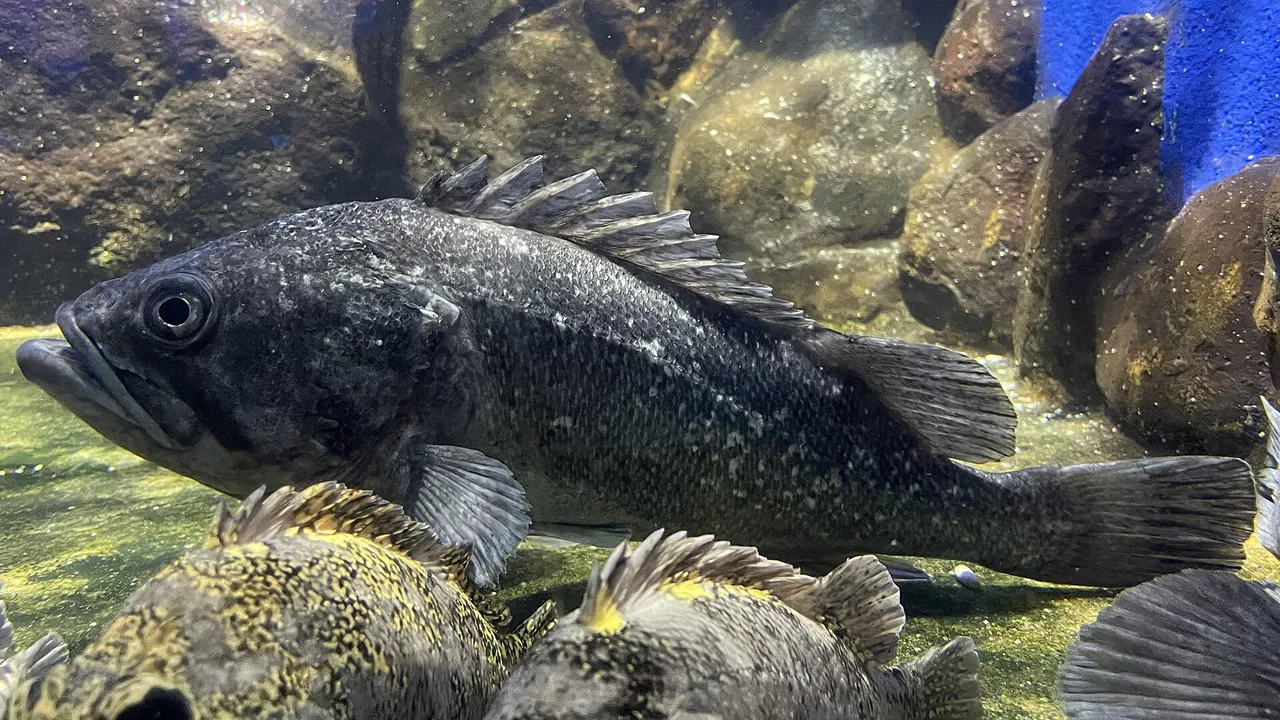
Identified by: The record's character is exactly what the frame shows: a heavy-bodied dark grey to black rockfish carrying irregular pale and dusky blotching over the flank, with a strong spinous dorsal, a large eye and a big oblique mouth in which the lower jaw projects. The Japanese common name in the source description, kurosoi, is unambiguous for Sebastes schlegelii.Totti — CC BY-SA 4.0, via Wikimedia Commons — source, licenceAbout the image above: The photograph is of a captive fish in a public aquarium display tank rather than a wild one. Tank lighting flattens the contrast, so a fish taken off open-coast rock is usually darker and the blotching more strongly marked than the image shows.
Look at this first
Read the build before the colour: a heavy, deep, blunt-headed fish with a spiny dorsal running the length of its back, spines on the head and gill cover, a large eye and a lower jaw that pushes past the upper. Then confirm with the flank, which is dark grey to black broken by irregular dusky blotches rather than by bars, spots or stripes.
Diagnostic — settles it on its own
Each of these settles the identification on its own. If one is clear, you have your answer.
Heavy dark body with irregular dusky blotching
The flank is grey to near-black overlaid with soft-edged darker patches that do not form bands, rows or a regular pattern. Several Sebastes of the same coast carry sharp vertical bars or clean spots, and the absence of any organised pattern is the thing to notice. Tank and shallow-water fish read paler than fish from deep rock, so judge the pattern's organisation rather than its darkness.
Supporting — use with other characters
Real characters that are not conclusive by themselves. Use two or three together.
Spines on the head and gill cover as well as the dorsal fin
Run a careful eye — not a careless finger — over the top of the head, the bone above the eye and the rear edge of the gill cover. Sebastes carry hard spines in all three places in addition to the long spiny first dorsal. This places the fish in the rockfishes and away from the groupers and the sea basses it is otherwise built like, and it is the reason handling matters: these spines carry venom and a puncture from one hurts far more than its size suggests.
A large mouth with the lower jaw projecting
The gape is wide and the lower jaw closes outside the upper, giving the head a slightly undershot look. Combined with the large low-light eye it describes an ambush predator that hunts at dusk and in shadow around structure, which is exactly how the fish behaves.
A rounded tail on a robust deep body
The caudal fin is rounded or very slightly truncate rather than forked, and the body is deep and thick through the shoulder. This is the standard Sebastes silhouette and it is worth knowing because it separates the group at distance from the jacks and the sea breams that share the same rock.
What it gets confused with
- Sebastes inermis and the other small rockfishes of Japanese and Korean coasts, which are lighter, slimmer and reach a fraction of the size.
- Sebastes vulpes and Sebastes taczanowskii, which share the heavy build and are separated on the pattern's organisation and on head spination.
- Black rockfish, Sebastes melanops, of the North American Pacific, which occupies the same visual niche in a different ocean and is a genuine confusion in a photograph without a locality.
- Groupers and sea basses of the same structure, which lack the head and gill-cover spines entirely.
Where this stops working
Sebastes is one of the most species-rich genera a shore angler will meet and the north-west Pacific holds many of them, several of which are dark, blotched and heavy-bodied. Colour within a species varies with depth, substrate and time of day to a degree that defeats colour-led keys. Juveniles frequently carry patterns adults lose. Where the species matters, the separation is on spine counts and head spination done with the fish in hand, and a page cannot substitute for it. The handling point is not optional: rockfish dorsal, anal and opercular spines are venomous, a wound should be treated as a puncture and not a scratch, and medical advice belongs with a clinician rather than with a fishing page.
The full record
This page covers identification only. The Korean rockfish record covers behaviour, lifecycle, distribution, handling and the sources behind all of it.
Reviewed 2026-08-16.
More about this fish
Telling it apart is one question. Here are the others.
Similar and related fish
How it is caught
Where it lives
Where you will find it
Why the 7 connections on this page are here, and the sources
Similar and related fish
Backed by research — 1 connection
Supported by peer-reviewed research or fisheries science. The sources are listed and can be checked.
Black rockfish
An identification comparison naming both binomials: Sebastes schlegelii and Sebastes melanops.
- FishBase: a global information system on fishes — Froese, R. and D. Pauly, eds. — FishBase Consortium (Scientific institute)Relied on for: Morphological and distributional data for Sebastes schlegelii and for Sebastes melanops.States this directlyPassage read and verified
- The IUCN Red List of Threatened Species — International Union for Conservation of Nature (Conservation authority)Relied on for: Separate assessments treating Sebastes schlegelii and Sebastes melanops as distinct species.States this directlyCitation checked — the work exists and is described correctly
How it is caught
What experienced anglers do — 3 connections
Widely and independently recommended by experienced anglers and specialist sources. This is real angling knowledge, not proof: controlled evidence for it is limited, and FishingHQ records it as convention rather than as a demonstrated effect.
Float fishing
A practitioner claim about how Sebastes schlegelii is commonly fished, following from where and how it feeds.
- General angling website restatements of established technique — Various (Credible secondary source)Relied on for: Widely restated practitioner accounts of fishing for korean rockfish.Citation checked — the work exists and is described correctly
- Sea Angler — Bauer Media (Specialist angling publication)Relied on for: Practitioner treatment of the methods used for korean rockfish and comparable species.Citation checked — the work exists and is described correctly
Jigging
A practitioner claim about how Sebastes schlegelii is commonly fished, following from where and how it feeds.
- General angling website restatements of established technique — Various (Credible secondary source)Relied on for: Widely restated practitioner accounts of fishing for korean rockfish.Citation checked — the work exists and is described correctly
- Sea Angler — Bauer Media (Specialist angling publication)Relied on for: Practitioner treatment of the methods used for korean rockfish and comparable species.Citation checked — the work exists and is described correctly
Ledgering
A practitioner claim about how Sebastes schlegelii is commonly fished, following from where and how it feeds.
- General angling website restatements of established technique — Various (Credible secondary source)Relied on for: Widely restated practitioner accounts of fishing for korean rockfish.Citation checked — the work exists and is described correctly
- Sea Angler — Bauer Media (Specialist angling publication)Relied on for: Practitioner treatment of the methods used for korean rockfish and comparable species.Citation checked — the work exists and is described correctly
Where it lives
Backed by research — 2 connections
Supported by peer-reviewed research or fisheries science. The sources are listed and can be checked.
Harbours, piers and breakwaters
A habitat association for Sebastes schlegelii taken from the environment and distribution data on its FishBase summary.
- FishBase: a global information system on fishes — Froese, R. and D. Pauly, eds. — FishBase Consortium (Scientific institute)Relied on for: The environment, depth range and habitat description recorded for Sebastes schlegelii.States this directlyPassage read and verified
Rocky shores and reefs
A habitat association for Sebastes schlegelii taken from the environment and distribution data on its FishBase summary.
- FishBase: a global information system on fishes — Froese, R. and D. Pauly, eds. — FishBase Consortium (Scientific institute)Relied on for: The environment, depth range and habitat description recorded for Sebastes schlegelii.States this directlyPassage read and verified
Where you will find it
Backed by research — 1 connection
Supported by peer-reviewed research or fisheries science. The sources are listed and can be checked.
Korea
A distribution association between an animal and a kind of water, rather than a claim about any named mark.
- FishBase: a global information system on fishes — Froese, R. and D. Pauly, eds. — FishBase Consortium (Scientific institute)Relied on for: Distribution, habitat association and depth range recorded for the species, including its occurrence in the water body concerned.States this directlyPassage read and verified
- The IUCN Red List of Threatened Species — International Union for Conservation of Nature (Conservation authority)Relied on for: Assessment and range account for the species, including the systems and coasts it occupies.Background and mechanism onlyCitation checked — the work exists and is described correctly
Safety
Venomous and spined species — Can cause injury needing treatment
The dorsal, anal and pelvic spines carry venom, and the head and gill cover bear additional sharp spines. Punctures cause immediate intense pain and swelling.
What reduces it: Wear gloves, handle across the body away from all fins, use pliers for unhooking, and treat a puncture by immersing in water as hot as can be tolerated and seeking medical advice.