Yelloweye rockfish
Fish · Last reviewed 2026-08-10
A brilliant orange-red deepwater rockfish that lives well over a century, matures very late, and is a rebuilding species under strict protection.
Safety: barotrauma and pressure injury — can cause serious injury or death. One more point applies here.
Barotrauma and pressure injury — Can cause serious injury or death
Yelloweye live deep and suffer major swim bladder expansion on capture; a released fish cannot submerge unaided and will not survive without help.
What reduces it: Carry a descending device whenever fishing deep rocky ground and use it immediately for every released fish.
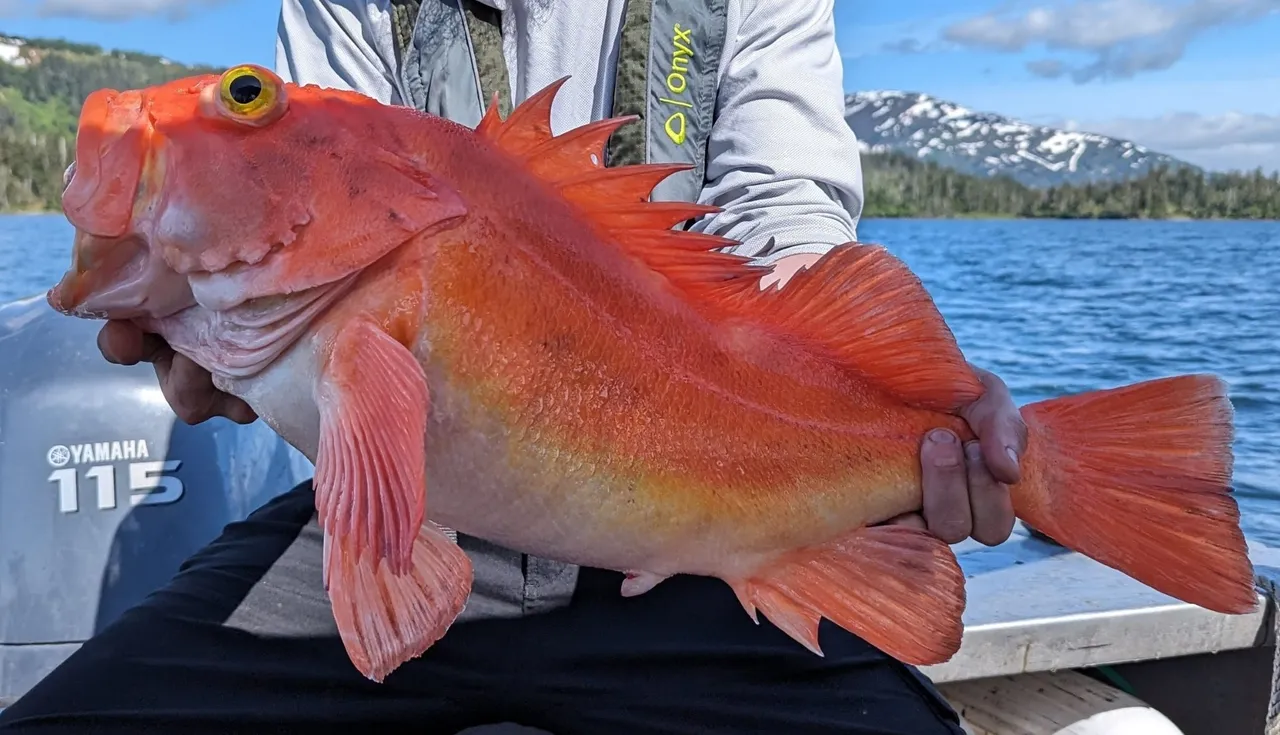
How this was identified, and who took it
Identified by: Bright yellow iris, pale lateral-line stripe on an orange-red ground, strongly ridged and spined head, and rough scaling — the combination that places this in Sebastes ruberrimus rather than in the canary, vermilion or copper rockfishes with which it shares its ground. Two agreeing identifications on the source, none disagreeing.Alexandria 'Alex' Wenninger — CC BY, via iNaturalist — source, licenceCatching Yelloweye rockfish
Everything here on fishing for it. Each entry opens the page behind it.
- Ground
Yelloweye rockfish is the clearest illustration on FishingHQ of what extreme longevity means for a fishery. Individuals have been aged well beyond a century, maturity comes after roughly two decades, and reproductive output rises with age — so the fish that matter most to the population are the oldest ones.
That is exactly the opposite of how a fishery naturally behaves, and yelloweye populations along the American and Canadian Pacific coast were reduced severely. The species has been the subject of long rebuilding plans and remains tightly restricted.
It is a striking fish — brilliant orange to red with a bright yellow eye and rough raspy ridges on the head — and it lives on deep rocky ground where barotrauma on release is severe.
How it is caught
Identification
- Scientific name
- Sebastes ruberrimus
- Family
- Sebastidae
- Water
- Saltwater
- Conservation status
- Not assessed
- Regions
- North America
- Brilliant orange to orange-red body, brightest in adults, with a distinctly bright yellow eye.
- Rough raspy ridges on the top of the head, giving the alternative name rasphead.
- Juveniles carry a white stripe along the lateral line that fades with age.
- Deep robust body with strong head and gill-cover spines and a spiny dorsal.
Size
- Typical
- 2–6 kg (4.4–13 lb)
- Large
- 8–14 kg (18–31 lb)
Exceptional: FishBase records a maximum of 104 cm and 17.8 kg
A fish older than the fishery, and why release has to be done properly
Everything in the black rockfish account applies here and the stakes are higher, because this is one of the longest-lived fish anybody catches on rod and line. Verified ages well beyond a century are recorded, maturity comes late, and a large yelloweye has been in that water since before most of the boats fishing over it were built.
WHAT THAT MEANS FOR HANDLING. A single fish is a much larger fraction of the population's reproductive capacity than its weight suggests, and the species has been under rebuilding management across much of its range for exactly that reason. Where retention is prohibited, the release has to actually work — a fish returned to the surface to die satisfies the regulation and not its purpose.
THE BAROTRAUMA IS SEVERE AND VISIBLE. These fish come from depth, and the everted stomach, bulging eyes and distended abdomen are usually present. None of it is repairable at the surface. A descending device, deployed quickly, is the only intervention with good evidence behind it, and recompression reverses the visible signs as the fish goes down.
AND THE SPINES ARE A SECOND, SEPARATE PROBLEM. The dorsal spines are sharp and the associated tissue causes a wound that is disproportionately painful and slow to heal. Handle the fish with a wet cloth or gloves, from behind, with the palm below the dorsal — and do it once, because the fish should be back in the water within seconds.
WHAT NOT TO ASSUME. That a fish which swam down strongly survived. Recompression greatly improves the odds; it does not make them certain, and the residual mortality is why deep-water avoidance matters more than good release technique.
Backed by research — why, and the sources (2)
Supported by peer-reviewed research or fisheries science. The sources are listed and can be checked.
- Do we need species-specific guidelines for catch-and-release recreational angling? — Biodiversity and Conservation 14:1195–1209, 2005 (Scientific literature)Relied on for: That post-release mortality varies with species, capture depth, water temperature, air exposure and handling, and that species-specific guidance outperforms general guidance.States this directlyCitation checked — the work exists and is described correctly
- A review of catch-and-release angling mortality with implications for no-take reserves — Reviews in Fish Biology and Fisheries 15:129–154, 2005 (Scientific literature)Relied on for: Review of hooking and release mortality across fisheries, including the contribution of depth of capture and handling duration.States this directlyCitation checked — the work exists and is described correctly
Lifecycle and reproduction
Exceptionally long-lived, with documented ages well past a hundred years, and very late to mature. Reproductive output increases with size and age, so old females are disproportionately important and effectively irreplaceable within a human timescale.
Viviparous, with internal fertilisation and the release of live larvae. Older, larger females produce far more and better-provisioned larvae than young ones, which is why age structure matters more than raw numbers.
Feeding and senses
Takes fish, crabs, shrimp and other invertebrates on and around deep rocky ground, feeding opportunistically from an ambush position.
Hunts at depth in low light around rocky structure, relying on sight at close range and on lateral-line detection of movement. The large eye is suited to the very low light levels at the depths it occupies, and it is an ambush feeder rather than a pursuer.
Through the year
Largely resident on deep rocky ground year-round with limited movement, which is why depletion is local and recovery slow.
Distribution
Eastern Pacific: Gulf of Alaska to northern Baja California, Mexico
This is a biological range — where the species occurs, not a prediction that you will catch one. To browse the fishing geography FishingHQ holds, start at fishing places.
Why anglers care
Very largely a species anglers must avoid or release rather than target, subject to strict restrictions across much of its range as part of long-running rebuilding plans. Where it is encountered incidentally on deep reef, correct release handling is the whole of the angling responsibility. FishingHQ does not state what any rule is; Pacific rockfish rules are detailed, area-specific and change frequently.
Handling and returning
Barotrauma is severe and unavoidable from the depths this fish lives at, and a released yelloweye floating at the surface will die. A descending device is essential rather than optional. Handle with gloves clear of the venomous fin spines and head spines, and return the fish promptly to depth.
Safety
Barotrauma and pressure injury is set out at the top of this page, where it cannot be missed.
Venomous and spined species — Can cause injury needing treatment
The dorsal, anal and pelvic spines carry venom, and the head bears additional sharp ridges and spines.
What reduces it: Wear gloves, handle across the body, use pliers, and treat punctures by immersion in hot water and by seeking medical advice.
Where to go next
Similar and related fish
Where it lives
Where you will find it
More fish
Not related to this page — just the rest of the section. There is little else joined to this subject yet, and a short page should still lead somewhere.
Sources and evidence
- FishBase: a global information system on fishes — Froese, R. and D. Pauly, eds. — FishBase Consortium (Scientific institute)Relied on for: Family, maximum size, depth and environment, distribution and the IUCN assessment for Sebastes ruberrimus.States this directlyPassage read and verified
- The IUCN Red List of Threatened Species — International Union for Conservation of Nature (Conservation authority)Relied on for: The Not Evaluated assessment for Sebastes ruberrimus.States this directlyCitation checked — the work exists and is described correctly
Why the 4 connections on this page are here, and the sources
Similar and related fish
Backed by research — 1 connection
Supported by peer-reviewed research or fisheries science. The sources are listed and can be checked.
Black rockfish
An identification comparison naming both binomials: Sebastes melanops and Sebastes ruberrimus.
- FishBase: a global information system on fishes — Froese, R. and D. Pauly, eds. — FishBase Consortium (Scientific institute)Relied on for: Morphological and distributional data for Sebastes melanops and for Sebastes ruberrimus.States this directlyPassage read and verified
- The IUCN Red List of Threatened Species — International Union for Conservation of Nature (Conservation authority)Relied on for: Separate assessments treating Sebastes melanops and Sebastes ruberrimus as distinct species.States this directlyCitation checked — the work exists and is described correctly
How it is caught
What experienced anglers do — 1 connection
Widely and independently recommended by experienced anglers and specialist sources. This is real angling knowledge, not proof: controlled evidence for it is limited, and FishingHQ records it as convention rather than as a demonstrated effect.
Deep-drop fishing
A practitioner claim about how Sebastes ruberrimus is commonly fished, following from where and how it feeds.
- General angling website restatements of established technique — Various (Credible secondary source)Relied on for: Widely restated practitioner accounts of fishing for yelloweye rockfish.Citation checked — the work exists and is described correctly
- Sea Angler — Bauer Media (Specialist angling publication)Relied on for: Practitioner treatment of the methods used for yelloweye rockfish and comparable species.Citation checked — the work exists and is described correctly
Where it lives
Backed by research — 1 connection
Supported by peer-reviewed research or fisheries science. The sources are listed and can be checked.
Inshore ground
A habitat association for Sebastes ruberrimus taken from the environment and distribution data on its FishBase summary.
- FishBase: a global information system on fishes — Froese, R. and D. Pauly, eds. — FishBase Consortium (Scientific institute)Relied on for: The environment, depth range and habitat description recorded for Sebastes ruberrimus.States this directlyPassage read and verified
Where you will find it
Backed by research — 1 connection
Supported by peer-reviewed research or fisheries science. The sources are listed and can be checked.
The Pacific Northwest coast
Occurrence of the species in this system or along this coast: a statement about the animal's distribution, not a venue recommendation.
- FishBase: a global information system on fishes — Froese, R. and D. Pauly, eds. — FishBase Consortium (Scientific institute)Relied on for: Distribution, salinity tolerance and habitat association recorded for the species, including its occurrence in this system.States this directlyPassage read and verified
- The IUCN Red List of Threatened Species — International Union for Conservation of Nature (Conservation authority)Relied on for: Assessment and range description for the species, including the waters in which it occurs.Background and mechanism onlyCitation checked — the work exists and is described correctly
How FishingHQ labels evidence is explained in the evidence policy.