How to identify yelloweye rockfish
Sebastes ruberrimus · Sebastidae
The characters that identify yelloweye rockfish, ranked by how far each one can be trusted on its own.
Safety: barotrauma and pressure injury — can cause serious injury or death. One more point applies here.
How this was identified, and who took it
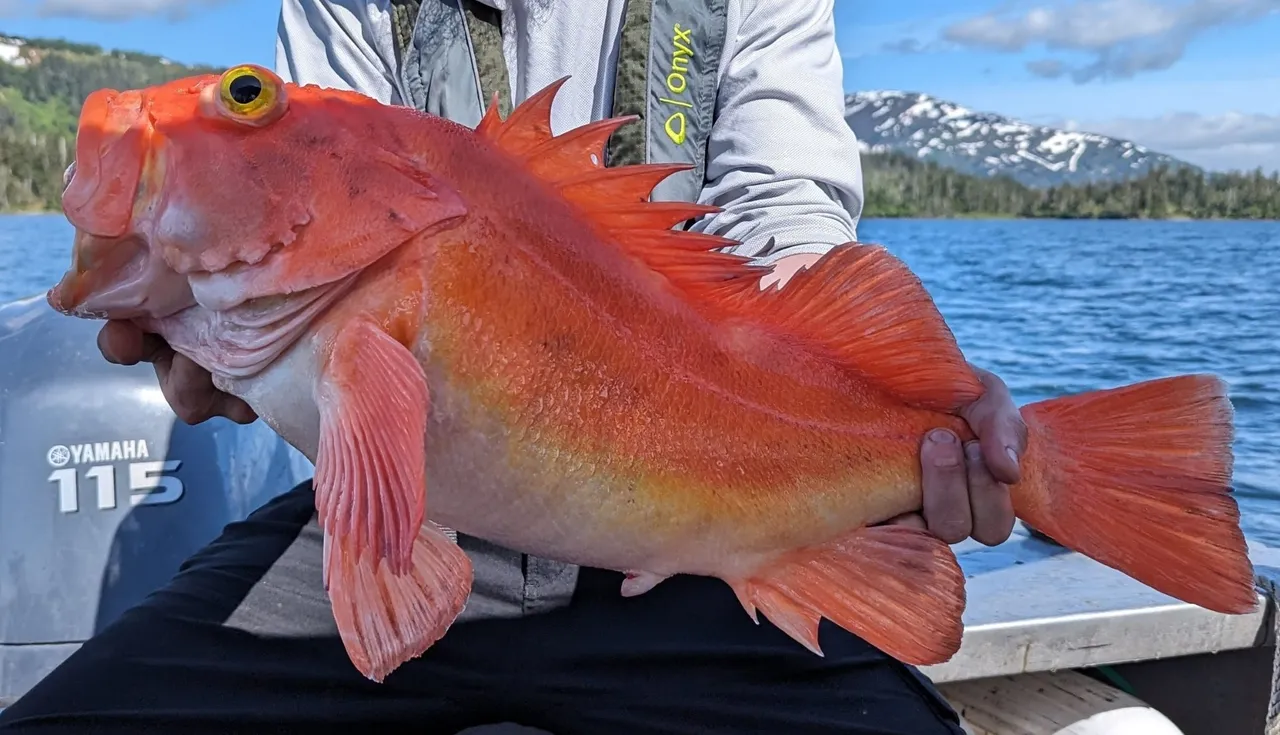
Identified by: Bright yellow iris, pale lateral-line stripe on an orange-red ground, strongly ridged and spined head, and rough scaling — the combination that places this in Sebastes ruberrimus rather than in the canary, vermilion or copper rockfishes with which it shares its ground. Two agreeing identifications on the source, none disagreeing.Alexandria 'Alex' Wenninger — CC BY, via iNaturalist — source, licenceLook at this first
Start with the iris. On an adult the ring around the pupil is a solid, saturated yellow that reads across a boat deck, and no other orange rockfish on this coast pairs that eye with a heavily ridged head. Check the eye before you decide anything from the body colour, because the body colour is shared with several species and the eye is not.
Diagnostic — settles it on its own
Each of these settles the identification on its own. If one is clear, you have your answer.
A saturated yellow iris
The ring around the pupil is a strong, even yellow rather than a pale straw or a dull gold, and it holds its colour on a fish that has been out of the water for some time. This is the character the common name records and it is the one to check first. Canary, vermilion and copper rockfish all overlap this species in colour and ground and none of them carries an eye like this. Treat it as settling the species when it is paired with the head sculpture below.
Rasping ridges over the top of the head
Run a look along the crown between and behind the eyes. There is a set of coarse bony ridges there, rough enough that the fish carries rasphead as a second common name in parts of its range. The ridges are structural, so they are present at every size, they survive handling, and they show in almost any photograph taken from slightly above. Together with the eye they are the pair that closes the identification.
Supporting — use with other characters
Real characters that are not conclusive by themselves. Use two or three together.
Orange to orange-red body, strongest in old fish
The ground colour is a deep orange that reddens with age, and it is genuinely striking on a large adult. Rank it below the eye and the head ridges rather than above them: it is the character most likely to send a reader to the wrong species, because canary and vermilion rockfish occupy the same ground in something close to the same colour. Use it as confirmation once the eye has already answered the question.
A pale stripe along the lateral line — mostly on young fish
Younger fish carry a distinct white or cream line running the length of the flank along the lateral line, and it fades progressively as the fish ages, so a very old adult may show little or none of it. This makes it useful in one direction only: its presence on an orange rockfish with a yellow eye supports the identification, and its absence rules nothing out. A reader working from a photograph of a small fish will see it clearly; a reader holding a large one may not.
Strong spines on the head, gill cover and dorsal fin
The head and gill cover carry hard spines and the first dorsal is stiffly spined. This matters for two reasons at once. It is part of the robust, heavy-headed build that separates this fish from the more streamlined rockfishes, and the spines carry venom, so a reader confirming the identification in hand should be wearing gloves and keeping fingers clear of the dorsal and the gill cover while they do it.
Size, and what a very large one means
Ordinary fish run two to six kilos, a good one is eight to fourteen, and the published maximum is around 104 cm and 17.8 kg. Size is supporting evidence here in an unusual way: this species is very long-lived and slow-growing, so a genuinely large fish is an old fish rather than a fast-growing one, and the population consequences of removing it are different from those of removing a large individual of a short-lived species.
Suggestive only — varies with condition
Hints only. These vary with condition, season, water and how long the fish has been out of it, and a fish that contradicts them is still the same species.
Eastern Pacific, on deep rocky ground
The range runs from the Gulf of Alaska south to northern Baja California, and within it the fish is a resident of deep rocky structure rather than a rover. Individuals move very little, which is why depletion is local and recovery is slow. Range narrows the candidate list to the Pacific rockfishes and does nothing to separate this species from the dozens of others inside it, so treat it as a frame for the question rather than as an answer.
What it gets confused with
- Canary rockfish, which shares the orange ground and the depth but has a plain dark eye and a smoother head, and whose lateral-line stripe persists into adulthood.
- Vermilion rockfish, similar in colour and much more finely mottled about the head, again without the yellow eye.
- Copper rockfish, browner and blotched rather than evenly orange, and normally shallower.
- Quillback rockfish, which has the heavy spined build and a strongly notched dorsal but is brown and yellow rather than orange-red.
Where this stops working
Sebastes is a very large genus and the eastern Pacific holds dozens of species that share ground, depth and broad colour with this one, so a rockfish identification made from colour alone is unreliable in a way that a reader used to freshwater fish will underestimate. The eye settles it on an adult; on a small juvenile the iris is less saturated and the pale lateral stripe is at its strongest, which is close to the reverse of the adult pattern this page describes. Hybrids are recorded within the genus but are not the usual problem — the usual problem is a photograph in which the eye is shaded, the head is not visible from above, or the fish has been on ice long enough for the ground colour to shift.
The full record
This page covers identification only. The Yelloweye rockfish record covers behaviour, lifecycle, distribution, handling and the sources behind all of it.
Reviewed 2026-08-17.
More about this fish
Telling it apart is one question. Here are the others.
Similar and related fish
How it is caught
Where it lives
Where you will find it
Why the 4 connections on this page are here, and the sources
Similar and related fish
Backed by research — 1 connection
Supported by peer-reviewed research or fisheries science. The sources are listed and can be checked.
Black rockfish
An identification comparison naming both binomials: Sebastes melanops and Sebastes ruberrimus.
- FishBase: a global information system on fishes — Froese, R. and D. Pauly, eds. — FishBase Consortium (Scientific institute)Relied on for: Morphological and distributional data for Sebastes melanops and for Sebastes ruberrimus.States this directlyPassage read and verified
- The IUCN Red List of Threatened Species — International Union for Conservation of Nature (Conservation authority)Relied on for: Separate assessments treating Sebastes melanops and Sebastes ruberrimus as distinct species.States this directlyCitation checked — the work exists and is described correctly
How it is caught
What experienced anglers do — 1 connection
Widely and independently recommended by experienced anglers and specialist sources. This is real angling knowledge, not proof: controlled evidence for it is limited, and FishingHQ records it as convention rather than as a demonstrated effect.
Deep-drop fishing
A practitioner claim about how Sebastes ruberrimus is commonly fished, following from where and how it feeds.
- General angling website restatements of established technique — Various (Credible secondary source)Relied on for: Widely restated practitioner accounts of fishing for yelloweye rockfish.Citation checked — the work exists and is described correctly
- Sea Angler — Bauer Media (Specialist angling publication)Relied on for: Practitioner treatment of the methods used for yelloweye rockfish and comparable species.Citation checked — the work exists and is described correctly
Where it lives
Backed by research — 1 connection
Supported by peer-reviewed research or fisheries science. The sources are listed and can be checked.
Inshore ground
A habitat association for Sebastes ruberrimus taken from the environment and distribution data on its FishBase summary.
- FishBase: a global information system on fishes — Froese, R. and D. Pauly, eds. — FishBase Consortium (Scientific institute)Relied on for: The environment, depth range and habitat description recorded for Sebastes ruberrimus.States this directlyPassage read and verified
Where you will find it
Backed by research — 1 connection
Supported by peer-reviewed research or fisheries science. The sources are listed and can be checked.
The Pacific Northwest coast
Occurrence of the species in this system or along this coast: a statement about the animal's distribution, not a venue recommendation.
- FishBase: a global information system on fishes — Froese, R. and D. Pauly, eds. — FishBase Consortium (Scientific institute)Relied on for: Distribution, salinity tolerance and habitat association recorded for the species, including its occurrence in this system.States this directlyPassage read and verified
- The IUCN Red List of Threatened Species — International Union for Conservation of Nature (Conservation authority)Relied on for: Assessment and range description for the species, including the waters in which it occurs.Background and mechanism onlyCitation checked — the work exists and is described correctly
Safety
Barotrauma and pressure injury is set out at the top of this page, where it cannot be missed.
Venomous and spined species — Can cause injury needing treatment
The dorsal, anal and pelvic spines carry venom, and the head bears additional sharp ridges and spines.
What reduces it: Wear gloves, handle across the body, use pliers, and treat punctures by immersion in hot water and by seeking medical advice.