Lingcod
Fish · Last reviewed 2026-08-10
A large ambush predator of Pacific rocky reefs with an enormous toothed mouth, no relation to true cod, and a serious barotrauma problem on release.
Safety: species that bite — can cause serious injury or death. One more point applies here.
Barotrauma and pressure injury — Can cause serious injury or death
A fish brought up quickly from depth suffers swim bladder expansion and cannot swim back down, and will die on the surface if simply released.
What reduces it: Use a weighted descending device to return the fish to depth, and decide before fishing deep water how released fish will be handled.
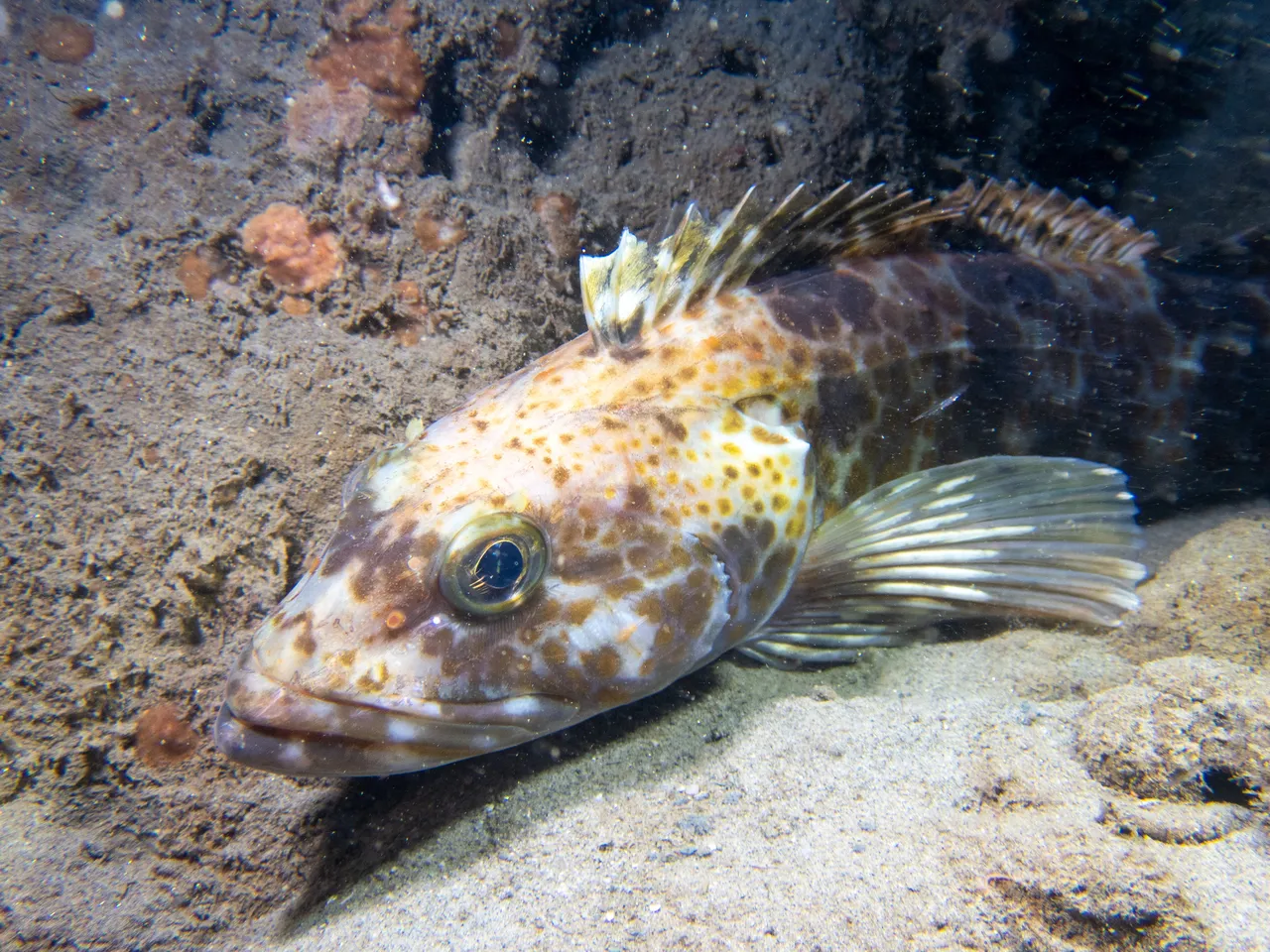
How this was identified, and who took it
Identified by: The jaw line runs back well past the rear margin of the eye, giving the enormous gape the record leads on, and the front of the long dorsal is resolved clearly enough to show the notch between spiny and soft portions. Mottled orange-brown, cream and white camouflage over a large gold eye is characteristic.Mike Carr — CC BY, via iNaturalist — source, licenceCatching Lingcod
Everything here on fishing for it. Each entry opens the page behind it.
Lingcod is not a cod. It is a greenling, and the resemblance is entirely a matter of a large mouth and a long body — the mouth in question being a wide, heavily toothed trap that will take prey more than half the fish's own length.
It is the signature bottom fish of the North American Pacific coast: a territorial ambush predator sitting on rocky reef, pinnacle and boulder ground from the shallows down past a hundred metres, taking rockfish, greenling, squid and octopus. Males guard egg masses through winter and are aggressive in doing so.
The flesh is sometimes blue-green, a harmless pigment that cooks out white and alarms everybody who meets it for the first time.
How it is caught
- Boat divingHeavy jigs and swimbaits worked hard on the reef, and a common catch for reef spearfishing.
- JiggingHeavy jigs and swimbaits worked hard on the reef, and a common catch for reef spearfishing.
- Reef spearfishingHeavy jigs and swimbaits worked hard on the reef, and a common catch for reef spearfishing.
Gear for this fish
Identification
- Scientific name
- Ophiodon elongatus
- Family
- Hexagrammidae
- Water
- Saltwater
- Conservation status
- Not assessed
- Regions
- North America, Pacific Islands
- Very large mouth reaching well past the eye, armed with large irregular canine teeth.
- Long body with a single very long dorsal fin, notched between the spiny and soft portions.
- Mottled brown, grey, green or copper camouflage over a pale belly, varying with the ground the fish sits on.
- A prominent cirrus — a small fleshy flap — above each eye.
Size
- Typical
- 2–6 kg (4.4–13 lb)
- Large
- 8–14 kg (18–31 lb)
Exceptional: FishBase records a maximum of 152 cm and 59.1 kg
How lingcod are fished, and why
A large ambush predator that sits on rocky reef and kelp ground in cold Pacific water, and the methods are shaped by a fish that does not chase far but attacks anything close.
JIGGING is the primary method because the fish holds tight to structure at depth and a heavy jig worked vertically reaches it — and because lingcod strike hard at anything that looks like an injured fish passing their position.
SPEARFISHING and DIVING are significant, for the usual structure-fish reasons: the fish holds, is approachable, and can be selected by size.
AND ONE BEHAVIOUR WORTH KNOWING. Lingcod frequently seize a hooked smaller fish and hold on all the way to the surface without being hooked themselves, which is a well-known feature of the fishery and a genuine illustration of how aggressively they take.
THE MANAGEMENT NOTE. Nest-guarding males are vulnerable to divers and anglers during the spawning period, and closures exist in places for that reason. Check the current position locally.
What experienced anglers do — why, and the sources (2)
Widely and independently recommended by experienced anglers and specialist sources. This is real angling knowledge, not proof: controlled evidence for it is limited, and FishingHQ records it as convention rather than as a demonstrated effect.
- FishBase: a global information system on fishes — Froese, R. and D. Pauly, eds. — FishBase Consortium (Scientific institute)Relied on for: Habitat association, depth range, feeding ecology and prey of the species, from which the method association follows.Background and mechanism onlyPassage read and verified
- IGFA International Angling Rules and World Record Requirements — International Game Fish Association (Angling or fisheries organisation)Relied on for: Recognised angling methods and the tackle classes used for them internationally.Background and mechanism onlyPassage read and verified
The mouth is the hazard, the depth is the injury
Lingcod give an angler two entirely separate problems and it is easy to prepare for only one.
THE MOUTH. This is a large-headed ambush predator with a mouth full of long, inward-curving canines set in powerful jaws, and it does not stop being a predator on the deck. The characteristic injury is a hand introduced to the mouth to retrieve a jig and withdrawn across teeth angled to prevent exactly that. The teeth are not serrated and do not slice; they puncture deeply and hold, which is worse. Long pliers, always. A lingcod's head should be controlled with a gripper or a gloved hold behind the gill covers before anything approaches its mouth.
AND THE JAW IS STRONG ENOUGH TO MATTER. This is not a fish that can be jaw-gripped by hand in the way a bass can.
THE DEPTH. Lingcod are taken from rocky ground at depths where barotrauma is common, and they suffer it in the ordinary way — distension, buoyancy, inability to descend. A fish over or under the slot has to be recompressed with a descending device to have a realistic chance, and in several jurisdictions carrying that equipment is required.
ONE ODDITY WORTH KNOWING. A hooked lingcod will frequently arrive with another fish clamped in its jaws that it refused to let go of on the way up. That second fish is not hooked and is usually a rockfish with its own barotrauma. It is easy to let it drift off at the surface without thinking; it needs descending too.
AND THE FLESH IS SOMETIMES BLUE-GREEN. It is a harmless pigment, it cooks out white, and it alarms people unnecessarily.
What experienced anglers do — why, and the sources (2)
Widely and independently recommended by experienced anglers and specialist sources. This is real angling knowledge, not proof: controlled evidence for it is limited, and FishingHQ records it as convention rather than as a demonstrated effect.
- FishBase: a global information system on fishes — Froese, R. and D. Pauly, eds. — FishBase Consortium (Scientific institute)Relied on for: Dentition, fin and spine morphology, body form, air-breathing capability and distribution for the species, which are the anatomical facts the handling practice below follows from.States this directlyPassage read and verified
- General angling website restatements of established technique — Various (Credible secondary source)Relied on for: Widely restated angling practice for handling this species, recorded as practitioner consensus rather than as tested fact.Background and mechanism onlyCitation checked — the work exists and is described correctly
A female who leaves and a male who cannot, in high-current rock
Lingcod split the reproductive labour completely between the sexes, and the split is what creates the fishery's central problem.
THE FEMALE DOES THE INVESTMENT AND DEPARTS. She deposits a large, dense, adhesive egg mass — a conspicuous white or pinkish block, sometimes the size of a football — wedged into a crevice on rocky ground in strong current. The site selection is deliberate: high flow keeps the mass oxygenated and keeps silt off it. Having laid, she leaves entirely.
THE MALE STAYS FOR THE WHOLE INCUBATION, and it is a long one — the eggs develop over a period of weeks in cold winter water. He guards the mass against the animals that eat it, which in that habitat means rockfish, greenling, sculpins, starfish and crabs. Egg masses are highly nutritious, entirely stationary and well known to every predator on the reef, and an unguarded one is consumed quickly.
WHICH MAKES THE GUARDING MALE THE MOST CATCHABLE FISH ON THE GROUND AT THE WORST POSSIBLE MOMENT. He is stationary, he is on a known and identifiable site, he is aggressive toward anything approaching, and a lure dropped near the nest is attacked as an intruder. Nothing about a lingcod's ordinary caution applies. He is also, at that point, load-bearing for an entire clutch: nest abandonment following capture is documented, and a mass that loses its guard is eaten rather than merely at risk.
SO THE ARITHMETIC IS STARK. A winter lingcod taken from a nest is not one fish; it is one fish plus a clutch representing a female's entire reproductive output for the season. That is a biological statement about consequences, and it is the reasoning behind winter closures where they exist — instruments whose dates, waters and terms are current, local, and not stated here.
AND THE FISH IS OTHERWISE A DEEP AMBUSH PREDATOR, taken from rock, meaning most nesting-season captures also involve barotrauma — so a release intended to undo the mistake may not work either.
Backed by research — why, and the sources (2)
Supported by peer-reviewed research or fisheries science. The sources are listed and can be checked.
- FishBase: a global information system on fishes — Froese, R. and D. Pauly, eds. — FishBase Consortium (Scientific institute)Relied on for: Reproductive mode, spawning season, fecundity, parental care, sex-change pattern and larval development recorded for the species.States this directlyPassage read and verified
- The IUCN Red List of Threatened Species — International Union for Conservation of Nature (Conservation authority)Relied on for: Assessment, population trend, and the life-history traits — age at maturity, longevity, reproductive strategy — that determine sensitivity to exploitation.States this directlyCitation checked — the work exists and is described correctly
Lifecycle and reproduction
Slow-growing and long-lived, with females substantially larger than males and later to mature. A very large lingcod represents many years of growth and is disproportionately valuable to the population as a spawner.
Spawns in winter. Females deposit large adhesive egg masses in crevices on high-current rocky ground and depart; males guard the nests against predators until the eggs hatch, and a guarding male is easily caught and easily removed from a nest that then fails.
Feeding and senses
An ambush predator with an exceptional gape, taking rockfish, greenling, herring, squid and octopus. Prey is engulfed whole, and lingcod frequently hold onto a hooked fish being retrieved — a behaviour anglers exploit deliberately.
Hunts by sight and by ambush from the bottom, relying on camouflage against reef rather than on pursuit. Vision matters more than scent, which is why moving lures outfish static baits over reef.
Through the year
Moves into shallower rocky ground to spawn in winter and disperses across a wider depth range through summer. Guarding males are concentrated and vulnerable in the nesting season.
Distribution
Northeast Pacific: Shumagin Islands in the western Gulf of Alaska to Ensenada, Baja California, Mexico. Possibly occurring in the Bering Sea
This is a biological range — where the species occurs, not a prediction that you will catch one. To browse the fishing geography FishingHQ holds, start at fishing places.
Why anglers care
A major Pacific bottom-fishing target on jigs, swimbaits and live bait worked hard on the reef, and a common spearfishing catch in the same ground. Its significance rests on size, accessibility from small boats and excellent eating. The nest-guarding behaviour is the reason seasons and area rules around spawning exist in many jurisdictions, and it is the single most important thing an angler should understand about the species.
Handling and returning
Fish brought up from depth suffer barotrauma — an expanded swim bladder that prevents them returning down — and a lingcod floating on the surface will not survive without help. Use a descending device to return fish to depth rather than venting by guesswork. The teeth are genuinely dangerous: use a grip that keeps fingers clear of the mouth, and never lip a lingcod.
Safety
Barotrauma and pressure injury is set out at the top of this page, where it cannot be missed.
Species that bite — Can cause serious injury or death
The mouth is lined with irregular sharp teeth capable of deep lacerations, and a lingcod will bite hard while being unhooked.
What reduces it: Never place fingers in the mouth. Use long pliers or a dehooker and control the fish across the body.
Where to go next
Where it lives
Where you will find it
More fish
Not related to this page — just the rest of the section. There is little else joined to this subject yet, and a short page should still lead somewhere.
Sources and evidence
- FishBase: a global information system on fishes — Froese, R. and D. Pauly, eds. — FishBase Consortium (Scientific institute)Relied on for: Family, maximum size, depth and environment, distribution and the IUCN assessment for Ophiodon elongatus.States this directlyPassage read and verified
- The IUCN Red List of Threatened Species — International Union for Conservation of Nature (Conservation authority)Relied on for: The Not Evaluated assessment for Ophiodon elongatus.States this directlyCitation checked — the work exists and is described correctly
Why the 8 connections on this page are here, and the sources
How it is caught
What experienced anglers do — 3 connections
Widely and independently recommended by experienced anglers and specialist sources. This is real angling knowledge, not proof: controlled evidence for it is limited, and FishingHQ records it as convention rather than as a demonstrated effect.
Boat diving
A practitioner claim about how Ophiodon elongatus is commonly fished, following from where and how it feeds.
- General angling website restatements of established technique — Various (Credible secondary source)Relied on for: Widely restated practitioner accounts of fishing for lingcod.Citation checked — the work exists and is described correctly
- Sea Angler — Bauer Media (Specialist angling publication)Relied on for: Practitioner treatment of the methods used for lingcod and comparable species.Citation checked — the work exists and is described correctly
Jigging
A practitioner claim about how Ophiodon elongatus is commonly fished, following from where and how it feeds.
- General angling website restatements of established technique — Various (Credible secondary source)Relied on for: Widely restated practitioner accounts of fishing for lingcod.Citation checked — the work exists and is described correctly
- Sea Angler — Bauer Media (Specialist angling publication)Relied on for: Practitioner treatment of the methods used for lingcod and comparable species.Citation checked — the work exists and is described correctly
Reef spearfishing
A practitioner claim about how Ophiodon elongatus is commonly fished, following from where and how it feeds.
- General angling website restatements of established technique — Various (Credible secondary source)Relied on for: Widely restated practitioner accounts of fishing for lingcod.Citation checked — the work exists and is described correctly
- Sea Angler — Bauer Media (Specialist angling publication)Relied on for: Practitioner treatment of the methods used for lingcod and comparable species.Citation checked — the work exists and is described correctly
Gear for this fish
What experienced anglers do — 2 connections
Widely and independently recommended by experienced anglers and specialist sources. This is real angling knowledge, not proof: controlled evidence for it is limited, and FishingHQ records it as convention rather than as a demonstrated effect.
Soft plastics
A practitioner claim about which lure family answers this species' feeding or holding behaviour.
- General angling website restatements of established technique — Various (Credible secondary source)Relied on for: Widely restated North American lure practice for this species.Background and mechanism onlyCitation checked — the work exists and is described correctly
- IGFA International Angling Rules and World Record Requirements — International Game Fish Association (Angling or fisheries organisation)Relied on for: Recognition of the species as an established sport fish taken on artificial lures, and the tackle conventions used for it.States this directlyPassage read and verified
Swimbaits
A practitioner claim about tackle commonly used for Ophiodon elongatus.
- General angling website restatements of established technique — Various (Credible secondary source)Relied on for: Widely restated practitioner accounts of this presentation for lingcod.Citation checked — the work exists and is described correctly
- Angling Times — Bauer Media (Specialist angling publication)Relied on for: Practitioner treatment of comparable presentations for the species group.Citation checked — the work exists and is described correctly
Where it lives
Backed by research — 2 connections
Supported by peer-reviewed research or fisheries science. The sources are listed and can be checked.
Inshore ground
A habitat association for Ophiodon elongatus taken from the environment and distribution data on its FishBase summary.
- FishBase: a global information system on fishes — Froese, R. and D. Pauly, eds. — FishBase Consortium (Scientific institute)Relied on for: The environment, depth range and habitat description recorded for Ophiodon elongatus.States this directlyPassage read and verified
Kelp forest
A habitat association for Ophiodon elongatus taken from the environment and distribution data on its FishBase summary.
- FishBase: a global information system on fishes — Froese, R. and D. Pauly, eds. — FishBase Consortium (Scientific institute)Relied on for: The environment, depth range and habitat description recorded for Ophiodon elongatus.States this directlyPassage read and verified
Where you will find it
Backed by research — 1 connection
Supported by peer-reviewed research or fisheries science. The sources are listed and can be checked.
The Pacific Northwest coast
Occurrence of the species in this system or along this coast: a statement about the animal's distribution, not a venue recommendation.
- FishBase: a global information system on fishes — Froese, R. and D. Pauly, eds. — FishBase Consortium (Scientific institute)Relied on for: Distribution, salinity tolerance and habitat association recorded for the species, including its occurrence in this system.States this directlyPassage read and verified
- The IUCN Red List of Threatened Species — International Union for Conservation of Nature (Conservation authority)Relied on for: Assessment and range description for the species, including the waters in which it occurs.Background and mechanism onlyCitation checked — the work exists and is described correctly
How FishingHQ labels evidence is explained in the evidence policy.