Homer Spit
Port · Salt water · in Alaska
A long gravel spit running out into Kachemak Bay from the town of Homer, carrying the boat harbour that the Lower Cook Inlet halibut and salmon boats work from and, on the spit itself, a stocked tidal lagoon built for shore fishing and known as the Fishing Hole.
Safety: boat safety — can cause serious injury or death.
FishingHQ describes what this place is, not whether you may fish it. Access, permits and who to ask.
What you can catch here
Documented at this place, grouped by how you would be fishing, with how strongly the sources support each one. This is what has been written down, not a forecast, and being listed is never permission to fish.
From the shore · 2
From a boat · 2
On a charter · 1
What these strengths mean
- Characteristic of this water
- This water is strongly identified with this species by the sources that cover it.
- Regular local target
- Fishing sources describe this as a normal local target here, not merely as caught.
- Seasonal
- Well supported, and concentrated in part of the year rather than spread through it.
- How breadth is counted
- A fish documented at six marks is shown as six marks: breadth never raises the strength on its own. A fishery account describes the fishing; a recorded catch reports one specific catch. How evidence is weighed.
How people fish it
Practised here: Sea fishing.
Methods the sources name for this ground. Each one is explained in full on its own page.
- Trolling
Towing lures or baits behind a moving boat to cover large volumes of water and locate scattered fish.
- Jigging
Working a weighted lure with a rising-and-falling motion, usually vertically, so it behaves like a wounded or fleeing baitfish.
- Drift fishing
Letting the boat move with tide and wind while fishing, so the tackle searches ground instead of waiting on it — and the decision that determines whether a boat session works at all.
- Spinning
Casting an artificial lure and retrieving it so that it moves like something alive — the most direct form of lure fishing.
Baits and lures for these fish
The baits and lures each of the fish above is commonly taken on, from that fish’s own page. This is what works for the fish, not a report of what people use on this particular water — local knowledge and the conditions on the day still decide.
The ground and the water
- The ground
- A long gravel spit running out into Kachemak Bay from the town of Homer, carrying the boat harbour that the Lower Cook Inlet halibut and salmon boats work from and, on the spit itself, a stocked tidal lagoon built for shore fishing and known as the Fishing Hole.
- Exposure
- The spit lies inside Kachemak Bay, and the more protected halibut ground behind it is named by the department as an alternative to the open water of Cook Inlet.
- Tide and flow
- Strongly tidal. The department says the lagoon fishes on an incoming tide of more than twelve feet, when the water runs into it like a river, and that halibut anglers outside often fish slack water so that lighter weights will hold bottom.
Getting there
What public sources describe, last checked 2026-10-09. Car parks fill, services change and a path existing is not a path anybody may use — none of this is a guarantee of availability and none of it is permission to be anywhere.
- Getting to it
- The spit is reached by road from Homer, which is on the state highway system, and the halibut and salmon fisheries of Lower Cook Inlet are reached by boat from the Homer harbour on it. The lagoon is fished from shore along its inside edge or just outside its entrance.
Where this access information comes from
- Alaska Department of Fish and Game: sport fishing by area — Alaska Department of Fish and Game, Division of Sport Fish (Government fisheries body)Relied on for: The Alaska Department of Fish and Game's description of the Lower Cook Inlet sport fisheries: the places named, the fish taken at each, the methods and the months.States this directlyPassage read and verified
Through the year
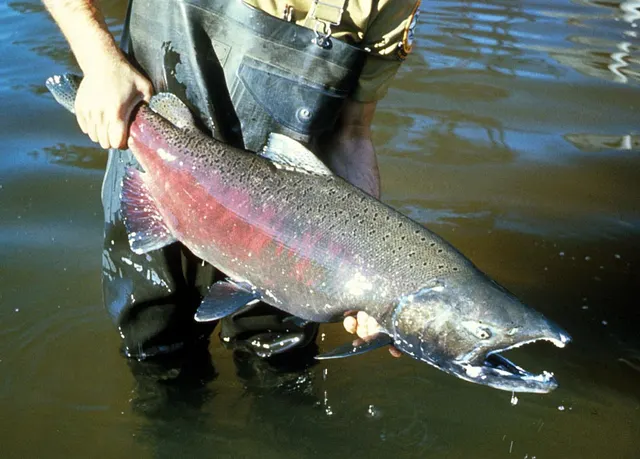
Stocked king salmon are fished in the lagoon from mid-May, peaking in mid-June and over by July; stocked coho from mid-July to mid-August. Halibut are mostly taken from May to early September. Feeder king salmon are trolled for from the harbour all year.
The months the sources attach to each species here. Where a species carries no season it is listed underneath rather than assumed to run through the year.
| Species | J | F | M | A | M | J | J | A | S | O | N | D |
|---|---|---|---|---|---|---|---|---|---|---|---|---|
| Pacific halibut — characteristic of this water, recorded in May, June, July, August, September. | ||||||||||||
| Coho salmon — seasonal, recorded in July, August. |
Recorded here with no season stated: Chinook salmon.
Safety
Boat safety — Can cause serious injury or death
The marine fisheries are fished in strong tidal currents and in open water. The department says of one Cook Inlet crossing that only boats seaworthy of making it should try, and that small boats are launched from open beaches at some sites because there is no ramp.
What reduces it: Match the boat to the water and the crossing, fish around slack water where the department suggests it, and use an established charter where the trip is beyond the boat or the crew.
Rules and access
FishingHQ does not know the current access position here. Alaska's sport fisheries are managed area by area by the state, with seasons, limits and closures that are changed within a season by emergency order. Pacific halibut is the exception: its sport rules are set at international and federal level, with separate measures for guided charter fishing. Some fisheries need a permit as well as a licence. Check the current position with the Alaska Department of Fish and Game and, for halibut, with the federal fisheries authority before going.
Particular to this water: Seasons, emergency closures, bag limits and catch-and-release rules for this water are set by the Alaska Department of Fish and Game and change within a season. Nothing here states that it is open. Check the current regulation summary and emergency orders with the department's Homer office before fishing. The department notes that snagging in the lagoon is not allowed except by emergency order, and that a youth-only area is set up there on two Saturdays a year.
Who holds the answer:
- The Alaska Department of Fish and Game, Division of Sport Fish, which sets and announces seasons, limits and emergency orders by management area.
- The federal fisheries authority and the International Pacific Halibut Commission, for sport fishing for Pacific halibut, including the separate rules for charter trips.
- The Alaska Department of Fish and Game, for sport, personal-use and most state-water fisheries, and for the emergency orders that adjust them in-season.
- The Alaska Board of Fisheries, which sets the allocation and regulatory framework between user categories.
- The Federal Subsistence Board, for subsistence fisheries on federal lands and waters.
- NOAA Fisheries, for federally managed offshore fisheries and listed species.
- The International Pacific Halibut Commission, for the management framework governing Pacific halibut.
- The relevant Alaska Native tribal or corporate authority where fishing takes place on or affects their lands and waters.
- Alaska Department of Fish and Game, Division of Sport Fish: sets and announces seasons, limits and emergency orders for these waters.
Nearby fishing
Other publicly documented places within about 40 km, by distance. Positions are approximate public geography and are never exact marks.
- Seldovia Lagoon — 10–25 km · Cove
- Anchor River — 25–40 km · River reach
Sources for this place
- Alaska Department of Fish and Game: sport fishing by area — Alaska Department of Fish and Game, Division of Sport Fish (Government fisheries body)Relied on for: The Alaska Department of Fish and Game's description of the Lower Cook Inlet sport fisheries: the places named, the fish taken at each, the methods and the months.States this directlyPassage read and verified
How FishingHQ labels evidence is explained in the evidence policy. Last reviewed 2026-10-09.