What does chinook salmon eat?
What is established about how chinook salmon feeds, kept separate from what anglers infer from it.
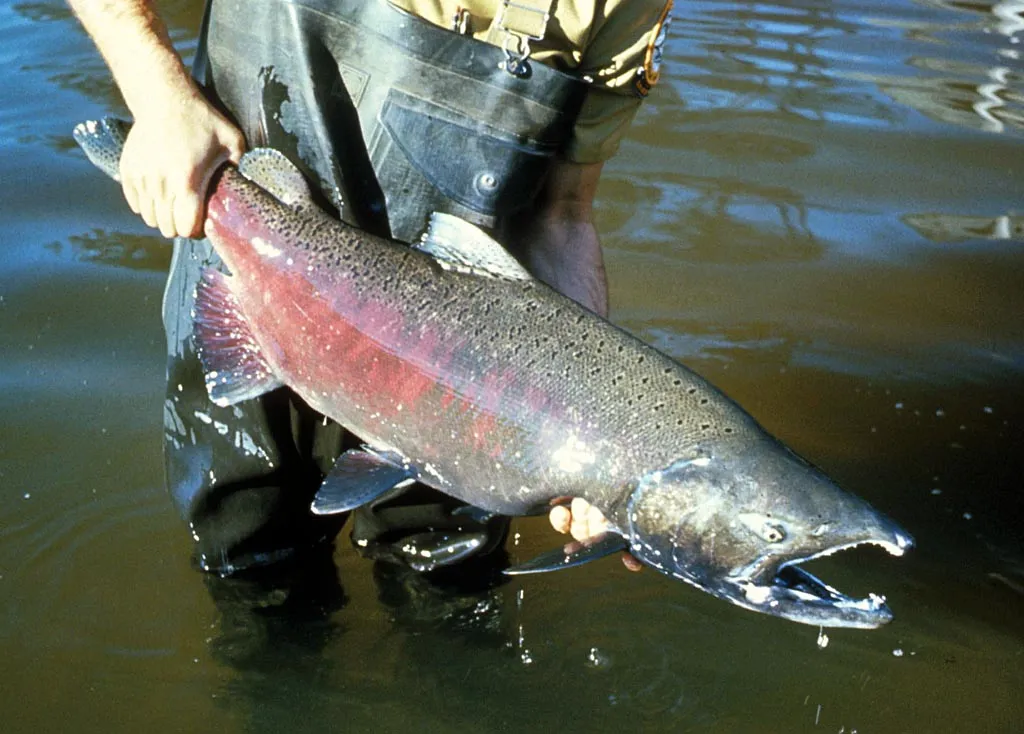
How this was identified, and who took it
Identified by: The two diagnostic chinook characters are both visible and both legible: heavy black spotting distributed across the upper and lower lobes of the caudal fin, where coho carries spots on the upper lobe only; and the dark gum line at the base of the teeth in the open lower jaw, which coho lacks. The fish is in spawning colour, which is stated in the caption because the flank red is not a year-round character.U.S. Geological Survey — public domain, via Wikimedia Commons — source, licenceWhat is known about how it feeds
A chinook grows larger than any other Pacific salmon, and the marine diet is where that happens.
The two verified relationships are the principal forage fish of the north-eastern Pacific coastal zone: Pacific sand lance, whose abundance chinook condition tracks closely, and northern anchovy, which dominates further south in the California Current.
That pair carries an important piece of ocean ecology. Anchovy and sardine abundance in the California Current alternate over decadal regimes, so what a chinook eats off California in one decade is not what it ate in the last, and salmon condition and survival move with those regimes. The diet is not a fixed property of the species; it is a property of the ocean at the time.
Juveniles in fresh water and in estuaries feed on insect larvae and small crustaceans before going to sea, which is a phase this page's relationships do not describe.
On returning to fresh water to spawn, chinook cease feeding and metabolise reserves, exactly as an Atlantic salmon does — and the same open question applies about why a non-feeding fish takes anything at all.
The life history is semelparous: chinook spawn once and die. Everything above describes a feeding phase that ends deliberately.
The food
Prey with a verified dietary link to this fish. Each entry carries its own evidence, and each is written at the precision the source actually used: a named species where the source named one, a group or food category where it said “polychaetes”, “crustaceans” or “detritus” and meant it. That is why this list is shorter than the animal’s real diet rather than longer.
- Pacific sand lance — Ammodytes personatus
Sand lance are a principal prey of chinook in coastal waters, and chinook condition in the north-eastern Pacific tracks sand lance abundance closely.
- Northern anchovy — Engraulis mordax
In the California Current anchovy replaces sand lance as the dominant forage item, and the anchovy and sardine regime shift changes what chinook are eating for decades at a time.
Food with no page of its own here yet
These are real components of the diet, listed as plain text because FishingHQ has no page for them yet. Inventing pages to make the list look fuller would be the fabrication this whole approach exists to prevent.
- Pacific herring
- euphausiids
- squid
- juvenile rockfish
- insect larvae, in the freshwater juvenile phase
What anglers do with this
Everything below is interpretation, not finding. It is what experienced anglers conclude from the biology above, and the reasoning is usually sound and almost never tested. It is separated from the biology deliberately.
The marine fishery is a bait-finding exercise, and anglers locate chinook by locating sand lance and anchovy concentrations and the birds and mammals working them. That is convention with a direct biological basis.
The freshwater fishery targets a fish that is not feeding, which puts it in the same category as Atlantic salmon: the conventions about presentation depth and speed are practitioner consensus resting on a behaviour nobody has explained.
The conservation position governs much of the fishery. Many chinook populations are listed or heavily managed, hatchery and wild fish are frequently regulated differently, and retention rules change within a season. What applies is a question for the relevant fisheries authority.
What this does not establish
Two relationships describe the coastal marine phase. They say nothing about the freshwater juvenile diet or the non-feeding spawning phase, and the marine diet varies with region and with the current ocean regime. Nothing here establishes proportions.
Where this connects
These are the baits, lures, methods and explainers FishingHQ already joins to this fish — which is why the list is sometimes short. They are not chosen for this page, and a link here means an evidenced relationship exists, not that it follows from the diet.
This page covers feeding. The Chinook salmon record covers identification, lifecycle, seasonal behaviour, handling and the sources behind all of it.
Reviewed 2026-08-12.