How to identify chinook salmon
Oncorhynchus tshawytscha · Salmonidae
The characters that identify chinook salmon, ranked by how far each one can be trusted on its own.
Safety: moving water and currents — can cause serious injury or death. One more point applies here.
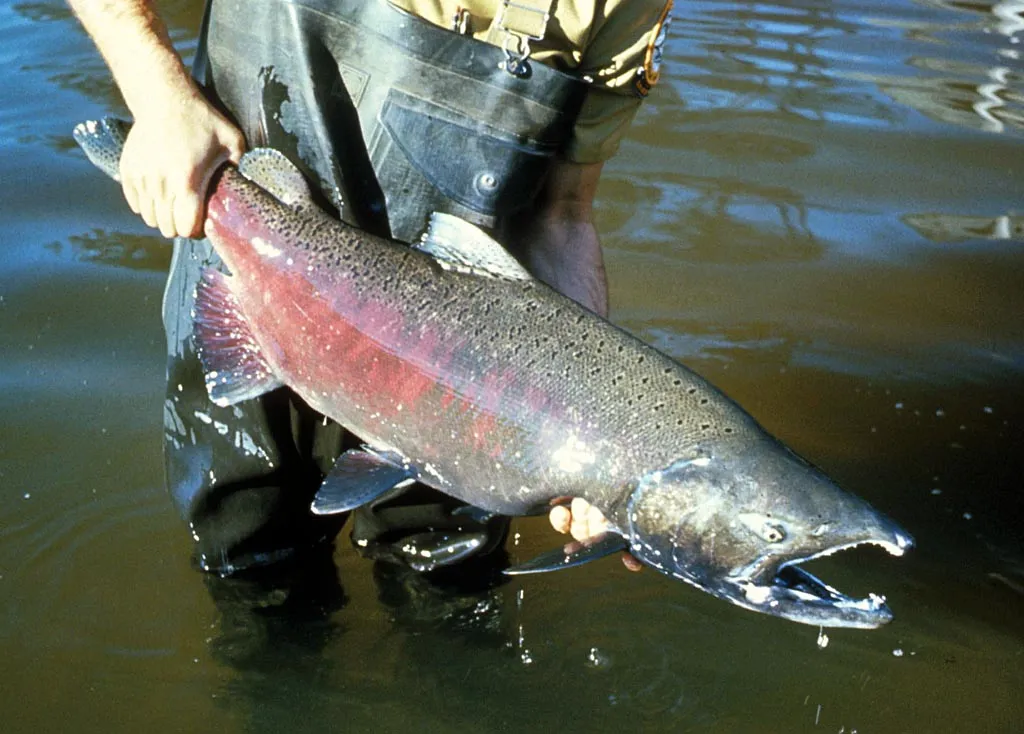
How this was identified, and who took it
Identified by: The two diagnostic chinook characters are both visible and both legible: heavy black spotting distributed across the upper and lower lobes of the caudal fin, where coho carries spots on the upper lobe only; and the dark gum line at the base of the teeth in the open lower jaw, which coho lacks. The fish is in spawning colour, which is stated in the caption because the flank red is not a year-round character.U.S. Geological Survey — public domain, via Wikimedia Commons — source, licenceLook at this first
Open the mouth and look at the gum line where the teeth of the lower jaw sit. On a chinook it is black. On a coho — the fish it is most often confused with — it is white or pale grey with black only on the tongue. It is an odd character to lead with and it is the one that does not fail.
Diagnostic — settles it on its own
Each of these settles the identification on its own. If one is clear, you have your answer.
A black lower gum line
The tissue at the base of the teeth in the lower jaw is dark. Coho, the species chinook is confused with most often and most consequentially, keeps that tissue pale. It holds on bright sea-run fish and on coloured spawners alike.
Spots on both lobes of the tail
Chinook carry small dark spots across the back, the dorsal fin and the whole of the tail. Coho are spotted on the upper lobe only. Take the two together with the gum line and a fish is named beyond argument.
Supporting — use with other characters
Real characters that are not conclusive by themselves. Use two or three together.
Bulk for the length
Deeper through the shoulder and heavier for a given length than the other Pacific salmon, which is why the largest fish in a mixed run is usually this one. A proportion, and one that a fish late in its migration loses.
An adipose fin, and a long anal fin
The small fleshy fin between dorsal and tail places the fish in the salmon family. The anal fin carrying more rays than a trout's is what separates the Pacific salmon from the trouts, and it is worth knowing where a hatchery fin clip is part of the local rules.
Suggestive only — varies with condition
Hints only. These vary with condition, season, water and how long the fish has been out of it, and a fish that contradicts them is still the same species.
Spawning colour
Fish on the redds run olive through maroon to nearly black and males grow a hooked jaw. Dramatic and useless for identification, because coho and sockeye do their own versions of the same thing on the same gravel at the same time.
What it gets confused with
- Coho salmon, the confusion that matters. Gum line first, then count which lobes of the tail carry spots.
- Steelhead, which lacks the black gum and has a longer, more slender tail wrist.
- Atlantic salmon in the Great Lakes and in Chile and New Zealand, where both have been introduced into the same water.
Side by side: Chinook salmon vs Atlantic salmon, Chinook salmon vs Rainbow trout, Chinook salmon vs Sockeye salmon, Chinook salmon vs Coho salmon.
Where this stops working
Jack chinook — precocious males returning a year or more early — are a fraction of the size the description implies and are routinely mistaken for coho on size alone, which is exactly the mistake the gum line exists to prevent. Late spawning fish of several Pacific species converge on the same dark, hook-jawed appearance. Where a fishery distinguishes hatchery from wild fish by a clipped adipose fin, that mark is not a species character and must not be read as one.
The full record
This page covers identification only. The Chinook salmon record covers behaviour, lifecycle, distribution, handling and the sources behind all of it.
Reviewed 2026-08-14.
More about this fish
Telling it apart is one question. Here are the others.
Similar and related fish
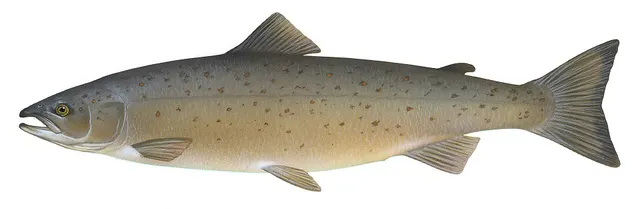 Atlantic salmonThe clearest illustration of what semelparity means: Atlantic salmon can spawn more than once and Pacific salmon cannot. Same family, one irreversible difference.
- Coho salmonCongeners that run the same rivers at overlapping times and are separated by the gums: chinook black, coho pale. The rules for them frequently differ, which is why the character is worth learning.
- Northern anchovyIn the California Current anchovy replaces sand lance as the dominant forage item, and the anchovy and sardine regime shift changes what chinook are eating for decades at a time.
- Pacific sand lanceSand lance are a principal prey of chinook in coastal waters, and chinook condition in the north-eastern Pacific tracks sand lance abundance closely.
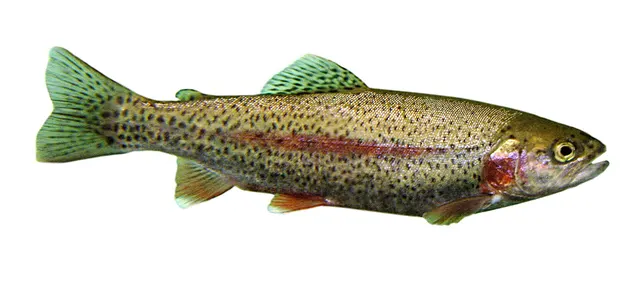 Rainbow troutCongeners in the genus Oncorhynchus. The difference that matters is that chinook is semelparous and dies after spawning while rainbow trout is not — the same genus, two entirely different life strategies.
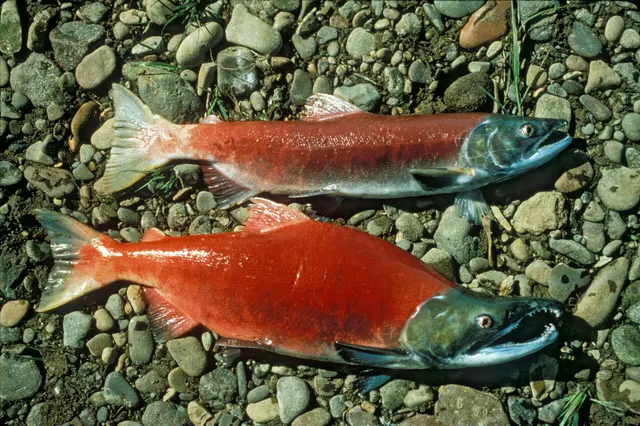 Sockeye salmonCongeners with completely different diets: chinook eats fish, sockeye filters plankton with long fine gill rakers. That is why sockeye barely take lures and chinook do.
How it is caught
Where it lives
Where you will find it
- AlaskaRuns rivers across the state, with several stocks in serious decline and managed by in-season emergency order.
- CanadaRuns the Pacific drainages of British Columbia and is the largest of the five Pacific salmon returning to Canadian rivers.
- PatagoniaNow running a number of Chilean rivers as feral self-sustaining populations, a large anadromous predator in a system that previously had none.
- The Great LakesIntroduced deliberately from the Pacific drainage from the 1960s to control irrupting alewife and to create a sport fishery. The modern open-water troll fishery is built on it and is maintained by stocking.
- The Pacific Northwest coastThe largest of the Pacific salmon and the organising species of the region's saltwater and river fisheries, with many populations listed as threatened or endangered.
Why the 13 connections on this page are here, and the sources
Similar and related fish
Backed by research — 6 connections
Supported by peer-reviewed research or fisheries science. The sources are listed and can be checked.
Atlantic salmon
A life-history comparison naming both binomials, and one that corrects a common assumption that all salmon die after spawning.
- FishBase: a global information system on fishes — Froese, R. and D. Pauly, eds. — FishBase Consortium (Scientific institute)Relied on for: That Oncorhynchus tshawytscha is an anadromous Salmonidae of the North Pacific, distinct from Salmo salar of the North Atlantic.States this directlyPassage read and verified
- NASCO conservation and management of North Atlantic salmon — North Atlantic Salmon Conservation Organization (Government fisheries body)Relied on for: The anadromous life history of Atlantic salmon, including repeat spawning, and its management as distinct river populations.States this directlyCitation checked — the work exists and is described correctly
Coho salmon
A taxonomic and identification comparison naming both binomials, with a practical consequence.
- FishBase: a global information system on fishes — Froese, R. and D. Pauly, eds. — FishBase Consortium (Scientific institute)Relied on for: That Oncorhynchus tshawytscha and Oncorhynchus kisutch are congeners in the genus Oncorhynchus occupying overlapping North Pacific ranges.States this directlyPassage read and verified
Northern anchovy
Recorded diet evidence identifies Engraulis mordax as a food item of this predator at species level. The edge is written at that granularity and no further.
- FishBase: a global information system on fishes — Froese, R. and D. Pauly, eds. — FishBase Consortium (Scientific institute)Relied on for: Food items recorded for this predator, including Engraulis mordax.States this directlyPassage read and verified
- FAO Species Identification Guides for Fishery Purposes and the FAO Species Catalogues — Food and Agriculture Organization of the United Nations (Scientific institute)Relied on for: Species account describing the diet of this predator in the region where Engraulis mordax occurs.Background and mechanism onlyCitation checked — the work exists and is described correctly
Pacific sand lance
Recorded diet evidence identifies Ammodytes personatus as a food item of this predator at species level. The edge is written at that granularity and no further.
- FishBase: a global information system on fishes — Froese, R. and D. Pauly, eds. — FishBase Consortium (Scientific institute)Relied on for: Food items recorded for this predator, including Ammodytes personatus.States this directlyPassage read and verified
- FAO Species Identification Guides for Fishery Purposes and the FAO Species Catalogues — Food and Agriculture Organization of the United Nations (Scientific institute)Relied on for: Species account describing the diet of this predator in the region where Ammodytes personatus occurs.Background and mechanism onlyCitation checked — the work exists and is described correctly
Rainbow trout
A taxonomic claim naming both binomials, with the life-history contrast being the useful content.
- FishBase: a global information system on fishes — Froese, R. and D. Pauly, eds. — FishBase Consortium (Scientific institute)Relied on for: That Oncorhynchus mykiss and Oncorhynchus tshawytscha are congeners in the genus Oncorhynchus, the Pacific salmon and trout.States this directlyPassage read and verified
Sockeye salmon
A comparison resting on documented feeding morphology and naming both binomials.
- FishBase: a global information system on fishes — Froese, R. and D. Pauly, eds. — FishBase Consortium (Scientific institute)Relied on for: That Oncorhynchus nerka and Oncorhynchus tshawytscha are congeners in the genus Oncorhynchus with differing feeding ecology.States this directlyPassage read and verified
How it is caught
What experienced anglers do — 1 connection
Widely and independently recommended by experienced anglers and specialist sources. This is real angling knowledge, not proof: controlled evidence for it is limited, and FishingHQ records it as convention rather than as a demonstrated effect.
Trolling
A practitioner claim about the principal marine method for the species.
- General angling website restatements of established technique — Various (Credible secondary source)Relied on for: Widely restated practitioner accounts of trolling and mooching for Pacific salmon in coastal waters.Citation checked — the work exists and is described correctly
- Sea Angler — Bauer Media (Specialist angling publication)Relied on for: Practitioner treatment of trolling technique for salmon and other pelagic species.Citation checked — the work exists and is described correctly
Where it lives
Backed by research — 1 connection
Supported by peer-reviewed research or fisheries science. The sources are listed and can be checked.
Spate rivers
A claim that the species uses rain-fed rivers on impermeable geology, resting on documented distribution and spawning habitat rather than on angling report.
- FishBase: a global information system on fishes — Froese, R. and D. Pauly, eds. — FishBase Consortium (Scientific institute)Relied on for: Recorded depth range, temperature tolerance and habitat association for the species outside north-west Europe.States this directlyPassage read and verified
- The IUCN Red List of Threatened Species — International Union for Conservation of Nature (Conservation authority)Relied on for: Global conservation assessment, range and recorded threats for the species.States this directlyCitation checked — the work exists and is described correctly
Where you will find it
Backed by research — 5 connections
Supported by peer-reviewed research or fisheries science. The sources are listed and can be checked.
Alaska
A distribution association between an animal and a kind of water, rather than a claim about any named mark.
- FishBase: a global information system on fishes — Froese, R. and D. Pauly, eds. — FishBase Consortium (Scientific institute)Relied on for: Distribution, habitat association and depth range recorded for the species, including its occurrence in the water body concerned.States this directlyPassage read and verified
- The IUCN Red List of Threatened Species — International Union for Conservation of Nature (Conservation authority)Relied on for: Assessment and range account for the species, including the systems and coasts it occupies.Background and mechanism onlyCitation checked — the work exists and is described correctly
Canada
A distribution association between an animal and a kind of water, rather than a claim about any named mark.
- FishBase: a global information system on fishes — Froese, R. and D. Pauly, eds. — FishBase Consortium (Scientific institute)Relied on for: Distribution, habitat association and depth range recorded for the species, including its occurrence in the water body concerned.States this directlyPassage read and verified
- The IUCN Red List of Threatened Species — International Union for Conservation of Nature (Conservation authority)Relied on for: Assessment and range account for the species, including the systems and coasts it occupies.Background and mechanism onlyCitation checked — the work exists and is described correctly
Patagonia
A distribution association between an animal and a kind of water, rather than a claim about any named mark.
- The IUCN Red List of Threatened Species — International Union for Conservation of Nature (Conservation authority)Relied on for: Assessment and habitat account for the species, including the river or lake system it occupies and the pressures acting on it.States this directlyCitation checked — the work exists and is described correctly
- FishBase: a global information system on fishes — Froese, R. and D. Pauly, eds. — FishBase Consortium (Scientific institute)Relied on for: Distribution, habitat association, size and life history recorded for the species in the system concerned.States this directlyPassage read and verified
The Great Lakes
Occurrence of the species in this system or along this coast: a statement about the animal's distribution, not a venue recommendation.
- FishBase: a global information system on fishes — Froese, R. and D. Pauly, eds. — FishBase Consortium (Scientific institute)Relied on for: Distribution, salinity tolerance and habitat association recorded for the species, including its occurrence in this system.States this directlyPassage read and verified
- The IUCN Red List of Threatened Species — International Union for Conservation of Nature (Conservation authority)Relied on for: Assessment and range description for the species, including the waters in which it occurs.Background and mechanism onlyCitation checked — the work exists and is described correctly
The Pacific Northwest coast
Occurrence of the species in this system or along this coast: a statement about the animal's distribution, not a venue recommendation.
- FishBase: a global information system on fishes — Froese, R. and D. Pauly, eds. — FishBase Consortium (Scientific institute)Relied on for: Distribution, salinity tolerance and habitat association recorded for the species, including its occurrence in this system.States this directlyPassage read and verified
- The IUCN Red List of Threatened Species — International Union for Conservation of Nature (Conservation authority)Relied on for: Assessment and range description for the species, including the waters in which it occurs.Background and mechanism onlyCitation checked — the work exists and is described correctly
Safety
Moving water and currents — Can cause serious injury or death
Salmon river fishing means wading fast, cold, powerful water, frequently in remote country and often at low light. Rivers rise quickly with rainfall in the catchment rather than overhead.
What reduces it: Use a wading staff and a buoyancy aid, and do not wade alone in heavy water. Check the forecast for the catchment. Know the exit before you commit to a crossing, and be willing to walk round.
Species that bite — Can cause serious injury or death
Across much of the native range, salmon rivers in the run season are also where bears concentrate, for the same reason the anglers are there.
What reduces it: Make noise, fish with others, carry deterrent where it is advised locally, and never stand between a bear and the water or a bear and a carcass. Treat local guidance as authoritative rather than cautious.