Atlantic salmon vs Chinook salmon
How to tell them apart, and what follows from getting it right.
Why they get confused
Both are called salmon, both are large silver anadromous fish, and both now occur outside their native ranges — Atlantic salmon are farmed and escape widely including in the Pacific, and chinook have been introduced to the southern hemisphere and to the Great Lakes. Anglers who know one well frequently meet the other for the first time in a place neither belongs, with no expectation that a second salmon is possible. They are not close relatives: one is a Salmo, the other an Oncorhynchus, and the differences are structural once you know where to look.
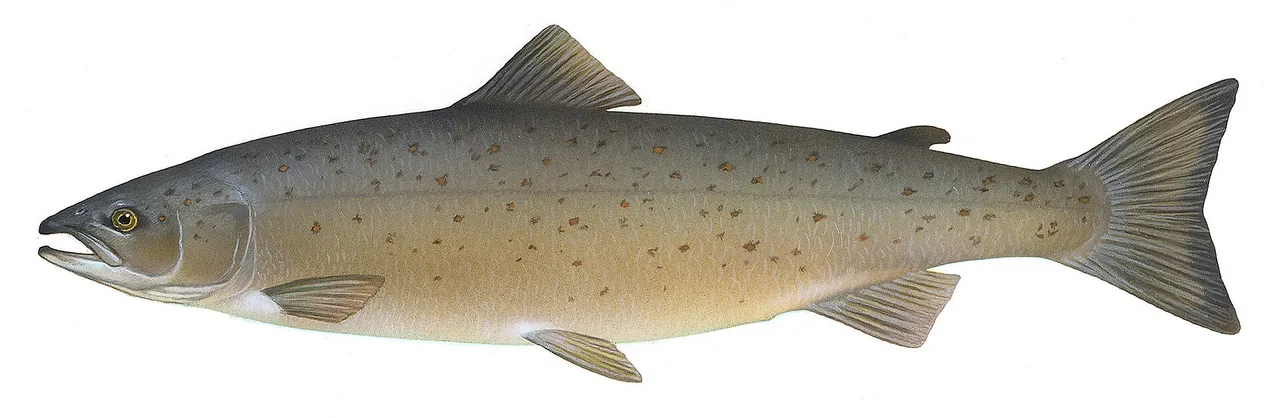
Atlantic salmon
Salmo salar — Salmonidae

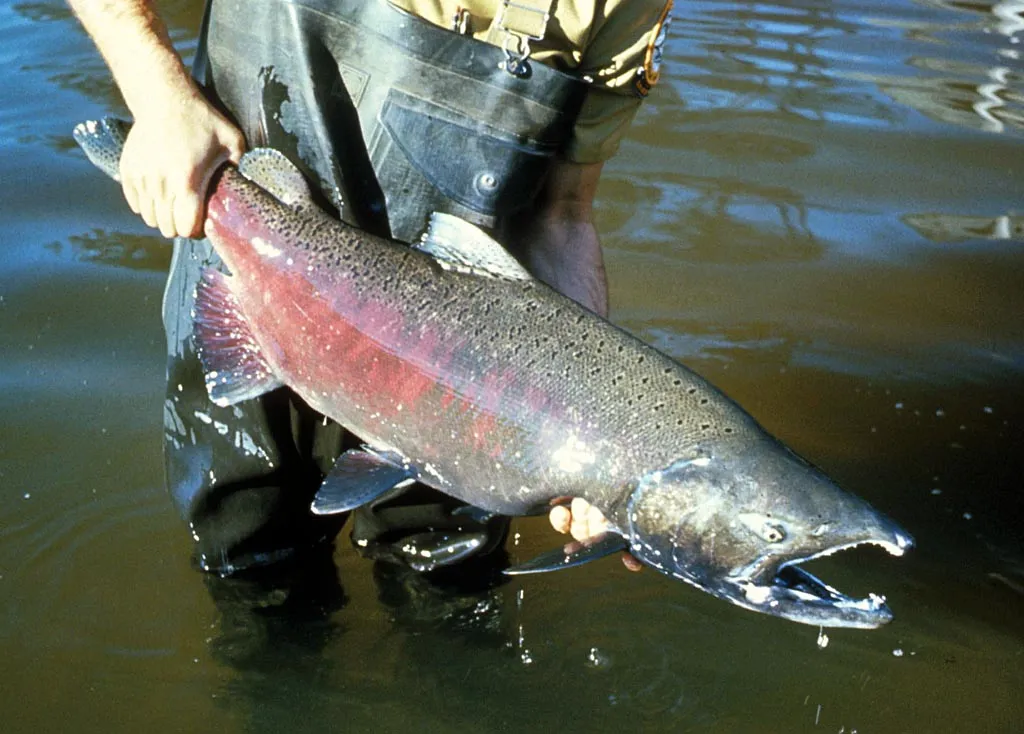
Chinook salmon
Oncorhynchus tshawytscha — Salmonidae

The differences
Each difference is marked with how far it can be trusted on its own. A single diagnostic character settles the identification; suggestive ones only narrow it.
| Character | Atlantic salmon | Chinook salmon | Reliability |
|---|---|---|---|
| Colour of the gum line at the base of the lower teethIdentification | Gums pale; no dark line at the base of the lower jaw teeth. | Gums black at the base of the lower jaw teeth — the character that also separates chinook from coho, and reliable enough to settle this pair on its own. | Diagnostic on its own |
| Spotting on the tailIdentification | Tail essentially unspotted; the black spots are on the body, mostly above the lateral line. | Small black spots on the back, the dorsal fin AND both lobes of the tail. | Diagnostic on its own |
| Body depth for a given lengthIdentification | Slender through the shoulder with a fine tail wrist. | Notably deep and heavy through the body relative to other salmon of the same length. | Supporting — use with others |
| What happens after spawningSpawning | Iteroparous in principle: a proportion of fish survive to spawn again, and kelts return to sea. | Semelparous: every fish dies after spawning, without exception. | Supporting — use with others |
| Size you should expectSize | Large, but a fish beyond about fourteen kilos is exceptional and increasingly rare. | Reaches substantially greater weights; the largest Pacific salmon by a wide margin. | Suggestive only — varies |
| Where the fish is likely to beRange | North Atlantic and its rivers natively, plus escapes from marine farming wherever those operate. | North Pacific and its rivers natively, plus established introductions in the Great Lakes, New Zealand and South America. | Suggestive only — varies |
Why it matters
Where the two overlap, one is almost always an escape or an introduction and the management response differs sharply. Escaped farmed Atlantic salmon in the Pacific, and Atlantic salmon anywhere outside their native range, are frequently reportable and sometimes subject to mandatory retention; native chinook may be protected, size-limited or under mark-selective rules distinguishing hatchery from wild fish. Beyond the rules, the biology diverges: a chinook is going to die whatever happens, an Atlantic salmon may spawn again, and that changes what releasing one achieves. What is required anywhere is a matter for the competent authority.
The full records
This page compares two species. Each of them has a complete record covering biology, behaviour, handling and the evidence behind all of it.
More about atlantic salmon
Where it lives, how it is caught, and what else it is confused with.
Similar and related fish
- CapelinIn northern feeding areas capelin is a principal item in the marine diet, which is one of the connections between capelin stock health and salmon returns.
- Chinook salmonThe clearest illustration of what semelparity means: Atlantic salmon can spawn more than once and Pacific salmon cannot. Same family, one irreversible difference.
- Lesser sandeelAt sea, salmon feed heavily on sandeel, and the growth a salmon achieves during its marine phase is largely a function of forage fish availability rather than anything that happens in fresh water.
How it is caught
- Salmon fly fishingThe method the species is fished for almost everywhere it is fished for, and on many rivers the only one permitted for part of the season.
- SpinningThe high-water and coloured-water method. A salmon that has run on a spate holds in a lie it will not leave, and a spun bait reaches and provokes it where a fly cannot be presented deep or heavy enough. Permitted tackle and season vary sharply by river and are set locally.
- TrollingHarling and trolling on large rivers and in lochs covers water that cannot be waded or covered from a bank, which is how much of the Scandinavian and Scottish loch fishery is conducted.
Gear for this fish
- SpoonsThe traditional spinning alternative on high or coloured water, where the flash and vibration reach a fish that cannot see a fly. Its legality varies sharply by river and by season and is a matter for the local authority rather than for this page.
- StreamersLarge winged and tube patterns are the cold-water and heavy-water answer, fished deeper and slower than a summer fly on the same lie.
- Wet fliesAtlantic salmon do not feed in fresh water, so the wet fly is not imitating food — it is provoking a response from a fish holding in a lie, and the whole apparatus of fly size, depth and swing speed is about presenting it at the pace the fish will react to.
Where it lives
Why the 10 connections on this page are here, and the sources
Similar and related fish
Backed by research — 3 connections
Supported by peer-reviewed research or fisheries science. The sources are listed and can be checked.
Capelin
Recorded diet evidence identifies Mallotus villosus as a food item of this predator at species level. The edge is written at that granularity and no further.
- FishBase: a global information system on fishes — Froese, R. and D. Pauly, eds. — FishBase Consortium (Scientific institute)Relied on for: Food items recorded for this predator, including Mallotus villosus.States this directlyPassage read and verified
- FAO Species Identification Guides for Fishery Purposes and the FAO Species Catalogues — Food and Agriculture Organization of the United Nations (Scientific institute)Relied on for: Species account describing the diet of this predator in the region where Mallotus villosus occurs.Background and mechanism onlyCitation checked — the work exists and is described correctly
Chinook salmon
A life-history comparison naming both binomials, and one that corrects a common assumption that all salmon die after spawning.
- FishBase: a global information system on fishes — Froese, R. and D. Pauly, eds. — FishBase Consortium (Scientific institute)Relied on for: That Oncorhynchus tshawytscha is an anadromous Salmonidae of the North Pacific, distinct from Salmo salar of the North Atlantic.States this directlyPassage read and verified
- NASCO conservation and management of North Atlantic salmon — North Atlantic Salmon Conservation Organization (Government fisheries body)Relied on for: The anadromous life history of Atlantic salmon, including repeat spawning, and its management as distinct river populations.States this directlyCitation checked — the work exists and is described correctly
Lesser sandeel
Recorded diet evidence identifies Ammodytes marinus as a food item of this predator at species level. The edge is written at that granularity and no further.
- FishBase: a global information system on fishes — Froese, R. and D. Pauly, eds. — FishBase Consortium (Scientific institute)Relied on for: Food items recorded for this predator, including Ammodytes marinus.States this directlyPassage read and verified
- FAO Species Identification Guides for Fishery Purposes and the FAO Species Catalogues — Food and Agriculture Organization of the United Nations (Scientific institute)Relied on for: Species account describing the diet of this predator in the region where Ammodytes marinus occurs.Background and mechanism onlyCitation checked — the work exists and is described correctly
How it is caught
Official guidance — 1 connection
Stated by a fisheries authority, scientific institute or recognised angling body. Authoritative, but summarising rather than demonstrating.
Salmon fly fishing
A river fish taken over beats and named pools through a defined season, and the game-angling sources describe that fishery as a fly fishery throughout.
- Trout & Salmon — Bauer Media (Specialist angling publication)Relied on for: Long-running published description of British and Irish game angling practice by river, beat and season, including the technique, tackle and seasonal decisions of salmon fly fishing.FishingHQ's interpretation of what it saysCitation checked — the work exists and is described correctly
- General angling website restatements of established technique — Various (Credible secondary source)Relied on for: Widely restated public descriptions of salmon fly technique — the down-and-across swing, Spey casting, and the water-temperature convention for fly size and line density — recorded as practitioner consensus rather than as scholarship, including where that consensus is openly disputed.Background and mechanism onlyCitation checked — the work exists and is described correctly
What experienced anglers do — 2 connections
Widely and independently recommended by experienced anglers and specialist sources. This is real angling knowledge, not proof: controlled evidence for it is limited, and FishingHQ records it as convention rather than as a demonstrated effect.
Spinning
Established angling practice for this species, recorded as convention. The note states the property of the animal or its water that makes the method the answer.
- Trout & Salmon — Bauer Media (Specialist angling publication)Relied on for: Established salmonid angling technique and its application to this species.States this directlyCitation checked — the work exists and is described correctly
- General angling website restatements of established technique — Various (Credible secondary source)Relied on for: Widely restated practice connecting this species and method.Background and mechanism onlyCitation checked — the work exists and is described correctly
Trolling
Established angling practice for this species, recorded as convention. The note states the property of the animal or its water that makes the method the answer.
- Trout & Salmon — Bauer Media (Specialist angling publication)Relied on for: Established salmonid angling technique and its application to this species.States this directlyCitation checked — the work exists and is described correctly
- General angling website restatements of established technique — Various (Credible secondary source)Relied on for: Widely restated practice connecting this species and method.Background and mechanism onlyCitation checked — the work exists and is described correctly
Gear for this fish
What experienced anglers do — 3 connections
Widely and independently recommended by experienced anglers and specialist sources. This is real angling knowledge, not proof: controlled evidence for it is limited, and FishingHQ records it as convention rather than as a demonstrated effect.
Spoons
A practitioner claim about which lure family answers this species' feeding or holding behaviour.
- Trout & Salmon — Bauer Media (Specialist angling publication)Relied on for: Fly categories and their application to river salmonids.States this directlyCitation checked — the work exists and is described correctly
- The Compleat Angler, or the Contemplative Man's Recreation — Richard Marriot, 1653 (Reference work)Relied on for: The long documentary record of artificial-fly fishing for trout and grayling in English rivers.Background and mechanism onlyPassage read and verified
Streamers
A practitioner claim about which lure family answers this species' feeding or holding behaviour.
- Trout & Salmon — Bauer Media (Specialist angling publication)Relied on for: Fly categories and their application to river salmonids.States this directlyCitation checked — the work exists and is described correctly
- The Compleat Angler, or the Contemplative Man's Recreation — Richard Marriot, 1653 (Reference work)Relied on for: The long documentary record of artificial-fly fishing for trout and grayling in English rivers.Background and mechanism onlyPassage read and verified
Wet flies
A practitioner claim about which lure family answers this species' feeding or holding behaviour.
- Trout & Salmon — Bauer Media (Specialist angling publication)Relied on for: Fly categories and their application to river salmonids.States this directlyCitation checked — the work exists and is described correctly
- The Compleat Angler, or the Contemplative Man's Recreation — Richard Marriot, 1653 (Reference work)Relied on for: The long documentary record of artificial-fly fishing for trout and grayling in English rivers.Background and mechanism onlyPassage read and verified
Where it lives
Backed by research — 1 connection
Supported by peer-reviewed research or fisheries science. The sources are listed and can be checked.
Spate rivers
A claim that the species uses rain-fed rivers on impermeable geology, resting on documented distribution and spawning habitat rather than on angling report.
- Freshwater Fishes of the British Isles — HarperCollins (New Naturalist 75), 1992 (Reference work)Relied on for: Distribution, habitat association, thermal requirements and life history of the freshwater fishes of the British Isles and north-west Europe.States this directlyCitation checked — the work exists and is described correctly
- FishBase: a global information system on fishes — Froese, R. and D. Pauly, eds. — FishBase Consortium (Scientific institute)Relied on for: Recorded depth range, temperature tolerance and habitat association for the species.States this directlyPassage read and verified
Reviewed 2026-08-13. FishingHQ does not state what any rule is or where any rule applies. Where this page says the two species are managed differently, that is a reason to check the authority for the water you are on — not a statement of what it requires.