What does sockeye salmon eat?
What is established about how sockeye salmon feeds, kept separate from what anglers infer from it.
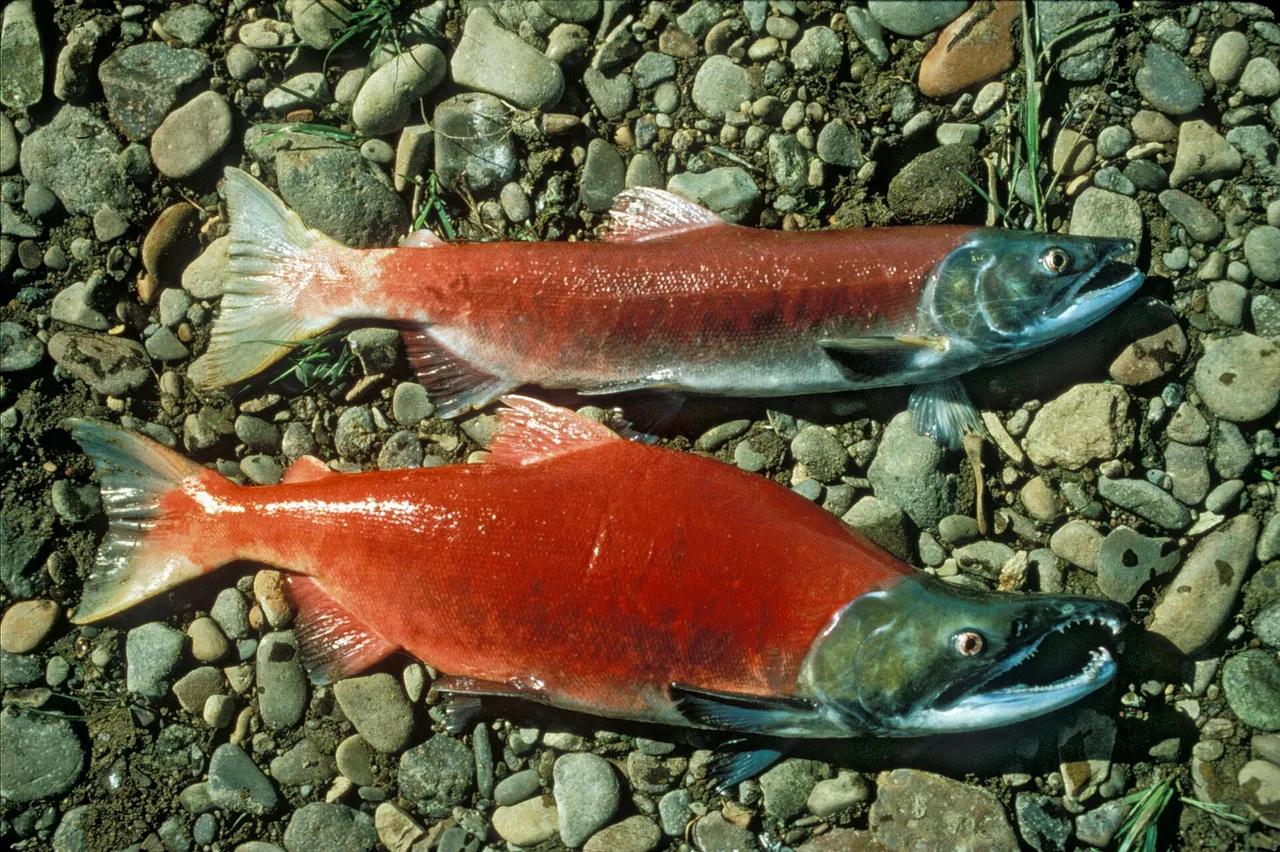
How this was identified, and who took it
Identified by: Male and female in full spawning colour: brilliant red body, green head, and no black spotting on the back — the absence of spotting is the character that separates spawning sockeye from the other Pacific salmon. A US Fish and Wildlife Service photograph.David Menke — Public domain, via Wikimedia Commons — source, licenceWhat is known about how it feeds
The sockeye is the Pacific salmon that does not eat fish, and that single fact is the whole of what an angler needs to understand about it.
The species is a zooplankton specialist throughout life. Long, fine gill rakers strain copepods and other small crustaceans from the water, and this continues at sea where the other Pacific salmon become piscivorous. Insects and the occasional small fish supplement it; they do not replace it.
The single verified relationship — euphausiids and planktonic crustaceans, recorded at group level — is therefore not an incomplete picture of the diet. It is very close to the whole of it.
The consequence for the flesh is well known and worth stating because it is the same fact seen from the other end: the deep red colour comes from carotenoid pigments accumulated from a crustacean diet, which is why sockeye is coloured differently from the salmon that eat fish.
In fresh water the species is lake-dependent in a way the other Pacific salmon are not. Juveniles rear in lakes for a year or more, feeding on lake zooplankton, before going to sea. A river system without a suitable lake does not produce sockeye.
On returning to spawn the fish stops feeding and undergoes the extreme morphological change the species is famous for — the red body and green head, and in males a pronounced hooked jaw and dorsal hump.
The food
Prey with a verified dietary link to this fish. Each entry carries its own evidence, and each is written at the precision the source actually used: a named species where the source named one, a group or food category where it said “polychaetes”, “crustaceans” or “detritus” and meant it. That is why this list is shorter than the animal’s real diet rather than longer.
- Krill and planktonic crustaceans as prey — a group rather than a species: the evidence names the group
Sockeye are the least piscivorous of the Pacific salmon and feed principally on zooplankton at sea, which is why their flesh colour comes from a crustacean diet.
Food with no page of its own here yet
These are real components of the diet, listed as plain text because FishingHQ has no page for them yet. Inventing pages to make the list look fuller would be the fabrication this whole approach exists to prevent.
- copepods
- amphipods
- insects, in the lake juvenile phase
- small fish, occasionally
What anglers do with this
Everything below is interpretation, not finding. It is what experienced anglers conclude from the biology above, and the reasoning is usually sound and almost never tested. It is separated from the biology deliberately.
This is the page in FishingHQ where the honest answer is that the biology does not help. A fish that filters plankton has no feeding interest in anything an angler can present, and the returning fish is not feeding at all — so the sockeye fishery does not rest on imitating food.
What anglers do instead is a matter of provoking a response from a fish holding in a river, and the conventional explanations — irritation, territorial reaction, a reflex — are the same unresolved set that applies to Atlantic salmon. FishingHQ does not choose between them.
The practical consequence is that sockeye angling is dominated by placement and depth rather than by pattern or presentation realism, and that is convention arrived at by a fishery that has no biological story to work from.
What this does not establish
One group-level relationship, which in this case is close to a complete description of the diet rather than a fragment — an unusual position in this family. It says nothing about why a non-feeding fish in fresh water responds to anything, because nothing establishes that.
Where this connects
These are the baits, lures, methods and explainers FishingHQ already joins to this fish — which is why the list is sometimes short. They are not chosen for this page, and a link here means an evidenced relationship exists, not that it follows from the diet.
Methods used for it
This page covers feeding. The Sockeye salmon record covers identification, lifecycle, seasonal behaviour, handling and the sources behind all of it.
Reviewed 2026-08-12.