What does common snook eat?
What is established about how common snook feeds, kept separate from what anglers infer from it.
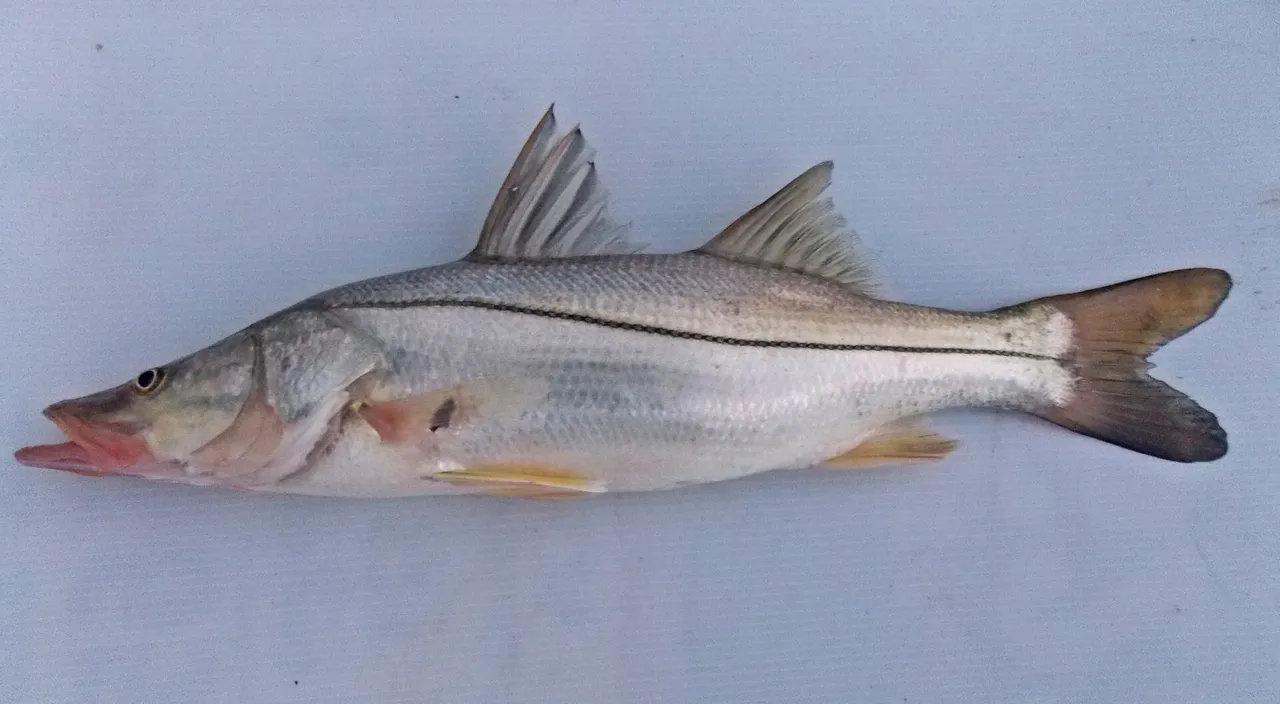
How this was identified, and who took it
Identified by: The heavy black lateral line running unbroken onto the caudal fin is the diagnostic character for the species, and it could not be clearer. Sloping forehead, protruding lower jaw and yellow pelvic fin all confirm it.jose_colorado-dapa — CC BY-SA 4.0, via Wikimedia Commons — source, licenceWhat is known about how it feeds
A snook does not chase. It holds in current beside structure, facing the flow, and inhales what the water brings past it.
The mechanism is suction. The mouth is large and protrusible, and opening it suddenly creates an inrush that draws prey in from a short distance — the same engulfing mechanism a largemouth bass uses, applied in a tidal environment. The fish does not need to overtake anything, which is why an ambush position in current is worth more to a snook than open-water speed.
The two verified relationships fit the method precisely. Scaled sardines, taken from shoals moving past structure, and decapod crustaceans — shrimp above all — which are flushed out of mangrove and grass habitat on falling tides and delivered directly to a waiting fish.
That tidal delivery is the organising fact of the species' feeding. A snook's productive period is not a time of day but a state of tide, and the same position is worth everything on one and nothing on the other.
Temperature sets the outer boundary. Snook are cold-sensitive to an unusual degree and suffer mass mortality in severe cold events, which has repeatedly reshaped populations at the northern edge of the range. A cold snap is not a slow-feeding period for this species; it is a mortality event.
The food
Prey with a verified dietary link to this fish. Each entry carries its own evidence, and each is written at the precision the source actually used: a named species where the source named one, a group or food category where it said “polychaetes”, “crustaceans” or “detritus” and meant it. That is why this list is shorter than the animal’s real diet rather than longer.
- Scaled sardine — Harengula jaguana
Snook feed heavily on scaled sardines around structure and along beaches, which is the ecological basis of the live-bait fishery for them.
- Decapod crustaceans as prey — a group rather than a species: the evidence names the group
Shrimp are a substantial part of the diet, particularly on outgoing tides when they are flushed out of mangrove and grass habitat.
Food with no page of its own here yet
These are real components of the diet, listed as plain text because FishingHQ has no page for them yet. Inventing pages to make the list look fuller would be the fabrication this whole approach exists to prevent.
- mullet
- gobies and mojarras
- pinfish
- juvenile tarpon and other small fish
- crabs
What anglers do with this
Everything below is interpretation, not finding. It is what experienced anglers conclude from the biology above, and the reasoning is usually sound and almost never tested. It is separated from the biology deliberately.
The suction-ambush mechanism converts into a presentation principle anglers state consistently: an offering delivered past a holding fish with the current is convincing, and one dragged against it is not. The reasoning follows from the feeding mechanics.
The outgoing-tide flush is the timing, and it is one of the clearest examples on FishingHQ of a fishery organised around the state of tide rather than the clock.
The cold sensitivity is not interpretation and it matters for the fishery's management: after a severe cold event, populations at the northern edge take years to recover, and retention rules are adjusted accordingly. What applies is a question for the relevant authority.
What this does not establish
The crustacean relationship is group-level. Two relationships for an opportunistic ambush predator whose diet reflects whatever the tide delivers. Composition varies between mangrove, beach, inlet and freshwater habitat, and nothing here establishes proportions.
Where this connects
These are the baits, lures, methods and explainers FishingHQ already joins to this fish — which is why the list is sometimes short. They are not chosen for this page, and a link here means an evidenced relationship exists, not that it follows from the diet.
Lures recorded for this species
Methods used for it
Where it lives
The science behind the feeding
This page covers feeding. The Common snook record covers identification, lifecycle, seasonal behaviour, handling and the sources behind all of it.
Reviewed 2026-08-12.