The Egyptian Red Sea coast
Fishing regions · Last reviewed 2026-08-17
A desert coast with coral reef in swimming distance of the beach, no rivers at all, and more European visitors in the water than almost anywhere on earth — where the diving is documented exhaustively and the fishing is barely written about in English.
Safety: sun, dehydration and fatigue — can cause serious injury or death. 4 more points apply here.
Contamination and toxins in the catch — Can cause injury needing treatment
Ciguatera occurs in tropical reef systems and is associated particularly with large predatory reef fish. It is not destroyed by cooking, freezing or any preparation, and there is no way to detect it in a fish by appearance, smell or taste.
What reduces it: Local knowledge is the only real guide to which species and which areas carry risk, and it is worth asking rather than assuming. Avoid large predatory reef fish for the table where local practice avoids them. Where a fish is unfamiliar, the safe answer is to return it.
Worse when:
- Large individuals of predatory reef species
- Areas where local people avoid eating a species
Being listed here is not permission to fish. What that meansClose
Access, fishing rights, seasons, licences, local bylaws and permitted methods vary and can change. Check current access, permission, local regulations, closures and restrictions before you travel or fish. FishingHQ describes what the ground is and names who holds the answer; it does not hold the answer itself.
Find the authority for a jurisdiction · What FishingHQ does and does not cover
The Red Sea is where FishingHQ's destination model ranked first, and the reason is the gap rather than the fish.
AN ENORMOUS NUMBER OF PEOPLE GO THERE. The Egyptian Red Sea is a mass-market winter-sun destination for northern and eastern Europe, reached by direct charter flight, and a very large share of those visitors get in the water. It is one of the largest recreational diving destinations in the world.
AND ALMOST NOTHING IS WRITTEN ABOUT FISHING THERE IN ENGLISH. Diving is documented exhaustively — sites, conditions, marine life, operators. What a person with a travel rod can do from a shore they can walk to, what lives there, when, and what the rules actually are, is close to absent.
THE PHYSICAL SETUP IS UNUSUAL AND IT IS WHAT MAKES SHORE ACCESS POSSIBLE. This is a narrow, deep, hot, extremely saline sea in a desert, with no permanent rivers anywhere along it. Fringing reef runs close to the shore for much of the coast, with a shallow reef flat, a reef crest and then a drop into deep water frequently within a hundred metres of the beach. That geometry puts genuine reef and drop-off water within reach of somebody standing on land.
NO RIVERS MEANS NO ESTUARIES. There is no salinity gradient, no turbid plume, no nursery in the sense the rest of FishingHQ uses — the mangrove that does exist is patchy and localised, and the productivity comes from the reef itself. An angler arriving from Atlantic Europe finds an entire category of ground simply missing, and a category of fishing with it.
AND IT IS A HEAVILY PROTECTED COAST. Much of it sits inside marine parks with real restrictions on fishing and spearfishing, enforced, and differing between areas. That is not a footnote on this page; it is the first thing a visitor needs to establish, and it is why this page names authorities at length and states no rule.
What fishing here is like
A desert coast on a narrow, deep, hot and very saline sea, with fringing coral reef close inshore along much of its length and no permanent freshwater input anywhere.
The fishing character follows directly from that geometry. A shallow reef flat runs out from the beach, ends at a crest, and drops — often steeply, often within a hundred metres of dry land — into deep blue water. That means reef species, drop-off species and, in places, genuinely pelagic fish are within reach of somebody on foot, which is unusual anywhere and almost unknown in a mass-market holiday destination.
Water temperature is high year-round and higher still in summer, salinity is above ocean average, and visibility is frequently exceptional. Clear water and heavily visited reef together produce fish that have seen people, which is why light presentation matters more here than power.
The recreational sector is overwhelmingly diving rather than angling, the charter fishing sector is small relative to the visitor numbers, and the local fishery is artisanal and commercial rather than sporting. A visitor is therefore doing something the destination is not organised around, which is exactly why a careful explainer is worth writing.
What dominates
Snorkelling and diving above everything else — this is one of the world's principal recreational diving destinations and the reason most visitors are in the water at all.
Shore fishing from beach, reef flat edge and rock where it is permitted: light lure and bait fishing for reef species, and casting into the drop-off for larger fish. Boat fishing exists as a small charter sector, running trolling and jigging over deeper ground and offshore banks.
Spearfishing is the discipline where the gap between what a visitor assumes and what is permitted is widest, and where the consequences of assuming are most serious. It is restricted or prohibited in many areas of this coast and enforcement in marine parks is real. FishingHQ does not state the position; it states that the position must be established first and that it is not what a Mediterranean spearfisher will expect.
Fly fishing is practised on the shallow flats and sandy lagoon ground in a few areas, and is a small and specialist activity here rather than an established sector.
The water available
Fringing coral reef running close to shore for much of the coast, with a shallow reef flat, a crest and a steep drop-off into deep water. Patch reefs and offshore banks. Sand and coral rubble between reef systems. Sheltered bays and lagoons with seagrass on sand, which are the nursery ground this coast has instead of estuaries.
Patchy and localised mangrove in some southern and Sinai areas, which is regionally important out of proportion to its extent because it is the only mangrove on the coast.
No rivers, no estuaries, no salinity gradient and no freshwater fishing of any kind. Deep water is reached quickly almost everywhere, and offshore the sea is genuinely oceanic within a short distance.
How the rules are structured
Egyptian national fisheries and environmental law, applied through a marine protected area system covering a very substantial proportion of this coast, with the protected areas administered separately and carrying their own zoning and restrictions. Recreational fishing, spearfishing and the taking of any marine organism are regulated, and the rules inside a protected area differ from those outside it and between areas.
What a visitor most needs to understand is structural rather than specific: this is a coast where a large share of the accessible water is inside a designation, where diving and fishing are administered by different bodies, and where the assumption that shore fishing is unregulated because nobody is checking is both wrong and expensive. Coral, shells and marine organisms are protected in ways that surprise visitors, and enforcement exists.
NOTHING ON THIS PAGE IS A CURRENT RULE. Licensing, permitted methods, marine park boundaries, spearfishing restrictions, size limits and what may be taken all differ here from what a visitor will assume, differ between areas, and are revised. Establish the position with the authorities named on this page before fishing, and do it before travelling rather than on arrival. FishingHQ does not state what any current rule is.
Who to ask
- The Egyptian Environmental Affairs Agency and the protectorate administration for the specific marine protected area concerned, which is the body whose zoning decides what is permitted where
- The Egyptian national fisheries authority, for licensing and for any recreational fishing framework outside protected areas
- The tourism and chamber-of-diving-and-watersports bodies that license dive and watersport operators, which are frequently the practical route to a current answer
- The dive centre or operator you are with, who will know the local position and whose licence depends on it — and who is a better first question than any website
- Your accommodation or resort, where much of the accessible shoreline is managed and where a house reef may carry its own rules
Words you will meet
- House reef
- The reef directly accessible from a hotel or dive centre's own beach or jetty. The unit most Red Sea shore activity is organised around, and the place where local rules are most likely to be the operator's rather than the state's.
- Reef flat
- The shallow platform running out from the shore to the reef crest, sometimes only ankle-deep. Walking on it damages living coral and is restricted in many places — entry is via a jetty or a marked channel for that reason.
- Drop-off
- The wall where the reef crest ends and the bottom falls away steeply into deep water. The productive line, and frequently within casting distance of the shore.
- Marsa
- A sheltered bay or inlet in the reef coast, from the Arabic for anchorage. Appears in a great many place names along this coast and usually indicates protected water with a sand or seagrass bottom.
- Protectorate
- The Egyptian designation for a protected area. A very large share of this coastline sits inside one, and the protectorate administration rather than the fisheries authority is frequently the body whose rules apply.
Conditions and hazards
The hazards here are not the ones a European visitor arrives worrying about.
HEAT AND SUN are the most consistent danger and the most underestimated. This is a desert coast; a day on an open reef flat or a boat produces heat exhaustion and severe burn quickly, and the water being warm removes the sensation that would normally warn a person.
CORAL is the second. Fire coral produces a painful and persistent sting, and any coral abrasion in warm water infects readily and heals slowly. Standing on reef damages the reef and cuts the person doing it.
VENOMOUS AND SPINED FISH are a genuine and specific risk on this coast rather than a generic tropical warning: stonefish and scorpionfish lie motionless on the bottom in shallow water and are stood on, lionfish hover against structure and do not move away, and several other reef species carry spines. Footwear on a reef flat is not optional and reaching into holes is a bad idea.
CURRENT AND OFFSHORE WIND. The prevailing wind blows along and off this coast, and a person who swims or drifts out through a reef channel can find the return swim impossible. Reef channels concentrate flow.
SHARKS are present, incidents are rare, and the pattern that produces them is well known and avoidable: feeding, fish waste in the water, spearing, and swimming at dusk in deep water off a drop-off. Local advice on specific sites is the authority and is worth taking seriously rather than treating as caution.
AND MEDICAL EVACUATION IS A REAL CONSTRAINT on parts of this coast. Hyperbaric facilities exist and are not everywhere, and travel insurance that covers diving and watersports is a practical rather than a bureaucratic matter.
What is there, and what it is like to fish from the shore
The reef community here is Red Sea rather than generically Indo-Pacific: a high proportion of the species are found only in this sea and its approaches, which is one of the reasons the diving is what it is.
WHAT A SHORE ANGLER MEETS. Emperors, snappers, groupers, wrasse, parrotfish, rabbitfish and goatfish over and around the reef and reef flat. Trevallies and queenfish working the drop-off and the reef edges, particularly at dawn and dusk. Barracuda along the wall. Needlefish and halfbeaks on the surface. Bonefish and small trevally on the sand and seagrass flats in sheltered bays.
WHAT COMES OFF THE DROP-OFF. Where deep water is close, the fish that live in it are within reach: larger trevallies, jobfish, and — occasionally and unpredictably — genuinely pelagic species. This is the feature that makes the coast unusual, and it means a shore session here can produce something that would require a boat almost anywhere else.
THE PRACTICAL SHAPE OF A SESSION. Light tackle, because the water is clear and the fish are pressured. Small metal lures, soft plastics and surface lures work; bait works and attracts the reef's smaller residents immediately. Dawn and dusk are worth more than the middle of the day by a wide margin, for the fish and for the person. Casting into the drop-off from the reef crest is the productive presentation where access permits it, and the reef flat itself is shallow, delicate and frequently protected.
AND THE FIRST QUESTION IS NOT WHERE BUT WHETHER. On this coast a very large proportion of accessible shoreline is inside a protected area, hotel-managed, or both. Establishing what is permitted where you are standing is the first step rather than a formality, and the dive centre or the resort is usually the fastest honest answer.
NOTHING ON THIS PAGE IS A CURRENT RULE. Licensing, permitted methods, marine park boundaries, spearfishing restrictions, size limits and what may be taken all differ here from what a visitor will assume, differ between areas, and are revised. Establish the position with the authorities named on this page before fishing, and do it before travelling rather than on arrival. FishingHQ does not state what any current rule is.
What experienced anglers do — why, and the sources (3)
Widely and independently recommended by experienced anglers and specialist sources. This is real angling knowledge, not proof: controlled evidence for it is limited, and FishingHQ records it as convention rather than as a demonstrated effect.
- FAO Species Identification Guides for Fishery Purposes and the FAO Species Catalogues — Food and Agriculture Organization of the United Nations (Scientific institute)Relied on for: Species composition, habitat association and distribution for the region concerned, as set out in the FAO species identification sheets.States this directlyCitation checked — the work exists and is described correctly
- General angling website restatements of established technique — Various (Credible secondary source)Relied on for: Widely restated descriptions of regional practice, ground and species, recorded as consensus rather than as scholarship.Background and mechanism onlyCitation checked — the work exists and is described correctly
- The IUCN Red List of Threatened Species — International Union for Conservation of Nature (Conservation authority)Relied on for: Global assessments and distribution for the species and habitats concerned, including reef-associated and migratory species.States this directlyCitation checked — the work exists and is described correctly
Why the diving and the fishing pull in opposite directions here
This is the destination where FishingHQ's two audiences most obviously collide, and it is worth setting out honestly rather than smoothing over.
THE ECONOMY OF THIS COAST IS BUILT ON REEF TOURISM. Diving and snorkelling bring the visitors, the reef is the asset, and the protected-area system exists to keep it intact. A reef fish taken by a visiting angler is a fish another visitor paid to look at, and that argument is made explicitly here in a way it is not on most coasts.
WHICH IS WHY THE RESTRICTIONS ARE WHAT THEY ARE. Fishing and spearfishing limits inside marine parks on this coast are more extensive than a European visitor expects, and they are not primarily about stock — they are about a reef that a large industry depends on being left alone.
AND THE BIOLOGY SUPPORTS THAT RATHER THAN CONTRADICTING IT. Reef predators here are slow-growing, site-attached and long-lived: groupers in particular are protogynous, so the largest individuals are males, and size-selective removal takes the males out of a population. Several species form predictable spawning aggregations, which is the single most exploitable behaviour any fish has. A reef can be emptied of its large fish while looking exactly the same to a snorkeller.
SO THE HONEST POSITION FOR A VISITING ANGLER is that this is a place to fish lightly, where permitted, and to return almost everything. Not because a rule says so on any particular beach, but because the case for taking reef fish from a heavily visited protected coast is weak and the case against it is arithmetic.
THE OTHER SIDE OF IT. Offshore, over deeper water and away from the reef, with a licensed operator, is a different proposition and a legitimate one. The distinction that matters is reef versus blue water rather than shore versus boat.
AND SPEARFISHING SPECIFICALLY. A Mediterranean spearfisher arriving here should assume nothing. The restrictions differ from those they know, they differ between areas of this coast, they are enforced, and the penalties are not trivial. Establish the position before travelling with equipment.
Backed by research — why, and the sources (4)
Supported by peer-reviewed research or fisheries science. The sources are listed and can be checked.
- Reef Fish Spawning Aggregations: Biology, Research and Management — Springer, Fish & Fisheries Series vol. 35, 2012 (Scientific literature)Relied on for: The biology and exploitation of reef fish spawning aggregations and their vulnerability to size-selective fishing.States this directlyCitation checked — the work exists and is described correctly
- Code of Conduct for Responsible Fisheries — Food and Agriculture Organization of the United Nations, Rome, 1995 (Standards body)Relied on for: International principles for responsible fisheries, including the management of small-scale and artisanal fisheries and the protection of critical habitat.Background and mechanism onlyCitation checked — the work exists and is described correctly
- The IUCN Red List of Threatened Species — International Union for Conservation of Nature (Conservation authority)Relied on for: Global assessments and distribution for the species and habitats concerned, including reef-associated and migratory species.States this directlyCitation checked — the work exists and is described correctly
- FAO Species Identification Guides for Fishery Purposes and the FAO Species Catalogues — Food and Agriculture Organization of the United Nations (Scientific institute)Relied on for: Species composition, habitat association and distribution for the region concerned, as set out in the FAO species identification sheets.States this directlyCitation checked — the work exists and is described correctly
When to go, and what the season actually changes
The Red Sea's year is not a temperature cycle in the way a temperate coast's is — it is warm to very warm throughout — so what varies is comfort, wind and what is moving.
WINTER, ROUGHLY NOVEMBER TO MARCH, is the northern-European season and the reason this coast is on a winter-sun list at all. Air temperatures are pleasant, water is cooler but entirely swimmable, and the shore fishing is workable through the middle of the day rather than only at the ends of it. This is when most visitors are there.
SUMMER IS SEVERE. Air temperatures on this coast in high summer are genuinely dangerous for anybody standing on an open reef flat, and the water is warm enough that it provides no relief. Fishing is a dawn-and-dusk activity at best. Local people organise around this and visitors frequently do not.
WIND IS THE VARIABLE THAT DECIDES A DAY. The prevailing northerly along much of this coast can blow hard for days, and it flattens the fishing from exposed shore while leaving sheltered bays workable. It is also what makes an offshore drift uncomfortable and a swim back difficult.
DAWN AND DUSK DO MORE THAN ANY SEASON. Predator activity along the drop-off concentrates sharply at both ends of the day, in clear water where fish can see everything at midday. An angler who fishes the first and last hour will out-fish one who fishes the middle six by a distance, in any month.
AND THE PLANKTON AND MEGAFAUNA SEASONS matter for the reason most visitors are there. Whale sharks and manta rays appear seasonally on parts of this coast; those seasons are documented by the diving sector and are not what this page is for, but they change what the water is doing and therefore what is feeding in it.
What experienced anglers do — why, and the sources (3)
Widely and independently recommended by experienced anglers and specialist sources. This is real angling knowledge, not proof: controlled evidence for it is limited, and FishingHQ records it as convention rather than as a demonstrated effect.
- General angling website restatements of established technique — Various (Credible secondary source)Relied on for: Widely restated descriptions of regional practice, ground and species, recorded as consensus rather than as scholarship.Background and mechanism onlyCitation checked — the work exists and is described correctly
- FAO Species Identification Guides for Fishery Purposes and the FAO Species Catalogues — Food and Agriculture Organization of the United Nations (Scientific institute)Relied on for: Species composition, habitat association and distribution for the region concerned, as set out in the FAO species identification sheets.States this directlyCitation checked — the work exists and is described correctly
- The IUCN Red List of Threatened Species — International Union for Conservation of Nature (Conservation authority)Relied on for: Global assessments and distribution for the species and habitats concerned, including reef-associated and migratory species.States this directlyCitation checked — the work exists and is described correctly
Some of what lives here
Fish recorded here that FishingHQ holds a reviewed photograph of. It is not a complete list of what The Egyptian Red Sea coast holds, and it is not a prediction that you will catch any of them — it is a way in to the ones we can show you.
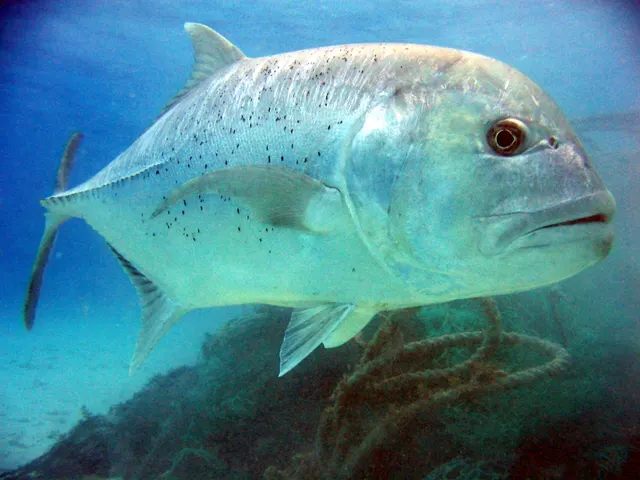 Giant trevallyA hugely powerful Indo-Pacific reef predator that hunts over shallow structure, and the fish popping was built around.
Dr. Dwayne Meadows, NOAA/NMFS/OPR — Public domain, via Wikimedia Commons
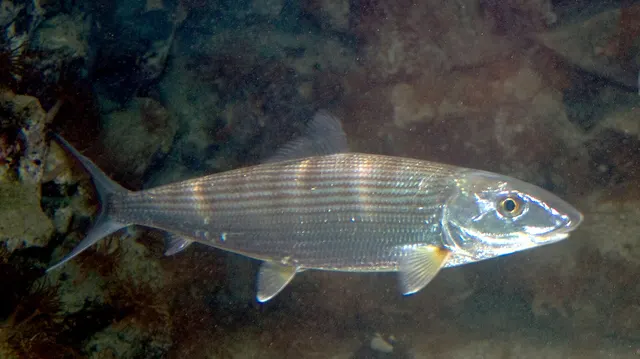 BonefishA silver bottom-feeder of tropical shallows, hunted on sight in knee-deep water, that runs further than anything of its size.
Brian Gratwicke — CC BY 2.0, via Wikimedia Commons
Safety
Contamination and toxins in the catch is set out at the top of this page, where it cannot be missed.
Sun, dehydration and fatigue — Can cause serious injury or death
A desert coast with high year-round temperatures and extreme summer heat. A day on an open reef flat or an unshaded boat produces heat exhaustion and severe sunburn quickly, and warm water removes the sensation of heat that would otherwise warn a person.
What reduces it: Fish dawn and dusk and stay out of the middle of the day, particularly in summer. Physical cover rather than sunscreen alone. Far more water than feels necessary. Treat a headache or loss of concentration as a reason to stop rather than to push on.
Worse when:
- Summer, when conditions on this coast are genuinely dangerous rather than uncomfortable
- Open reef flats and boats with no shade
- Long shore sessions with no shelter within reach
Venomous and spined species — Can cause serious injury or death
Stonefish and scorpionfish lie motionless and camouflaged on shallow bottom and are stood on; lionfish hover against structure and do not move away from a hand or a knee; and several reef species carry spines that envenomate or that simply puncture. Envenomation produces severe pain and occasionally systemic effects.
What reduces it: Footwear with a firm sole on any reef flat or shallow bottom, and look before placing a hand or a foot anywhere. Do not reach into holes. If stung, immerse in water as hot as can be tolerated without scalding and seek medical help — this coast's clinics see these injuries regularly and know what to do.
Worse when:
- Wading a reef flat barefoot or in thin shoes
- Handling any fish that is not confidently identified
- Poor light at dawn and dusk, which is when most fishing happens here
Moving water and currents — Can cause serious injury or death
Reef channels concentrate flow and the prevailing wind blows along and off this coast. A swimmer or snorkeller carried out through a channel or downwind of their entry can find the return impossible, and the shoreline offers few alternative exits.
What reduces it: Enter and exit at known points, check the wind direction before entering the water, and do not swim out through a channel on the assumption that coming back will be as easy. Ask the dive centre about the specific site — this is exactly the knowledge they hold.
Worse when:
- Strong prevailing wind
- Falling tide through a reef channel
- Swimming alone
Encounters with marine life — Can cause injury needing treatment
Sharks are present on this coast. Incidents are rare and the pattern that produces them is well documented: fish waste and feeding in the water, spearing, and being in deep water off a drop-off at dawn or dusk.
What reduces it: Do not put fish waste in the water and do not fish where people are swimming. Take local advice on specific sites seriously — it is based on what has actually happened there. Do not tow a speared or landed fish through the water.
Worse when:
- Dawn and dusk
- Deep water off the drop-off
- Any blood or bait in the water
Further safety reading
- Sun, dehydration and fatigue — A desert coast where warm water removes the sensation that would otherwise warn somebody how hot they are.
- Venomous and spined fish — Stonefish and scorpionfish on shallow bottom, lionfish against structure, and a reef flat people wade barefoot.
Check the rules before you fish
Fishing laws, bylaws, access rules, seasons, bait restrictions and permitted methods vary by location and can change. Check the current rules from the relevant authority and the water you intend to fish before fishing.
Check with:
- Current national or regional law for where you are fishing
- Current local bylaws
- The relevant fisheries authority
- The landowner, club or fishery whose water it is
- Any restrictions specific to the species or the method you intend to use
Where to go next
What swims here
- Blacktip reef sharkShallow reef flats and lagoon margins, where juveniles are the shark most snorkellers here actually encounter.
- BonefishOn the sand and seagrass flats of sheltered bays, which is the nursery ground this riverless coast has instead of estuaries.
- Giant trevallyWorks the reef edges and drop-offs, and is one of the pelagic species a shore angler can genuinely meet here because deep water is so close.
- Great barracudaAlong the wall and over the reef flat edge, and a fish a snorkeller is likely to see before an angler catches one.
- Red lionfishNative here rather than invasive, which is the other half of the Caribbean story: the same species that is being culled across the western Atlantic belongs in this sea.
- Reef stonefishPresent along this coast, and named on the destination record as its sharpest specific hazard — which was written before the species page existed and could not show a reader one.
How this compares
- Canary IslandsThe two winter-sun destinations reachable from northern Europe with deep water close to the shore and no rivers at all. Both put pelagic species within reach of a rock; one is a coral sea inside a protected-area system and the other is volcanic Atlantic.
- Coral reefThe habitat this whole coast is made of, and the reason a hundred metres of walking reaches ground that would need a boat elsewhere.
- Saltwater fly fishingShallow sand and seagrass flats in sheltered bays are the nursery ground this riverless coast has instead of estuaries, and they are the one part of it that is genuinely a fly proposition rather than a diving one.
- Seagrass bedsThe sheltered bays and lagoons hold seagrass, which on a coast with no estuaries is the nursery habitat doing the job an estuary would.
- Sri LankaTwo tropical destinations ranked in the same batch and almost opposite in structure: one has reef and no fresh water at all, the other has reef, mangrove, estuary and an ancient reservoir network.
- The MaldivesTwo Indian Ocean reef destinations with opposite access models: one has a shore a person can walk along, the other runs almost everything through a resort.
Rules and access
Sources and evidence
- FAO Species Identification Guides for Fishery Purposes and the FAO Species Catalogues — Food and Agriculture Organization of the United Nations (Scientific institute)Relied on for: Species composition, habitat association and distribution for the region concerned, as set out in the FAO species identification sheets.States this directlyCitation checked — the work exists and is described correctly
- Code of Conduct for Responsible Fisheries — Food and Agriculture Organization of the United Nations, Rome, 1995 (Standards body)Relied on for: International principles for responsible fisheries, including the management of small-scale and artisanal fisheries and the protection of critical habitat.Background and mechanism onlyCitation checked — the work exists and is described correctly
- The IUCN Red List of Threatened Species — International Union for Conservation of Nature (Conservation authority)Relied on for: Global assessments and distribution for the species and habitats concerned, including reef-associated and migratory species.States this directlyCitation checked — the work exists and is described correctly
- Reef Fish Spawning Aggregations: Biology, Research and Management — Springer, Fish & Fisheries Series vol. 35, 2012 (Scientific literature)Relied on for: The biology and exploitation of reef fish spawning aggregations and their vulnerability to size-selective fishing.States this directlyCitation checked — the work exists and is described correctly
- General angling website restatements of established technique — Various (Credible secondary source)Relied on for: Widely restated descriptions of regional practice, ground and species, recorded as consensus rather than as scholarship.Background and mechanism onlyCitation checked — the work exists and is described correctly
Why the 15 connections on this page are here, and the sources
What swims here
Backed by research — 6 connections
Supported by peer-reviewed research or fisheries science. The sources are listed and can be checked.
Blacktip reef shark
A distributional claim about where a species occurs, resting on the regional identification literature rather than on angling report. It says nothing about where a reader should fish.
- FAO Species Identification Guides for Fishery Purposes and the FAO Species Catalogues — Food and Agriculture Organization of the United Nations (Scientific institute)Relied on for: Species composition, habitat association and distribution for the region concerned, as set out in the FAO species identification sheets.States this directlyCitation checked — the work exists and is described correctly
- The IUCN Red List of Threatened Species — International Union for Conservation of Nature (Conservation authority)Relied on for: Global assessment and distribution for the species concerned.States this directlyCitation checked — the work exists and is described correctly
Bonefish
A distributional claim about where a species occurs, resting on the regional identification literature rather than on angling report. It says nothing about where a reader should fish.
- FAO Species Identification Guides for Fishery Purposes and the FAO Species Catalogues — Food and Agriculture Organization of the United Nations (Scientific institute)Relied on for: Species composition, habitat association and distribution for the region concerned, as set out in the FAO species identification sheets.States this directlyCitation checked — the work exists and is described correctly
- The IUCN Red List of Threatened Species — International Union for Conservation of Nature (Conservation authority)Relied on for: Global assessment and distribution for the species concerned.States this directlyCitation checked — the work exists and is described correctly
Giant trevally
A distributional claim about where a species occurs, resting on the regional identification literature rather than on angling report. It says nothing about where a reader should fish.
- FAO Species Identification Guides for Fishery Purposes and the FAO Species Catalogues — Food and Agriculture Organization of the United Nations (Scientific institute)Relied on for: Species composition, habitat association and distribution for the region concerned, as set out in the FAO species identification sheets.States this directlyCitation checked — the work exists and is described correctly
- The IUCN Red List of Threatened Species — International Union for Conservation of Nature (Conservation authority)Relied on for: Global assessment and distribution for the species concerned.States this directlyCitation checked — the work exists and is described correctly
Great barracuda
A distributional claim about where a species occurs, resting on the regional identification literature rather than on angling report. It says nothing about where a reader should fish.
- FAO Species Identification Guides for Fishery Purposes and the FAO Species Catalogues — Food and Agriculture Organization of the United Nations (Scientific institute)Relied on for: Species composition, habitat association and distribution for the region concerned, as set out in the FAO species identification sheets.States this directlyCitation checked — the work exists and is described correctly
- The IUCN Red List of Threatened Species — International Union for Conservation of Nature (Conservation authority)Relied on for: Global assessment and distribution for the species concerned.States this directlyCitation checked — the work exists and is described correctly
Red lionfish
A distributional claim about where a species occurs, resting on the regional identification literature rather than on angling report. It says nothing about where a reader should fish.
- FAO Species Identification Guides for Fishery Purposes and the FAO Species Catalogues — Food and Agriculture Organization of the United Nations (Scientific institute)Relied on for: Species composition, habitat association and distribution for the region concerned, as set out in the FAO species identification sheets.States this directlyCitation checked — the work exists and is described correctly
- The IUCN Red List of Threatened Species — International Union for Conservation of Nature (Conservation authority)Relied on for: Global assessment and distribution for the species concerned.States this directlyCitation checked — the work exists and is described correctly
Reef stonefish
A habitat association resting on the standard regional reference works rather than on angling report.
- FAO Species Identification Guides for Fishery Purposes and the FAO Species Catalogues — Food and Agriculture Organization of the United Nations (Scientific institute)Relied on for: Habitat association, depth range and distribution as set out in the FAO species identification sheets for the Indo-Pacific and Red Sea.States this directlyCitation checked — the work exists and is described correctly
- The IUCN Red List of Threatened Species — International Union for Conservation of Nature (Conservation authority)Relied on for: Global assessment and distribution for the species concerned.States this directlyCitation checked — the work exists and is described correctly
How this compares
What experienced anglers do — 6 connections
Widely and independently recommended by experienced anglers and specialist sources. This is real angling knowledge, not proof: controlled evidence for it is limited, and FishingHQ records it as convention rather than as a demonstrated effect.
Canary Islands
A comparison a traveller choosing between two destinations genuinely needs.
- General angling website restatements of established technique — Various (Credible secondary source)Relied on for: Widely restated descriptions of regional practice, ground and species, recorded as consensus rather than as scholarship.Background and mechanism onlyCitation checked — the work exists and is described correctly
- Code of Conduct for Responsible Fisheries — Food and Agriculture Organization of the United Nations, Rome, 1995 (Standards body)Relied on for: International principles for responsible fisheries, including the management of small-scale and artisanal fisheries.Background and mechanism onlyCitation checked — the work exists and is described correctly
Coral reef
A destination joined to the ground it is made of, so a reader can follow from the place to how the habitat behaves.
- General angling website restatements of established technique — Various (Credible secondary source)Relied on for: Widely restated descriptions of regional practice, ground and species, recorded as consensus rather than as scholarship.Background and mechanism onlyCitation checked — the work exists and is described correctly
- Code of Conduct for Responsible Fisheries — Food and Agriculture Organization of the United Nations, Rome, 1995 (Standards body)Relied on for: International principles for responsible fisheries, including the management of small-scale and artisanal fisheries.Background and mechanism onlyCitation checked — the work exists and is described correctly
Saltwater fly fishing
A comparison a reader making this decision genuinely needs.
- Still Water Fly-Fishing — Andre Deutsch, 1952 (Specialist angling publication)Relied on for: Fly-fishing practice from a practitioner tradition: line control, depth management, retrieve and the reading of water.States this directlyCitation checked — the work exists and is described correctly
- Sea Angler — Bauer Media (Specialist angling publication)Relied on for: Contemporary UK sea angling practice as reported by practitioners: ground, tackle, presentation and seasonal timing.States this directlyCitation checked — the work exists and is described correctly
Seagrass beds
A destination joined to the ground it is made of, so a reader can follow from the place to how the habitat behaves.
- General angling website restatements of established technique — Various (Credible secondary source)Relied on for: Widely restated descriptions of regional practice, ground and species, recorded as consensus rather than as scholarship.Background and mechanism onlyCitation checked — the work exists and is described correctly
- Code of Conduct for Responsible Fisheries — Food and Agriculture Organization of the United Nations, Rome, 1995 (Standards body)Relied on for: International principles for responsible fisheries, including the management of small-scale and artisanal fisheries.Background and mechanism onlyCitation checked — the work exists and is described correctly
Sri Lanka
A comparison a traveller choosing between two destinations genuinely needs.
- General angling website restatements of established technique — Various (Credible secondary source)Relied on for: Widely restated descriptions of regional practice, ground and species, recorded as consensus rather than as scholarship.Background and mechanism onlyCitation checked — the work exists and is described correctly
- Code of Conduct for Responsible Fisheries — Food and Agriculture Organization of the United Nations, Rome, 1995 (Standards body)Relied on for: International principles for responsible fisheries, including the management of small-scale and artisanal fisheries.Background and mechanism onlyCitation checked — the work exists and is described correctly
The Maldives
A comparison a traveller choosing between two destinations genuinely needs.
- General angling website restatements of established technique — Various (Credible secondary source)Relied on for: Widely restated descriptions of regional practice, ground and species, recorded as consensus rather than as scholarship.Background and mechanism onlyCitation checked — the work exists and is described correctly
- Code of Conduct for Responsible Fisheries — Food and Agriculture Organization of the United Nations, Rome, 1995 (Standards body)Relied on for: International principles for responsible fisheries, including the management of small-scale and artisanal fisheries.Background and mechanism onlyCitation checked — the work exists and is described correctly
Safety reading
Official guidance — 2 connections
Stated by a fisheries authority, scientific institute or recognised angling body. Authoritative, but summarising rather than demonstrating.
Sun, dehydration and fatigue
A link to a safety topic substantial enough to be read in full.
- RNLI water safety guidance: cold water shock and Float to Live — Royal National Lifeboat Institution (Water-safety or diver-training authority)Relied on for: Water safety guidance for coastal users.States this directlyPassage read and verified
Venomous and spined fish
A link to a safety topic substantial enough to be read in full.
- RNLI water safety guidance: cold water shock and Float to Live — Royal National Lifeboat Institution (Water-safety or diver-training authority)Relied on for: Water safety guidance for coastal users.States this directlyPassage read and verified
Rules and access
Official guidance — 1 connection
Stated by a fisheries authority, scientific institute or recognised angling body. Authoritative, but summarising rather than demonstrating.
Who regulates fishing, and how to find your rules
This points to the kind of rule that applies rather than to any rule itself, so the page carries the notice that the requirement varies.
- Code of Conduct for Responsible Fisheries — Food and Agriculture Organization of the United Nations, Rome, 1995 (Standards body)Relied on for: International principles for fisheries management, including the role of national authorities and the management of protected areas.Background and mechanism onlyCitation checked — the work exists and is described correctly
- Angling Trust guidance for anglers — Angling Trust (Angling or fisheries organisation)Relied on for: The structure of angling regulation and the framework within which anglers are asked to establish local rules.States this directlyCitation checked — the work exists and is described correctly
How FishingHQ labels evidence is explained in the evidence policy.