Redtail catfish
Fish · Last reviewed 2026-08-10
A very large Amazonian catfish with a brilliant orange-red tail and a white belly stripe, popular in the aquarium trade and unsuited to it.
Safety: injury while handling fish — can cause injury needing treatment.
How this was identified, and who took it
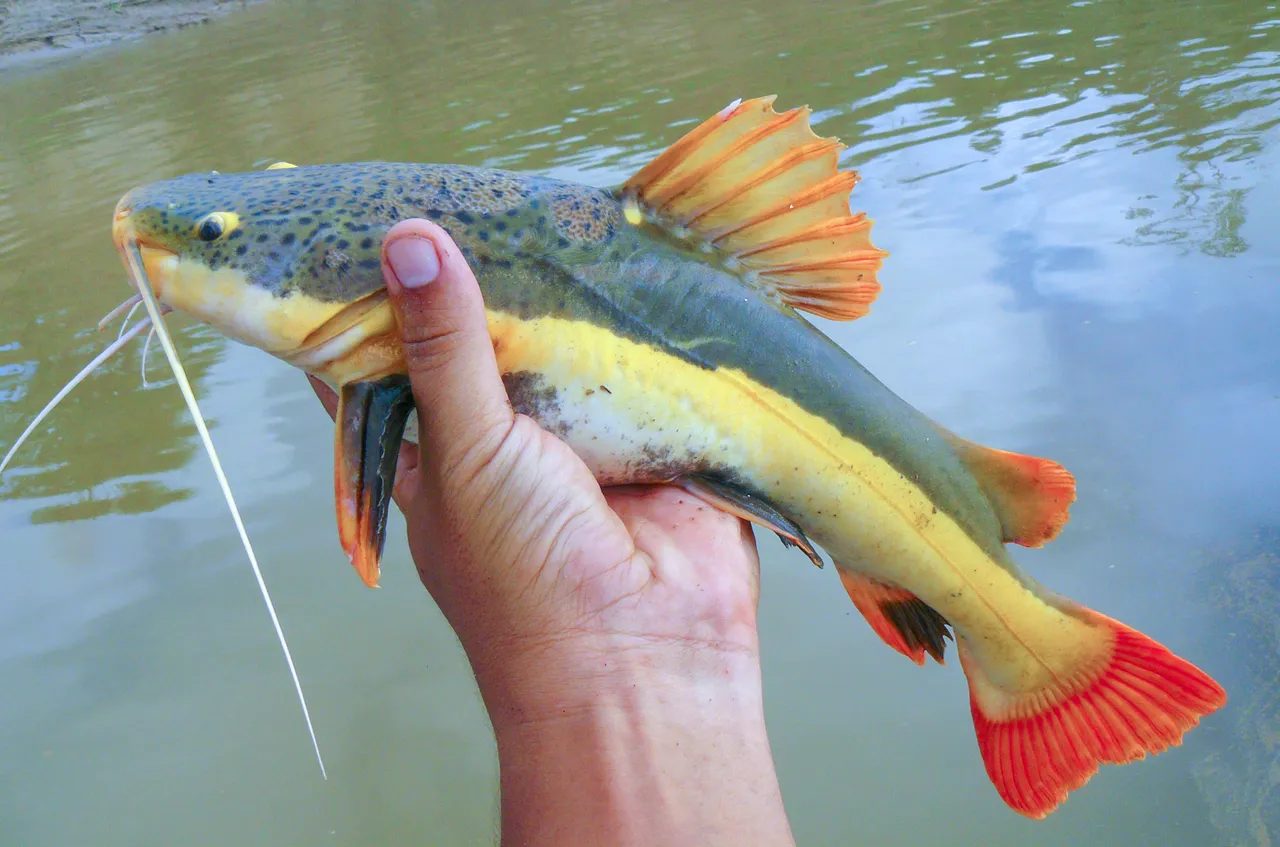
Identified by: Both characters unmistakable: a brilliant orange-red caudal fin with the dorsal fin margin orange to match, and a broad pale stripe running the full length of the flank from behind the head to the tail. Supported by the dark olive back with heavy black spotting, the long white barbels and the broad flattened head.w_endo — CC0, via iNaturalist — source, licenceCatching Redtail catfish
Everything here on fishing for it. Each entry opens the page behind it.
- Ground
Redtail catfish is unmistakable: a huge, broad-headed Amazonian catfish, dark grey-brown above with a bold white stripe along the flank and a brilliant orange-red tail and dorsal fin.
It is a nocturnal bottom predator of the Amazon and Orinoco basins, taking fish, crabs and fallen fruit, and it grows to well over a metre.
It has a second, less happy significance: it is widely sold as a small aquarium fish and grows far beyond any domestic tank, which has led to widespread abandonment and to releases in warm waters around the world where it has established as an invasive. That is a genuine and well-documented problem and worth stating plainly on a page about the species.
Gear for this fish
Identification
- Scientific name
- Phractocephalus hemioliopterus
- Family
- Pimelodidae
- Water
- Freshwater
- Conservation status
- Least Concern
- Regions
- Central & South America
- Brilliant orange to red caudal fin and dorsal fin margin, unmistakable in a fish of this size.
- A broad white or cream stripe running along the flank from head to tail.
- Very broad flattened head with three pairs of long barbels and small eyes.
- Dark grey-brown back with scattered dark spots, over a pale belly.
Size
- Typical
- 8–25 kg (18–55 lb)
- Large
- 35–60 kg (77–130 lb)
Exceptional: FishBase records a maximum of 135 cm and 44.2 kg
A very large pimelodid, and the spines are the small problem
Redtail catfish are handled badly more often than almost anything else in tropical freshwater fishing, because they are photogenic, they are enormous, and they look robust.
THE SPINES FIRST. Stout, locking dorsal and pectoral spines, capable of deep punctures, on a fish with enough mass behind them to drive one through a hand. They project laterally and they are the reason a redtail is never gripped around the shoulders.
BUT THE REAL DAMAGE IS THE LIFT. A large redtail is a heavy-bodied fish with a soft, scaleless abdomen and no structural support out of water. Lifting one by the lower jaw, or with a hand under the gill cover, or vertically for a photograph, puts the entire mass on tissue that has never carried it. The injury is internal, invisible and frequently fatal, and the fish swims away looking fine.
SO: SUPPORT UNDERNEATH, HORIZONTAL, TWO POINTS, TWO PEOPLE FOR A BIG ONE. Better still, do not lift it at all — hold it in the water at the margin, which is what the better-run fisheries for this species now require.
THE MOUTH IS ENORMOUS AND SAFE. No cutting teeth; broad rasping pads. A hand can go in without being cut, though it will be abraded, and the jaws close with real force.
AND THE SLIME COAT MATTERS MORE THAN ON A SCALED FISH. Scaleless catfish rely entirely on mucus as a barrier. Dry hands, dry grass, hot sand and boat carpet all remove it, and the resulting infections kill fish days later where nobody sees them. Wet everything that touches the fish.
What experienced anglers do — why, and the sources (2)
Widely and independently recommended by experienced anglers and specialist sources. This is real angling knowledge, not proof: controlled evidence for it is limited, and FishingHQ records it as convention rather than as a demonstrated effect.
- FishBase: a global information system on fishes — Froese, R. and D. Pauly, eds. — FishBase Consortium (Scientific institute)Relied on for: Dentition, fin and spine morphology, body form, air-breathing capability and distribution for the species, which are the anatomical facts the handling practice below follows from.States this directlyPassage read and verified
- General angling website restatements of established technique — Various (Credible secondary source)Relied on for: Widely restated angling practice for handling this species, recorded as practitioner consensus rather than as tested fact.Background and mechanism onlyCitation checked — the work exists and is described correctly
Lifecycle and reproduction
Fast-growing and long-lived, reaching a very large size. Its growth rate is precisely why it is unsuitable for the aquarium trade that nonetheless sells it, and why released fish survive and establish in warm waters.
Spawns during the wet season in main river channels, with reproduction tied to the flood pulse. Detailed reproductive biology in the wild is not well documented and FishingHQ does not fill that gap.
Feeding and senses
A nocturnal opportunist taking fish, crabs and fallen fruit from the riverbed, swallowing prey whole with a very wide mouth.
Hunts at night and in turbid water by smell, taste and barbel contact rather than sight, which is why static scented baits on the bottom are the standard approach.
Through the year
Follows the flood cycle, feeding in flooded areas on high water and concentrating in channels and deep pools as water falls.
Distribution
South America: Amazon and Orinoco River basins
This is a biological range — where the species occurs, not a prediction that you will catch one. To browse the fishing geography FishingHQ holds, start at fishing places.
Why anglers care
A major Amazonian sport fish taken on large cut and whole dead baits fished on the bottom at night, and one of the main targets of destination trips to Brazil, Bolivia and Guyana. Its significance is size and power, and it is also a cautionary example in the ornamental trade — anglers encountering released redtails outside South America should report them rather than move them.
Handling and returning
Very large, heavy and armed with stout serrated pectoral and dorsal spines that cause severe punctures. Support the body from beneath, avoid the fin bases entirely, use gloves, and keep the fish in the water for large individuals.
Safety
Injury while handling fish — Can cause injury needing treatment
The pectoral and dorsal spines are thick, serrated and capable of deep puncture wounds that readily become infected.
What reduces it: Support the fish from underneath clear of the pectoral fins, wear gloves, and use long pliers. Clean punctures thoroughly and seek medical advice.
Where to go next
Where it lives
Where you will find it
More fish
Not related to this page — just the rest of the section. There is little else joined to this subject yet, and a short page should still lead somewhere.
Sources and evidence
- FishBase: a global information system on fishes — Froese, R. and D. Pauly, eds. — FishBase Consortium (Scientific institute)Relied on for: Family, maximum size, depth and environment, distribution and the IUCN assessment for Phractocephalus hemioliopterus.States this directlyPassage read and verified
- The IUCN Red List of Threatened Species — International Union for Conservation of Nature (Conservation authority)Relied on for: The Least Concern assessment for Phractocephalus hemioliopterus, assessed 27 December 2020.States this directlyCitation checked — the work exists and is described correctly
Why the 4 connections on this page are here, and the sources
How it is caught
What experienced anglers do — 1 connection
Widely and independently recommended by experienced anglers and specialist sources. This is real angling knowledge, not proof: controlled evidence for it is limited, and FishingHQ records it as convention rather than as a demonstrated effect.
Ledgering
A practitioner claim about how Phractocephalus hemioliopterus is commonly fished, following from where and how it feeds.
- General angling website restatements of established technique — Various (Credible secondary source)Relied on for: Widely restated practitioner accounts of fishing for redtail catfish.Citation checked — the work exists and is described correctly
- Sea Angler — Bauer Media (Specialist angling publication)Relied on for: Practitioner treatment of the methods used for redtail catfish and comparable species.Citation checked — the work exists and is described correctly
Gear for this fish
What experienced anglers do — 1 connection
Widely and independently recommended by experienced anglers and specialist sources. This is real angling knowledge, not proof: controlled evidence for it is limited, and FishingHQ records it as convention rather than as a demonstrated effect.
Fish strip and cut bait
A practitioner claim about tackle commonly used for Phractocephalus hemioliopterus.
- General angling website restatements of established technique — Various (Credible secondary source)Relied on for: Widely restated practitioner accounts of this presentation for redtail catfish.Citation checked — the work exists and is described correctly
- Angling Times — Bauer Media (Specialist angling publication)Relied on for: Practitioner treatment of comparable presentations for the species group.Citation checked — the work exists and is described correctly
Where it lives
Backed by research — 1 connection
Supported by peer-reviewed research or fisheries science. The sources are listed and can be checked.
Lowland rivers
A habitat association for Phractocephalus hemioliopterus taken from the environment and distribution data on its FishBase summary.
- FishBase: a global information system on fishes — Froese, R. and D. Pauly, eds. — FishBase Consortium (Scientific institute)Relied on for: The environment, depth range and habitat description recorded for Phractocephalus hemioliopterus.States this directlyPassage read and verified
Where you will find it
Backed by research — 1 connection
Supported by peer-reviewed research or fisheries science. The sources are listed and can be checked.
The Amazon basin
A distribution association between an animal and a kind of water, rather than a claim about any named mark.
- FishBase: a global information system on fishes — Froese, R. and D. Pauly, eds. — FishBase Consortium (Scientific institute)Relied on for: Distribution, habitat association and depth range recorded for the species, including its occurrence in the water body concerned.States this directlyPassage read and verified
- The IUCN Red List of Threatened Species — International Union for Conservation of Nature (Conservation authority)Relied on for: Assessment and range account for the species, including the systems and coasts it occupies.Background and mechanism onlyCitation checked — the work exists and is described correctly
How FishingHQ labels evidence is explained in the evidence policy.