How to identify speckled peacock bass
Cichla temensis · Cichlidae
The characters that identify speckled peacock bass, ranked by how far each one can be trusted on its own.
Safety: biosecurity and disease transfer — can cause serious injury or death. One more point applies here.
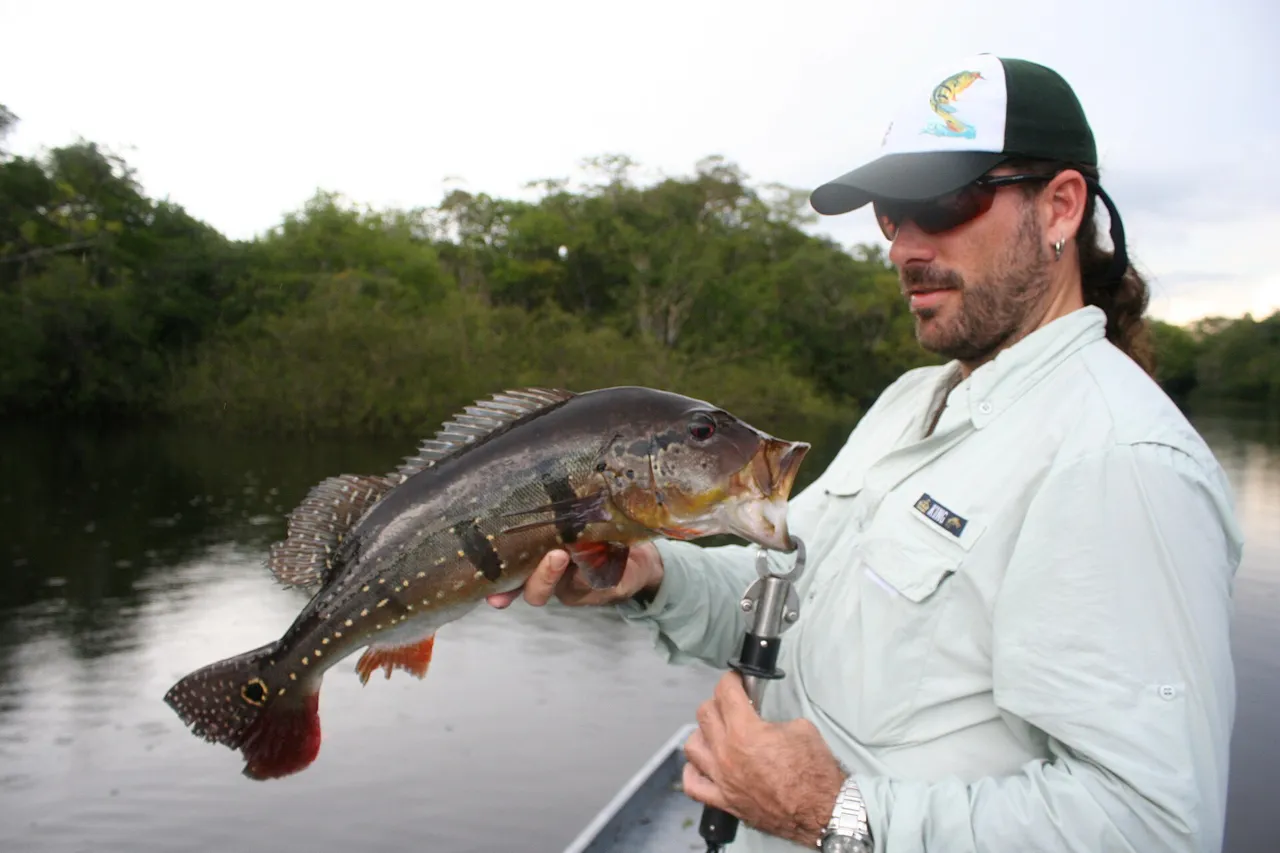
How this was identified, and who took it
Identified by: Both characters, and unusually the frame shows the TRANSITION between them rather than one end of it: the three dark vertical flank bars of the resting pattern are still present while rows of pale gold speckles have come up over the flank, which is the change the page describes. The black ocellus ringed in gold at the base of the tail is unambiguous and places the fish in Cichla.Wellerson Santana — CC BY-SA 4.0, via Wikimedia Commons — source, licenceLook at this first
Start at the tail. Every Cichla carries a black spot ringed with gold at the base of the caudal fin, and it is there whatever colour phase the fish is in. Find that, and you have a peacock bass; the rest of the page is about which one.
Diagnostic — settles it on its own
Each of these settles the identification on its own. If one is clear, you have your answer.
A gold-ringed black eyespot at the base of the tail
Look at the join between the body and the tail fin, low on the flank. There is a round dark spot with a pale gold ring around it, and it is present on every individual of the genus at every size and in every colour phase. It is a structural marking rather than a mood colour: it does not fade with stress or handling the way the body pattern does. It establishes the genus with certainty and it is the only character on this page that is reliable on its own.
Supporting — use with other characters
Real characters that are not conclusive by themselves. Use two or three together.
Three vertical bars, or rows of pale speckles instead
This species wears two completely different patterns. Out of breeding condition it shows three dark vertical bars down the flank. In spawning condition those bars fade away and are replaced by rows of pale speckles along the body — which is where the name comes from. A reader who has learned the barred pattern and meets a speckled fish will think they are looking at a different species, and they are not. Whichever pattern is showing, it is telling you about the fish's condition rather than about which species it is.
A long single dorsal fin notched in the middle
The fin along the back runs almost the whole length of the body as one structure with a clear notch between a spiny front section and a soft rear one. That is a cichlid arrangement and it is one of the things that tells a visiting angler this fish is not a bass in any sense that transfers from North America — it is a very large cichlid, related to the tilapias and the aquarium fishes, and the body plan says so.
The size the fish reaches, and the water it came from
Ordinary rod-caught fish run two to five kilos, a large one seven to nine, and the maximum published weight is 12.2 kg — larger than most of the congeners reach. The species occupies the Negro and Uatumã drainages of the Amazon and Orinoco tributaries in Venezuela and Colombia, in acidic blackwater of around pH 5.5 to 6.5. Several Cichla share that water, so range narrows the field without settling it, and a very large fish from blackwater is a reasonable prior for this species rather than a proof of it.
Suggestive only — varies with condition
Hints only. These vary with condition, season, water and how long the fish has been out of it, and a fish that contradicts them is still the same species.
Golden to olive flanks with red or orange low on the body
The general cast is gold to olive with red or orange along the lower body and in the fins, intensifying markedly on a breeding fish. Treat this as scene-setting rather than as evidence. Colour in this genus is mood- and condition-dependent, it shifts within minutes of capture, and it is the single least reliable thing about a fish that is otherwise reasonably tractable.
What it gets confused with
- Other Cichla species across the Amazon and Orinoco, several of which overlap in range and are routinely confused. They share the tail eyespot and the body plan, and separating them turns on bar pattern, proportion and detail that a photograph frequently does not resolve.
- The same species in its other colour phase, which is the commonest mistake of all: a barred fish and a speckled fish from the same lagoon are the same species in different condition.
- Large cichlids of the same water at a distance, none of which carries the gold-ringed tail spot, so the first look separates them immediately.
Where this stops working
This is a genus that resists photographs. Several Cichla overlap in range, they share the diagnostic tail eyespot, and the characters that separate them are patterns and proportions that shift with condition and are frequently not resolvable in an image. This species compounds the problem by changing its own pattern completely between barred and speckled phases, so the fish's appearance encodes its breeding condition rather than its identity. What can be said with confidence from a photograph is the genus. What often cannot is the species, and a page that implied otherwise would be more useful-sounding and less true.
The full record
This page covers identification only. The Speckled peacock bass record covers behaviour, lifecycle, distribution, handling and the sources behind all of it.
Reviewed 2026-08-16.
More about this fish
Telling it apart is one question. Here are the others.
Similar and related fish
How it is caught
Where it lives
- Floodplains, backwaters and oxbowsLagoons, cut-off channels and floodplain lakes hold peacock bass, and the fishing is organised around falling water concentrating them into reachable systems.
- Lowland riversLives in acidic blackwater around pH 5.5 to 6.5, in the deeper littoral of lagoons and along the sandy and rocky banks of the main channel — and is a cichlid, not a bass.
Where you will find it
Why the 6 connections on this page are here, and the sources
Similar and related fish
Backed by research — 1 connection
Supported by peer-reviewed research or fisheries science. The sources are listed and can be checked.
Butterfly peacock bass
An identification comparison naming both binomials: Cichla ocellaris and Cichla temensis.
- FishBase: a global information system on fishes — Froese, R. and D. Pauly, eds. — FishBase Consortium (Scientific institute)Relied on for: Morphological and distributional data for Cichla ocellaris and for Cichla temensis.States this directlyPassage read and verified
- The IUCN Red List of Threatened Species — International Union for Conservation of Nature (Conservation authority)Relied on for: Separate assessments treating Cichla ocellaris and Cichla temensis as distinct species.States this directlyCitation checked — the work exists and is described correctly
How it is caught
What experienced anglers do — 1 connection
Widely and independently recommended by experienced anglers and specialist sources. This is real angling knowledge, not proof: controlled evidence for it is limited, and FishingHQ records it as convention rather than as a demonstrated effect.
Spinning
Established angling practice for this species, recorded as convention. The note states the property of the animal or its water that makes the method the answer.
- IGFA International Angling Rules and World Record Requirements — International Game Fish Association (Angling or fisheries organisation)Relied on for: Recognition of the species as an established sport fish and the angling methods and tackle classes conventionally used for it.States this directlyPassage read and verified
- General angling website restatements of established technique — Various (Credible secondary source)Relied on for: Widely restated practice connecting this species and method.Background and mechanism onlyCitation checked — the work exists and is described correctly
Where it lives
Backed by research — 2 connections
Supported by peer-reviewed research or fisheries science. The sources are listed and can be checked.
Floodplains, backwaters and oxbows
A habitat association resting on the regional identification and fisheries literature rather than on angling report.
- The Flood Pulse Concept in River-Floodplain Systems — Canadian Special Publication of Fisheries and Aquatic Sciences 106, Department of Fisheries and Oceans, Ottawa, 1989 (Scientific literature)Relied on for: That fish move laterally onto the inundated floodplain to feed and breed and return to the channel as water falls, and that floodplain inundation drives production in large river systems.States this directlyCitation checked — the work exists and is described correctly
- FAO Species Identification Guides for Fishery Purposes and the FAO Species Catalogues — Food and Agriculture Organization of the United Nations (Scientific institute)Relied on for: Habitat association and distribution of the species concerned.States this directlyCitation checked — the work exists and is described correctly
Lowland rivers
A habitat claim held to a scientific standard.
- FishBase: a global information system on fishes — Froese, R. and D. Pauly, eds. — FishBase Consortium (Scientific institute)Relied on for: That Cichla temensis is a freshwater benthopelagic Cichlidae of the Amazon and Orinoco basins occupying deeper littoral areas in lagoons and the sandy and rocky banks of the main river channel at pH 5.5 to 6.5.States this directlyPassage read and verified
Where you will find it
Backed by research — 2 connections
Supported by peer-reviewed research or fisheries science. The sources are listed and can be checked.
South American fishing
A distributional claim taken from reference sources on the species rather than from angling report. It states presence and asserts nothing about a fishery.
- FishBase: a global information system on fishes — Froese, R. and D. Pauly, eds. — FishBase Consortium (Scientific institute)Relied on for: Distribution, habitat association, depth range and life history recorded for the species concerned.States this directlyPassage read and verified
- The IUCN Red List of Threatened Species — International Union for Conservation of Nature (Conservation authority)Relied on for: Global distribution, population trend and extinction-risk assessment for the species concerned.States this directlyCitation checked — the work exists and is described correctly
The Amazon basin
A distribution association between an animal and a kind of water, rather than a claim about any named mark.
- FishBase: a global information system on fishes — Froese, R. and D. Pauly, eds. — FishBase Consortium (Scientific institute)Relied on for: Distribution, habitat association and depth range recorded for the species, including its occurrence in the water body concerned.States this directlyPassage read and verified
- The IUCN Red List of Threatened Species — International Union for Conservation of Nature (Conservation authority)Relied on for: Assessment and range account for the species, including the systems and coasts it occupies.Background and mechanism onlyCitation checked — the work exists and is described correctly
Safety
Biosecurity and disease transfer — Can cause serious injury or death
Cichla species introduced outside their native range are effective predators of small fish and have established in several countries. Movement of live fish is the route.
What reduces it: Never move live fish or water between waters. Clean, drain, dry and check equipment. Where the species is non-native, establish what the local requirement is rather than assuming a fish should be returned.
Species that bite — Can cause injury needing treatment
The rivers this fish lives in also hold caiman, electric eels, stingrays and, in places, piranha, and the fishing is done from small boats and banks in that habitat.
What reduces it: Fish with people who know the water and treat local guidance as authoritative. Do not wade or swim in unfamiliar water. Shuffle rather than step where wading is unavoidable, because freshwater stingrays lie buried in sand.