What does golden dorado eat?
What is established about how golden dorado feeds, kept separate from what anglers infer from it.
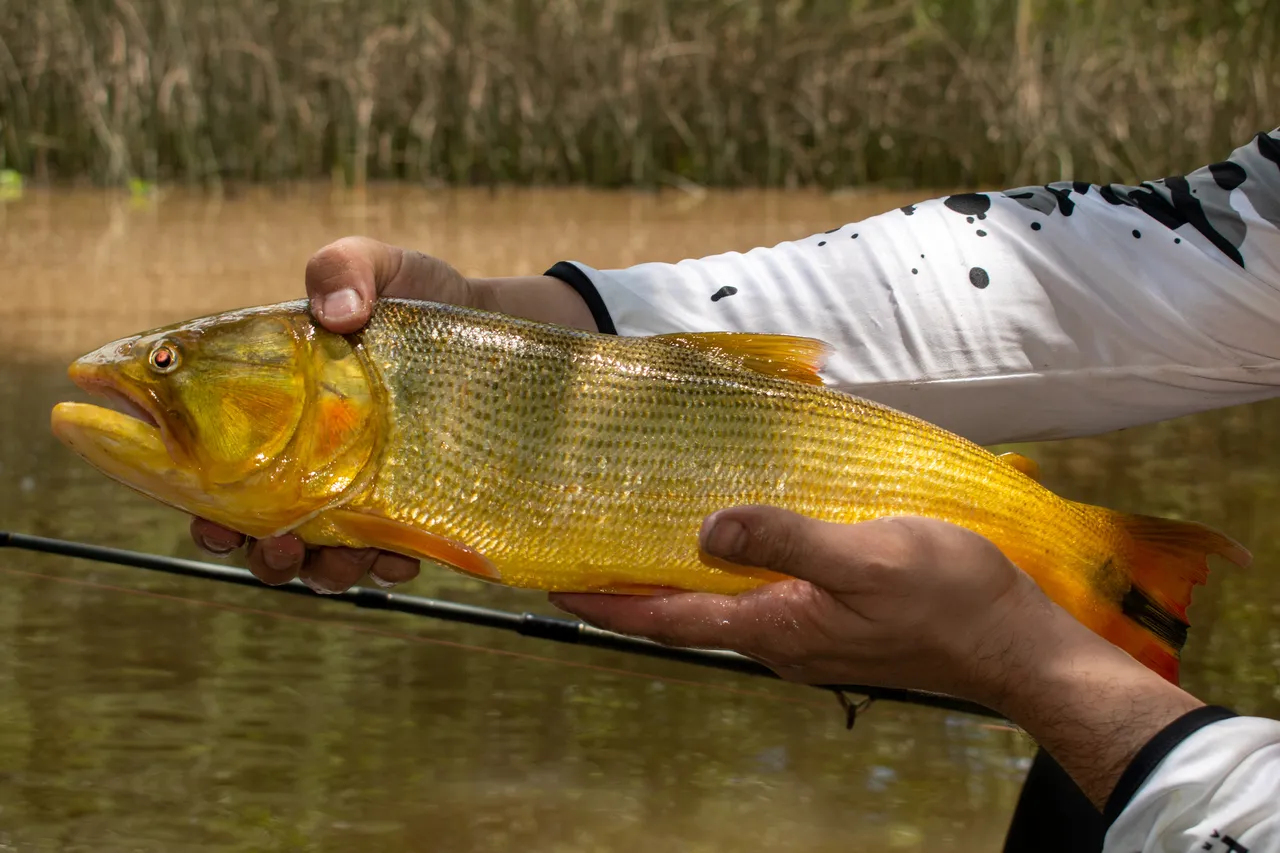
How this was identified, and who took it
Identified by: All three characters vivid: burnished brassy gold flanks over a darker back with dark scale-row striping; a deep compressed body with a large blunt head and a very large mouth showing conical teeth; and red-orange caudal and anal fins with a distinct BLACK stripe along the middle caudal rays. Four agreeing identifications, none disagreeing.Ezequiel Racker — CC BY, via iNaturalist — source, licenceWhat is known about how it feeds
The golden dorado is a predator whose entire distribution is an answer to the question of where one prey species is.
Sábalo — a large, migratory, detritus-feeding characiform — make up the majority of fish biomass in parts of the Paraná basin, and they are the dorado's principal prey. The verified relationship is to that species specifically, which is unusual precision for a tropical freshwater predator and reflects how dominant the relationship is.
Sábalo undertake long upstream spawning migrations timed to rising water, and dorado distribution, timing and concentration follow them. The classic dorado situation — fish smashing into a shoal below a rapid or at a confluence — is a sábalo shoal being intercepted where the geography constrains it.
The hunting is fast, frequently cooperative, and takes place in open water and at current seams rather than from cover. The conical dentition seizes and holds rather than shearing, and the skull is heavily built.
The consequence for the fishery is that the river's hydrological calendar matters more than the season as such: a flow event that triggers the sábalo migration reorganises where every dorado in the system is.
Crustaceans feature in the diet of smaller fish, and other characiforms are taken alongside sábalo.
The food
Prey with a verified dietary link to this fish. Each entry carries its own evidence, and each is written at the precision the source actually used: a named species where the source named one, a group or food category where it said “polychaetes”, “crustaceans” or “detritus” and meant it. That is why this list is shorter than the animal’s real diet rather than longer.
- Sábalo — Prochilodus lineatus
Sábalo are the principal prey of golden dorado in the Paraná basin, and dorado distribution and timing are largely a function of sábalo migration.
Food with no page of its own here yet
These are real components of the diet, listed as plain text because FishingHQ has no page for them yet. Inventing pages to make the list look fuller would be the fabrication this whole approach exists to prevent.
- other characiforms
- freshwater crustaceans
- smaller dorado (cannibalism)
- catfish
What anglers do with this
Everything below is interpretation, not finding. It is what experienced anglers conclude from the biology above, and the reasoning is usually sound and almost never tested. It is separated from the biology deliberately.
Finding the sábalo is finding the dorado, and that is the whole of the practical reasoning. Anglers work confluences, rapids and current seams where the migration is constrained, and the convention rests on a documented relationship rather than on lore.
The hydrological calendar converts into timing: the fishery is organised around flow rather than around a month.
The hard, bony mouth is a mechanical fact rather than an interpretation, and it is why hook penetration and sustained pressure matter more for this species than for most.
The species is under pressure from the commercial sábalo fishery as much as from angling — removing the prey base affects the predator — and several jurisdictions manage both together.
What this does not establish
One relationship for a diet that includes other fish and crustaceans. The dominance of sábalo is well supported in the Paraná basin and may not describe populations elsewhere in the range. Nothing here establishes proportions or predicts a migration.
Where this connects
These are the baits, lures, methods and explainers FishingHQ already joins to this fish — which is why the list is sometimes short. They are not chosen for this page, and a link here means an evidenced relationship exists, not that it follows from the diet.
Lures recorded for this species
Methods used for it
Where it lives
This page covers feeding. The Golden dorado record covers identification, lifecycle, seasonal behaviour, handling and the sources behind all of it.
Reviewed 2026-08-12.