How to identify african tigerfish
Hydrocynus vittatus · Alestidae
The characters that identify african tigerfish, ranked by how far each one can be trusted on its own.
Safety: species that bite — can cause serious injury or death. One more point applies here.
How this was identified, and who took it
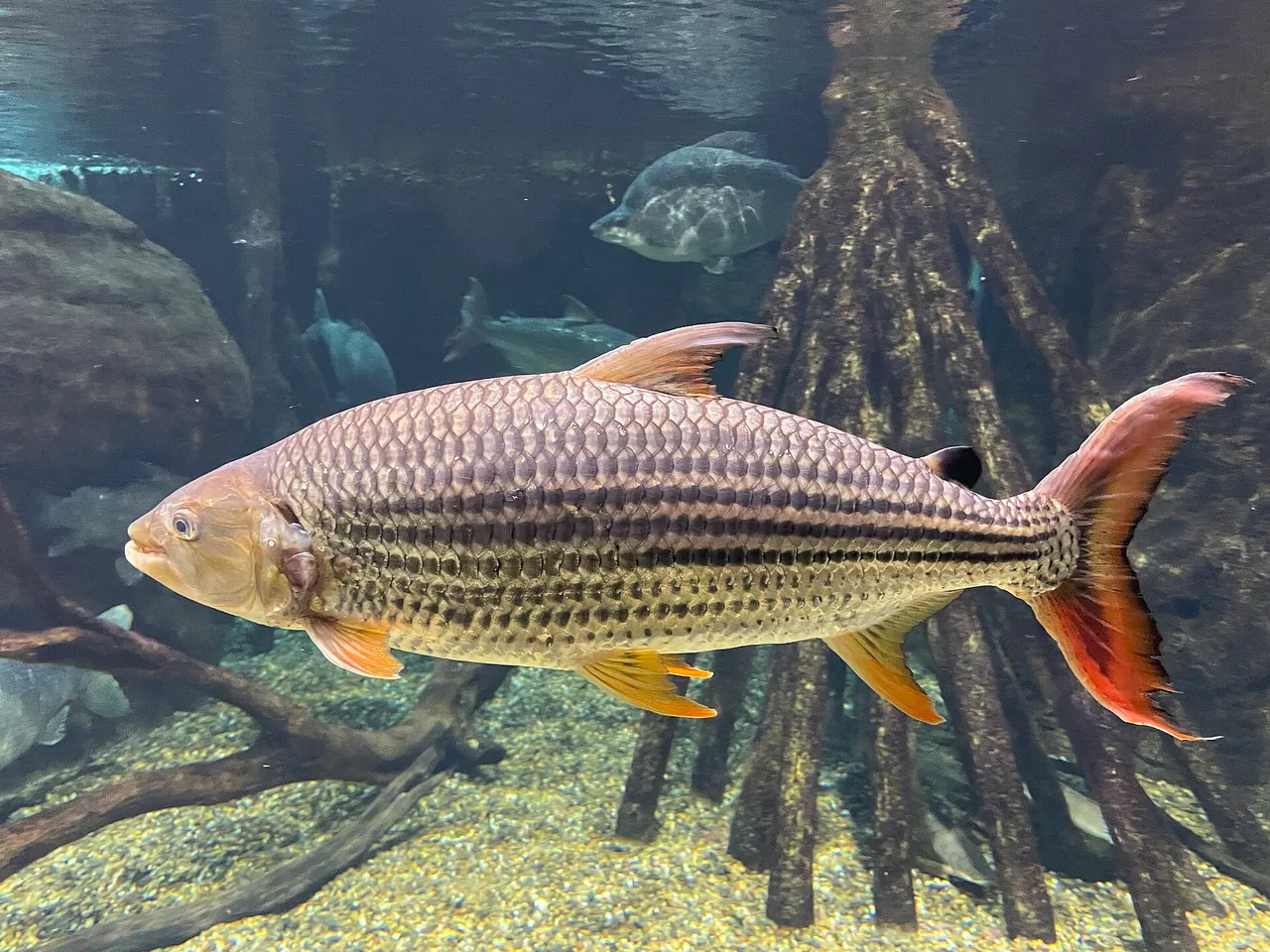
Identified by: Full lateral view in an aquarium. The horizontal dark stripes along the flank, the red-orange fins, the deeply forked red tail and the adipose fin are all clear — the striping is what places it in Hydrocynus.Totti — CC BY-SA 4.0, via Wikimedia Commons — source, licenceLook at this first
Look at the closed mouth. On a tigerfish the fangs stay outside it — they slot past each other along the outside of the jaws and are plainly visible on a fish that has not opened its mouth at all. Nothing else an angler meets in African fresh water does that.
Diagnostic — settles it on its own
Each of these settles the identification on its own. If one is clear, you have your answer.
Fangs that remain visible with the mouth shut
Look at the jaw line of a closed mouth from the side. The upper and lower teeth pass outside each other rather than meeting inside, so they show along the outside of the lip as a row of points. This is a structural arrangement rather than a colour or a shade: it is present on every individual at every size, it survives death and poor light, and it is visible in almost any photograph that shows the head. It is the character to check first and it settles the genus on its own.
Supporting — use with other characters
Real characters that are not conclusive by themselves. Use two or three together.
Dark horizontal stripes along a bright silver flank
Look along the side of the fish for a set of narrow dark lines running head to tail rather than up and down. They are distinct and evenly spaced on a healthy fish and they are the reason for the name. Treat this as confirmation of the species within the genus rather than as the primary test: the stripes fade on a dead or stressed fish, they vary in strength between individuals and populations, and the goliath tigerfish of the Congo carries a much more uniform silver flank with the striping far less strongly marked.
How big the fish is, and which river it came from
Ordinary rod-caught fish run one to three kilos and a very good one is six to ten, with a maximum published weight around 28 kg. A very large Hydrocynus from the Congo basin or Lake Tanganyika is much more likely to be the goliath tigerfish, which reaches weights this species does not approach. Range is supporting evidence and never an identification on its own — this species is spread across an enormous list of African systems from the Niger and the Nile to the Zambezi and the Okavango, and the two overlap in places.
A streamlined body with a deeply forked tail
Seen side on the fish is laterally compressed and built along its length rather than deep, and the tail is deeply forked. That is the profile of a pursuit predator that runs prey down in open water rather than ambushing from cover, and it fits everything else about the animal. It will not separate this fish from its congeners, all of which share the build, but it does rule out the deep-bodied and blunt-tailed predators of the same water.
Suggestive only — varies with condition
Hints only. These vary with condition, season, water and how long the fish has been out of it, and a fish that contradicts them is still the same species.
Orange to red caudal and anal fins
The tail and the fin beneath the rear of the body carry a warm orange or red wash, strongest on a fresh fish. It is a genuine mark and it is worth noticing, but it is a colour on a fish that loses colour quickly out of water and in a photograph taken in strong African light. Rank it below the teeth and below the stripes, and never let it settle an identification against a character that contradicts it.
What it gets confused with
- Goliath tigerfish in the Congo basin and Lake Tanganyika, which is the same genus at a much larger size with a more uniform silver flank and far weaker striping. A very large Hydrocynus from those waters is very unlikely to be this species.
- Other Hydrocynus species across the African systems, several of which are separated on stripe pattern and proportion rather than on anything obvious, and which a photograph frequently cannot settle.
- Large characins of the same rivers at a glance and at a distance, though none of them carries teeth outside a closed mouth and the first look resolves it immediately.
Where this stops working
The genus is easy and the species is not. Several Hydrocynus occur across Africa, they are separated on stripe pattern, proportion and range rather than on any single clean character, and where ranges meet a photograph is frequently not enough. Colour is unreliable: the fin wash fades, and the striping weakens on dead, stressed or poorly lit fish. Juveniles show the teeth but not the adult proportions. Where the fish came from does real work here, which is unusual in this family and is a consequence of how many similar species share the continent.
The full record
This page covers identification only. The African tigerfish record covers behaviour, lifecycle, distribution, handling and the sources behind all of it.
Reviewed 2026-08-16.
More about this fish
Telling it apart is one question. Here are the others.
How it is caught
- SpinningCasting heavy spoons across current into visible structure is the traditional approach, and the retrieve speed is set by a fish that strikes hard and is hard to hook.
- TrollingTrolling is a principal tigerfish method on the Zambezi and its lakes, covering the current lines and drop-offs the fish patrols.
Where it lives
Where you will find it
Why the 5 connections on this page are here, and the sources
How it is caught
What experienced anglers do — 2 connections
Widely and independently recommended by experienced anglers and specialist sources. This is real angling knowledge, not proof: controlled evidence for it is limited, and FishingHQ records it as convention rather than as a demonstrated effect.
Spinning
Established angling practice for this species, recorded as convention. The note states the property of the animal or its water that makes the method the answer.
- IGFA International Angling Rules and World Record Requirements — International Game Fish Association (Angling or fisheries organisation)Relied on for: Recognition of the species as an established sport fish and the angling methods and tackle classes conventionally used for it.States this directlyPassage read and verified
- General angling website restatements of established technique — Various (Credible secondary source)Relied on for: Widely restated practice connecting this species and method.Background and mechanism onlyCitation checked — the work exists and is described correctly
Trolling
Established angling practice for this species, recorded as convention. The note states the property of the animal or its water that makes the method the answer.
- IGFA International Angling Rules and World Record Requirements — International Game Fish Association (Angling or fisheries organisation)Relied on for: Recognition of the species as an established sport fish and the angling methods and tackle classes conventionally used for it.States this directlyPassage read and verified
- General angling website restatements of established technique — Various (Credible secondary source)Relied on for: Widely restated practice connecting this species and method.Background and mechanism onlyCitation checked — the work exists and is described correctly
Where it lives
Backed by research — 1 connection
Supported by peer-reviewed research or fisheries science. The sources are listed and can be checked.
Lowland rivers
A habitat claim held to a scientific standard.
- FishBase: a global information system on fishes — Froese, R. and D. Pauly, eds. — FishBase Consortium (Scientific institute)Relied on for: That Hydrocynus vittatus is a freshwater demersal potamodromous species of warm well-oxygenated waters in larger rivers and lakes at 22 to 28 degrees.States this directlyPassage read and verified
Where you will find it
Backed by research — 2 connections
Supported by peer-reviewed research or fisheries science. The sources are listed and can be checked.
Lake Victoria and the Rift Valley lakes
A distribution association between an animal and a kind of water, rather than a claim about any named mark.
- The IUCN Red List of Threatened Species — International Union for Conservation of Nature (Conservation authority)Relied on for: Assessment and habitat account for the species, including the river or lake system it occupies and the pressures acting on it.States this directlyCitation checked — the work exists and is described correctly
- FishBase: a global information system on fishes — Froese, R. and D. Pauly, eds. — FishBase Consortium (Scientific institute)Relied on for: Distribution, habitat association, size and life history recorded for the species in the system concerned.States this directlyPassage read and verified
Southern African fishing
A distributional claim taken from reference sources on the species rather than from angling report. It states presence and asserts nothing about a fishery.
- FishBase: a global information system on fishes — Froese, R. and D. Pauly, eds. — FishBase Consortium (Scientific institute)Relied on for: Distribution, habitat association, depth range and life history recorded for the species concerned.States this directlyPassage read and verified
- The IUCN Red List of Threatened Species — International Union for Conservation of Nature (Conservation authority)Relied on for: Global distribution, population trend and extinction-risk assessment for the species concerned.States this directlyCitation checked — the work exists and is described correctly
Safety
Species that bite — Can cause serious injury or death
Large interlocking fang-like teeth on a strong fish that thrashes when handled. A hand near the mouth of a tigerfish will be cut severely, and the wound will be deep.
What reduces it: Never put a hand near the mouth. Control the fish completely before attempting to unhook, ideally in the water and with a second person. Use long-nosed pliers or a de-hooking tool. A wire trace is required tackle.
Encounters with marine life — Can cause serious injury or death
Much of this fish's range is shared with hippopotamus and crocodile, both of which kill people, and the fishing is done from small boats and river banks in exactly that habitat.
What reduces it: Treat local guidance as authoritative and fish with people who know the water. Do not stand at the water's edge, wade, or clean fish at the water. Keep clear of hippo in open water — they are the more dangerous of the two and are frequently underestimated.