What does african tigerfish eat?
What is established about how african tigerfish feeds, kept separate from what anglers infer from it.
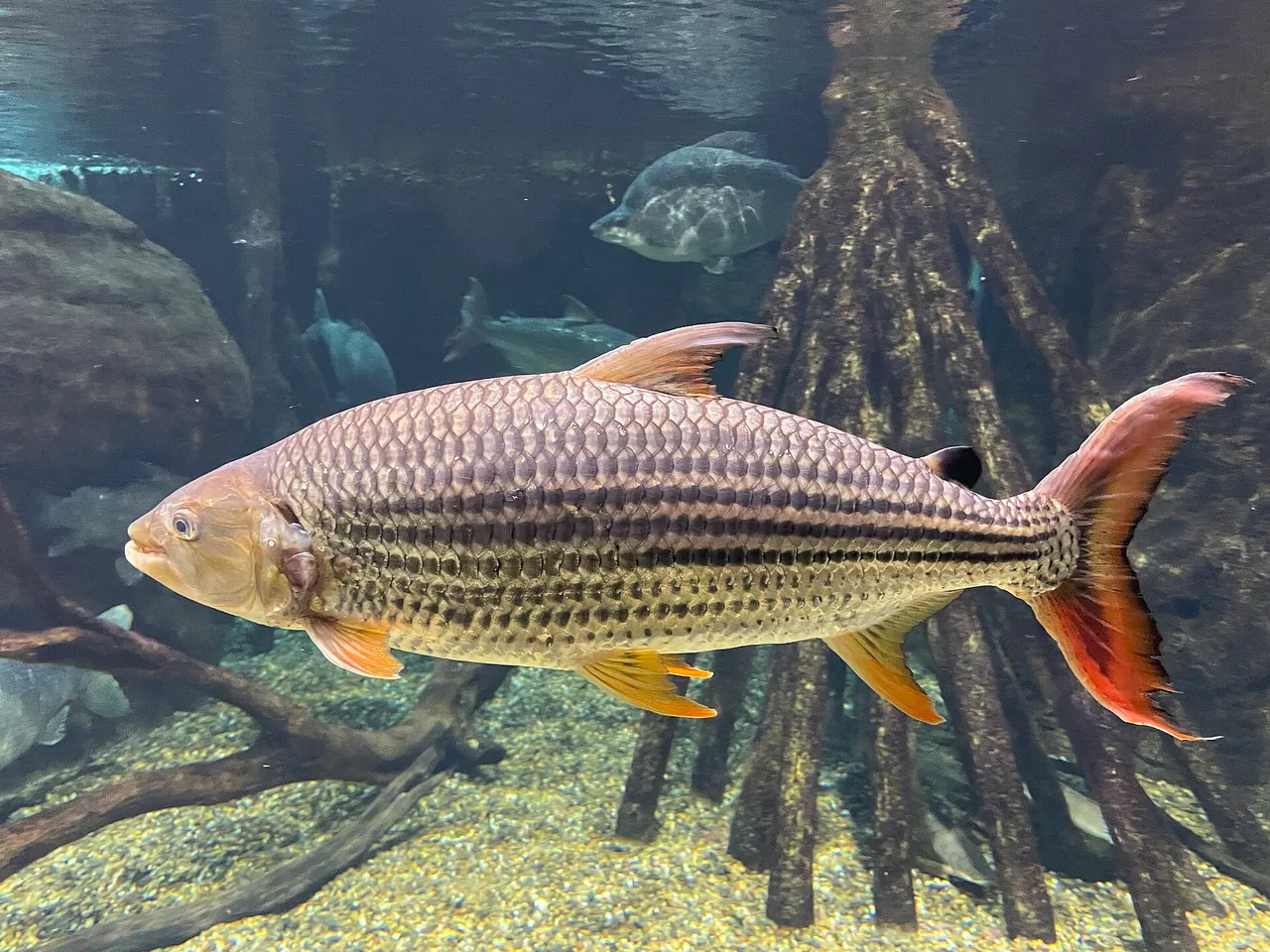
How this was identified, and who took it
Identified by: Full lateral view in an aquarium. The horizontal dark stripes along the flank, the red-orange fins, the deeply forked red tail and the adipose fin are all clear — the striping is what places it in Hydrocynus.Totti — CC BY-SA 4.0, via Wikimedia Commons — source, licenceWhat is known about how it feeds
The African tigerfish stops eating anything but fish at a size small enough to hold in one hand.
The shift is unusually sharp. Smaller individuals take shrimp and insects alongside fish; above roughly ninety to a hundred millimetres they are exclusive fish feeders, and they remain so for the rest of a life that reaches several kilograms. Most predators on FishingHQ shift gradually and never completely; this one crosses a line.
The verified relationship is characiform fishes, recorded at order level because that is the precision the evidence has. The species page names Brycinus and Micralestes among recorded prey — both African tetras, both Alestidae — and FishingHQ holds neither as a species page. Pointing the edge at some other small fish because one happened to exist would have been exactly the substitution FishingHQ refuses to make, so this names the group and says so.
Barbus and Limnothrissa also appear in the recorded diet and are not characiforms; they remain unmodelled.
It runs its prey down in open water instead of waiting in cover for it, which is unusual among large freshwater predators and is what the body is built for: deeply forked tail, streamlined section, and the interlocking conical teeth the species is named for. Those teeth grip and hold rather than shear, and the strike is made at speed into a shoal.
Water temperature governs activity, and the fish is a warm-water animal whose feeding falls away sharply as rivers cool.
The food
Prey with a verified dietary link to this fish. Each entry carries its own evidence, and each is written at the precision the source actually used: a named species where the source named one, a group or food category where it said “polychaetes”, “crustaceans” or “detritus” and meant it. That is why this list is shorter than the animal’s real diet rather than longer.
- Characiform fishes as prey — a group rather than a species: the evidence names the group
The tigerfish page names Brycinus and Micralestes among recorded prey. Both are Alestidae, the African characiform family, and FishingHQ holds neither as a species — so the edge is written at the order the evidence identifies rather than pointed at a substitute.
Food with no page of its own here yet
These are real components of the diet, listed as plain text because FishingHQ has no page for them yet. Inventing pages to make the list look fuller would be the fabrication this whole approach exists to prevent.
- Barbus species
- Limnothrissa and other small clupeids in lake populations
- Caridina shrimp, in smaller fish
- insects, in smaller fish
- smaller tigerfish (cannibalism)
What anglers do with this
Everything below is interpretation, not finding. It is what experienced anglers conclude from the biology above, and the reasoning is usually sound and almost never tested. It is separated from the biology deliberately.
The exclusive piscivory of adults is the reasoning behind fish-imitating presentations, and it is one of the safer inferences in this file because the alternative — that a large tigerfish might take something else — is contradicted by the record rather than merely unsupported.
The pursuit hunting in open water converts into a location argument that differs from most freshwater predator fishing: current seams, drop-offs and open channels rather than structure and cover.
The dentition is a mechanical fact with two consequences. Hook penetration into a hard bony mouth is difficult, which is why the species is known for dropped fish; and the teeth are dangerous to handle, which is not advice but a description.
The warm-water activity pattern converts into a season, and it is the reverse of the northern species on FishingHQ.
What this does not establish
One taxon-level relationship covering part of a recorded diet that also includes cyprinids and clupeids FishingHQ cannot represent. Nothing here establishes proportions. Composition differs substantially between river populations and the lake populations that feed on Limnothrissa, and the account describes adults rather than the invertebrate-feeding juvenile phase.
Where this connects
These are the baits, lures, methods and explainers FishingHQ already joins to this fish — which is why the list is sometimes short. They are not chosen for this page, and a link here means an evidenced relationship exists, not that it follows from the diet.
Where it lives
This page covers feeding. The African tigerfish record covers identification, lifecycle, seasonal behaviour, handling and the sources behind all of it.
Reviewed 2026-08-12.