Sailfish
Fish · Last reviewed 2026-08-10
The billfish with a sail — a dorsal fin taller than the fish is deep, raised when hunting, and probably the fastest accelerator in the ocean.
Safety: injury while handling fish — can cause serious injury or death. 5 more points apply here.
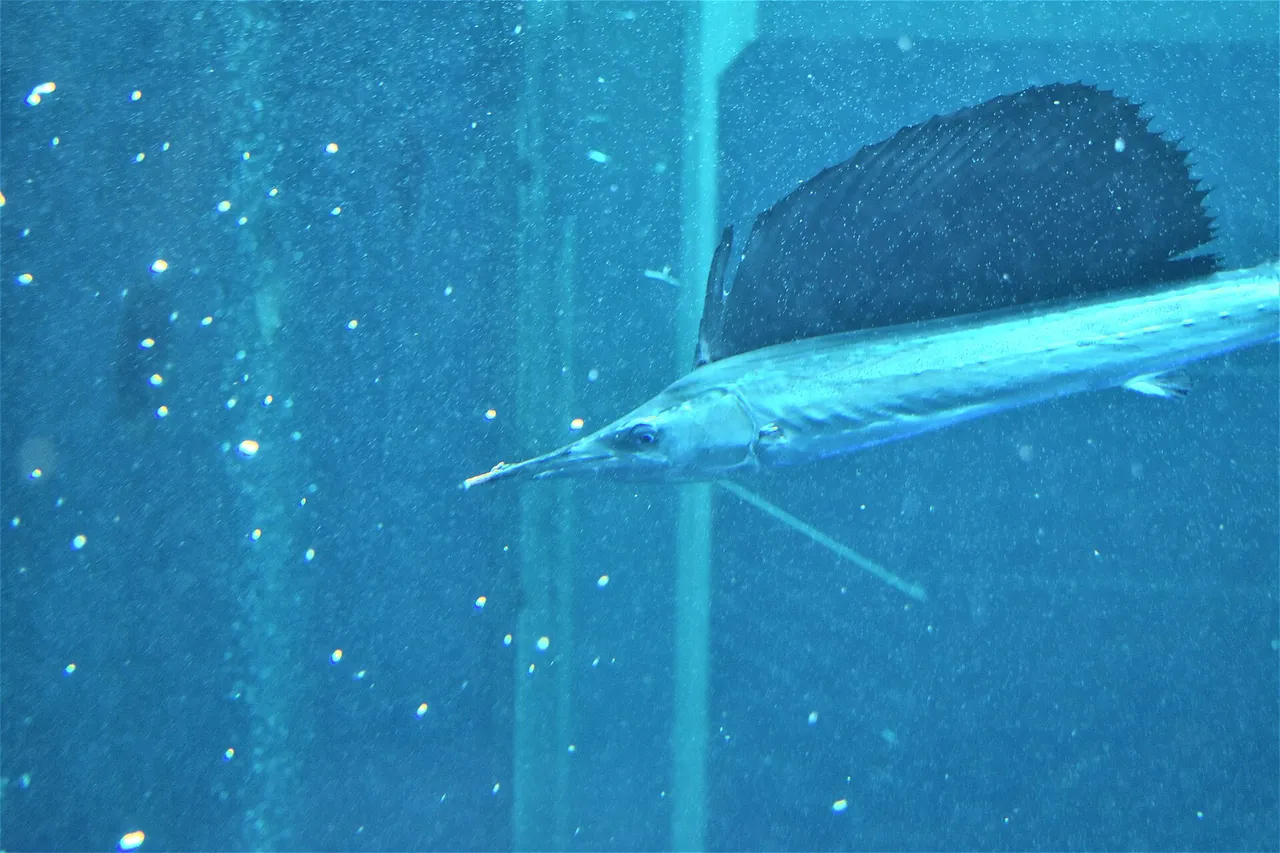
How this was identified, and who took it
Identified by: The sail dorsal is fully raised and taller than the body is deep, and the long rounded bill is clear — the two characters that separate a sailfish from any marlin. Rear body outside the frame; photographed in an aquarium.出羽雀台 — CC BY-SA 4.0, via Wikimedia Commons — source, licence
Catching Sailfish
Everything here on fishing for it. Each entry opens the page behind it.
- Where
- 1 place FishingHQ documents — strongest claim anywhere: repeatedly reported · On a charter, From a boat
The sailfish is the most recognisable billfish and the most accessible: smaller than marlin, more abundant, and found close enough inshore in several parts of the world to be reachable from a modest boat.
Its defining feature is the sail — a first dorsal fin far taller than the body is deep, normally folded into a groove and raised during hunting and display. Sailfish hunt cooperatively, using the raised sail to herd and confuse baitfish while they pick individuals off with the bill, and the behaviour has been filmed often enough to be well documented. It is one of the clearer examples of coordinated hunting in fish.
Its speed is frequently overstated in popular accounts, where figures are quoted with a confidence the underlying measurements do not support. What is not in doubt is that it accelerates extraordinarily fast and that it is among the fastest fish in the sea. FishingHQ states that rather than repeating a number whose provenance nobody can produce.
Recreationally it is a premier light-tackle big-game target, most often fished with kites, live bait and trolled dead bait, and is now overwhelmingly a tag-and-release fishery — a shift the sport made largely on its own initiative.
Where Sailfish is documented
Places where public sources describe this species as fished, with how it is fished and how strongly the evidence supports it. This is not a range map and it is not a recommendation — it is what has been written down about a fishery rather than a record of any individual catch, and being listed is never permission to fish.
What these strengths mean
- Repeatedly reported
- Several independent public accounts. Enough to say it happens more than once; not enough to call it a fishery.
Identification
- Scientific name
- Istiophorus platypterus
- Family
- Istiophoridae
- Water
- Saltwater
- Conservation status
- Vulnerable
- Regions
- Global, Caribbean, North America, Central & South America, Indo-Pacific, East & Southern Africa, West Africa, Australia, Mediterranean, Pacific Islands
- An enormous first dorsal fin, far taller than the body depth, folding into a groove along the back — unmistakable and shared with no other billfish.
- A long, rounded bill, shorter relative to body length than a marlin's.
- Dark blue above with pale vertical bars of blue spots on the flanks, which flash and intensify when the fish is excited.
- Body slender and compressed; long pelvic fins that also fold into grooves.
- Separated from marlin by the sail and by body proportion rather than by size, since small marlin overlap in weight.
Size
- Typical
- 15–25 kg (33–55 lb)
- Large
- 30–45 kg (66–99 lb)
Exceptional: Over 55 kg (121 lb); maximum published weight 100 kg
Above the thermocline, and never far from the edge
Sailfish are epipelagic and oceanic but they are the most coastal of the billfishes, and both halves of that matter.
THEY LIVE IN THE WARM SURFACE LAYER, above the thermocline, and are strongly limited by it: the species has a low tolerance for cold, low-oxygen water beneath, so a shallow thermocline compresses the habitable layer and concentrates the fish in it. That compression is why particular coasts produce exceptional sailfish concentrations.
THEY ASSOCIATE WITH THE SHELF EDGE AND WITH STRUCTURE, more than marlin do — drop-offs, banks, current edges, and the boundaries between water masses. A sailfish ground is usually a place where deep water comes close to something, rather than open blue water.
CURRENT FRONTS AND UPWELLING SUPPLY THE PREY. Sailfish hunt small schooling fish and squid, and they are found where those are concentrated: colour changes, weed lines, temperature breaks and areas of localised upwelling.
THE SPECIES IS HIGHLY MOBILE WITHIN THAT ENVELOPE, covering long distances, so habitat here means a set of conditions rather than a territory.
AND JUVENILES OCCUPY THE SAME SURFACE LAYER but tend to be found in warmer, more equatorial parts of the range, with larger fish ranging further into subtropical water as the season allows.
Backed by research — why, and the sources (2)
Supported by peer-reviewed research or fisheries science. The sources are listed and can be checked.
- FAO Species Identification Guides for Fishery Purposes and the FAO Species Catalogues — Food and Agriculture Organization of the United Nations (Scientific institute)Relied on for: Distribution, habitat, depth and fishery accounts for the species in the FAO regional identification guides for the ocean area concerned.States this directlyCitation checked — the work exists and is described correctly
- FishBase: a global information system on fishes — Froese, R. and D. Pauly, eds. — FishBase Consortium (Scientific institute)Relied on for: Distribution, habitat association, depth range, size, reproduction and life-history parameters recorded for the species.States this directlyPassage read and verified
Pairing at the surface, and a very fast start to life
Sailfish reproduction is a warm-water, high-volume, no-investment strategy, with one behaviour that is genuinely distinctive.
SPAWNING PAIRS AND GROUPS FORM AT THE SURFACE. Females are frequently accompanied by one or more smaller males, swimming close alongside near the surface, and spawning occurs in that formation in warm oceanic water. It is one of the more observable billfish behaviours and it is documented from both boats and the air.
SPAWNING IS BATCH AND PROLONGED. Females release eggs in multiple batches over an extended season, with fecundity in the millions, and in the warmer parts of the range spawning may occur across much of the year rather than in a narrow window.
EGGS AND LARVAE ARE PELAGIC AND GROWTH IS EXTREMELY FAST. Sailfish larvae grow at among the highest rates recorded for any teleost, and juveniles reach substantial size within their first year. That speed is the species' answer to enormous early mortality.
MATURITY IS EARLY, at a young age relative to the fish's eventual size, which is part of why sailfish stocks are generally in better condition than the slower-maturing marlins.
THERE IS NO NEST, NO SITE FIDELITY AND NO PARENTAL CARE.
AND THE VULNERABILITY IS IN THE AGGREGATION RATHER THAN THE SPAWNING. Sailfish concentrate to feed on bait balls, not to reproduce, so the fishery's pressure falls on feeding aggregations — which is a different management problem from that of a reef species gathering to spawn.
Backed by research — why, and the sources (2)
Supported by peer-reviewed research or fisheries science. The sources are listed and can be checked.
- FAO Species Identification Guides for Fishery Purposes and the FAO Species Catalogues — Food and Agriculture Organization of the United Nations (Scientific institute)Relied on for: Distribution, habitat, depth and fishery accounts for the species in the FAO regional identification guides for the ocean area concerned.States this directlyCitation checked — the work exists and is described correctly
- FishBase: a global information system on fishes — Froese, R. and D. Pauly, eds. — FishBase Consortium (Scientific institute)Relied on for: Distribution, habitat association, depth range, size, reproduction and life-history parameters recorded for the species.States this directlyPassage read and verified
Seasons made by upwelling and by bait, not by temperature alone
Sailfish are present in warm water year-round across much of their range, so a sailfish season is about concentration rather than presence.
THE FISH GATHER WHERE BAIT IS CONCENTRATED, and bait concentrates seasonally. The great sailfish grounds have seasons because a seasonal process — upwelling, a current shift, a bait migration — packs prey into a small area for a few months. Remove the concentration and the sailfish are still there, spread out and uncatchable.
SO THE DRIVER IS FREQUENTLY WIND OR CURRENT RATHER THAN WARMTH. On several coasts the season coincides with a period of persistent wind driving upwelling or pushing bait against a shelf edge, and the fishing follows the wind more closely than it follows the thermometer.
THERMOCLINE DEPTH IS THE OTHER SEASONAL VARIABLE. When the thermocline shallows, the habitable surface layer thins and the fish are compressed into it, which raises encounter rates without any change in abundance.
SEASONS DIFFER BY COAST AND BY HEMISPHERE, and the same ocean can have peak sailfish fishing at opposite times of year on its two sides.
AND YEAR-TO-YEAR VARIABILITY IS HIGH. Because the drivers are oceanographic, a season can arrive early, late, weak or not at all, and any account offering fixed months for this species is describing an average rather than a prediction.
Backed by research — why, and the sources (2)
Supported by peer-reviewed research or fisheries science. The sources are listed and can be checked.
- FAO Species Identification Guides for Fishery Purposes and the FAO Species Catalogues — Food and Agriculture Organization of the United Nations (Scientific institute)Relied on for: Distribution, habitat, depth and fishery accounts for the species in the FAO regional identification guides for the ocean area concerned.States this directlyCitation checked — the work exists and is described correctly
- FishBase: a global information system on fishes — Froese, R. and D. Pauly, eds. — FishBase Consortium (Scientific institute)Relied on for: Distribution, habitat association, depth range, size, reproduction and life-history parameters recorded for the species.States this directlyPassage read and verified
A bill at head height, and a fish too fragile for the deck
Sailfish handling has a hazard to the angler and a hazard to the fish and they point in the same direction: the fish should stay in the water.
THE BILL IS THE DANGER. A sailfish brought alongside is a metre-plus of fish with a rigid pointed bill attached, thrashing at chest height beside a moving boat. Billfish have injured and killed people, almost always at the boat, almost always when somebody was leaning over. The person on the leader has a specific job and everybody else should be clear.
SO THE FISH IS NEVER LIFTED ABOARD. Standard practice in this fishery is a boat-side release: the leader is taken, the fish is controlled beside the boat, the hook is removed or the leader cut close, and the fish is revived alongside. Bringing a live billfish onto a deck is dangerous and unnecessary.
THE FISH IS ALSO GENUINELY FRAGILE. Sailfish fight at extreme intensity and arrive physiologically exhausted. Handling them out of water, or holding them for photographs, produces high release mortality. Circle hooks are standard in this fishery and are used because they lodge in the jaw rather than deep, which is the single largest determinant of whether a released billfish survives.
REVIVAL IS AN ACTIVE PROCESS. The boat moves slowly forward with the fish held alongside so that water flows over the gills, until the fish takes hold and swims off. That may take several minutes and it is the part of the release that actually matters.
AND THE COLOUR CHANGE PEOPLE PHOTOGRAPH is a stress response. It is not a sign the fish is doing well.
Official guidance — why, and the sources (3)
Stated by a fisheries authority, scientific institute or recognised angling body. Authoritative, but summarising rather than demonstrating.
- IGFA International Angling Rules and World Record Requirements — International Game Fish Association (Angling or fisheries organisation)Relied on for: Standard billfish release practice, including boat-side release, circle hook use and active revival.Background and mechanism onlyPassage read and verified
- Do we need species-specific guidelines for catch-and-release recreational angling? — Biodiversity and Conservation 14:1195–1209, 2005 (Scientific literature)Relied on for: That post-release mortality varies with species, capture depth, water temperature, air exposure and handling, and that species-specific guidance outperforms general guidance.States this directlyCitation checked — the work exists and is described correctly
- A review of catch-and-release angling mortality with implications for no-take reserves — Reviews in Fish Biology and Fisheries 15:129–154, 2005 (Scientific literature)Relied on for: Review of hooking and release mortality across fisheries, including the contribution of depth of capture and handling duration.States this directlyCitation checked — the work exists and is described correctly
Lifecycle and reproduction
Fast-growing and comparatively short-lived for a billfish, maturing within a few years and generally living around a decade. Spawns in warm water, with pelagic eggs and larvae. Growth in the first year is exceptionally rapid. The relatively fast life history is why sailfish stocks have proved more resilient than those of the larger, slower billfish.
Broadcast spawning in warm surface waters, often near the edges of currents, with very high fecundity and pelagic eggs and larvae. Juvenile growth is among the fastest recorded for any marine fish, which combined with high fecundity gives the species more capacity to absorb pressure than marlin have.
Feeding and senses
A cooperative hunter taking small schooling fish and squid, using the raised sail and the bill together to herd, confuse and strike prey. The bill is used to slash and stun rather than to spear. The coordinated group hunting is well documented and is one of the more remarkable behaviours in pelagic fish.
Sight-dominant, hunting fast-moving prey visually in the upper water column. The colour changes — bars and spots flashing brighter when the fish is hunting or excited — appear to function in coordination between individuals, which is consistent with the cooperative hunting and is visible to anglers when a fish comes up behind a bait.
Through the year
Follows warm water and bait concentrations, with local seasons defined by the arrival of suitable conditions rather than a date, and opposite between hemispheres. Current edges, temperature fronts and bait concentrations govern where fish are on any given day, which is why the search is for conditions rather than for a place.
Distribution
Circumglobal in tropical and subtropical waters of the Atlantic, Indian and Pacific oceans, including the Mediterranean, generally in the upper water column above the thermocline and often near coasts where the shelf is narrow.
This is a biological range — where the species occurs, not a prediction that you will catch one. To browse the fishing geography FishingHQ holds, start at fishing places.
Why anglers care
A premier light-tackle big-game species, fished with kites, live bait, trolled dead bait and increasingly on fly. The fishery is overwhelmingly tag-and-release, a change driven substantially from within the sport, and it supports significant angling tourism in several regions. Circle hooks are required or strongly recommended in many fisheries for release survival.
Handling and returning
Handle in the water and never lift a billfish by the bill alone — the weight damages the fish. Hold the bill to control the fish, support the body, keep it in the water and revive it by moving it forward to pass water over the gills. Circle hooks and a short fight materially improve survival. The bill itself is a hazard to people at boatside, and a green billfish beside a boat is dangerous.
Going further
- What does sailfish eat? — feeding biology, kept separate from what anglers infer from it.
Safety
Injury while handling fish — Can cause serious injury or death
A long, hard bill on a powerful fish thrashing beside a boat. Billfish have injured and occasionally killed people, and the danger is greatest when a green fish is brought to the boat too early.
What reduces it: Do not bring a green fish to the boat. Control the bill with a gloved hand from behind, never in front. Nobody in the water with a billfish alongside. Agree roles before the fish arrives and clear the deck.
Line under tension — Can cause serious injury or death
Big-game tackle at load, with leader work at boatside being where injuries occur.
What reduces it: Nobody stands in the line's path or behind a leader being handled. Gloves, and a wireman prepared to let go. Inspect connections regularly.
Precautions that always apply here
- Wear a buoyancy aid or lifejacket. Cold water incapacitates strong swimmers within a minute, long before swimming ability matters.
- Support the fish's weight along its body, keep it out of the water for as short a time as possible, and hold it over something soft.
- Tell somebody where you are going and when you expect to be back.
- Carry a charged phone in a waterproof case, or another means of calling for help.
Check the rules before you fish
Fishing laws, bylaws, access rules, seasons, bait restrictions and permitted methods vary by location and can change. Check the current rules from the relevant authority and the water you intend to fish before fishing.
Check with:
- Current national or regional law for where you are fishing
- Current local bylaws
- The relevant fisheries authority
- The landowner, club or fishery whose water it is
- Any restrictions specific to the species or the method you intend to use
Where to go next
Similar and related fish
Where you will find it
- Cape VerdePresent in the offshore fishery alongside the marlin the islands are known for, and released as a matter of course. The release practice a crew uses is the thing worth asking about before booking.
- CubaOn the migration route through the Florida Straits and the Yucatán Channel, which is the reason the island has the deep-sea reputation and the literary history that it does.
- FloridaConcentrates along the Atlantic coast where the Gulf Stream and the shelf edge converge, in one of the best-known sailfish fisheries in the Atlantic.
- The Agulhas CurrentOccurs along the warm current edge, part of the tropical pelagic assemblage the system carries poleward.
- The West African coastOccurs offshore along the coast and is taken by both artisanal and sport fisheries where they reach that water.
- The western Indian Ocean coastConcentrates seasonally along parts of this coast, drawn by the eddies of the Mozambique Channel and the bait they hold.
- The Yucatán and Mexican Caribbean coastAlong the drop-off outside the barrier reef, concentrated by the northward current that runs along it and reachable within a short run of shore.
Understanding this fish
- Cephalopods as preySquid are taken alongside surface baitfish, and sailfish feeding at depth on squid is a recognised pattern distinct from the surface hunting they are known for.
- What actually happens to a released fishThe billfish fisheries moved to tag-and-release largely from within the sport, and circle hooks and short fights are the handling that makes it actually work.
Sources and evidence
- FishBase: a global information system on fishes — Froese, R. and D. Pauly, eds. — FishBase Consortium (Scientific institute)Relied on for: Scientific name, family placement in the Istiophoridae, a maximum length of 348 cm FL, a maximum published weight of 100.2 kg, a maximum reported age of 13 years.States this directlyPassage read and verified
- FishBase: a global information system on fishes — Froese, R. and D. Pauly, eds. — FishBase Consortium (Scientific institute)Relied on for: Environment, climate zone and depth range as recorded: Marine; pelagic-oceanic; oceanodromous ; depth range 0 - 200 m , usually 30 - ? m . Subtropical; 50°N - 43°S, 180°W - 180°EStates this directlyPassage read and verified
- FishBase: a global information system on fishes — Froese, R. and D. Pauly, eds. — FishBase Consortium (Scientific institute)Relied on for: The IUCN Red List category for Istiophorus platypterus — Vulnerable, assessed 01 May 2021 — as republished by FishBase, the Red List itself being unreachable during review.States this directlyPassage read and verified
- IGFA International Angling Rules and World Record Requirements — International Game Fish Association (Angling or fisheries organisation)Relied on for: The tackle classes, circle hook conventions and tag-and-release practice recognised in offshore big-game angling.States this directlyPassage read and verified
- Understanding the Complexity of Catch-and-Release in Recreational Fishing — Reviews in Fisheries Science 15:75–167, 2007 (Scientific literature)Relied on for: That hook type, fight duration and handling materially affect the survival of released fish, and that circle hooks reduce deep hooking.States this directlyCitation checked — the work exists and is described correctly
Why the 12 connections on this page are here, and the sources
Similar and related fish
Backed by research — 2 connections
Supported by peer-reviewed research or fisheries science. The sources are listed and can be checked.
Atlantic blue marlin
An identification comparison naming both binomials: Makaira nigricans and Istiophorus platypterus.
- FishBase: a global information system on fishes — Froese, R. and D. Pauly, eds. — FishBase Consortium (Scientific institute)Relied on for: Morphological and distributional data for Makaira nigricans and for Istiophorus platypterus.States this directlyPassage read and verified
- The IUCN Red List of Threatened Species — International Union for Conservation of Nature (Conservation authority)Relied on for: Separate assessments treating Makaira nigricans and Istiophorus platypterus as distinct species.States this directlyCitation checked — the work exists and is described correctly
Ballyhoo
Recorded diet evidence identifies Hemiramphus brasiliensis as a food item of this predator at species level. The edge is written at that granularity and no further.
- FishBase: a global information system on fishes — Froese, R. and D. Pauly, eds. — FishBase Consortium (Scientific institute)Relied on for: Food items recorded for this predator, including Hemiramphus brasiliensis.States this directlyPassage read and verified
- FAO Species Identification Guides for Fishery Purposes and the FAO Species Catalogues — Food and Agriculture Organization of the United Nations (Scientific institute)Relied on for: Species account describing the diet of this predator in the region where Hemiramphus brasiliensis occurs.Background and mechanism onlyCitation checked — the work exists and is described correctly
How it is caught
What experienced anglers do — 1 connection
Widely and independently recommended by experienced anglers and specialist sources. This is real angling knowledge, not proof: controlled evidence for it is limited, and FishingHQ records it as convention rather than as a demonstrated effect.
Kite fishing
A practitioner claim about the pairing of a method with the species it was refined around.
- IGFA International Angling Rules and World Record Requirements — International Game Fish Association (Angling or fisheries organisation)Relied on for: That kite fishing is a recognised angling method within the offshore rule framework, with conventions for release clips and live bait.Passage read and verified
- Sea Angler — Bauer Media (Specialist angling publication)Relied on for: Practitioner treatment of kite fishing technique for surface-feeding billfish.Citation checked — the work exists and is described correctly
Where you will find it
Backed by research — 7 connections
Supported by peer-reviewed research or fisheries science. The sources are listed and can be checked.
Cape Verde
A distribution edge resting on published regional identification and distribution references, written where the species is genuinely characteristic of the destination's fishing rather than merely recorded from its waters.
- FAO Species Identification Guides for Fishery Purposes and the FAO Species Catalogues — Food and Agriculture Organization of the United Nations (Scientific institute)Relied on for: Distribution, habitat association and biology of the fishes of the eastern central Atlantic and the Mediterranean, from the regional identification guides prepared for fishery purposes.States this directlyCitation checked — the work exists and is described correctly
- FishBase: a global information system on fishes — Froese, R. and D. Pauly, eds. — FishBase Consortium (Scientific institute)Relied on for: Recorded environment, depth range, distribution and biology of the species named.States this directlyPassage read and verified
Cuba
That a species occurs in these waters, drawn from distribution science. It is a statement about where the animal lives and is not a statement that anybody will catch one, still less where.
- FAO Species Identification Guides for Fishery Purposes and the FAO Species Catalogues — Food and Agriculture Organization of the United Nations (Scientific institute)Relied on for: Identification, distribution and habitat association of the fishes and invertebrates of the tropical region named.States this directlyCitation checked — the work exists and is described correctly
- FishBase: a global information system on fishes — Froese, R. and D. Pauly, eds. — FishBase Consortium (Scientific institute)Relied on for: Recorded distribution, depth range and habitat association of the species named, including its occurrence in the waters concerned.States this directlyPassage read and verified
Florida
A distribution association between an animal and a kind of water, rather than a claim about any named mark.
- NOAA National Ocean Service education on estuaries and the National Estuarine Research Reserve System — National Oceanic and Atmospheric Administration, United States (Government fisheries body)Relied on for: Estuarine, seagrass and coastal habitat function in North American waters, and the nursery role of shallow habitat for the species concerned.Background and mechanism onlyCitation checked — the work exists and is described correctly
- FishBase: a global information system on fishes — Froese, R. and D. Pauly, eds. — FishBase Consortium (Scientific institute)Relied on for: Distribution, habitat association, depth range and life history recorded for the species.States this directlyPassage read and verified
The Agulhas Current
A distribution association between an animal and a kind of water, rather than a claim about any named mark.
- FAO Species Identification Guides for Fishery Purposes and the FAO Species Catalogues — Food and Agriculture Organization of the United Nations (Scientific institute)Relied on for: Distribution, habitat, depth and fishery accounts for the species in the FAO regional identification guides for the ocean area concerned.States this directlyCitation checked — the work exists and is described correctly
- FishBase: a global information system on fishes — Froese, R. and D. Pauly, eds. — FishBase Consortium (Scientific institute)Relied on for: Distribution, habitat association and depth range recorded for the species.States this directlyPassage read and verified
The West African coast
A distribution association between an animal and a kind of water, rather than a claim about any named mark.
- FAO Species Identification Guides for Fishery Purposes and the FAO Species Catalogues — Food and Agriculture Organization of the United Nations (Scientific institute)Relied on for: Distribution, habitat, depth and fishery accounts for the species in the FAO regional identification guides for the ocean area concerned.States this directlyCitation checked — the work exists and is described correctly
- FishBase: a global information system on fishes — Froese, R. and D. Pauly, eds. — FishBase Consortium (Scientific institute)Relied on for: Distribution, habitat association and depth range recorded for the species.States this directlyPassage read and verified
The western Indian Ocean coast
A distribution association between an animal and a kind of water, rather than a claim about any named mark.
- FAO Species Identification Guides for Fishery Purposes and the FAO Species Catalogues — Food and Agriculture Organization of the United Nations (Scientific institute)Relied on for: Distribution, habitat, depth and fishery accounts for the species in the FAO regional identification guides for the ocean area concerned.States this directlyCitation checked — the work exists and is described correctly
- FishBase: a global information system on fishes — Froese, R. and D. Pauly, eds. — FishBase Consortium (Scientific institute)Relied on for: Distribution, habitat association and depth range recorded for the species.States this directlyPassage read and verified
The Yucatán and Mexican Caribbean coast
That a species occurs in these waters, drawn from distribution science. It is a statement about where the animal lives and is not a statement that anybody will catch one, still less where.
- FAO Species Identification Guides for Fishery Purposes and the FAO Species Catalogues — Food and Agriculture Organization of the United Nations (Scientific institute)Relied on for: Identification, distribution and habitat association of the fishes and invertebrates of the tropical region named.States this directlyCitation checked — the work exists and is described correctly
- FishBase: a global information system on fishes — Froese, R. and D. Pauly, eds. — FishBase Consortium (Scientific institute)Relied on for: Recorded distribution, depth range and habitat association of the species named, including its occurrence in the waters concerned.States this directlyPassage read and verified
Understanding this fish
Backed by research — 1 connection
Supported by peer-reviewed research or fisheries science. The sources are listed and can be checked.
Cephalopods as prey
Recorded diet evidence identifies cephalopods as a food item of this predator at group level rather than to species. The edge points at the taxon record for that reason, and encoding it as a species-level claim would assert something the source does not.
- FishBase: a global information system on fishes — Froese, R. and D. Pauly, eds. — FishBase Consortium (Scientific institute)Relied on for: Food items recorded for this predator, given as cephalopods.States this directlyPassage read and verified
- FAO Species Identification Guides for Fishery Purposes and the FAO Species Catalogues — Food and Agriculture Organization of the United Nations (Scientific institute)Relied on for: Species account describing this predator's diet, recorded at the level of cephalopods.Background and mechanism onlyCitation checked — the work exists and is described correctly
Official guidance — 1 connection
Stated by a fisheries authority, scientific institute or recognised angling body. Authoritative, but summarising rather than demonstrating.
What actually happens to a released fish
A release-survival claim held above practitioner level because it justifies a change in practice.
- Understanding the Complexity of Catch-and-Release in Recreational Fishing — Reviews in Fisheries Science 15:75–167, 2007 (Scientific literature)Relied on for: That hook type, fight duration and handling materially affect the survival of released fish, and that circle hooks reduce deep hooking.States this directlyCitation checked — the work exists and is described correctly
- IGFA International Angling Rules and World Record Requirements — International Game Fish Association (Angling or fisheries organisation)Relied on for: That tag-and-release and circle hook practice are recognised within the sport's own rule framework.FishingHQ's interpretation of what it saysPassage read and verified
How FishingHQ labels evidence is explained in the evidence policy.