What does sailfish eat?
What is established about how sailfish feeds, kept separate from what anglers infer from it.
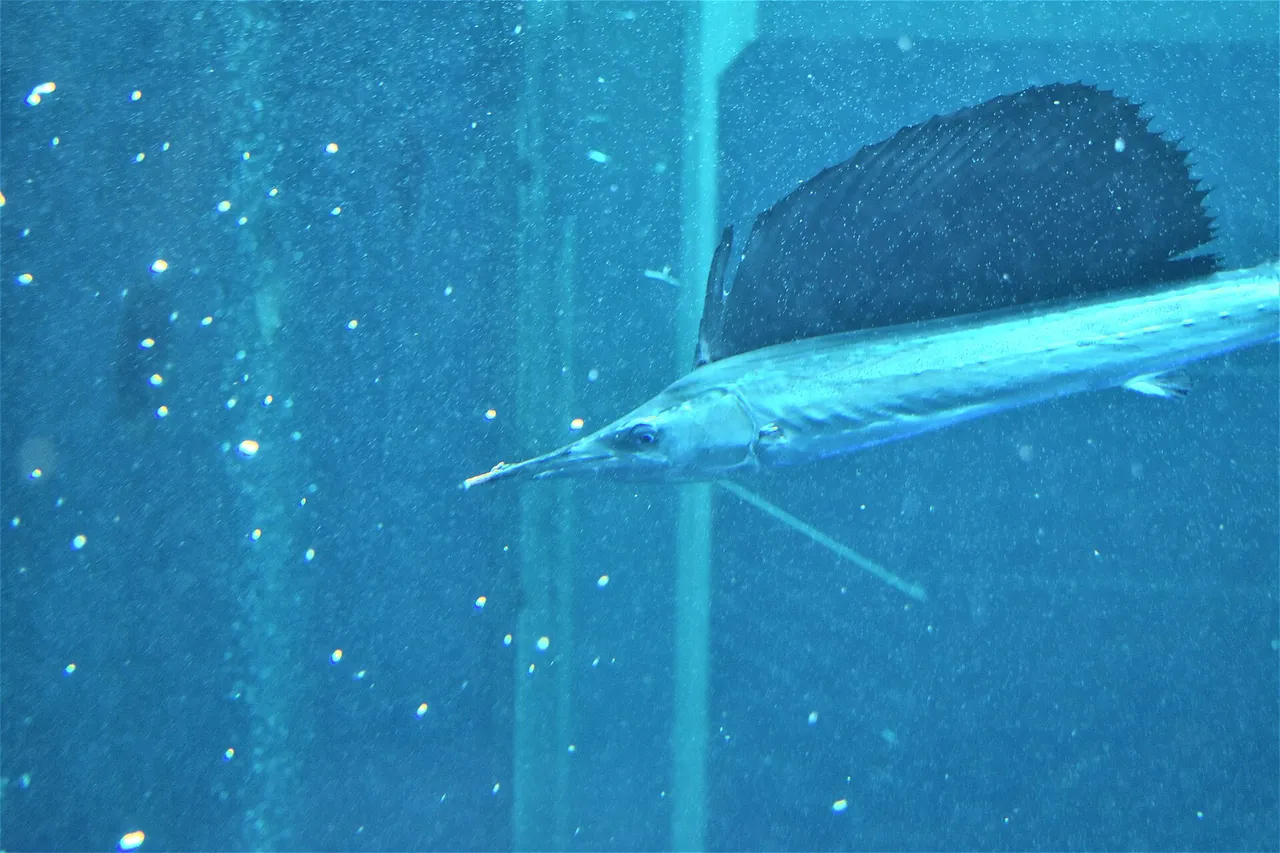
How this was identified, and who took it
Identified by: The sail dorsal is fully raised and taller than the body is deep, and the long rounded bill is clear — the two characters that separate a sailfish from any marlin. Rear body outside the frame; photographed in an aquarium.出羽雀台 — CC BY-SA 4.0, via Wikimedia Commons — source, licenceWhat is known about how it feeds
The sail is a hunting tool, and the diet is what it is used to obtain.
Sailfish hunt cooperatively, working in groups to separate individuals from a bait shoal. The dorsal fin is raised during the attack, which is thought to make the fish appear larger and to help herd and confuse prey, and the bill is used to slash and stun rather than to spear. Stunned prey is then picked up.
That is one of the more sophisticated hunting behaviours in the ocean and it is well documented rather than inferred.
The two verified relationships describe both halves of the diet. Ballyhoo — the surface halfbeak of the tropical western Atlantic — is a principal prey, and it is worth noting that its status as the standard rigged offering in the region follows from this relationship rather than establishing it. Cephalopods, recorded at group level, are taken at depth and at night, which is a separate feeding mode from the surface hunting the species is known for.
Sailfish are among the fastest fish in the ocean over short distances, and the whole physiology serves the same purpose: locate a bait shoal, arrive quickly, and use the bill and the sail to break it up.
The fish grows fast and does not live long — a decade or so — which is a different life-history strategy from the slow-growing giants elsewhere on FishingHQ.
The food
Prey with a verified dietary link to this fish. Each entry carries its own evidence, and each is written at the precision the source actually used: a named species where the source named one, a group or food category where it said “polychaetes”, “crustaceans” or “detritus” and meant it. That is why this list is shorter than the animal’s real diet rather than longer.
- Ballyhoo — Hemiramphus brasiliensis
Ballyhoo are a principal sailfish prey in the tropical western Atlantic, and the species' status as the standard rigged trolling bait there follows from this relationship rather than establishing it.
- Cephalopods as prey — a group rather than a species: the evidence names the group
Squid are taken alongside surface baitfish, and sailfish feeding at depth on squid is a recognised pattern distinct from the surface hunting they are known for.
Food with no page of its own here yet
These are real components of the diet, listed as plain text because FishingHQ has no page for them yet. Inventing pages to make the list look fuller would be the fabrication this whole approach exists to prevent.
- sardines and anchovies
- small jacks and mackerel
- flying fish
- needlefish
What anglers do with this
Everything below is interpretation, not finding. It is what experienced anglers conclude from the biology above, and the reasoning is usually sound and almost never tested. It is separated from the biology deliberately.
The bill-slashing behaviour is the reason a sailfish frequently strikes an offering without taking it, and anglers respond by allowing the fish to return for the stunned prey before applying pressure. That convention follows directly from documented hunting behaviour and is one of the better-grounded pieces of big-game practice.
The cooperative hunting converts into an expectation that a raised sail or a single fish indicates a group, and into multiple-presentation approaches.
The deep and nocturnal cephalopod feeding explains fish that are present but not at the surface.
Sailfish are overwhelmingly released, and the handling standards — keeping the fish in the water, supporting it, minimising fight duration — are the fishery's own convention and increasingly a regulatory requirement.
What this does not establish
The cephalopod relationship is group-level. Two relationships for a broad pelagic diet that varies with region and with what is locally concentrated. The account describes the Atlantic population. Nothing here establishes proportions.
Where this connects
These are the baits, lures, methods and explainers FishingHQ already joins to this fish — which is why the list is sometimes short. They are not chosen for this page, and a link here means an evidenced relationship exists, not that it follows from the diet.
Methods used for it
The science behind the feeding
This page covers feeding. The Sailfish record covers identification, lifecycle, seasonal behaviour, handling and the sources behind all of it.
Reviewed 2026-08-12.