Ballyhoo
Fish · Last reviewed 2026-08-11
A surface-schooling halfbeak of warm Atlantic waters with a greatly elongated lower jaw, and the standard prey and trolling bait of the tropical western Atlantic.
Background, not a fishing profile
This page is here so FishingHQ can describe a biological relationship accurately — usually because a fish covered elsewhere on the site feeds on this. It covers what it is, where it lives and the evidence behind that relationship, and deliberately nothing about methods, bait or tackle. Its presence here is not a statement that anybody fishes for it.
The ballyhoo is a halfbeak: a slender surface fish whose lower jaw extends into a long beak while the upper jaw remains short, giving it an unmistakable profile.
It schools at the surface in clear warm water over reefs and in open water, feeding on seagrass fragments, algae and small planktonic animals. When threatened it skips across the surface in long low leaps, which is what makes a ballyhoo school visible from a distance and what makes it so attractive to fast surface predators.
Sailfish, dolphinfish, king mackerel, barracuda and wahoo all feed on ballyhoo heavily, and the species is the single most widely used rigged trolling bait in the tropical western Atlantic — a status that follows directly from the diet relationship rather than being independent of it.
The record exists so that the diets of Atlantic sailfish, dolphinfish and great barracuda can name their prey rather than describe it.
Identification
No photograph of Ballyhoo has passed identity review yet, so none is shown. A photograph is published only once somebody has checked the animal in it against the diagnostic features described on this page.
- Scientific name
- Hemiramphus brasiliensis
- Family
- Hemiramphidae
- Water
- Saltwater
- Conservation status
- Least Concern
- Regions
- Caribbean, North America, Central & South America, West Africa
- Greatly elongated lower jaw forming a beak, with a short upper jaw — the defining halfbeak character.
- The tip of the beak is bright orange or red in life, fading rapidly after death.
- Slender silver body with a blue-green back and a broad silver lateral band.
- Lower lobe of the tail fin distinctly longer than the upper, which drives its skipping surface escape.
Size
- Typical
- 20–30 cm
- Large
- up to about 40 cm
Lifecycle and reproduction
Short-lived and fast-growing, maturing within the first year and rarely living beyond three or four. Populations turn over rapidly and are strongly seasonal in the northern part of the range.
Spawns through much of the year in warm water, producing eggs bearing filaments that entangle in floating weed and seagrass, which is the species' nursery.
Feeding and senses
Feeds at and just below the surface on seagrass and algal fragments together with small planktonic crustaceans and larvae. It is largely herbivorous, which is unusual for so widely eaten a baitfish.
Vision dominates, with eyes positioned for surface feeding. The long lower jaw acts partly as a sensory and skimming structure at the surface film.
Through the year
Present year-round in the tropics and seasonally abundant at the northern edge of the range, moving with warm water. Schools concentrate along weed lines and reef edges.
Distribution
The western Atlantic from Florida and the Gulf of Mexico through the Caribbean to Brazil, and in the eastern Atlantic off West Africa, in clear warm surface waters over reefs and seagrass.
This is a biological range — where the species occurs, not a prediction that you will catch one. To browse the fishing geography FishingHQ holds, start at fishing places.
Why anglers care
Not a sport fish. It is caught by anglers and bait suppliers with cast nets and fine-mesh nets over chum, and is the standard rigged trolling bait of the region. That use rests on the predation relationship rather than establishing it.
Handling and returning
Fragile and quick to lose condition; ballyhoo used as bait are handled minimally and kept iced or brined. The beak is easily broken and a broken beak spoils a rigged bait.
Where to go next
Similar and related fish
- Great barracudaBarracuda take ballyhoo at the surface over reef and grass ground, and this species-level record replaces an approximate connection that was written and then withdrawn.
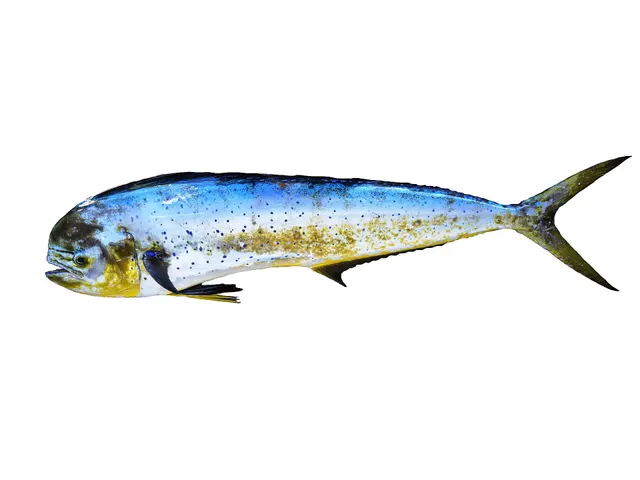 Mahi-mahiBallyhoo are a principal prey around weed lines and floating structure, which is where both species concentrate.
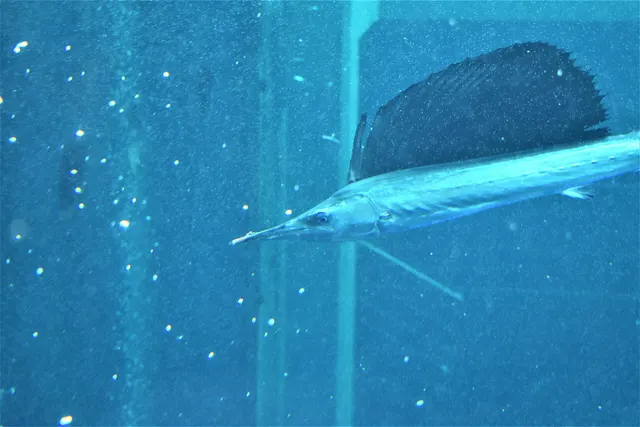 SailfishBallyhoo are a principal sailfish prey in the tropical western Atlantic, and the species' status as the standard rigged trolling bait there follows from this relationship rather than establishing it.
More fish
Not related to this page — just the rest of the section. There is little else joined to this subject yet, and a short page should still lead somewhere.
Sources and evidence
- FishBase: a global information system on fishes — Froese, R. and D. Pauly, eds. — FishBase Consortium (Scientific institute)Relied on for: Species identity, binomial, family placement, size, distribution and recorded biology for this species.States this directlyPassage read and verified
- FAO Species Identification Guides for Fishery Purposes and the FAO Species Catalogues — Food and Agriculture Organization of the United Nations (Scientific institute)Relied on for: The regional species account describing identity, distribution and the role of this species in the fisheries and food webs it belongs to.States this directlyCitation checked — the work exists and is described correctly
Why the 3 connections on this page are here, and the sources
Similar and related fish
Backed by research — 3 connections
Supported by peer-reviewed research or fisheries science. The sources are listed and can be checked.
Great barracuda
Recorded diet evidence identifies Hemiramphus brasiliensis as a food item of this predator at species level. The edge is written at that granularity and no further.
- FishBase: a global information system on fishes — Froese, R. and D. Pauly, eds. — FishBase Consortium (Scientific institute)Relied on for: Food items recorded for this predator, including Hemiramphus brasiliensis.States this directlyPassage read and verified
- FAO Species Identification Guides for Fishery Purposes and the FAO Species Catalogues — Food and Agriculture Organization of the United Nations (Scientific institute)Relied on for: Species account describing the diet of this predator in the region where Hemiramphus brasiliensis occurs.Background and mechanism onlyCitation checked — the work exists and is described correctly
Mahi-mahi
Recorded diet evidence identifies Hemiramphus brasiliensis as a food item of this predator at species level. The edge is written at that granularity and no further.
- FishBase: a global information system on fishes — Froese, R. and D. Pauly, eds. — FishBase Consortium (Scientific institute)Relied on for: Food items recorded for this predator, including Hemiramphus brasiliensis.States this directlyPassage read and verified
- FAO Species Identification Guides for Fishery Purposes and the FAO Species Catalogues — Food and Agriculture Organization of the United Nations (Scientific institute)Relied on for: Species account describing the diet of this predator in the region where Hemiramphus brasiliensis occurs.Background and mechanism onlyCitation checked — the work exists and is described correctly
Sailfish
Recorded diet evidence identifies Hemiramphus brasiliensis as a food item of this predator at species level. The edge is written at that granularity and no further.
- FishBase: a global information system on fishes — Froese, R. and D. Pauly, eds. — FishBase Consortium (Scientific institute)Relied on for: Food items recorded for this predator, including Hemiramphus brasiliensis.States this directlyPassage read and verified
- FAO Species Identification Guides for Fishery Purposes and the FAO Species Catalogues — Food and Agriculture Organization of the United Nations (Scientific institute)Relied on for: Species account describing the diet of this predator in the region where Hemiramphus brasiliensis occurs.Background and mechanism onlyCitation checked — the work exists and is described correctly
How FishingHQ labels evidence is explained in the evidence policy.