The Strait of Gibraltar
Fishing regions · Last reviewed 2026-08-14
Fourteen kilometres between two continents, where Atlantic water flows in on the surface and Mediterranean water flows out beneath it, and where tuna have been intercepted in fixed traps for three thousand years.
Safety: boat traffic and being seen — can cause serious injury or death. 2 more points apply here.
Being listed here is not permission to fish. What that meansClose
Access, fishing rights, seasons, licences, local bylaws and permitted methods vary and can change. Check current access, permission, local regulations, closures and restrictions before you travel or fish. FishingHQ describes what the ground is and names who holds the answer; it does not hold the answer itself.
Find the authority for a jurisdiction · What FishingHQ does and does not cover
The Strait of Gibraltar is the feature-tier record an earlier pass built to test whether the tier travels outside north-west Europe, and it earns the place on hydrography and on documented history in equal measure.
TWO WATER MASSES MOVE IN OPPOSITE DIRECTIONS AT ONCE. The Mediterranean loses more water to evaporation than its rivers and rainfall supply, so it is saltier and denser than the Atlantic. The result is a two-layer exchange: less saline Atlantic water flows in at the surface, and denser Mediterranean water flows out beneath it. The strait is one of the clearest examples of this arrangement anywhere.
THE SILL FORCES THE INTERACTION. A shallow ridge across the strait constrains the outflow, and the interaction between the two layers over it generates enormous internal waves — some of the largest measured anywhere — along with strong surface currents, tidal modulation and areas of visibly disturbed water.
THAT MIXING CONCENTRATES LIFE. Nutrients are brought towards the surface and prey is concentrated, which is why the strait is a feeding as well as a transit route.
AND IT IS A MIGRATORY BOTTLENECK. Atlantic bluefin tuna pass through in both directions on their spawning migration, and so do other large pelagics and cetaceans. A migratory route fourteen kilometres wide is the most interceptable piece of water in the region, which is precisely why the almadraba trap fishery grew here and has operated, in recognisable form, since antiquity.
What fishing here is like
A narrow strait between two continents where Atlantic and Mediterranean water exchange in two layers over a shallow sill, generating powerful currents, large internal waves and intense mixing. It is a migratory bottleneck for bluefin tuna and other large pelagics, and the site of a fixed-trap tuna fishery documented since antiquity. Shore fishing works the rocky margins on both sides, small-boat and charter fishing works the current lines, and the water carries some of the heaviest shipping traffic in the world.
What dominates
Almadraba trap fishing for bluefin tuna, a fixed-net fishery of great antiquity operating on the Atlantic approaches to the strait. Small-boat and charter fishing on the current lines for tuna, bonito, amberjack and dentex. Shore fishing from the rocky margins and harbour structures for seabream, mullet and passing pelagics. Trolling and drifting along the tide lines and shear zones. Artisanal line and net fishing from both coasts. Cetacean watching, which is a substantial industry in the same water and constrains vessel behaviour.
The water available
A narrow strait around fourteen kilometres wide at its narrowest, with a shallow sill across it and deeper basins either side; a two-layer exchange flow with Atlantic water entering at the surface and Mediterranean water leaving beneath; strong tidally modulated surface currents and visible shear lines and boils; large internal waves generated at the sill; steep rocky coasts on both sides with deep water close in; and, either side of the strait, the very different environments of the Alborán Sea and the Gulf of Cádiz.
How the rules are structured
The strait is bounded by Spain and Morocco with Gibraltar's waters inside it, so several jurisdictions apply and the boundaries themselves are in places disputed — a fact this page notes rather than adjudicates. Bluefin tuna, the species the strait is best known for, is managed internationally by the commission responsible for Atlantic tunas, which sets catch limits, seasons and minimum sizes implemented through European and national law; the almadraba fishery operates within that quota system. Recreational fishing for bluefin and other regulated large pelagics is separately controlled with authorisation and reporting requirements. Cetacean approach is regulated, and the strait's resident and migratory cetacean populations support a watching industry with rules on distance and behaviour. Navigation is governed by a traffic separation scheme, because the strait carries some of the densest shipping traffic in the world. Marine protected areas exist on both sides. FishingHQ does not state what any current rule is.
Who to ask
- The international commission managing Atlantic bluefin tuna, whose measures set the catch limits, seasons and sizes.
- The national fisheries authority of the state whose waters the fishing takes place in, and the European framework through which international measures are implemented.
- The maritime authority administering the traffic separation scheme and navigation in the strait.
- The authority regulating cetacean approach and the marine protected areas on either side.
- The port or harbour authority for access to walls, moles and harbour structures.
Words you will meet
- Almadraba
- A fixed labyrinth of nets set from the shore to intercept migrating bluefin tuna, guiding them into a final chamber. Documented in this region since antiquity and still operated seasonally under quota, it is among the oldest continuously practised fishing methods in Europe.
- Two-layer exchange
- The arrangement by which less saline Atlantic water flows into the Mediterranean at the surface while denser Mediterranean water flows out beneath it. The defining hydrographic fact about the strait and the reason for its mixing.
- Internal wave
- A wave travelling along the density interface between two water layers rather than at the surface. Those generated at the strait's sill are among the largest measured anywhere and are visible from space as surface slicks.
- Levante and poniente
- The easterly and westerly winds of the strait. They dominate local conditions, and which one is blowing decides sea state, visibility and whether small craft can work — the practical daily variable.
- Traffic separation scheme
- The regulated shipping lanes through the strait. It matters to any small vessel here because this is among the busiest maritime passages in the world and a fishing boat is operating beside vessels that cannot manoeuvre.
Conditions and hazards
The strait carries some of the densest shipping traffic in the world through a narrow passage, and a small boat is operating beside large vessels that cannot stop or turn quickly. Currents are strong and tidally modulated, with shear lines, boils and areas of visibly disturbed water where the exchange flow interacts with the sill and the coast. Wind against current steepens the sea sharply, and the levante in particular can produce difficult conditions quickly. The rocky margins on both sides drop into deep, fast-moving water, and a fall from them puts a person into a current they cannot swim against. Water temperature is mild by northern European standards but the current is the hazard rather than the cold. Visibility can be reduced by the strait's characteristic cloud and haze under easterly conditions.
Two seas exchanging over a sill, and the waves you cannot see
The strait's hydrography is unusual enough to be a textbook case, and the mechanism explains both the fishing and the hazards.
THE MEDITERRANEAN IS A CONCENTRATION BASIN. It loses more water to evaporation than its rivers and rainfall replace, so the water left behind is saltier and therefore denser than the Atlantic's.
THAT DRIVES A TWO-LAYER EXCHANGE. Less saline Atlantic water flows in at the surface to make up the deficit, and denser Mediterranean water flows out beneath it. Two currents, opposite directions, stacked. It is one of the clearest examples of this arrangement in the world and it has been studied for centuries.
THE SILL CONSTRAINS THE OUTFLOW. A shallow ridge across the strait forces the dense outflowing layer over it, accelerating it and generating turbulence.
AND THE INTERNAL WAVES ARE THE SPECTACULAR CONSEQUENCE. Waves travelling along the interface between the two layers are generated at the sill on the tidal cycle, and those produced here are among the largest measured anywhere — tens of metres in amplitude, invisible at the surface except as bands of slick and roughness, and clearly visible in satellite imagery.
THE MIXING CONCENTRATES NUTRIENTS AND PREY, which is why the strait is a feeding area and not merely a corridor.
AND TIDES MODULATE ALL OF IT. Although the Mediterranean has little tide, the Atlantic side does, and the tidal signal modulates the exchange flow and the generation of internal waves — so the strait has a strong fortnightly and daily rhythm that a Mediterranean angler would not otherwise expect.
Backed by research — why, and the sources (2)
Supported by peer-reviewed research or fisheries science. The sources are listed and can be checked.
- NOAA Ocean Service tides and water levels educational tutorial — National Oceanic and Atmospheric Administration, United States (Government fisheries body)Relied on for: The mechanism of tides, tidal range, tidal streams and the amplification of flow through constrictions.States this directlyPassage read and verified
- Met Office shipping forecast, inshore waters forecast and marine warnings — Met Office, United Kingdom (Government fisheries body)Relied on for: Inshore waters forecasting, sea state, swell and the marine warning products issued for European coastal waters.Background and mechanism onlyCitation checked — the work exists and is described correctly
Tuna passing through, and what lives here permanently
The strait's species picture divides into migrants using it as a corridor and residents exploiting the mixing.
ATLANTIC BLUEFIN TUNA ARE THE FAMOUS MIGRANTS. Fish move from Atlantic feeding grounds into the Mediterranean to spawn and return afterwards, passing through the strait in both directions on a seasonal schedule. The two passages are different — fish entering are in spawning condition, fish leaving are spent — and the traditional fishery distinguishes them.
OTHER LARGE PELAGICS USE THE SAME ROUTE: albacore, bonito, swordfish and amberjack, along with the small pelagic shoals that feed them.
EUROPEAN ANCHOVY AND OTHER SMALL PELAGICS concentrate in the mixing, forming the forage base and supporting the artisanal fishery.
COMMON DENTEX AND WHITE SEABREAM occupy the rocky margins, and dentex in particular use the current-swept rock in the way FishingHQ describes for the western Mediterranean generally.
GREY MULLET OCCUPY THE HARBOURS AND SHELTERED MARGINS on both sides.
CEPHALOPODS — squid and cuttlefish — occur along the margins and are taken recreationally and commercially.
CETACEANS ARE ABUNDANT AND ARE A PROTECTED PRESENCE. Resident and migratory whales and dolphins use the strait, drawn by the same concentration of prey, and they support a substantial watching industry that constrains how vessels behave here.
AND THE STOCK POSITION MATTERS. Atlantic bluefin declined severely and has recovered substantially under international management, which is one of the better fisheries recovery stories of recent decades and is directly visible in this fishery.
Backed by research — why, and the sources (2)
Supported by peer-reviewed research or fisheries science. The sources are listed and can be checked.
- FAO Species Identification Guides for Fishery Purposes and the FAO Species Catalogues — Food and Agriculture Organization of the United Nations (Scientific institute)Relied on for: Distribution, habitat, depth and fishery accounts for the species of the eastern central Atlantic and Mediterranean in the FAO regional identification guides.States this directlyCitation checked — the work exists and is described correctly
- FishBase: a global information system on fishes — Froese, R. and D. Pauly, eds. — FishBase Consortium (Scientific institute)Relied on for: Distribution, habitat association and depth range recorded for the species.States this directlyPassage read and verified
A trap older than the Roman empire, and the boats beside it
The strait's disciplines are dominated by one method of extraordinary antiquity and supplemented by ordinary modern ones.
THE ALMADRABA IS THE DEFINING PRACTICE. A labyrinth of fixed nets is set from the shore into the migration path, guiding tuna along a leader net into a series of chambers and finally into a killing chamber. It is set seasonally, worked by a large crew, and it intercepts fish that are moving past rather than pursuing them.
IT IS SELECTIVE IN AN UNUSUAL WAY. Because the fish are held alive in the final chamber, the catch can be sorted, and undersized or non-target animals can in principle be released. The method takes what the migration delivers to a fixed position rather than searching the ocean, which is a genuinely different relationship between fishery and stock.
AND IT IS DOCUMENTED SINCE ANTIQUITY. Phoenician, Roman and later Andalusian sources describe tuna trapping in this region, and the salted tuna and garum industries of the Roman period were built on it. Very few fishing methods have that continuity.
SMALL-BOAT AND CHARTER FISHING works the current lines and shear zones for tuna, bonito, amberjack and dentex, with the strait's flow as the feature being fished.
SHORE FISHING WORKS THE ROCKY MARGINS AND HARBOUR STRUCTURES on both sides, where deep water is close and the current manageable, for seabream, mullet and passing pelagics.
ARTISANAL LINE AND NET FISHING operates from both coasts for the coastal and small pelagic species.
AND CETACEAN WATCHING SHARES THE WATER, which is not fishing but is a substantial industry whose rules affect how every vessel here behaves.
What experienced anglers do — why, and the sources (2)
Widely and independently recommended by experienced anglers and specialist sources. This is real angling knowledge, not proof: controlled evidence for it is limited, and FishingHQ records it as convention rather than as a demonstrated effect.
- General angling website restatements of established technique — Various (Credible secondary source)Relied on for: Widely restated practice associating this discipline or technique with this place, recorded as practitioner consensus rather than as tested fact.Background and mechanism onlyCitation checked — the work exists and is described correctly
- Fishers' Craft and Lettered Art: Tracts on Fishing from the End of the Middle Ages — University of Toronto Press, 1997 (Scientific literature)Relied on for: That fishing traditions develop around the water and fish available to them, and the historical method of reading such traditions from their documentary record.States this directlyCitation checked — the work exists and is described correctly
Two tuna passages a year, and a wind that decides the day
The strait's seasonality has an annual migratory rhythm and a daily and fortnightly hydrographic one.
THE INWARD TUNA PASSAGE IS IN SPRING AND EARLY SUMMER, as bluefin move from Atlantic feeding grounds into the Mediterranean to spawn. Fish are in spawning condition and in prime state, and this is the passage the traditional trap fishery has always targeted.
THE OUTWARD PASSAGE FOLLOWS IN SUMMER, as spent fish return to the Atlantic. The two are distinguished in the traditional fishery and the fish are described differently, which is a piece of practical knowledge older than any stock assessment.
OTHER PELAGIC MOVEMENTS FOLLOW THEIR OWN SCHEDULES through the year, with bonito, albacore and small pelagics moving on their own patterns.
THE WIND IS THE DAILY VARIABLE AND IT HAS TWO STATES. The levante from the east and the poniente from the west dominate conditions, and which is blowing decides sea state, water clarity, cloud and whether small craft can work. A strong levante against the surface inflow produces a difficult sea quickly.
THE TIDE MODULATES THE EXCHANGE on a daily and fortnightly cycle, strengthening and weakening the currents and the generation of internal waves. Spring tides produce the strongest flows and the most disturbed water.
AND THE FISHING SEASON FOR THE REGULATED SPECIES IS AN ADMINISTRATIVE OBJECT. Bluefin seasons and quotas are set internationally and revised, so the fishery's calendar is a management decision layered on top of the migration's biological one.
Backed by research — why, and the sources (2)
Supported by peer-reviewed research or fisheries science. The sources are listed and can be checked.
- ICES Advice on fishing opportunities, catch and effort — International Council for the Exploration of the Sea (Scientific institute)Relied on for: Stock assessment, the environmental drivers of stock distribution and abundance, and the scientific basis for advice in the sea areas concerned.States this directlyCitation checked — the work exists and is described correctly
- FishBase: a global information system on fishes — Froese, R. and D. Pauly, eds. — FishBase Consortium (Scientific institute)Relied on for: Distribution, temperature tolerance, migratory behaviour and habitat association of the species concerned.Background and mechanism onlyPassage read and verified
Several jurisdictions, one quota system and a shipping lane
Governance here is complicated by geography and simplified by the fact that the most important species is managed internationally.
SEVERAL JURISDICTIONS MEET IN A NARROW SPACE. Spain and Morocco bound the strait, Gibraltar's waters lie within it, and some maritime boundaries are disputed. This page notes that rather than adjudicating it, and the practical consequence for anybody on the water is that whose rules apply is a real question.
BLUEFIN TUNA IS MANAGED INTERNATIONALLY, by the commission responsible for Atlantic tunas, which sets total catch limits, national allocations, seasons and minimum sizes. Those pass into European and national law, and the almadraba operates inside that quota system — a fishery documented since antiquity fishing to a number decided annually by an international scientific and political process.
RECREATIONAL FISHING FOR REGULATED LARGE PELAGICS IS SEPARATELY CONTROLLED, generally requiring authorisation and reporting, because recreational catch counts against managed stocks.
CETACEAN APPROACH IS REGULATED, with rules on distance, vessel numbers and behaviour that apply to any vessel including a fishing boat.
NAVIGATION IS GOVERNED BY A TRAFFIC SEPARATION SCHEME, and this is among the busiest shipping passages in the world. That regulation matters more to a small boat's safety here than any fisheries rule does.
MARINE PROTECTED AREAS EXIST ON BOTH SIDES with their own restrictions.
AND FISHINGHQ DOES NOT STATE WHAT ANY OF THIS CURRENTLY PERMITS. Bluefin quotas and seasons are revised annually, which is precisely the kind of information FishingHQ refuses to hold.
Official guidance — why, and the sources (2)
Stated by a fisheries authority, scientific institute or recognised angling body. Authoritative, but summarising rather than demonstrating.
- Code of Conduct for Responsible Fisheries — Food and Agriculture Organization of the United Nations, Rome, 1995 (Standards body)Relied on for: Principles for the management of fisheries, including licensing, closed seasons, size limits and the treatment of small-scale and shared stocks.States this directlyCitation checked — the work exists and is described correctly
- Good Fish Guide — Marine Conservation Society (Conservation authority)Relied on for: Assessment of fisheries and the management measures applied to them, including the instruments used and their purpose.Background and mechanism onlyCitation checked — the work exists and is described correctly
Almadraba, levante, and words for water you cannot see moving
The strait's vocabulary mixes an ancient fishing term with modern physical oceanography, and both halves are needed.
ALMADRABA NAMES THE FIXED TRAP AND THE WHOLE INSTITUTION. It is a labyrinth of nets set from shore into the migration path, and the word carries with it a crew structure, a season, a set of chambers with their own names and a body of knowledge about where the fish will pass. The term derives from Arabic and the practice predates the language.
TWO-LAYER EXCHANGE IS THE PHYSICAL TERM THAT EXPLAINS THE PLACE. Once a reader knows that Atlantic water comes in on top and Mediterranean water goes out beneath, the currents, the mixing and the productivity all follow.
INTERNAL WAVE NAMES SOMETHING INVISIBLE AND ENORMOUS. Waves travelling along the density interface between the two layers, generated at the sill, reaching amplitudes of tens of metres and showing at the surface only as bands of slick and roughness. They are among the largest measured anywhere and they are a genuine piece of vocabulary attached to this place.
LEVANTE AND PONIENTE NAME THE TWO WINDS, easterly and westerly, and local conversation about conditions is conducted almost entirely in those terms.
SILL NAMES THE SHALLOW RIDGE that constrains the outflow, and it is the feature that generates everything else.
AND THE PILLARS OF HERCULES IS THE CLASSICAL NAME for the strait's flanking promontories, which is worth knowing because it marks the strait as the edge of the known world in ancient geography — the point beyond which the Mediterranean ended and something else began.
What experienced anglers do — why, and the sources (2)
Widely and independently recommended by experienced anglers and specialist sources. This is real angling knowledge, not proof: controlled evidence for it is limited, and FishingHQ records it as convention rather than as a demonstrated effect.
- General angling website restatements of established technique — Various (Credible secondary source)Relied on for: Widely restated practice associating this discipline or technique with this place, recorded as practitioner consensus rather than as tested fact.Background and mechanism onlyCitation checked — the work exists and is described correctly
- Fishers' Craft and Lettered Art: Tracts on Fishing from the End of the Middle Ages — University of Toronto Press, 1997 (Scientific literature)Relied on for: That fishing traditions develop around the water and fish available to them, and the historical method of reading such traditions from their documentary record.States this directlyCitation checked — the work exists and is described correctly
Phoenician salting, Roman garum and a quota system three millennia later
The strait has one of the longest documented fishing histories anywhere, and its continuity is the remarkable part.
TUNA TRAPPING HERE IS ANCIENT. Phoenician settlements on both sides of the strait exploited the bluefin migration, and the fishery was already established when Rome arrived.
THE ROMAN INDUSTRY WAS SUBSTANTIAL AND IS ARCHAEOLOGICALLY VISIBLE. Salting factories and garum production sites on both coasts processed tuna and other fish at scale, and the products were traded across the empire. The remains of those installations are among the best evidence anywhere for the industrial scale of ancient fisheries.
THE ALMADRABA CONTINUED THROUGH THE MEDIEVAL AND EARLY MODERN PERIODS under successive rulers, with rights held, granted and fought over, and with the fishery's seasonal rhythm structuring coastal life.
THE TWENTIETH CENTURY BROUGHT INDUSTRIAL FISHING AND COLLAPSE. Purse seining, longlining and, from the later part of the century, the tuna ranching industry — in which wild-caught fish are penned and fattened — put enormous pressure on Atlantic bluefin, and the stock declined severely enough to prompt serious proposals for trade prohibition.
THE RECOVERY IS RECENT AND REAL. Under a rebuilding plan with reduced quotas, closed seasons, minimum sizes and improved monitoring, Atlantic bluefin has recovered substantially — one of the better fisheries management stories of the last two decades, and one visible directly in this fishery.
AND THE STRAIT'S OTHER HISTORY IS NAVIGATIONAL. As the entrance to the Mediterranean it has been strategically contested for as long as it has been fished, and the shipping that now crowds it is the modern form of that.
Official guidance — why, and the sources (2)
Stated by a fisheries authority, scientific institute or recognised angling body. Authoritative, but summarising rather than demonstrating.
- Fishers' Craft and Lettered Art: Tracts on Fishing from the End of the Middle Ages — University of Toronto Press, 1997 (Scientific literature)Relied on for: The historical development of fishing practice and its transmission, and the method of reading a fishing tradition from its documentary record.States this directlyCitation checked — the work exists and is described correctly
- Code of Conduct for Responsible Fisheries — Food and Agriculture Organization of the United Nations, Rome, 1995 (Standards body)Relied on for: Principles for fisheries management including the treatment of traditional, small-scale and shared fisheries, against which historical arrangements can be read.Background and mechanism onlyCitation checked — the work exists and is described correctly
An ancient fishery, a modern quota and two continents watching
The culture of the strait is shaped by antiquity, by proximity and by the fact that everything here is shared.
THE ALMADRABA IS A CULTURAL INSTITUTION AS WELL AS A FISHERY. The seasonal setting of the nets, the crew structure, the levantá — the raising of the net — and the associated food culture around bluefin are a genuine tradition with continuity rather than a revival, and they carry considerable local pride.
THE TUNA FOOD CULTURE IS SERIOUS. The different cuts of bluefin have their own names and uses on both sides of the strait, and a substantial part of the catch's value is culinary rather than merely commercial. A great deal of it is exported to Japan, which is an economic fact worth knowing.
TWO CONTINENTS SHARE THE WATER, and the fisheries, the shipping and the migration all cross a boundary that is in places contested. The strait is a place where fishing is inseparable from geopolitics.
THE CETACEAN WATCHING INDUSTRY IS A DIFFERENT CULTURE ON THE SAME WATER, valuing the animals for not being caught, and it has become economically significant enough to shape vessel behaviour.
SHORE ANGLING IS ORDINARY AND LOCAL on both sides, worked from rock and harbour, and it sits well below the commercial fishery in visibility.
THE SHIPPING IS PART OF DAILY LIFE. A working fishing boat here shares water with some of the densest commercial traffic in the world, and the resulting caution is practical rather than cultural.
AND THE RECOVERY OF THE TUNA IS FELT LOCALLY. A fishery that came close to losing its species and has seen it return is unusual, and the local attitude to the quota system reflects that experience rather than resenting it in the abstract.
What experienced anglers do — why, and the sources (2)
Widely and independently recommended by experienced anglers and specialist sources. This is real angling knowledge, not proof: controlled evidence for it is limited, and FishingHQ records it as convention rather than as a demonstrated effect.
- General angling website restatements of established technique — Various (Credible secondary source)Relied on for: Widely restated practice associating this discipline or technique with this place, recorded as practitioner consensus rather than as tested fact.Background and mechanism onlyCitation checked — the work exists and is described correctly
- Fishers' Craft and Lettered Art: Tracts on Fishing from the End of the Middle Ages — University of Toronto Press, 1997 (Scientific literature)Relied on for: That fishing traditions develop around the water and fish available to them, and the historical method of reading such traditions from their documentary record.States this directlyCitation checked — the work exists and is described correctly
A shipping motorway with a permanent river running through it
Two independent systems occupy the same narrow water here, and a small boat working the strait is inside both of them at once. Neither is a weather hazard, which is why a good forecast is not the same thing as a safe day.
THE FIRST IS THE FLOW, AND IT IS NOT A TIDE. Evaporation inside the Mediterranean exceeds what its rivers and rain supply, so Atlantic water flows in through the strait more or less permanently at the surface, with saltier Mediterranean water flowing out beneath it. That exchange is modulated by the tide rather than created by it, which means the current does not simply reverse and go slack the way a tidal stream does — there is a persistent set through the strait with a tidal signal on top.
WHAT THAT PRODUCES ON THE SURFACE is shear lines, boils and visibly disturbed water where the flow meets the sill and the coast. Those lines are exactly where fish concentrate, so the fishing and the hazard are the same feature. The current runs faster than a person can swim, and wind against it steepens the sea sharply.
THE SECOND SYSTEM IS THE TRAFFIC. This is among the densest shipping passages in the world, funnelled through a narrow gap and organised under a traffic separation scheme. A large vessel cannot stop, cannot turn quickly, and cannot see a small craft close ahead of its bow. A small boat holding position on a current line is not in open water; it is in or beside a lane on a motorway, and the rules of that motorway assume everybody in it is going somewhere at a predictable speed.
WHICH IS WHY THE TWO COMPOUND. The current sets a small boat across the ground while the engine idles and the skipper watches the rod, so a craft clear of a lane is in it twenty minutes later without anybody having steered — which is why position here is fixed by looking at the land rather than at the water.
ASHORE, THE ROCKY MARGINS DROP INTO THE SAME FLOW. A slip from the rocks on either side puts a person into a current they cannot swim against, with few places to get out and the shipping offshore. The water is mild by northern European standards, so the temperature is not the killer here — the current is, and mild water does nothing about it.
AND VISIBILITY IS THE FOURTH ELEMENT. Under easterly conditions the strait develops its characteristic cloud and haze, which cuts the distance at which a ship might see a small craft.
WHAT ACTUALLY HELPS. Know where the traffic separation lanes are and stay out of them; cross at right angles and quickly if crossing is unavoidable. Fix position against the shore continually rather than trusting an idling engine. Carry the means of being seen and of calling for help, and do not assume you have been seen. Plan movements around the state of the tidal modulation and the wind together. Wear flotation, on the rocks as well as afloat. And check the current local rules and any restricted areas with the authority for the water you are in.
Official guidance — why, and the sources (3)
Stated by a fisheries authority, scientific institute or recognised angling body. Authoritative, but summarising rather than demonstrating.
- NOAA National Weather Service marine forecasts and marine weather services — National Oceanic and Atmospheric Administration, United States (Government fisheries body)Relied on for: Marine forecasting, warning products, sea state and swell information, and the coastal and offshore zones at which those forecasts are issued.States this directlyCitation checked — the work exists and is described correctly
- NOAA Ocean Service tides and water levels educational tutorial — National Oceanic and Atmospheric Administration, United States (Government fisheries body)Relied on for: How tides and tidal currents are generated, why range and stream speed vary so greatly between coasts, and how tidal predictions are produced and used.States this directlyPassage read and verified
- RNLI water safety guidance: cold water shock and Float to Live — Royal National Lifeboat Institution (Water-safety or diver-training authority)Relied on for: Cold water shock and the immersion response, and water-safety guidance for shore anglers and small-craft users.States this directlyPassage read and verified
Some of what lives here
Fish recorded here that FishingHQ holds a reviewed photograph of. It is not a complete list of what The Strait of Gibraltar holds, and it is not a prediction that you will catch any of them — it is a way in to the ones we can show you.
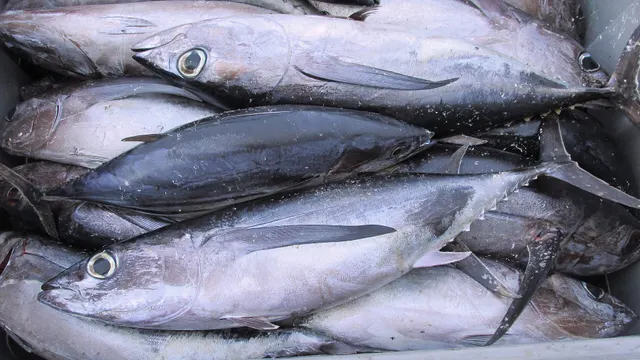 AlbacoreThe long-finned tuna of temperate open ocean — smaller and cooler-water than its relatives, with pectoral fins so long they are the identification.
Joachim Langeneck — CC BY-SA 4.0, via Wikimedia Commons
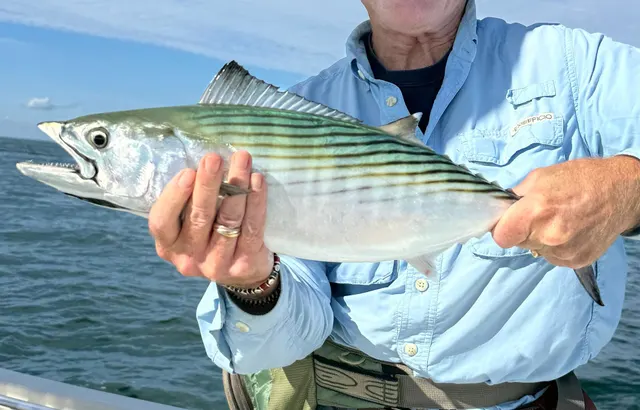 Atlantic bonitoA small, fast, striped tuna relative that arrives on temperate coasts in shoals each year and is the most accessible member of the family to a shore angler.
ricofish — CC0, via Wikimedia Commons
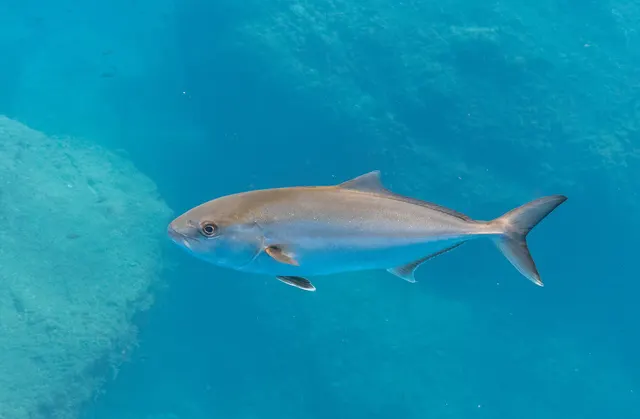 Greater amberjackThe largest amberjack — a circumglobal reef and wreck predator that fights downward with more raw power per kilogram than almost anything, and carries a genuine ciguatera caveat.
Diego Delso — CC BY-SA 4.0, via Wikimedia Commons
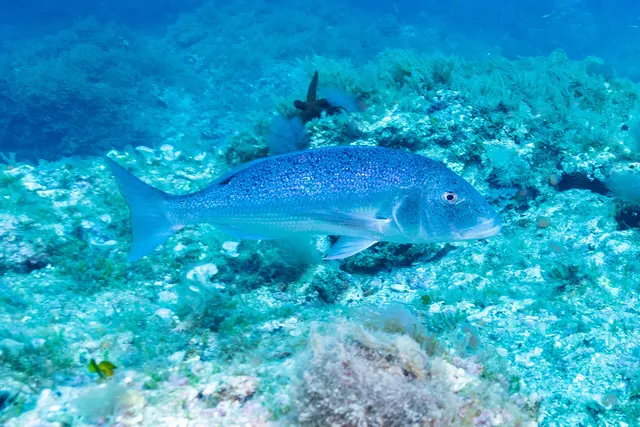 Common dentexThe Mediterranean's fastest and warriest inshore predator — a sea bream that hunts like a jack, and the fish spearfishers there rate above all others.
Diego Delso — CC BY-SA 4.0, via Wikimedia Commons
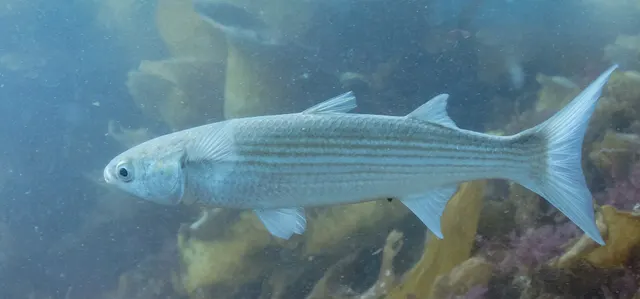 Flathead grey mulletThe most widely distributed mullet in the world, found on almost every warm and temperate coast, and a detritus feeder with a gizzard-like stomach.
Diego Delso, CC BY-SA 4.0, via Wikimedia Commons
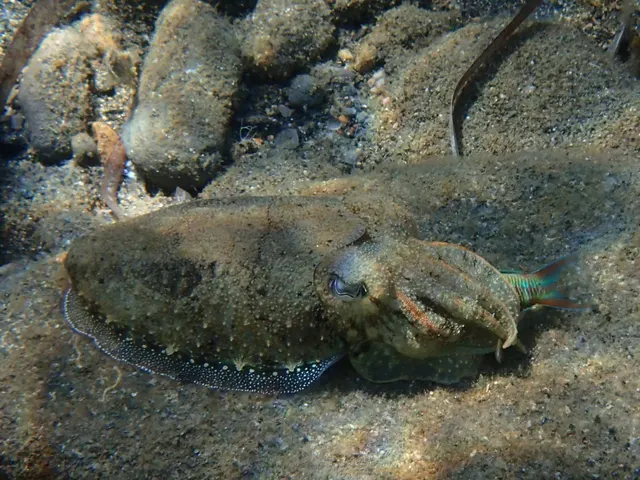 Common cuttlefishA bottom-oriented cephalopod with an internal buoyancy shell, the best-studied invertebrate mind in the sea, and a fishery that works quite differently from squid.
Katerina Kalogerini — CC BY, via iNaturalist
Safety
Boat traffic and being seen — Can cause serious injury or death
The strait carries some of the densest shipping traffic in the world through a narrow passage under a traffic separation scheme. Large vessels cannot stop or turn quickly and cannot see a small craft close ahead, and a fishing boat working the current lines is in or beside the lanes.
What reduces it: Know where the traffic lanes are and stay out of them, cross at right angles and quickly if you must, be visible, monitor traffic, and assume a large vessel has neither seen you nor could avoid you if it had.
Worse when:
- In poor visibility, which the strait produces under easterly conditions.
- At night, when a small boat's lights are lost against a shore.
- While drifting or working gear, when the boat is not under command.
Moving water and currents — Can cause serious injury or death
Exchange flow through the strait is strong and tidally modulated, producing shear lines, boils and areas of visibly disturbed water. Current runs faster than a person can swim, and wind against current steepens the sea sharply.
What reduces it: Plan around the state of tide, avoid the sill area and visible shear lines in a small craft, never enter the water, and treat a strong levante against the surface inflow as a reason to be ashore.
Cliffs and rock platforms — Can cause injury needing treatment
The rocky margins on both sides drop quickly into deep, fast-moving water. A slip from the rocks puts a person into a current they cannot swim against, with few places to get out.
What reduces it: Fish from stable ground well above the water, wear a buoyancy aid where the drop is straight into deep water, and do not fish the rocky margins alone.
Further safety reading
- Boat safety for anglers — Exchange flow through the strait is strong and tidally modulated, producing shear lines and boils, and wind against current steepens the sea sharply.
- Surface markers and boat traffic — The strait carries some of the densest shipping traffic in the world through a narrow passage under a traffic separation scheme, beside vessels that cannot stop or turn.
Check the rules before you fish
Fishing laws, bylaws, access rules, seasons, bait restrictions and permitted methods vary by location and can change. Check the current rules from the relevant authority and the water you intend to fish before fishing.
Check with:
- Current national or regional law for where you are fishing
- Current local bylaws
- The relevant fisheries authority
- The landowner, club or fishery whose water it is
- Any restrictions specific to the species or the method you intend to use
Where to go next
What swims here
- AlbacoreUses the strait as a migratory corridor and is taken along the current lines either side of it.
- Atlantic bluefin tunaPasses through in both directions on the spawning migration between Atlantic feeding grounds and Mediterranean spawning areas, which is why the trap fishery exists here.
- Atlantic bonitoWorks the shear zones and current lines the exchange flow generates, following the small pelagic shoals concentrated by the mixing.
- Common cuttlefishOccurs along the margins and moves into shallow water to spawn in the warmer months, as it does across the region.
- Common dentexOccupies the rocky margins on both sides, hunting in clear water over current-swept hard ground.
- European anchovyConcentrates in the mixing the two-layer exchange produces, forming the forage base that draws the larger pelagics and the cetaceans.
- Flathead grey mulletOccupies the harbours and sheltered margins on both sides of the strait.
- Greater amberjackHolds the current-swept structure and drop-offs in and around the strait, feeding on what the exchange flow delivers.
2 more
- Swordfish Fish
- White seabream Fish
How people fish here
- LongliningLonglining takes swordfish and large pelagics in the deeper water either side of the sill, from both coasts.
- Sea fishingShore fishing from the rocky margins and harbour structures, and small-boat fishing on the current lines, are the accessible forms here.
- Traditional net fishingThe almadraba — a fixed labyrinth of nets set from shore to intercept migrating tuna — is documented here since antiquity and still operated seasonally under quota.
Local knowledge
How this compares
- The Moroccan Atlantic coastThe strait's southern shore and the Atlantic coast beyond it are the same country's water, and the tuna passing through one migrate along the other.
- The Moroccan Mediterranean coastThe Strait is the western end of this coast and the hydraulic engine behind it: Atlantic inflow at the surface, Mediterranean outflow beneath, and a migration corridor for pelagic fish.
- The Strait of MessinaTwo Mediterranean straits whose fisheries were both built on intercepting migrating large pelagics in a narrows, one with a fixed trap and one with a harpoon, and both documented since antiquity.
Rules and access
- Close seasonsThe almadraba operates within an internationally set quota and season, so a fishery documented since antiquity now fishes to a number decided annually.
- Size limits and retentionBluefin catch limits, minimum sizes and seasons are set by international commission and implemented through European and national law, and recreational catch counts against them.
Environment and conservation
History and culture
Sources and evidence
- NOAA Ocean Service tides and water levels educational tutorial — National Oceanic and Atmospheric Administration, United States (Government fisheries body)Relied on for: The mechanism of tides, tidal range, tidal streams and the amplification of flow through constrictions.States this directlyPassage read and verified
- Met Office shipping forecast, inshore waters forecast and marine warnings — Met Office, United Kingdom (Government fisheries body)Relied on for: Inshore waters forecasting, sea state, swell and the marine warning products issued for European coastal waters.Background and mechanism onlyCitation checked — the work exists and is described correctly
- FAO Species Identification Guides for Fishery Purposes and the FAO Species Catalogues — Food and Agriculture Organization of the United Nations (Scientific institute)Relied on for: Distribution, habitat, depth and fishery accounts for the species of the eastern central Atlantic and Mediterranean in the FAO regional identification guides.States this directlyCitation checked — the work exists and is described correctly
- FishBase: a global information system on fishes — Froese, R. and D. Pauly, eds. — FishBase Consortium (Scientific institute)Relied on for: Distribution, habitat association and depth range recorded for the species.States this directlyPassage read and verified
- Fishers' Craft and Lettered Art: Tracts on Fishing from the End of the Middle Ages — University of Toronto Press, 1997 (Scientific literature)Relied on for: The historical development of fishing practice and its transmission, and the method of reading a fishing tradition from its documentary record.States this directlyCitation checked — the work exists and is described correctly
- Code of Conduct for Responsible Fisheries — Food and Agriculture Organization of the United Nations, Rome, 1995 (Standards body)Relied on for: Principles for fisheries management including the treatment of traditional, small-scale and shared fisheries, against which historical arrangements can be read.Background and mechanism onlyCitation checked — the work exists and is described correctly
Why the 23 connections on this page are here, and the sources
What swims here
Backed by research — 10 connections
Supported by peer-reviewed research or fisheries science. The sources are listed and can be checked.
Albacore
A distribution association between an animal and a kind of water, rather than a claim about any named mark.
- FAO Species Identification Guides for Fishery Purposes and the FAO Species Catalogues — Food and Agriculture Organization of the United Nations (Scientific institute)Relied on for: Distribution, habitat, depth and fishery accounts for the species of the eastern central Atlantic and Mediterranean in the FAO regional identification guides.States this directlyCitation checked — the work exists and is described correctly
- FishBase: a global information system on fishes — Froese, R. and D. Pauly, eds. — FishBase Consortium (Scientific institute)Relied on for: Distribution, habitat association and depth range recorded for the species.States this directlyPassage read and verified
Atlantic bluefin tuna
A distribution association between an animal and a kind of water, rather than a claim about any named mark.
- FAO Species Identification Guides for Fishery Purposes and the FAO Species Catalogues — Food and Agriculture Organization of the United Nations (Scientific institute)Relied on for: Distribution, habitat, depth and fishery accounts for the species of the eastern central Atlantic and Mediterranean in the FAO regional identification guides.States this directlyCitation checked — the work exists and is described correctly
- FishBase: a global information system on fishes — Froese, R. and D. Pauly, eds. — FishBase Consortium (Scientific institute)Relied on for: Distribution, habitat association and depth range recorded for the species.States this directlyPassage read and verified
Atlantic bonito
A distribution association between an animal and a kind of water, rather than a claim about any named mark.
- FAO Species Identification Guides for Fishery Purposes and the FAO Species Catalogues — Food and Agriculture Organization of the United Nations (Scientific institute)Relied on for: Distribution, habitat, depth and fishery accounts for the species of the eastern central Atlantic and Mediterranean in the FAO regional identification guides.States this directlyCitation checked — the work exists and is described correctly
- FishBase: a global information system on fishes — Froese, R. and D. Pauly, eds. — FishBase Consortium (Scientific institute)Relied on for: Distribution, habitat association and depth range recorded for the species.States this directlyPassage read and verified
Common cuttlefish
A distribution association between an animal and a kind of water, rather than a claim about any named mark.
- FAO Species Identification Guides for Fishery Purposes and the FAO Species Catalogues — Food and Agriculture Organization of the United Nations (Scientific institute)Relied on for: Distribution, habitat, depth and fishery accounts for the species of the eastern central Atlantic and Mediterranean in the FAO regional identification guides.States this directlyCitation checked — the work exists and is described correctly
- FishBase: a global information system on fishes — Froese, R. and D. Pauly, eds. — FishBase Consortium (Scientific institute)Relied on for: Distribution, habitat association and depth range recorded for the species.States this directlyPassage read and verified
Common dentex
A distribution association between an animal and a kind of water, rather than a claim about any named mark.
- FAO Species Identification Guides for Fishery Purposes and the FAO Species Catalogues — Food and Agriculture Organization of the United Nations (Scientific institute)Relied on for: Distribution, habitat, depth and fishery accounts for the species of the eastern central Atlantic and Mediterranean in the FAO regional identification guides.States this directlyCitation checked — the work exists and is described correctly
- FishBase: a global information system on fishes — Froese, R. and D. Pauly, eds. — FishBase Consortium (Scientific institute)Relied on for: Distribution, habitat association and depth range recorded for the species.States this directlyPassage read and verified
European anchovy
A distribution association between an animal and a kind of water, rather than a claim about any named mark.
- FAO Species Identification Guides for Fishery Purposes and the FAO Species Catalogues — Food and Agriculture Organization of the United Nations (Scientific institute)Relied on for: Distribution, habitat, depth and fishery accounts for the species of the eastern central Atlantic and Mediterranean in the FAO regional identification guides.States this directlyCitation checked — the work exists and is described correctly
- FishBase: a global information system on fishes — Froese, R. and D. Pauly, eds. — FishBase Consortium (Scientific institute)Relied on for: Distribution, habitat association and depth range recorded for the species.States this directlyPassage read and verified
Flathead grey mullet
A distribution association between an animal and a kind of water, rather than a claim about any named mark.
- FAO Species Identification Guides for Fishery Purposes and the FAO Species Catalogues — Food and Agriculture Organization of the United Nations (Scientific institute)Relied on for: Distribution, habitat, depth and fishery accounts for the species of the eastern central Atlantic and Mediterranean in the FAO regional identification guides.States this directlyCitation checked — the work exists and is described correctly
- FishBase: a global information system on fishes — Froese, R. and D. Pauly, eds. — FishBase Consortium (Scientific institute)Relied on for: Distribution, habitat association and depth range recorded for the species.States this directlyPassage read and verified
Greater amberjack
A distribution association between an animal and a kind of water, rather than a claim about any named mark.
- FAO Species Identification Guides for Fishery Purposes and the FAO Species Catalogues — Food and Agriculture Organization of the United Nations (Scientific institute)Relied on for: Distribution, habitat, depth and fishery accounts for the species of the eastern central Atlantic and Mediterranean in the FAO regional identification guides.States this directlyCitation checked — the work exists and is described correctly
- FishBase: a global information system on fishes — Froese, R. and D. Pauly, eds. — FishBase Consortium (Scientific institute)Relied on for: Distribution, habitat association and depth range recorded for the species.States this directlyPassage read and verified
Swordfish
A distribution association between an animal and a kind of water, rather than a claim about any named mark.
- FAO Species Identification Guides for Fishery Purposes and the FAO Species Catalogues — Food and Agriculture Organization of the United Nations (Scientific institute)Relied on for: Distribution, habitat, depth and fishery accounts for the species of the eastern central Atlantic and Mediterranean in the FAO regional identification guides.States this directlyCitation checked — the work exists and is described correctly
- FishBase: a global information system on fishes — Froese, R. and D. Pauly, eds. — FishBase Consortium (Scientific institute)Relied on for: Distribution, habitat association and depth range recorded for the species.States this directlyPassage read and verified
White seabream
A distribution association between an animal and a kind of water, rather than a claim about any named mark.
- FAO Species Identification Guides for Fishery Purposes and the FAO Species Catalogues — Food and Agriculture Organization of the United Nations (Scientific institute)Relied on for: Distribution, habitat, depth and fishery accounts for the species of the eastern central Atlantic and Mediterranean in the FAO regional identification guides.States this directlyCitation checked — the work exists and is described correctly
- FishBase: a global information system on fishes — Froese, R. and D. Pauly, eds. — FishBase Consortium (Scientific institute)Relied on for: Distribution, habitat association and depth range recorded for the species.States this directlyPassage read and verified
How people fish here
What experienced anglers do — 3 connections
Widely and independently recommended by experienced anglers and specialist sources. This is real angling knowledge, not proof: controlled evidence for it is limited, and FishingHQ records it as convention rather than as a demonstrated effect.
Longlining
A discipline that is characteristic of the place rather than merely possible there, joined so a reader can move between the place and the practice.
- General angling website restatements of established technique — Various (Credible secondary source)Relied on for: Widely restated practice associating this discipline with this place, recorded as practitioner consensus rather than as tested fact.Background and mechanism onlyCitation checked — the work exists and is described correctly
- Fishers' Craft and Lettered Art: Tracts on Fishing from the End of the Middle Ages — University of Toronto Press, 1997 (Scientific literature)Relied on for: That fishing traditions develop around the water and fish available to them, and the historical method of reading such traditions.States this directlyCitation checked — the work exists and is described correctly
Sea fishing
A discipline that is characteristic of the place rather than merely possible there, joined so a reader can move between the place and the practice.
- General angling website restatements of established technique — Various (Credible secondary source)Relied on for: Widely restated practice associating this discipline with this place, recorded as practitioner consensus rather than as tested fact.Background and mechanism onlyCitation checked — the work exists and is described correctly
- Fishers' Craft and Lettered Art: Tracts on Fishing from the End of the Middle Ages — University of Toronto Press, 1997 (Scientific literature)Relied on for: That fishing traditions develop around the water and fish available to them, and the historical method of reading such traditions.States this directlyCitation checked — the work exists and is described correctly
Traditional net fishing
A discipline that is characteristic of the place rather than merely possible there, joined so a reader can move between the place and the practice.
- General angling website restatements of established technique — Various (Credible secondary source)Relied on for: Widely restated practice associating this discipline with this place, recorded as practitioner consensus rather than as tested fact.Background and mechanism onlyCitation checked — the work exists and is described correctly
- Fishers' Craft and Lettered Art: Tracts on Fishing from the End of the Middle Ages — University of Toronto Press, 1997 (Scientific literature)Relied on for: That fishing traditions develop around the water and fish available to them, and the historical method of reading such traditions.States this directlyCitation checked — the work exists and is described correctly
Local knowledge
Backed by research — 1 connection
Supported by peer-reviewed research or fisheries science. The sources are listed and can be checked.
Currents, eddies and where fish hold
A link from a practice, an environment or a geography to the mechanism it rests on. It asserts that the mechanism is load-bearing here rather than merely relevant, which is the test applied throughout this file.
- ICES Advice on fishing opportunities, catch and effort — International Council for the Exploration of the Sea (Scientific institute)Relied on for: Hydrography, stratification, salinity structure and stock distribution across the European sea areas assessed, which is the physical basis for the mechanism named.States this directlyCitation checked — the work exists and is described correctly
- NOAA National Ocean Service education on estuaries and the National Estuarine Research Reserve System — National Oceanic and Atmospheric Administration, United States (Government fisheries body)Relied on for: Estuarine and coastal process: salt wedges, stratification, tidal exchange and the way water of different densities behaves where it meets.States this directlyCitation checked — the work exists and is described correctly
How this compares
What experienced anglers do — 3 connections
Widely and independently recommended by experienced anglers and specialist sources. This is real angling knowledge, not proof: controlled evidence for it is limited, and FishingHQ records it as convention rather than as a demonstrated effect.
The Moroccan Atlantic coast
Two places a reader would reasonably weigh against one another, joined where the comparison teaches something about both. It is also how the larger geography is linked to what sits inside it.
- General angling website restatements of established technique — Various (Credible secondary source)Relied on for: Widely restated practice associating this discipline with this place, recorded as practitioner consensus rather than as tested fact.Background and mechanism onlyCitation checked — the work exists and is described correctly
- Fishers' Craft and Lettered Art: Tracts on Fishing from the End of the Middle Ages — University of Toronto Press, 1997 (Scientific literature)Relied on for: That fishing traditions develop around the water and fish available to them, and the historical method of reading such traditions.States this directlyCitation checked — the work exists and is described correctly
The Moroccan Mediterranean coast
Two places a reader would reasonably weigh against one another, joined where the comparison teaches something about both. It is also how the larger geography is linked to what sits inside it.
- Cefas science, advice and data on marine and freshwater environments — Centre for Environment, Fisheries and Aquaculture Science (Government fisheries body)Relied on for: Marine and freshwater environmental science, including coastal physical processes, productivity and the monitoring behind them.States this directlyCitation checked — the work exists and is described correctly
- ICES Advice on fishing opportunities, catch and effort — International Council for the Exploration of the Sea (Scientific institute)Relied on for: Stock assessment and advice for north-east Atlantic and adjacent stocks, including the environmental drivers of productivity.Background and mechanism onlyCitation checked — the work exists and is described correctly
The Strait of Messina
Two places a reader would reasonably weigh against one another, joined where the comparison teaches something about both. It is also how the larger geography is linked to what sits inside it.
- General angling website restatements of established technique — Various (Credible secondary source)Relied on for: Widely restated practice associating this discipline with this place, recorded as practitioner consensus rather than as tested fact.Background and mechanism onlyCitation checked — the work exists and is described correctly
- Fishers' Craft and Lettered Art: Tracts on Fishing from the End of the Middle Ages — University of Toronto Press, 1997 (Scientific literature)Relied on for: That fishing traditions develop around the water and fish available to them, and the historical method of reading such traditions.States this directlyCitation checked — the work exists and is described correctly
Safety reading
Official guidance — 2 connections
Stated by a fisheries authority, scientific institute or recognised angling body. Authoritative, but summarising rather than demonstrating.
Boat safety for anglers
A place is joined to the safety topic that explains a hazard genuinely characteristic of it, so the mechanism is reachable rather than restated as a weak warning.
- RNLI water safety guidance: cold water shock and Float to Live — Royal National Lifeboat Institution (Water-safety or diver-training authority)Relied on for: Cold water shock and the immersion response, shore angling hazards, small-craft guidance and the circumstances in which water users are most often killed.States this directlyPassage read and verified
- RoSPA water safety information and UK accidental drowning statistics — Royal Society for the Prevention of Accidents (Water-safety or diver-training authority)Relied on for: Accidental drowning statistics and the circumstances in which recreational water users are most often killed.Background and mechanism onlyPassage read and verified
Surface markers and boat traffic
A place is joined to the safety topic that explains a hazard genuinely characteristic of it, so the mechanism is reachable rather than restated as a weak warning.
- RNLI water safety guidance: cold water shock and Float to Live — Royal National Lifeboat Institution (Water-safety or diver-training authority)Relied on for: Cold water shock and the immersion response, shore angling hazards, small-craft guidance and the circumstances in which water users are most often killed.States this directlyPassage read and verified
- RoSPA water safety information and UK accidental drowning statistics — Royal Society for the Prevention of Accidents (Water-safety or diver-training authority)Relied on for: Accidental drowning statistics and the circumstances in which recreational water users are most often killed.Background and mechanism onlyPassage read and verified
Rules and access
Official guidance — 2 connections
Stated by a fisheries authority, scientific institute or recognised angling body. Authoritative, but summarising rather than demonstrating.
Close seasons
A place joined to the regulatory concept whose structure it illustrates. The edge asserts that the concept applies here, never what any current rule says.
- Code of Conduct for Responsible Fisheries — Food and Agriculture Organization of the United Nations, Rome, 1995 (Standards body)Relied on for: Principles for the management of fisheries, including licensing, closed seasons, size limits and the treatment of small-scale and shared stocks.States this directlyCitation checked — the work exists and is described correctly
- Good Fish Guide — Marine Conservation Society (Conservation authority)Relied on for: Assessment of fisheries and the management measures applied to them, including the instruments used and their purpose.Background and mechanism onlyCitation checked — the work exists and is described correctly
Size limits and retention
A place joined to the regulatory concept whose structure it illustrates. The edge asserts that the concept applies here, never what any current rule says.
- Code of Conduct for Responsible Fisheries — Food and Agriculture Organization of the United Nations, Rome, 1995 (Standards body)Relied on for: Principles for the management of fisheries, including licensing, closed seasons, size limits and the treatment of small-scale and shared stocks.States this directlyCitation checked — the work exists and is described correctly
- Good Fish Guide — Marine Conservation Society (Conservation authority)Relied on for: Assessment of fisheries and the management measures applied to them, including the instruments used and their purpose.Background and mechanism onlyCitation checked — the work exists and is described correctly
Environment and conservation
Backed by research — 1 connection
Supported by peer-reviewed research or fisheries science. The sources are listed and can be checked.
Fish stocks and sustainability
An environmental pressure that is specific to this place rather than general to fishing, joined so the issue is anchored to a real example.
- The IUCN Red List of Threatened Species — International Union for Conservation of Nature (Conservation authority)Relied on for: Assessment of the species and habitats affected, and the pressures acting on them, including habitat change and exploitation.States this directlyCitation checked — the work exists and is described correctly
- Code of Conduct for Responsible Fisheries — Food and Agriculture Organization of the United Nations, Rome, 1995 (Standards body)Relied on for: Principles for responsible fisheries management, precaution, gear selectivity and the treatment of shared and small-scale fisheries.Background and mechanism onlyCitation checked — the work exists and is described correctly
History and culture
Official guidance — 1 connection
Stated by a fisheries authority, scientific institute or recognised angling body. Authoritative, but summarising rather than demonstrating.
Fishing, communities and economies
A place joined to the documented fishing tradition it belongs to, so the history has a real setting and the place has a real past.
- Fishers' Craft and Lettered Art: Tracts on Fishing from the End of the Middle Ages — University of Toronto Press, 1997 (Scientific literature)Relied on for: The historical development of fishing practice and its transmission, and the method of reading a fishing tradition from its documentary record.States this directlyCitation checked — the work exists and is described correctly
- FAO fishing gear types and fishing technology information — Food and Agriculture Organization of the United Nations (Scientific institute)Relied on for: Descriptions of fishing gear types and their operation, including fixed traps, pots and small-scale gears.Background and mechanism onlyCitation checked — the work exists and is described correctly
How FishingHQ labels evidence is explained in the evidence policy.