Common cuttlefish
Fish · Last reviewed 2026-08-12
A bottom-oriented cephalopod with an internal buoyancy shell, the best-studied invertebrate mind in the sea, and a fishery that works quite differently from squid.
Safety: injury while handling fish — minor injury. 2 more points apply here.
How this was identified, and who took it
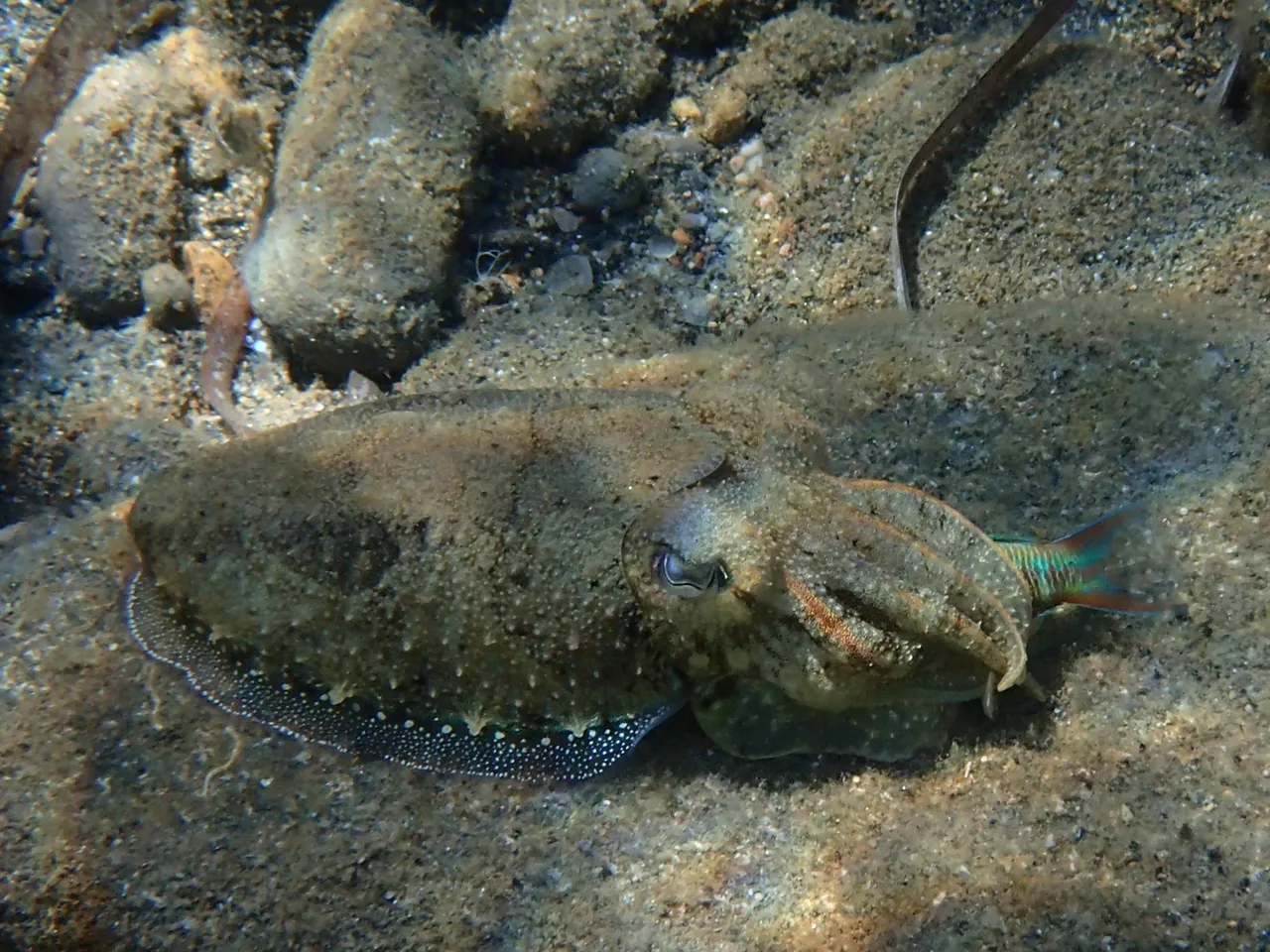
Identified by: Identified on the mantle and fin arrangement, the character the record leads on: a broad flattened oval mantle carrying a narrow continuous fin along the full length of both sides, unlike the triangular rear fins of any squid. The W-shaped pupil is legible, the arms are held forward with the tentacles withdrawn, and the pattern matches the substrate. Research grade with two agreeing identifications sets the identity floor; the visual check was made independently of it.Katerina Kalogerini — CC BY, via iNaturalist — source, licenceCatching Common cuttlefish
Everything here on fishing for it. Each entry opens the page behind it.
- When
- Mar–Jun and Oct–Nov — months recorded at the places that document it, not a season for the whole range.
- Where
- 8 places FishingHQ documents — strongest claim anywhere: seasonal · From the shore, From a boat
Cuttlefish are frequently treated as squid with a different outline, and the differences matter enough to change how they are fished. A cuttlefish carries a thick internal chalky shell — the cuttlebone familiar from bird cages — which is a gas-filled buoyancy device it can flood and empty to hover at any depth without swimming. That single organ is why a cuttlefish hangs motionless over the bottom while a squid must keep moving.
They are ambush hunters of the seabed rather than open-water pursuers, sitting over sand and weed, changing colour and skin texture to match it, and striking with two tentacles at crabs, prawns and small fish. The colour change is not merely camouflage: cuttlefish produce moving waves of pattern across the skin during hunting and display, and the animal's visual and cognitive abilities are among the most studied in the invertebrates.
For a fisher this makes them a slower, closer, more deliberate catch than squid — worked over ground rather than through the water column, often on the same jigs, and typically in the shallow inshore period when they come in to spawn.
Gear for this fish
Where Common cuttlefish is documented
Places where public sources describe this species as fished, with how it is fished and how strongly the evidence supports it. This is not a range map and it is not a recommendation — it is what has been written down about a fishery rather than a record of any individual catch, and being listed is never permission to fish.
Brittany and the French Atlantic coast
1 documented place
Tidal channel
Seasonal
From the shore · From a boat
Around Mar, Apr, May, Jun
The Soča and Slovenia's Adriatic rivers
1 documented place
Headland
Seasonal
From the shore
Around Mar, Apr, May, Oct, Nov
Portugal
5 documented places
Estuary
Recorded here
From the shore
Beach
Recorded here
From the shore
Estuary
Recorded here
From the shore
Mole
Recorded here
From the shore
Tidal channel
Recorded here
From the shore
What these strengths mean
- Seasonal
- Well supported, and concentrated in part of the year rather than spread through it.
- Recorded here
- At least one credible public account of this species being caught here. That is all it means.
Identification
- Scientific name
- Sepia officinalis
- Family
- Sepiidae
- Water
- Saltwater
- Conservation status
- Least Concern
- Regions
- Britain & Ireland, Western Europe, Mediterranean, North Africa
- A broad, flattened, oval mantle with a continuous narrow fin running the full length of both sides — quite unlike the triangular rear fins of a squid.
- A thick, chalky, buoyant internal cuttlebone rather than a transparent pen.
- Eight arms and two retractable tentacles kept withdrawn in pockets beneath the eyes, so a resting cuttlefish appears to have only eight.
- A distinctive W-shaped pupil, unlike anything else likely to be caught.
- Zebra-striped or mottled patterning that changes within a second, including moving bands during display.
Size
- Typical
- 15–25 cm mantle length for most inshore animals.
- Large
- Over 35 cm mantle length and around 2 kg.
Exceptional: Mantle lengths around 45 cm and weights approaching 4 kg are recorded in the scientific literature for the species, making it the largest cuttlefish in European waters.
How big cuttlefish get, and the bone that tells you afterwards
Cuttlefish are measured the same way as squid and for the same reason: MANTLE LENGTH, from the rear of the body to the front edge where the head joins. Total length including the arms is a much larger and much less useful number.
ORDINARY ANIMALS run fifteen to twenty-five centimetres of mantle, which is what most inshore captures are.
A GOOD ONE is over thirty-five centimetres and around two kilograms — a substantial animal and, in the hand, considerably heavier than its size suggests, because a cuttlefish is dense in a way a squid is not.
THE EXCEPTIONAL END reaches around forty-five centimetres of mantle and weights approaching four kilograms, which makes this the largest cuttlefish in European waters.
AND THERE IS A SIZE RECORD ON EVERY BEACH IN THE RANGE. The cuttlebone is the internal buoyancy shell, it is durable, and it washes up in enormous numbers. Its length is a direct proxy for the mantle length of the animal that carried it, so a walk along a strandline is a rough survey of what the local population was reaching. Most beachcombed cuttlebones are considerably smaller than the good fish described above, which is a useful corrective to the sizes people remember.
GROWTH IS FAST AND STRONGLY TEMPERATURE-DEPENDENT, so animals from the warmer parts of the range mature earlier and at smaller sizes than those from the cooler parts. A size comparison between the Mediterranean and the southern North Sea is not comparing like with like.
AND AS WITH SQUID, SIZE IS NOT AGE. These animals live one to two years and spawn once. A large cuttlefish grew faster, not longer, and the conservation question is about how many animals are taken from a single annual cohort rather than about protecting the big ones.
Backed by research — why, and the sources (2)
Supported by peer-reviewed research or fisheries science. The sources are listed and can be checked.
- FishBase: a global information system on fishes — Froese, R. and D. Pauly, eds. — FishBase Consortium (Scientific institute)Relied on for: Size, growth, moult biology, life history and measurement convention for the species, with SeaLifeBase as its sister database for non-finfish taxa.States this directlyPassage read and verified
- Code of Conduct for Responsible Fisheries — Food and Agriculture Organization of the United Nations, Rome, 1995 (Standards body)Relied on for: That minimum sizes are set against size at maturity and are specified on a body dimension particular to each taxon, which is why the measurement convention is the rule rather than a convention.Background and mechanism onlyCitation checked — the work exists and is described correctly
Handling a cuttlefish, and the eggs that come up on the gear
Everything in the squid handling account applies, with the ink turned up and one additional responsibility that has nothing to do with the animal in your hand.
THE INK IS THE HEADLINE. A cuttlefish holds a large reserve and deploys it accurately, and it is the source of the pigment that gave sepia its name. It stains permanently. Point a landed cuttlefish at the water and let it empty before bringing it close to anything you care about.
THE WATER JET is the same mechanism as a squid's and is used the same way.
THE BEAK is the only injury risk, and it is at the centre of the arm crown. Hold the animal by the mantle. The arms carry suckers rather than the hooked clubs of some open-water squid, so a cuttlefish gripping an arm is a curiosity rather than a problem.
THE CUTTLEBONE MAKES IT AWKWARD TO HOLD. The animal is rigid through the middle in a way a squid is not, and a big one is heavy, dense and hard to grip with wet hands. Two hands, and a drop net rather than a lift on the line.
FOR THE TABLE, dispatch immediately with a cut between the eyes — the colour drains at once, which is the confirmation — and chill it. The cuttlebone comes out through a slit in the mantle and the ink sac can be kept whole if wanted; both are easier on a fresh animal than a cold one.
AND THE PART MOST PEOPLE MISS. Cuttlefish attach clusters of black, grape-like eggs to weed, rope, netting, moorings and pot lines, and those clusters come up on gear constantly. They are the whole of next year's population, they cannot reattach themselves, and dropping them loose over the side kills them. Return an egg cluster to the water still attached to whatever it is on, or tie it to something on the bottom. It takes ten seconds and it is the single highest-value conservation act available to anybody fishing this species.
Backed by research — why, and the sources (2)
Supported by peer-reviewed research or fisheries science. The sources are listed and can be checked.
- FishBase: a global information system on fishes — Froese, R. and D. Pauly, eds. — FishBase Consortium (Scientific institute)Relied on for: Morphology, moult biology and behaviour underlying the handling described, with SeaLifeBase as its sister database for non-finfish taxa.States this directlyPassage read and verified
- General angling website restatements of established technique — Various (Credible secondary source)Relied on for: Widely restated handling practice for this species, recorded as practitioner consensus rather than as tested fact.Background and mechanism onlyCitation checked — the work exists and is described correctly
Black eggs on a mooring rope, and why they should go straight back
Cuttlefish reproduction produces the most conspicuous and most frequently disturbed egg mass in inshore European waters, and the handling of it is a genuine practical question rather than a theoretical one.
THE EGGS ARE STAINED WITH INK, which is where the colour comes from and why they look the way they do. The female attaches clusters of black, grape-like capsules — sometimes called sea grapes — to weed, rope, netting, pot lines and any suitable structure in shallow inshore water in the warmer months. Each capsule contains a single embryo, and the ink staining is thought to provide camouflage against the dark substrate and predators.
AND SHE DIES SOON AFTERWARDS. Like squid, cuttlefish are essentially semelparous, spawning at the end of a short life. The animals gathering inshore to spawn are at the terminal stage, and the egg clusters they leave behind are the whole of the next generation for that piece of ground.
WHICH MAKES THE INCIDENTAL CATCH A REAL ISSUE. Egg clusters lifted on pots, moorings, anchors and lines are common and unwelcome, and what happens next decides whether they survive. The correct handling is to return them promptly and intact to the water — not to pick them off, not to leave them on a deck to dry, and not to discard them ashore. A cluster returned quickly to the water continues developing; a cluster left in the sun for twenty minutes does not.
THE DEVELOPMENT IS SLOW AND DIRECT, which is unusual and relevant. Cuttlefish do not have a drifting planktonic larval stage the way most marine invertebrates do. The embryos develop over an extended period inside the capsule and hatch as miniature, fully formed, immediately functional cuttlefish. That direct development means recruitment to a piece of ground depends heavily on eggs laid on THAT ground rather than on larvae drifting in from elsewhere — so the local egg masses are the local population in a very direct sense, and losing them is not compensated by supply from somewhere else.
It is also why cuttlefish are more locally depletable than a broadcast-spawning fish of comparable abundance, and why the inshore spawning ground is the part of the cycle worth protecting.
Backed by research — why, and the sources (2)
Supported by peer-reviewed research or fisheries science. The sources are listed and can be checked.
- FishBase: a global information system on fishes — Froese, R. and D. Pauly, eds. — FishBase Consortium (Scientific institute)Relied on for: Reproductive mode, spawning season, fecundity, parental care, sex-change pattern and larval development recorded for the species.States this directlyPassage read and verified
- The IUCN Red List of Threatened Species — International Union for Conservation of Nature (Conservation authority)Relied on for: Assessment, population trend, and the life-history traits — age at maturity, longevity, reproductive strategy — that determine sensitivity to exploitation.States this directlyCitation checked — the work exists and is described correctly
Sand to bury in, structure to hunt over, and shallow water to breed in
Cuttlefish habitat has three separate requirements that must occur together, which is why the animal is common in some inshore areas and absent from apparently similar ones.
THE FIRST IS SOFT SEDIMENT. A cuttlefish buries — settling onto sand or fine gravel and using its fins to flick sediment over its back until only the eyes are exposed. That is its primary defence and its primary ambush position, and it requires a bottom that can actually be disturbed. Rock pavement and coarse shingle do not work.
THE SECOND IS SOMETHING TO HUNT AROUND. Cuttlefish take crustaceans and small fish, striking with two rapidly extended tentacles from a stationary position, and they need prey concentrated enough to be worth waiting for — which means the productive ground is the interface between sand and structure: the edge of a reef, a weed bed on sand, eelgrass, a broken bottom of rock and sediment. Featureless sand of any extent holds far fewer.
THE THIRD IS SHALLOW WATER WITH ATTACHMENT POINTS, for spawning. Females attach ink-stained egg clusters to weed, rope, netting and structure in shallow inshore water in the warmer months, so a population needs accessible shallow ground with something to hang eggs on. That is the requirement most easily removed by dredging, mooring management or the loss of eelgrass.
THE SEASONAL PATTERN FOLLOWS. Cuttlefish move inshore into shallow water in the warmer months to feed and spawn and retreat to deeper water afterwards, in the north-east Atlantic, Mediterranean and off north-west Africa. The timing is temperature-driven rather than calendrical.
AND THE CAMOUFLAGE IS WORTH ONE LINE BECAUSE IT IS THE HABITAT ADAPTATION. Cuttlefish change colour, pattern and skin texture within a second using chromatophores under direct neural control, matching substrate with a precision that is remarkable given that they are almost certainly colourblind — the matching appears to rely on contrast, polarisation and intensity rather than on hue. An animal that lives by being invisible against sediment is an animal tied absolutely to the kind of sediment it is sitting on.
Backed by research — why, and the sources (2)
Supported by peer-reviewed research or fisheries science. The sources are listed and can be checked.
- The Fishes of the British Isles and North-West Europe — Macmillan, 1969 (Reference work)Relied on for: Habitat association, depth and ground type of fishes in British and north-west European waters.States this directlyCitation checked — the work exists and is described correctly
- FishBase: a global information system on fishes — Froese, R. and D. Pauly, eds. — FishBase Consortium (Scientific institute)Relied on for: Habitat association, depth range and substrate preference recorded for the species.States this directlyPassage read and verified
A one-year life, and a season that is really a single inshore spawning migration
Cuttlefish seasonality is unlike any fish on FishingHQ, because the animal lives about a year, breeds once, and dies. The season is not a phase of a long life — it is the whole life, seen from the shore.
THE CYCLE RUNS ON TEMPERATURE AND IT IS SIMPLE. Cuttlefish spend the colder months in deeper offshore water, and as inshore water warms in spring they move in to shallow coastal ground to breed. They lay their black grape-like egg clusters on weed, ropes, pot lines and any available structure in shallow water, and then, having spawned, the adults die. What an inshore angler or diver encounters in spring and early summer is a mass migration of terminal-stage animals.
WHICH MAKES THE INSHORE SEASON SHORT, INTENSE AND ENTIRELY WEATHER-DEPENDENT. The timing shifts by weeks between years and between coasts according to how quickly the shallows warm, so a date learned one year is unreliable the next. The useful predictor is water temperature and the run of weather that produced it, not the calendar.
THE ANIMALS ARE AT THEIR LARGEST WHEN THEY ARRIVE, which is the counter-intuitive part. Because they have grown for a year and are about to spawn and die, the inshore migration delivers the biggest cuttlefish of the whole cycle. That is why the season produces such good fishing and it is also why it ends so abruptly.
AFTER SPAWNING THE POPULATION IS GONE AND THE NEXT ONE IS MICROSCOPIC. Eggs hatch through summer into small cuttlefish that grow rapidly offshore through autumn and winter and return the following spring. So the year's fishing depends entirely on last year's spawning success, and cuttlefish abundance swings hard between years for reasons that have nothing to do with what happened this season.
A WARM WINTER CAN SHIFT EVERYTHING FORWARD and a cold spring can compress the run into a fortnight. This is a species whose seasonal behaviour is unusually sensitive to conditions, and it is worth treating the inshore appearance as an event to watch for rather than a date to book.
AND THE BIOLOGY SAYS NOTHING ABOUT THE RULES. Where cuttlefish may be taken, by what method, in what quantity and at what time of year varies by jurisdiction and may have no relationship at all to the spawning migration described here. The competent authority is the only source for that, and FishingHQ does not state what any current rule is.
Backed by research — why, and the sources (2)
Supported by peer-reviewed research or fisheries science. The sources are listed and can be checked.
- The Fishes of the British Isles and North-West Europe — Macmillan, 1969 (Reference work)Relied on for: Seasonal occurrence, movement and spawning period of fishes in British and north-west European waters.States this directlyCitation checked — the work exists and is described correctly
- FishBase: a global information system on fishes — Froese, R. and D. Pauly, eds. — FishBase Consortium (Scientific institute)Relied on for: Spawning season, temperature preference and seasonal distribution for the species.States this directlyPassage read and verified
Skin that signals in colour, an eye that probably cannot see it, and a W-shaped pupil
Cuttlefish sensory biology contains the single most striking unresolved puzzle on FishingHQ, and it is worth stating plainly rather than smoothing over.
THE ANIMAL PRODUCES AND MATCHES COLOUR WITH REMARKABLE PRECISION. A cuttlefish changes the colour, pattern, texture and posture of its skin within a fraction of a second, matching backgrounds, signalling to other cuttlefish, and producing the travelling waves of dark banding used to mesmerise prey. The control is direct and neural rather than hormonal, which is why it is so fast.
AND IT ALMOST CERTAINLY CANNOT SEE COLOUR. Like squid, cuttlefish have a single visual pigment — the standard signature of monochromacy. So the animal is matching a coloured background it apparently cannot perceive in colour. Proposed explanations include using chromatic aberration together with the unusual pupil shape to extract wavelength information, and light-sensitive proteins in the skin itself providing a local readout. None of them is settled, and FishingHQ records it as unresolved rather than picking one.
THE W-SHAPED PUPIL IS A GENUINE OPTICAL DEVICE. It is thought to help control the distribution of light across the retina in bright conditions and to assist in judging distance — which matters enormously to an animal that strikes at prey with two extensible tentacles and must get the range right in a single attempt.
WHICH IS THE FUNCTIONAL POINT: THE WHOLE SENSORY SYSTEM SERVES A ONE-SHOT AMBUSH. A cuttlefish approaches, positions, and fires two tentacles a fixed distance. Everything — binocular positioning, the pupil, polarisation sensitivity, the hypnotic display — is in service of getting that one strike right.
POLARISATION VISION AND SKIN PHOTORECEPTION both extend what the animal can detect beyond anything a fish on FishingHQ manages, and both are areas of active research rather than settled fact.
COGNITION IS THE LAST PIECE AND IT IS SUBSTANTIAL. Cuttlefish learn, remember, and have been shown in controlled work to adjust foraging behaviour according to expected future food availability. That is a real and well-attested body of research, and it is relevant to anybody handling the animal: the record's handling section treats it as a subject rather than as a bait.
Backed by research — why, and the sources (2)
Supported by peer-reviewed research or fisheries science. The sources are listed and can be checked.
- The Ecology of Vision — Clarendon Press, Oxford, 1979 (Scientific literature)Relied on for: The ecology of vision in aquatic animals, including visual pigments, colour discrimination, polarisation sensitivity and the relationship between eye design and habitat.States this directlyCitation checked — the work exists and is described correctly
- FishBase: a global information system on fishes — Froese, R. and D. Pauly, eds. — FishBase Consortium (Scientific institute)Relied on for: Life history, growth, longevity and reproductive mode recorded for the species.Background and mechanism onlyPassage read and verified
Lifecycle and reproduction
One to two years depending on temperature, and semelparous like squid: they spawn once and die. Growth is rapid and strongly temperature-dependent, so animals from warmer parts of the range mature earlier and smaller. The absence of an accumulated age structure means the same annual-rebuild dynamics apply as for squid, and abundance varies substantially between years.
Spawning takes place inshore in shallow water in the warmer months. Females attach clusters of black, grape-like eggs — stained with ink, which is where the colour comes from — to weed, rope, netting and any suitable structure, and die soon afterwards. Egg clusters lifted on pots, moorings and anchors are a common and unwelcome incidental catch, and returning them promptly and intact to the water is the correct handling.
Feeding and senses
An ambush predator of the seabed taking crabs, prawns, shrimp and small fish. The hunting sequence is distinctive and worth knowing: the animal approaches slowly with the arms held together, produces a rippling display across the skin, and then extends both tentacles faster than the eye follows. Crustaceans dominate the diet, which is why crab- and prawn-imitating jigs work well.
Vision is exceptional and the eye carries a W-shaped pupil that appears to help judge distance. Like other cephalopods they have a single visual pigment and are very probably colourblind — while producing and matching colour patterns with great precision, which remains one of the genuinely unresolved puzzles in animal sensory biology. They detect polarised light, and the skin itself contains light-sensitive proteins. They also have well-developed learning and memory, and the animal's cognition is the subject of a substantial research literature.
Through the year
Cuttlefish move from deeper water into shallow inshore ground as it warms, to feed and to spawn, and retreat as it cools. The inshore period is therefore a spawning aggregation and should be treated as one: the animals are concentrated, catchable and about to die naturally, and taking large numbers at that point removes the whole of the next generation's parents. Within a day, dawn, dusk and night are the productive periods.
Distribution
Eastern Atlantic from the North Sea and the southern coasts of Britain and Ireland south to north-west Africa, and throughout the Mediterranean. Found from the shoreline to around two hundred metres, over sand, mud, seagrass and mixed ground, moving inshore seasonally.
This is a biological range — where the species occurs, not a prediction that you will catch one. To browse the fishing geography FishingHQ holds, start at fishing places.
Why anglers care
Taken on jigs from shore and small boats, and a substantial incidental catch in pots and nets. The cuttlebone is the most widely recognised part of the animal and is found on almost every beach in the range, which makes it one of the few target species most people have already handled without realising what it was.
Handling and returning
Cuttlefish ink prodigiously and accurately, and they hold a substantial reserve. A landed cuttlefish should be pointed away from people and allowed to discharge before it is brought close. Ink stains clothing permanently and a cuttlefish is capable of covering a considerable distance with it.
The beak is the only injury risk and is the same arrangement as a squid's. Hold the animal by the mantle.
For the table, dispatch promptly with a cut between the eyes and chill immediately. The cuttlebone is removed through a slit in the mantle and the ink sac can be kept intact if wanted; both are done more easily on a fresh animal than a cold one.
Where egg clusters come up on gear, return them to the water attached to something on the bottom rather than dropping them loose. They are the whole of the next year's population and they cannot reattach themselves.
Safety
Injury while handling fish — Minor injury
The beak at the centre of the arm crown can nip a finger placed among the arms. Not a serious injury, but a surprise.
What reduces it: Hold the animal by the mantle and keep hands clear of the arm crown.
Precautions that always apply here
- Tell somebody where you are going and when you expect to be back.
- Check the tide before you go and know your exit route. Being cut off is the commonest way a shore session becomes a rescue.
Check the rules before you fish
Fishing laws, bylaws, access rules, seasons, bait restrictions and permitted methods vary by location and can change. Check the current rules from the relevant authority and the water you intend to fish before fishing.
Check with:
- Current national or regional law for where you are fishing
- Current local bylaws
- The relevant fisheries authority
- The landowner, club or fishery whose water it is
- Any restrictions specific to the species or the method you intend to use
Where to go next
Similar and related fish
Where it lives
Where you will find it
- Balearic IslandsComes into shallow water over sand and seagrass in the warmer months to spawn, attaching egg clusters to weed and structure, and is taken on jigs from shore and boat.
- Galicia and the Iberian ria coastUses the sheltered sandy ground inside the rias for feeding and for spawning, attaching egg clusters to weed, rope and structure in shallow water.
- LanzaroteThe shared shallow shelf with Fuerteventura supplies the structure and ground that cephalopods need and that the deep-sided western islands largely lack.
- PortugalMoves inshore into shallow water in the warmer months to feed and spawn, and is taken on jigs and in traps along the coast.
- The Aegean and CreteIn the shallow sand and posidonia margins, taken from shore and boat, and part of the same seasonal cephalopod fishery as the squid.
- The Moroccan Atlantic coastMoves into shallow water to spawn in the warmer months and is a significant component of the coast's cephalopod fishery.
- The Moroccan Mediterranean coastTaken from shore and boat and part of the food culture rather than a specialist catch, moving inshore to spawn as water warms.
- The Solent and the Hampshire coastMoving inshore in spring to spawn on eelgrass and hard structure in the harbours and the strait, which supports a genuine seasonal eging fishery.
2 more
- The Strait of Gibraltar Fishing regions
- The Strait of Messina Fishing regions
Understanding this fish
- Handling squid, cuttlefish and octopusThe one that inks most comprehensively and carries the familiar internal bone, and which is cleaned by a different sequence from a squid despite being handled with the same tackle.
- Squid fishing from the shoreTaken on the same jigs and from the same ground as squid, with a shorter inshore season and a heavier, slower take.
- Where squid are found inshoreCuttlefish move into shallow weedy water in the warmer months to spawn and attach eggs to weed and structure, which makes their inshore arrival a genuine seasonal event rather than a constant.
Told apart from
Sources and evidence
- FishBase: a global information system on fishes — Froese, R. and D. Pauly, eds. — FishBase Consortium (Scientific institute)Relied on for: Taxonomy, distribution, depth range, size and life-history data for the species, with SeaLifeBase as its sister database for non-finfish taxa.States this directlyPassage read and verified
Why the 19 connections on this page are here, and the sources
Similar and related fish
Backed by research — 1 connection
Supported by peer-reviewed research or fisheries science. The sources are listed and can be checked.
European squid
Two cephalopods taken by the same method and told apart by structure — the cuttlebone of Sepia officinalis against the pen of Loligo vulgaris.
- FishBase: a global information system on fishes — Froese, R. and D. Pauly, eds. — FishBase Consortium (Scientific institute)Relied on for: Morphology, internal skeleton, fin arrangement and habitat association of Sepia officinalis and Loligo vulgaris specifically, which are what separate the two in the hand.States this directlyPassage read and verified
How it is caught
What experienced anglers do — 1 connection
Widely and independently recommended by experienced anglers and specialist sources. This is real angling knowledge, not proof: controlled evidence for it is limited, and FishingHQ records it as convention rather than as a demonstrated effect.
Eging
The method is the established way this species is taken recreationally.
- General angling website restatements of established technique — Various (Credible secondary source)Relied on for: Widely restated practice connecting this species to this method.Background and mechanism onlyCitation checked — the work exists and is described correctly
- FAO fishing gear types and fishing technology information — Food and Agriculture Organization of the United Nations (Scientific institute)Relied on for: Gear classification and operating principle for the method described.States this directlyCitation checked — the work exists and is described correctly
Gear for this fish
What experienced anglers do — 1 connection
Widely and independently recommended by experienced anglers and specialist sources. This is real angling knowledge, not proof: controlled evidence for it is limited, and FishingHQ records it as convention rather than as a demonstrated effect.
Squid jigs
Cuttlefish take the same spined jig in the same way, and the practitioner accounts treat the two as one tackle problem with a different working depth.
- Plugging for squid: the art of eging — The Fisherman (Specialist angling publication)Relied on for: A specialist angling feature on eging, read in full, describing the jig, the tackle and the retrieve.States this directlyPassage read and verified
- General angling website restatements of established technique — Various (Credible secondary source)Relied on for: The widely restated practitioner position on squid-jig use.Background and mechanism onlyCitation checked — the work exists and is described correctly
Where it lives
Backed by research — 2 connections
Supported by peer-reviewed research or fisheries science. The sources are listed and can be checked.
Inshore ground
Habitat association recorded for the species rather than inferred from the fishery.
- FishBase: a global information system on fishes — Froese, R. and D. Pauly, eds. — FishBase Consortium (Scientific institute)Relied on for: Habitat association, depth range, diet and distribution for the species, with SeaLifeBase as its sister database for non-finfish taxa.States this directlyPassage read and verified
Seagrass beds
A habitat association resting on the regional identification and fisheries literature rather than on angling report.
- JNCC species and habitat conservation advice — Joint Nature Conservation Committee (Conservation authority)Relied on for: UK and European habitat classification and the conservation status of seagrass beds, including the species associated with them.States this directlyCitation checked — the work exists and is described correctly
- FAO Species Identification Guides for Fishery Purposes and the FAO Species Catalogues — Food and Agriculture Organization of the United Nations (Scientific institute)Relied on for: Habitat association and distribution of the species concerned.States this directlyCitation checked — the work exists and is described correctly
Where you will find it
Backed by research — 10 connections
Supported by peer-reviewed research or fisheries science. The sources are listed and can be checked.
Balearic Islands
Occurrence of the species in these waters: a statement about the animal's distribution, not a venue recommendation.
- The Fishes of the British Isles and North-West Europe — Macmillan, 1969 (Reference work)Relied on for: Distribution and habitat association of fishes in north-west European and eastern Atlantic waters.States this directlyCitation checked — the work exists and is described correctly
- FishBase: a global information system on fishes — Froese, R. and D. Pauly, eds. — FishBase Consortium (Scientific institute)Relied on for: Distribution, depth range and habitat association recorded for the species.States this directlyPassage read and verified
Galicia and the Iberian ria coast
Occurrence of the species in this system or along this coast: a statement about the animal's distribution, not a venue recommendation.
- The Fishes of the British Isles and North-West Europe — Macmillan, 1969 (Reference work)Relied on for: Distribution and habitat association of fishes in British and north-west European waters.States this directlyCitation checked — the work exists and is described correctly
- FishBase: a global information system on fishes — Froese, R. and D. Pauly, eds. — FishBase Consortium (Scientific institute)Relied on for: Distribution, depth range and habitat association recorded for the species.States this directlyPassage read and verified
Lanzarote
A distribution association between an animal and a kind of water, rather than a claim about any named mark.
- FishBase: a global information system on fishes — Froese, R. and D. Pauly, eds. — FishBase Consortium (Scientific institute)Relied on for: Distribution, habitat association and depth range recorded for the species, including its occurrence in the water body concerned.States this directlyPassage read and verified
- The IUCN Red List of Threatened Species — International Union for Conservation of Nature (Conservation authority)Relied on for: Assessment and range account for the species, including the systems and coasts it occupies.Background and mechanism onlyCitation checked — the work exists and is described correctly
Portugal
Occurrence of the species in these waters: a statement about the animal's distribution, not a venue recommendation.
- The Fishes of the British Isles and North-West Europe — Macmillan, 1969 (Reference work)Relied on for: Distribution and habitat association of fishes in north-west European and eastern Atlantic waters.States this directlyCitation checked — the work exists and is described correctly
- FishBase: a global information system on fishes — Froese, R. and D. Pauly, eds. — FishBase Consortium (Scientific institute)Relied on for: Distribution, depth range and habitat association recorded for the species.States this directlyPassage read and verified
The Aegean and Crete
A claim that a place contains the ground, water and seasonal conditions the species is associated with. It is a distributional statement about the world, it rests on the regional reference literature, and it deliberately asserts nothing about access, permission or catch.
- FishBase: a global information system on fishes — Froese, R. and D. Pauly, eds. — FishBase Consortium (Scientific institute)Relied on for: Recorded distribution, depth range and habitat association for the Mediterranean species named.States this directlyPassage read and verified
- FAO Species Identification Guides for Fishery Purposes and the FAO Species Catalogues — Food and Agriculture Organization of the United Nations (Scientific institute)Relied on for: Regional species identification and distribution for the Mediterranean and eastern Atlantic, including habitat association.States this directlyCitation checked — the work exists and is described correctly
The Moroccan Atlantic coast
A distribution association between an animal and a kind of water, rather than a claim about any named mark.
- FAO Species Identification Guides for Fishery Purposes and the FAO Species Catalogues — Food and Agriculture Organization of the United Nations (Scientific institute)Relied on for: Distribution, habitat, depth and fishery accounts for the species of the eastern central Atlantic and Mediterranean in the FAO regional identification guides.States this directlyCitation checked — the work exists and is described correctly
- FishBase: a global information system on fishes — Froese, R. and D. Pauly, eds. — FishBase Consortium (Scientific institute)Relied on for: Distribution, habitat association and depth range recorded for the species.States this directlyPassage read and verified
The Moroccan Mediterranean coast
A distribution claim about the world, so it rests on the reference datasets rather than on angling report. FishingHQ's evidence policy requires it.
- FishBase: a global information system on fishes — Froese, R. and D. Pauly, eds. — FishBase Consortium (Scientific institute)Relied on for: Distribution, habitat association and depth range recorded for the species, including its occurrence in the water body concerned.States this directlyPassage read and verified
- FAO Species Identification Guides for Fishery Purposes and the FAO Species Catalogues — Food and Agriculture Organization of the United Nations (Scientific institute)Relied on for: Distribution, habitat, depth and fishery accounts for the species of the eastern central Atlantic and Mediterranean.States this directlyCitation checked — the work exists and is described correctly
The Solent and the Hampshire coast
A claim that a place contains the ground, water and seasonal conditions the species is associated with. It is a distributional statement about the world, it rests on the regional reference literature, and it deliberately asserts nothing about access, permission or catch.
- The Fishes of the British Isles and North-West Europe — Macmillan, 1969 (Reference work)Relied on for: Distribution and habitat association of the marine, estuarine and freshwater fishes of the British Isles, including which coasts, estuaries and ground types a species occupies.States this directlyCitation checked — the work exists and is described correctly
- FishBase: a global information system on fishes — Froese, R. and D. Pauly, eds. — FishBase Consortium (Scientific institute)Relied on for: Recorded distribution, depth range and habitat association for the species named.States this directlyPassage read and verified
The Strait of Gibraltar
A distribution association between an animal and a kind of water, rather than a claim about any named mark.
- FAO Species Identification Guides for Fishery Purposes and the FAO Species Catalogues — Food and Agriculture Organization of the United Nations (Scientific institute)Relied on for: Distribution, habitat, depth and fishery accounts for the species of the eastern central Atlantic and Mediterranean in the FAO regional identification guides.States this directlyCitation checked — the work exists and is described correctly
- FishBase: a global information system on fishes — Froese, R. and D. Pauly, eds. — FishBase Consortium (Scientific institute)Relied on for: Distribution, habitat association and depth range recorded for the species.States this directlyPassage read and verified
The Strait of Messina
A distribution association between an animal and a kind of water, rather than a claim about any named mark.
- FishBase: a global information system on fishes — Froese, R. and D. Pauly, eds. — FishBase Consortium (Scientific institute)Relied on for: Distribution, habitat association and depth range recorded for the species, including its occurrence in the water body concerned.States this directlyPassage read and verified
- The IUCN Red List of Threatened Species — International Union for Conservation of Nature (Conservation authority)Relied on for: Assessment and range account for the species, including the systems and coasts it occupies.Background and mechanism onlyCitation checked — the work exists and is described correctly
Understanding this fish
Backed by research — 1 connection
Supported by peer-reviewed research or fisheries science. The sources are listed and can be checked.
Handling squid, cuttlefish and octopus
A link from a cephalopod mollusc to the record covering its dispatch, cleaning and handling as a welfare subject.
- Review of the evidence of sentience in cephalopod molluscs and decapod crustaceans — LSE Consulting, LSE Enterprise Ltd, The London School of Economics and Political Science, 2021 (Scientific literature)Relied on for: The review of evidence for sentience in decapod crustaceans and cephalopod molluscs that underpins their treatment as welfare subjects.States this directlyCitation checked — the work exists and is described correctly
What experienced anglers do — 2 connections
Widely and independently recommended by experienced anglers and specialist sources. This is real angling knowledge, not proof: controlled evidence for it is limited, and FishingHQ records it as convention rather than as a demonstrated effect.
Squid fishing from the shore
A species joined to the practice that targets it, so a reader can move between the animal and the fishing without either page restating the other.
- General angling website restatements of established technique — Various (Credible secondary source)Relied on for: Widely restated practice associating this discipline with this place, recorded as practitioner consensus rather than as tested fact.Background and mechanism onlyCitation checked — the work exists and is described correctly
- Fishers' Craft and Lettered Art: Tracts on Fishing from the End of the Middle Ages — University of Toronto Press, 1997 (Scientific literature)Relied on for: That fishing traditions develop around the water and fish available to them, and the historical method of reading such traditions.States this directlyCitation checked — the work exists and is described correctly
Where squid are found inshore
A species joined to the explainer describing the inshore ground and the seasonal movement that bring it within reach.
- General angling website restatements of established technique — Various (Credible secondary source)Relied on for: Widely restated practice associating this discipline with this place, recorded as practitioner consensus rather than as tested fact.Background and mechanism onlyCitation checked — the work exists and is described correctly
- Fishers' Craft and Lettered Art: Tracts on Fishing from the End of the Middle Ages — University of Toronto Press, 1997 (Scientific literature)Relied on for: That fishing traditions develop around the water and fish available to them, and the historical method of reading such traditions.States this directlyCitation checked — the work exists and is described correctly
Told apart from
What experienced anglers do — 1 connection
Widely and independently recommended by experienced anglers and specialist sources. This is real angling knowledge, not proof: controlled evidence for it is limited, and FishingHQ records it as convention rather than as a demonstrated effect.
Veined squid
A comparison a reader with the animal or the decision in front of them actually needs, joining two records that resolve one another.
- The Fishes of the British Isles and North-West Europe — Macmillan, 1969 (Reference work)Relied on for: Distribution, habitat association, identification and biology of the fishes and inshore fauna of the British Isles and north-west Europe.States this directlyCitation checked — the work exists and is described correctly
- FAO Species Identification Guides for Fishery Purposes and the FAO Species Catalogues — Food and Agriculture Organization of the United Nations (Scientific institute)Relied on for: Diagnostic characters, family placement, habitat and depth range as set out in the FAO species identification sheets for the eastern Atlantic and Mediterranean.States this directlyCitation checked — the work exists and is described correctly
How FishingHQ labels evidence is explained in the evidence policy.