How to identify common cuttlefish
Sepia officinalis · Sepiidae
The characters that identify common cuttlefish, ranked by how far each one can be trusted on its own.
Safety: injury while handling fish — minor injury.
How this was identified, and who took it
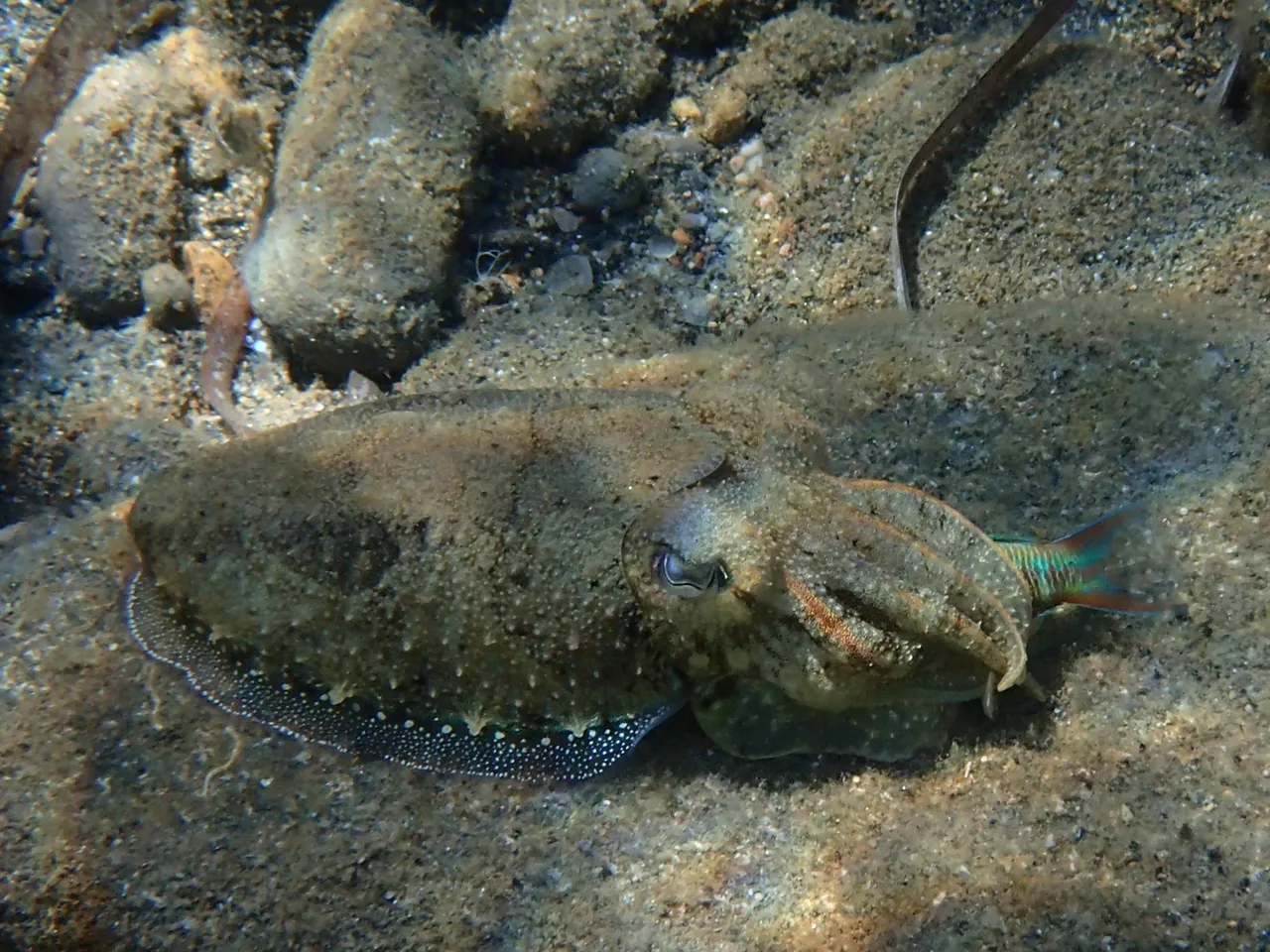
Identified by: Identified on the mantle and fin arrangement, the character the record leads on: a broad flattened oval mantle carrying a narrow continuous fin along the full length of both sides, unlike the triangular rear fins of any squid. The W-shaped pupil is legible, the arms are held forward with the tentacles withdrawn, and the pattern matches the substrate. Research grade with two agreeing identifications sets the identity floor; the visual check was made independently of it.Katerina Kalogerini — CC BY, via iNaturalist — source, licenceLook at this first
Trace the fin. On a cuttlefish it is a narrow unbroken skirt running the entire length of both sides of the mantle, from just behind the head to the very back. A squid's fins are two triangles at the rear end only. That one outline separates the two groups before you look at anything else.
Diagnostic — settles it on its own
Each of these settles the identification on its own. If one is clear, you have your answer.
A continuous fin down the whole mantle
The fin is a narrow undulating membrane attached along the full length of each side of the mantle. Look at where it STARTS as well as where it ends: a squid's fin begins well back and forms a rhomb or triangle at the tail, while a cuttlefish's runs almost to the head. Works on a live animal in the water and on a dead one in a bucket.
Broad flattened oval mantle
The body is wide and flattened rather than tubular, an oval shield rather than a cylinder, and it sits over a thick internal cuttlebone. A squid's mantle is a cone. This is the shape difference that makes the two obvious in the hand even before the fin is checked.
W-shaped pupil
The pupil of a living cuttlefish is drawn into a distinctive W, unlike the round or crescent pupil of a squid or octopus. It is present only in a live animal — the eye relaxes after death — so it is a check for something in a rock pool or on the end of a jig rather than in a box.
A thick chalky cuttlebone
Inside the mantle is a rigid buoyant plate of calcium carbonate, quite unlike a squid's thin transparent pen. It is the object that washes up on every beach in the range and is the most familiar part of the animal to most people who have never seen a live one.
Supporting — use with other characters
Real characters that are not conclusive by themselves. Use two or three together.
Eight arms with the tentacles withdrawn
A resting cuttlefish appears to have eight arms, because the two long feeding tentacles are folded into pockets beneath the eyes and only shoot out when it strikes. Somebody counting eight arms and concluding it is an octopus has been caught by exactly this. Look for the pockets rather than the count.
Suggestive only — varies with condition
Hints only. These vary with condition, season, water and how long the fish has been out of it, and a fish that contradicts them is still the same species.
Pattern that changes within a second
Zebra banding, mottling and travelling waves of colour appear and vanish faster than you can photograph them. It is spectacular and it is completely useless as an identification character, because the animal will not hold any of it.
What it gets confused with
- European squid and other Loligo, which have a conical mantle, a thin transparent pen and triangular fins confined to the rear third — the fin outline separates them instantly.
- Little cuttlefish (Sepiola and Sepietta), genuinely small round-bodied cephalopods with short fins near the middle of the mantle rather than running its full length.
- Octopus, which has eight arms and no fin at all, no internal shell, and a round pupil.
Where this stops working
Species-level identification within the cuttlefishes is harder than the group-level one this page mostly serves. Where more than one *Sepia* occurs, the separation runs on the shape of the cuttlebone and on the arrangement of the sucker rows on the tentacular clubs, neither of which is a field character on a live animal. The W-pupil and the pattern-changing both require a living animal and vanish on death. The inshore season during which cuttlefish are catchable is a spawning aggregation — the animals come in to breed and then die naturally — so the period when identification is easiest is also the period when taking large numbers removes the whole of the next generation's parents. Egg clusters lifted on pots and moorings should be returned to the water attached to something on the bottom; they cannot reattach themselves.
The full record
This page covers identification only. The Common cuttlefish record covers behaviour, lifecycle, distribution, handling and the sources behind all of it.
Reviewed 2026-08-15.
More about this fish
Telling it apart is one question. Here are the others.
Similar and related fish
How it is caught
Where it lives
Where you will find it
- Balearic IslandsComes into shallow water over sand and seagrass in the warmer months to spawn, attaching egg clusters to weed and structure, and is taken on jigs from shore and boat.
- Galicia and the Iberian ria coastUses the sheltered sandy ground inside the rias for feeding and for spawning, attaching egg clusters to weed, rope and structure in shallow water.
- LanzaroteThe shared shallow shelf with Fuerteventura supplies the structure and ground that cephalopods need and that the deep-sided western islands largely lack.
- PortugalMoves inshore into shallow water in the warmer months to feed and spawn, and is taken on jigs and in traps along the coast.
- The Aegean and CreteIn the shallow sand and posidonia margins, taken from shore and boat, and part of the same seasonal cephalopod fishery as the squid.
- The Moroccan Atlantic coastMoves into shallow water to spawn in the warmer months and is a significant component of the coast's cephalopod fishery.
- The Moroccan Mediterranean coastTaken from shore and boat and part of the food culture rather than a specialist catch, moving inshore to spawn as water warms.
- The Solent and the Hampshire coastMoving inshore in spring to spawn on eelgrass and hard structure in the harbours and the strait, which supports a genuine seasonal eging fishery.
2 more
- The Strait of Gibraltar Fishing regions
- The Strait of Messina Fishing regions
Why the 14 connections on this page are here, and the sources
Similar and related fish
Backed by research — 1 connection
Supported by peer-reviewed research or fisheries science. The sources are listed and can be checked.
European squid
Two cephalopods taken by the same method and told apart by structure — the cuttlebone of Sepia officinalis against the pen of Loligo vulgaris.
- FishBase: a global information system on fishes — Froese, R. and D. Pauly, eds. — FishBase Consortium (Scientific institute)Relied on for: Morphology, internal skeleton, fin arrangement and habitat association of Sepia officinalis and Loligo vulgaris specifically, which are what separate the two in the hand.States this directlyPassage read and verified
How it is caught
What experienced anglers do — 1 connection
Widely and independently recommended by experienced anglers and specialist sources. This is real angling knowledge, not proof: controlled evidence for it is limited, and FishingHQ records it as convention rather than as a demonstrated effect.
Eging
The method is the established way this species is taken recreationally.
- General angling website restatements of established technique — Various (Credible secondary source)Relied on for: Widely restated practice connecting this species to this method.Background and mechanism onlyCitation checked — the work exists and is described correctly
- FAO fishing gear types and fishing technology information — Food and Agriculture Organization of the United Nations (Scientific institute)Relied on for: Gear classification and operating principle for the method described.States this directlyCitation checked — the work exists and is described correctly
Where it lives
Backed by research — 2 connections
Supported by peer-reviewed research or fisheries science. The sources are listed and can be checked.
Inshore ground
Habitat association recorded for the species rather than inferred from the fishery.
- FishBase: a global information system on fishes — Froese, R. and D. Pauly, eds. — FishBase Consortium (Scientific institute)Relied on for: Habitat association, depth range, diet and distribution for the species, with SeaLifeBase as its sister database for non-finfish taxa.States this directlyPassage read and verified
Seagrass beds
A habitat association resting on the regional identification and fisheries literature rather than on angling report.
- JNCC species and habitat conservation advice — Joint Nature Conservation Committee (Conservation authority)Relied on for: UK and European habitat classification and the conservation status of seagrass beds, including the species associated with them.States this directlyCitation checked — the work exists and is described correctly
- FAO Species Identification Guides for Fishery Purposes and the FAO Species Catalogues — Food and Agriculture Organization of the United Nations (Scientific institute)Relied on for: Habitat association and distribution of the species concerned.States this directlyCitation checked — the work exists and is described correctly
Where you will find it
Backed by research — 10 connections
Supported by peer-reviewed research or fisheries science. The sources are listed and can be checked.
Balearic Islands
Occurrence of the species in these waters: a statement about the animal's distribution, not a venue recommendation.
- The Fishes of the British Isles and North-West Europe — Macmillan, 1969 (Reference work)Relied on for: Distribution and habitat association of fishes in north-west European and eastern Atlantic waters.States this directlyCitation checked — the work exists and is described correctly
- FishBase: a global information system on fishes — Froese, R. and D. Pauly, eds. — FishBase Consortium (Scientific institute)Relied on for: Distribution, depth range and habitat association recorded for the species.States this directlyPassage read and verified
Galicia and the Iberian ria coast
Occurrence of the species in this system or along this coast: a statement about the animal's distribution, not a venue recommendation.
- The Fishes of the British Isles and North-West Europe — Macmillan, 1969 (Reference work)Relied on for: Distribution and habitat association of fishes in British and north-west European waters.States this directlyCitation checked — the work exists and is described correctly
- FishBase: a global information system on fishes — Froese, R. and D. Pauly, eds. — FishBase Consortium (Scientific institute)Relied on for: Distribution, depth range and habitat association recorded for the species.States this directlyPassage read and verified
Lanzarote
A distribution association between an animal and a kind of water, rather than a claim about any named mark.
- FishBase: a global information system on fishes — Froese, R. and D. Pauly, eds. — FishBase Consortium (Scientific institute)Relied on for: Distribution, habitat association and depth range recorded for the species, including its occurrence in the water body concerned.States this directlyPassage read and verified
- The IUCN Red List of Threatened Species — International Union for Conservation of Nature (Conservation authority)Relied on for: Assessment and range account for the species, including the systems and coasts it occupies.Background and mechanism onlyCitation checked — the work exists and is described correctly
Portugal
Occurrence of the species in these waters: a statement about the animal's distribution, not a venue recommendation.
- The Fishes of the British Isles and North-West Europe — Macmillan, 1969 (Reference work)Relied on for: Distribution and habitat association of fishes in north-west European and eastern Atlantic waters.States this directlyCitation checked — the work exists and is described correctly
- FishBase: a global information system on fishes — Froese, R. and D. Pauly, eds. — FishBase Consortium (Scientific institute)Relied on for: Distribution, depth range and habitat association recorded for the species.States this directlyPassage read and verified
The Aegean and Crete
A claim that a place contains the ground, water and seasonal conditions the species is associated with. It is a distributional statement about the world, it rests on the regional reference literature, and it deliberately asserts nothing about access, permission or catch.
- FishBase: a global information system on fishes — Froese, R. and D. Pauly, eds. — FishBase Consortium (Scientific institute)Relied on for: Recorded distribution, depth range and habitat association for the Mediterranean species named.States this directlyPassage read and verified
- FAO Species Identification Guides for Fishery Purposes and the FAO Species Catalogues — Food and Agriculture Organization of the United Nations (Scientific institute)Relied on for: Regional species identification and distribution for the Mediterranean and eastern Atlantic, including habitat association.States this directlyCitation checked — the work exists and is described correctly
The Moroccan Atlantic coast
A distribution association between an animal and a kind of water, rather than a claim about any named mark.
- FAO Species Identification Guides for Fishery Purposes and the FAO Species Catalogues — Food and Agriculture Organization of the United Nations (Scientific institute)Relied on for: Distribution, habitat, depth and fishery accounts for the species of the eastern central Atlantic and Mediterranean in the FAO regional identification guides.States this directlyCitation checked — the work exists and is described correctly
- FishBase: a global information system on fishes — Froese, R. and D. Pauly, eds. — FishBase Consortium (Scientific institute)Relied on for: Distribution, habitat association and depth range recorded for the species.States this directlyPassage read and verified
The Moroccan Mediterranean coast
A distribution claim about the world, so it rests on the reference datasets rather than on angling report. FishingHQ's evidence policy requires it.
- FishBase: a global information system on fishes — Froese, R. and D. Pauly, eds. — FishBase Consortium (Scientific institute)Relied on for: Distribution, habitat association and depth range recorded for the species, including its occurrence in the water body concerned.States this directlyPassage read and verified
- FAO Species Identification Guides for Fishery Purposes and the FAO Species Catalogues — Food and Agriculture Organization of the United Nations (Scientific institute)Relied on for: Distribution, habitat, depth and fishery accounts for the species of the eastern central Atlantic and Mediterranean.States this directlyCitation checked — the work exists and is described correctly
The Solent and the Hampshire coast
A claim that a place contains the ground, water and seasonal conditions the species is associated with. It is a distributional statement about the world, it rests on the regional reference literature, and it deliberately asserts nothing about access, permission or catch.
- The Fishes of the British Isles and North-West Europe — Macmillan, 1969 (Reference work)Relied on for: Distribution and habitat association of the marine, estuarine and freshwater fishes of the British Isles, including which coasts, estuaries and ground types a species occupies.States this directlyCitation checked — the work exists and is described correctly
- FishBase: a global information system on fishes — Froese, R. and D. Pauly, eds. — FishBase Consortium (Scientific institute)Relied on for: Recorded distribution, depth range and habitat association for the species named.States this directlyPassage read and verified
The Strait of Gibraltar
A distribution association between an animal and a kind of water, rather than a claim about any named mark.
- FAO Species Identification Guides for Fishery Purposes and the FAO Species Catalogues — Food and Agriculture Organization of the United Nations (Scientific institute)Relied on for: Distribution, habitat, depth and fishery accounts for the species of the eastern central Atlantic and Mediterranean in the FAO regional identification guides.States this directlyCitation checked — the work exists and is described correctly
- FishBase: a global information system on fishes — Froese, R. and D. Pauly, eds. — FishBase Consortium (Scientific institute)Relied on for: Distribution, habitat association and depth range recorded for the species.States this directlyPassage read and verified
The Strait of Messina
A distribution association between an animal and a kind of water, rather than a claim about any named mark.
- FishBase: a global information system on fishes — Froese, R. and D. Pauly, eds. — FishBase Consortium (Scientific institute)Relied on for: Distribution, habitat association and depth range recorded for the species, including its occurrence in the water body concerned.States this directlyPassage read and verified
- The IUCN Red List of Threatened Species — International Union for Conservation of Nature (Conservation authority)Relied on for: Assessment and range account for the species, including the systems and coasts it occupies.Background and mechanism onlyCitation checked — the work exists and is described correctly
Safety
Injury while handling fish — Minor injury
The beak at the centre of the arm crown can nip a finger placed among the arms. Not a serious injury, but a surprise.
What reduces it: Hold the animal by the mantle and keep hands clear of the arm crown.