White seabream
Fish · Last reviewed 2026-08-10
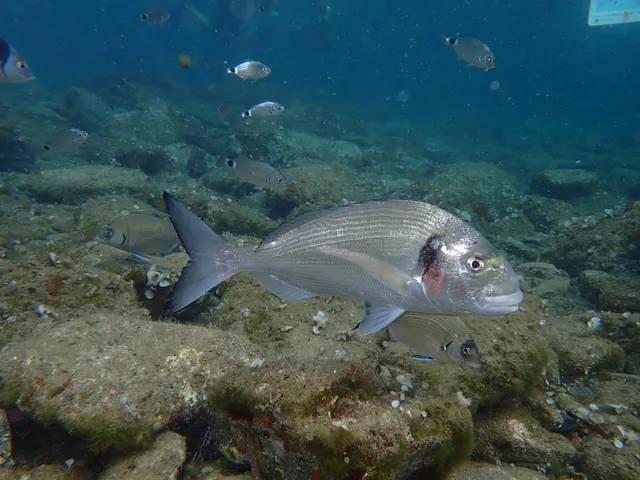
A boldly barred Mediterranean sparid of rocky shores, marked with vertical black bands and a black saddle at the tail, and a mainstay of shore fishing.
Safety: injury while handling fish — minor injury.
Catching White seabream
Everything here on fishing for it. Each entry opens the page behind it.
- Ground
- When
- Mar — months recorded at the places that document it, not a season for the whole range.
- Where
- 77 places FishingHQ documents — strongest claim anywhere: regular local target · From the shore, From a boat, Spearfishing
White seabream is the sparid that anyone fishing a Mediterranean rock mark will meet first. It is a deep, silver, strongly barred fish that holds tight to rock, breakwater and reef, feeding on shellfish and crustaceans it crushes with heavy jaws.
The identification is a matter of counting bars and checking the tail. White seabream carries a series of alternating dark vertical bars along the flank and a distinct black saddle on the caudal peduncle that does not encircle it. Its several congeners in the same water differ in the pattern and number of those bars, and separating Diplodus species is a genuine skill among Mediterranean shore anglers.
It is also a common spearfishing target on the same ground, and it is wary in a way that makes it a real test.
How it is caught
- Float fishingFine float and leger tackle with natural baits fished close to rock, and a common spearfishing catch.
- LedgeringFine float and leger tackle with natural baits fished close to rock, and a common spearfishing catch.
- Reef spearfishingFine float and leger tackle with natural baits fished close to rock, and a common spearfishing catch.
Where White seabream is documented
Places where public sources describe this species as fished, with how it is fished and how strongly the evidence supports it. This is not a range map and it is not a recommendation — it is what has been written down about a fishery rather than a record of any individual catch, and being listed is never permission to fish.
Canary Islands
29 documented places
The Arinaga coast, Gran Canaria
Rock platform
Regular local target
From the shore
Playa del Cabrón, Gran Canaria
Reef
Repeatedly reported
From the shore · Spearfishing
Playa de Arinaga, Gran Canaria
Beach
Recorded here
From the shore
Castillo del Romeral, Gran Canaria
Rock platform
Recorded here
From the shore
Sardina del Norte, Gran Canaria
Harbour wall
Repeatedly reported
From the shore · Spearfishing
The Agaete coast, Gran Canaria
Cliff coast
Recorded here
From the shore
Harbour wall
Regular local target
From the shore · Spearfishing
The Morro Jable coast, Fuerteventura
Rock platform
Repeatedly reported
From the shore
Gran Tarajal, Fuerteventura
Harbour wall
Repeatedly reported
From the shore
Madeira
11 documented places
Harbour wall
Regular local target
From the shore
Pier
Regular local target
From the shore
Rock mark
Regular local target
From the shore
Bay
Regular local target
From the shore
Harbour wall
Regular local target
From the shore
Bay
Regular local target
From the shore
Headland
Regular local target
From the shore
Rock platform
Recorded here
From the shore
Cove
Recorded here
From the shore
Lanzarote
11 documented places
Rock mark
Regular local target
From the shore
Puerto del Carmen harbour, Lanzarote
Harbour wall
Regular local target
From the shore
Cove
Recorded here
From the shore
Rock platform
Repeatedly reported
From the shore
The Costa Teguise shore, Lanzarote
Rock platform
Repeatedly reported
From the shore
Harbour wall
Regular local target
From the shore
Rock platform
Regular local target
From the shore
Cliff coast
Regular local target
From the shore
Cove
Regular local target
From the shore
Tenerife
10 documented places
Headland
Regular local target
From the shore
El Médano, Tenerife
Surf beach
Recorded here
From the shore
Playa de Las Teresitas, Tenerife
Beach
Recorded here
From the shore
Rock platform
Repeatedly reported
From the shore
Headland
Repeatedly reported
From the shore
Rock platform
Regular local target
From the shore
Rock platform
Regular local target
From the shore
Rock platform
Regular local target
From the shore
Cliff coast
Regular local target
From the shore
Balearic Islands
2 documented places
Sound or strait
Regular local target
From the shore
Rock mark
Regular local target
From the shore
The Aegean and Crete
2 documented places
Beach section
Regular local target
From the shore
Rock mark
Regular local target
From the shore
Also documented on 2 more coasts
Fewer places each, or less strongly supported. Each one names its own marks.
Portugal (7) · The Azores (3)
What these strengths mean
- Regular local target
- Fishing sources describe this as a normal local target here, not merely as caught.
- Recorded here
- At least one credible public account of this species being caught here. That is all it means.
- Repeatedly reported
- Several independent public accounts. Enough to say it happens more than once; not enough to call it a fishery.
Identification
No photograph of White seabream has passed identity review yet, so none is shown. A photograph is published only once somebody has checked the animal in it against the diagnostic features described on this page.
- Scientific name
- Diplodus sargus
- Family
- Sparidae
- Water
- Saltwater
- Conservation status
- Least Concern
- Regions
- Mediterranean, Western Europe, West Africa
- A series of alternating narrow and broad dark vertical bars along a silver flank.
- A distinct black saddle on the caudal peduncle that does not wrap fully around the body.
- Deep compressed body with a steep forehead, and incisor-like front teeth with molars behind.
- Yellowish tinge to the pelvic and anal fins in many fish, and a dark edge to the tail.
Size
- Typical
- 200–600 g (7 oz–1.3 lb)
- Large
- 1–1.8 kg (2.2–4 lb)
Exceptional: FishBase records a maximum of 45 cm and 1.9 kg
How white seabream are fished, and why
A cautious, hard-mouthed rocky-shore fish that feeds on shellfish, urchins and crustaceans among rock, and the methods are all attempts to present a small bait naturally in broken ground.
FLOAT FISHING is the Mediterranean standard, presenting a small bait at a controlled depth just off the rock so that it drifts as food does and avoids the ground itself. It is used because these fish inspect a bait carefully and reject anything held unnaturally.
LEDGERING reaches fish feeding hard on the bottom, at the cost of more snagging.
SPEARFISHING is a major method for the species and is where much of the practical knowledge about its behaviour comes from — divers watch these fish approach, inspect and retreat, which is exactly the behaviour that makes them difficult to catch.
AND THE HOOK IS THE USUAL FAILURE. A hard, small mouth crushing shellfish requires a small, strong, sharp hook, and most missed fish are hook-size problems rather than timing ones.
What experienced anglers do — why, and the sources (2)
Widely and independently recommended by experienced anglers and specialist sources. This is real angling knowledge, not proof: controlled evidence for it is limited, and FishingHQ records it as convention rather than as a demonstrated effect.
- FishBase: a global information system on fishes — Froese, R. and D. Pauly, eds. — FishBase Consortium (Scientific institute)Relied on for: Habitat association, depth range, feeding ecology and prey of the species, from which the method association follows.Background and mechanism onlyPassage read and verified
- IGFA International Angling Rules and World Record Requirements — International Game Fish Association (Angling or fisheries organisation)Relied on for: Recognised angling methods and the tackle classes used for them internationally.Background and mechanism onlyPassage read and verified
Crushing jaws, a spiny back, and a catch that is mostly undersized
White seabream present a modest hazard and a substantial welfare question, and the second one is the reason this section exists.
THE HAZARDS, BRIEFLY. The dorsal is a long row of stiff spines running most of the back, met by any hand that closes over the fish from above — grip across the body with the fin folded flat, or from underneath. The jaws carry incisiform front teeth and pharyngeal crushing plates behind, built for taking barnacles, urchins and molluscs off rock. They crush rather than cut, and there is no reason to put a finger anywhere near them.
THE REAL ISSUE IS THE SIZE STRUCTURE OF THE CATCH. Sargo are abundant, aggressive, and readily caught around rock, harbour walls and breakwaters throughout the Mediterranean and eastern Atlantic, and on most marks the overwhelming majority of fish taken are below any sensible retention size. That means a session consists largely of catching, unhooking and returning small fish — and the cumulative welfare outcome of a fishery is decided by how those undersized fish are treated, not by how the occasional large one is.
WHICH MAKES THE ROUTINE THE THING TO GET RIGHT. Small hooks in a small hard mouth come out with a disgorger far better than with fingers. Wet hands, always, because a small fish handled with dry hands on a hot rock loses its mucus layer over a large proportion of its surface. Back over the side immediately, rather than into a bucket while somebody decides. And a fish dropped onto dry concrete or hot rock has already had the worst of it before anybody picks it up.
None of that is difficult and all of it is skipped when fish are coming quickly, which is precisely when it matters most.
What experienced anglers do — why, and the sources (4)
Widely and independently recommended by experienced anglers and specialist sources. This is real angling knowledge, not proof: controlled evidence for it is limited, and FishingHQ records it as convention rather than as a demonstrated effect.
- FishBase: a global information system on fishes — Froese, R. and D. Pauly, eds. — FishBase Consortium (Scientific institute)Relied on for: Morphology, dentition, spination, thermal tolerance, reproductive strategy and depth range recorded for the species.States this directlyPassage read and verified
- The IUCN Red List of Threatened Species — International Union for Conservation of Nature (Conservation authority)Relied on for: Assessment, population trend and the life-history traits — longevity, growth rate, sex structure — that determine a population's sensitivity to the removal of large individuals.Background and mechanism onlyCitation checked — the work exists and is described correctly
- Understanding the Complexity of Catch-and-Release in Recreational Fishing — Reviews in Fisheries Science 15:75–167, 2007 (Scientific literature)Relied on for: The determinants of catch-and-release outcome in recreational fisheries, and the gap between angler belief and measured survival.States this directlyCitation checked — the work exists and is described correctly
- Do we need species-specific guidelines for catch-and-release recreational angling? — Biodiversity and Conservation 14:1195–1209, 2005 (Scientific literature)Relied on for: That air exposure, handling duration and water temperature are the dominant modifiable determinants of post-release survival.States this directlyCitation checked — the work exists and is described correctly
Lifecycle and reproduction
Moderately long-lived and slow-growing once mature. Site-faithful to particular rock and reef structures, which makes local populations vulnerable to concentrated pressure.
Spawns in spring in coastal waters. Like several sparids the species shows sex change in some populations, adding complexity to how size limits affect the stock.
Feeding and senses
Crushes molluscs, crustaceans and sea urchins with heavy pharyngeal teeth, and grazes algae. Feeding is close-range picking around rock and encrusted structure.
A daylight visual feeder in clear water, extremely wary of movement and shadow — the reason both shore anglers and spearfishers regard it as difficult.
Through the year
Present on rocky ground year-round in much of the Mediterranean, moving slightly deeper in winter. Feeding activity rises with water temperature.
Distribution
Northeastern Atlantic from Brittany (France) to Gibraltar, and Madeira I.; Mediterranean Sea and southwestern Black Sea
This is a biological range — where the species occurs, not a prediction that you will catch one. To browse the fishing geography FishingHQ holds, start at fishing places.
Why anglers care
A mainstay of Mediterranean shore fishing, taken on crab, shellfish, shrimp and bread on light float and leger tackle fished tight to rock, and a common spearfishing catch. Its significance is that it is the most consistently available quality shore species across a very large and heavily fished coastline. Practitioner consensus is that fine terminal tackle and natural baits matter more than anything else, because the fish inspect closely.
Handling and returning
The dorsal spines are sharp and the crushing jaws are powerful. Grip across the body with the dorsal folded and use pliers rather than fingers. Wet hands and quick release for undersized fish, which are a large proportion of the catch on many marks.
Safety
Injury while handling fish — Minor injury
The spiny dorsal is stiff and sharp and punctures a hand closed carelessly around the fish, particularly when landing over rock.
What reduces it: Grip across the body with the spines folded, use a wet cloth or gloves, and unhook with pliers.
Where to go next
Similar and related fish
Where it lives
Where you will find it
- Balearic IslandsAbundant around rock, harbour walls and the margins of seagrass meadows, and the principal shore-angling target across the islands.
- CyprusOne of the resident breams that make up much of what a shore angler actually catches over rock and mixed ground, taken on small hooks and fine line rather than on anything a British beach angler would recognise as sea tackle.
- Galicia and the Iberian ria coastAbundant around the rocky shore, harbour walls and breakwaters, and a principal target of shore angling here.
- GreeceOne of the commonest inshore sparids of Greek rock and mole ground, and frequently the answer to what a visitor has caught from a harbour wall.
- LanzaroteA mainstream shore target over the island's volcanic rock and mixed ground, present year-round in Canarian waters.
- PortugalAbundant around rock, harbour walls and breakwaters along the whole coast, and a mainstay of shore angling.
- TenerifeA mainstream shore target over the island's volcanic rock, taken from platforms into water that deepens rapidly.
- The Aegean and CreteOn the rock and the posidonia edges throughout, and one of the ordinary shore catches of the region. Growth here is slow because the sea is nutrient-poor, so a fish of a given size is older than the same fish from a productive Atlantic coast.
4 more
- The Croatian Adriatic Fishing regions
- The Moroccan Mediterranean coast Fishing regions
- The Strait of Gibraltar Fishing regions
- The Strait of Messina Fishing regions
Sources and evidence
- FishBase: a global information system on fishes — Froese, R. and D. Pauly, eds. — FishBase Consortium (Scientific institute)Relied on for: Family, maximum size, depth and environment, distribution and the IUCN assessment for Diplodus sargus.States this directlyPassage read and verified
- The IUCN Red List of Threatened Species — International Union for Conservation of Nature (Conservation authority)Relied on for: The Least Concern assessment for Diplodus sargus, assessed 30 March 2011.States this directlyCitation checked — the work exists and is described correctly
Why the 18 connections on this page are here, and the sources
Similar and related fish
Backed by research — 2 connections
Supported by peer-reviewed research or fisheries science. The sources are listed and can be checked.
Gilthead bream
An identification comparison naming both binomials: Diplodus sargus and Sparus aurata.
- FishBase: a global information system on fishes — Froese, R. and D. Pauly, eds. — FishBase Consortium (Scientific institute)Relied on for: Morphological and distributional data for Diplodus sargus and for Sparus aurata.States this directlyPassage read and verified
- The IUCN Red List of Threatened Species — International Union for Conservation of Nature (Conservation authority)Relied on for: Separate assessments treating Diplodus sargus and Sparus aurata as distinct species.States this directlyCitation checked — the work exists and is described correctly
Two-banded seabream
Diplodus vulgaris carries a dark collar behind the head AND a band at the tail wrist; Diplodus sargus carries the tail bar and no collar. They share ground, baits and habits, and the sargo grows larger.
- FishBase: a global information system on fishes — Froese, R. and D. Pauly, eds. — FishBase Consortium (Scientific institute)Relied on for: The morphology, size, depth range and distribution that separate these two species from one another.States this directlyPassage read and verified
How it is caught
What experienced anglers do — 3 connections
Widely and independently recommended by experienced anglers and specialist sources. This is real angling knowledge, not proof: controlled evidence for it is limited, and FishingHQ records it as convention rather than as a demonstrated effect.
Float fishing
A practitioner claim about how Diplodus sargus is commonly fished, following from where and how it feeds.
- General angling website restatements of established technique — Various (Credible secondary source)Relied on for: Widely restated practitioner accounts of fishing for white seabream.Citation checked — the work exists and is described correctly
- Sea Angler — Bauer Media (Specialist angling publication)Relied on for: Practitioner treatment of the methods used for white seabream and comparable species.Citation checked — the work exists and is described correctly
Ledgering
A practitioner claim about how Diplodus sargus is commonly fished, following from where and how it feeds.
- General angling website restatements of established technique — Various (Credible secondary source)Relied on for: Widely restated practitioner accounts of fishing for white seabream.Citation checked — the work exists and is described correctly
- Sea Angler — Bauer Media (Specialist angling publication)Relied on for: Practitioner treatment of the methods used for white seabream and comparable species.Citation checked — the work exists and is described correctly
Reef spearfishing
A practitioner claim about how Diplodus sargus is commonly fished, following from where and how it feeds.
- General angling website restatements of established technique — Various (Credible secondary source)Relied on for: Widely restated practitioner accounts of fishing for white seabream.Citation checked — the work exists and is described correctly
- Sea Angler — Bauer Media (Specialist angling publication)Relied on for: Practitioner treatment of the methods used for white seabream and comparable species.Citation checked — the work exists and is described correctly
Where it lives
Backed by research — 1 connection
Supported by peer-reviewed research or fisheries science. The sources are listed and can be checked.
Rocky shores and reefs
A habitat association for Diplodus sargus taken from the environment and distribution data on its FishBase summary.
- FishBase: a global information system on fishes — Froese, R. and D. Pauly, eds. — FishBase Consortium (Scientific institute)Relied on for: The environment, depth range and habitat description recorded for Diplodus sargus.States this directlyPassage read and verified
Where you will find it
Backed by research — 12 connections
Supported by peer-reviewed research or fisheries science. The sources are listed and can be checked.
Balearic Islands
Occurrence of the species in these waters: a statement about the animal's distribution, not a venue recommendation.
- The Fishes of the British Isles and North-West Europe — Macmillan, 1969 (Reference work)Relied on for: Distribution and habitat association of fishes in north-west European and eastern Atlantic waters.States this directlyCitation checked — the work exists and is described correctly
- FishBase: a global information system on fishes — Froese, R. and D. Pauly, eds. — FishBase Consortium (Scientific institute)Relied on for: Distribution, depth range and habitat association recorded for the species.States this directlyPassage read and verified
Cyprus
A distribution edge resting on published regional identification and distribution references, written where the species is genuinely characteristic of the destination's fishing rather than merely recorded from its waters.
- FAO Species Identification Guides for Fishery Purposes and the FAO Species Catalogues — Food and Agriculture Organization of the United Nations (Scientific institute)Relied on for: Distribution, habitat association and biology of the fishes of the eastern central Atlantic and the Mediterranean, from the regional identification guides prepared for fishery purposes.States this directlyCitation checked — the work exists and is described correctly
- FishBase: a global information system on fishes — Froese, R. and D. Pauly, eds. — FishBase Consortium (Scientific institute)Relied on for: Recorded environment, depth range, distribution and biology of the species named.States this directlyPassage read and verified
Galicia and the Iberian ria coast
Occurrence of the species in this system or along this coast: a statement about the animal's distribution, not a venue recommendation.
- The Fishes of the British Isles and North-West Europe — Macmillan, 1969 (Reference work)Relied on for: Distribution and habitat association of fishes in British and north-west European waters.States this directlyCitation checked — the work exists and is described correctly
- FishBase: a global information system on fishes — Froese, R. and D. Pauly, eds. — FishBase Consortium (Scientific institute)Relied on for: Distribution, depth range and habitat association recorded for the species.States this directlyPassage read and verified
Greece
That a species occurs in these waters, drawn from distribution science and stock assessment. It is a statement about where the animal lives and is not a statement that anybody will catch one, still less where.
- FAO Species Identification Guides for Fishery Purposes and the FAO Species Catalogues — Food and Agriculture Organization of the United Nations (Scientific institute)Relied on for: Identification, distribution and habitat association of the fishes and invertebrates of the Mediterranean and Black Sea.States this directlyCitation checked — the work exists and is described correctly
- FishBase: a global information system on fishes — Froese, R. and D. Pauly, eds. — FishBase Consortium (Scientific institute)Relied on for: Recorded distribution, depth range and habitat association of the species named.States this directlyPassage read and verified
Lanzarote
A distribution association between an animal and a kind of water, rather than a claim about any named mark.
- FishBase: a global information system on fishes — Froese, R. and D. Pauly, eds. — FishBase Consortium (Scientific institute)Relied on for: Distribution, habitat association and depth range recorded for the species, including its occurrence in the water body concerned.States this directlyPassage read and verified
- The IUCN Red List of Threatened Species — International Union for Conservation of Nature (Conservation authority)Relied on for: Assessment and range account for the species, including the systems and coasts it occupies.Background and mechanism onlyCitation checked — the work exists and is described correctly
Portugal
Occurrence of the species in these waters: a statement about the animal's distribution, not a venue recommendation.
- The Fishes of the British Isles and North-West Europe — Macmillan, 1969 (Reference work)Relied on for: Distribution and habitat association of fishes in north-west European and eastern Atlantic waters.States this directlyCitation checked — the work exists and is described correctly
- FishBase: a global information system on fishes — Froese, R. and D. Pauly, eds. — FishBase Consortium (Scientific institute)Relied on for: Distribution, depth range and habitat association recorded for the species.States this directlyPassage read and verified
Tenerife
A distribution association between an animal and a kind of water, rather than a claim about any named mark.
- FishBase: a global information system on fishes — Froese, R. and D. Pauly, eds. — FishBase Consortium (Scientific institute)Relied on for: Distribution, habitat association and depth range recorded for the species, including its occurrence in the water body concerned.States this directlyPassage read and verified
- The IUCN Red List of Threatened Species — International Union for Conservation of Nature (Conservation authority)Relied on for: Assessment and range account for the species, including the systems and coasts it occupies.Background and mechanism onlyCitation checked — the work exists and is described correctly
The Aegean and Crete
A claim that a place contains the ground, water and seasonal conditions the species is associated with. It is a distributional statement about the world, it rests on the regional reference literature, and it deliberately asserts nothing about access, permission or catch.
- FishBase: a global information system on fishes — Froese, R. and D. Pauly, eds. — FishBase Consortium (Scientific institute)Relied on for: Recorded distribution, depth range and habitat association for the Mediterranean species named.States this directlyPassage read and verified
- FAO Species Identification Guides for Fishery Purposes and the FAO Species Catalogues — Food and Agriculture Organization of the United Nations (Scientific institute)Relied on for: Regional species identification and distribution for the Mediterranean and eastern Atlantic, including habitat association.States this directlyCitation checked — the work exists and is described correctly
The Croatian Adriatic
A claim that a place contains the ground, water and seasonal conditions the species is associated with. It is a distributional statement about the world, it rests on the regional reference literature, and it deliberately asserts nothing about access, permission or catch.
- FishBase: a global information system on fishes — Froese, R. and D. Pauly, eds. — FishBase Consortium (Scientific institute)Relied on for: Recorded distribution, depth range and habitat association for the Mediterranean species named.States this directlyPassage read and verified
- FAO Species Identification Guides for Fishery Purposes and the FAO Species Catalogues — Food and Agriculture Organization of the United Nations (Scientific institute)Relied on for: Regional species identification and distribution for the Mediterranean and eastern Atlantic, including habitat association.States this directlyCitation checked — the work exists and is described correctly
The Moroccan Mediterranean coast
A distribution claim about the world, so it rests on the reference datasets rather than on angling report. FishingHQ's evidence policy requires it.
- FishBase: a global information system on fishes — Froese, R. and D. Pauly, eds. — FishBase Consortium (Scientific institute)Relied on for: Distribution, habitat association and depth range recorded for the species, including its occurrence in the water body concerned.States this directlyPassage read and verified
- FAO Species Identification Guides for Fishery Purposes and the FAO Species Catalogues — Food and Agriculture Organization of the United Nations (Scientific institute)Relied on for: Distribution, habitat, depth and fishery accounts for the species of the eastern central Atlantic and Mediterranean.States this directlyCitation checked — the work exists and is described correctly
The Strait of Gibraltar
A distribution association between an animal and a kind of water, rather than a claim about any named mark.
- FAO Species Identification Guides for Fishery Purposes and the FAO Species Catalogues — Food and Agriculture Organization of the United Nations (Scientific institute)Relied on for: Distribution, habitat, depth and fishery accounts for the species of the eastern central Atlantic and Mediterranean in the FAO regional identification guides.States this directlyCitation checked — the work exists and is described correctly
- FishBase: a global information system on fishes — Froese, R. and D. Pauly, eds. — FishBase Consortium (Scientific institute)Relied on for: Distribution, habitat association and depth range recorded for the species.States this directlyPassage read and verified
The Strait of Messina
A distribution association between an animal and a kind of water, rather than a claim about any named mark.
- FishBase: a global information system on fishes — Froese, R. and D. Pauly, eds. — FishBase Consortium (Scientific institute)Relied on for: Distribution, habitat association and depth range recorded for the species, including its occurrence in the water body concerned.States this directlyPassage read and verified
- The IUCN Red List of Threatened Species — International Union for Conservation of Nature (Conservation authority)Relied on for: Assessment and range account for the species, including the systems and coasts it occupies.Background and mechanism onlyCitation checked — the work exists and is described correctly
How FishingHQ labels evidence is explained in the evidence policy.